RenoHouse

The Beam Decision Drives Everything
Once a Toronto Professional Engineer confirms a wall is load-bearing and signs off on removal, the next decision is what kind of beam replaces it. The choice cascades through the rest of the project: span limits, cost, lead time, ceiling height, finish strategy, and whether you'll see the beam or hide it.
This post compares the three real options for Toronto residential work — LVL, steel W-beam, and Glulam — and helps you understand why your engineer specifies what they do. For broader context start with the pillar guide.
LVL — The Toronto Workhorse
Laminated Veneer Lumber. Layers of thin wood veneer glued under heat and pressure into a dimensionally stable beam. Sold as Microllam (Weyerhaeuser), Versa-Lam (Boise Cascade), and a few other brand names. The closely related Parallam is technically PSL (Parallel Strand Lumber) — same family, slightly different manufacturing, treated as functionally equivalent for residential design. See the Microllam vs Parallam vs Anthrax post for the deeper material distinction.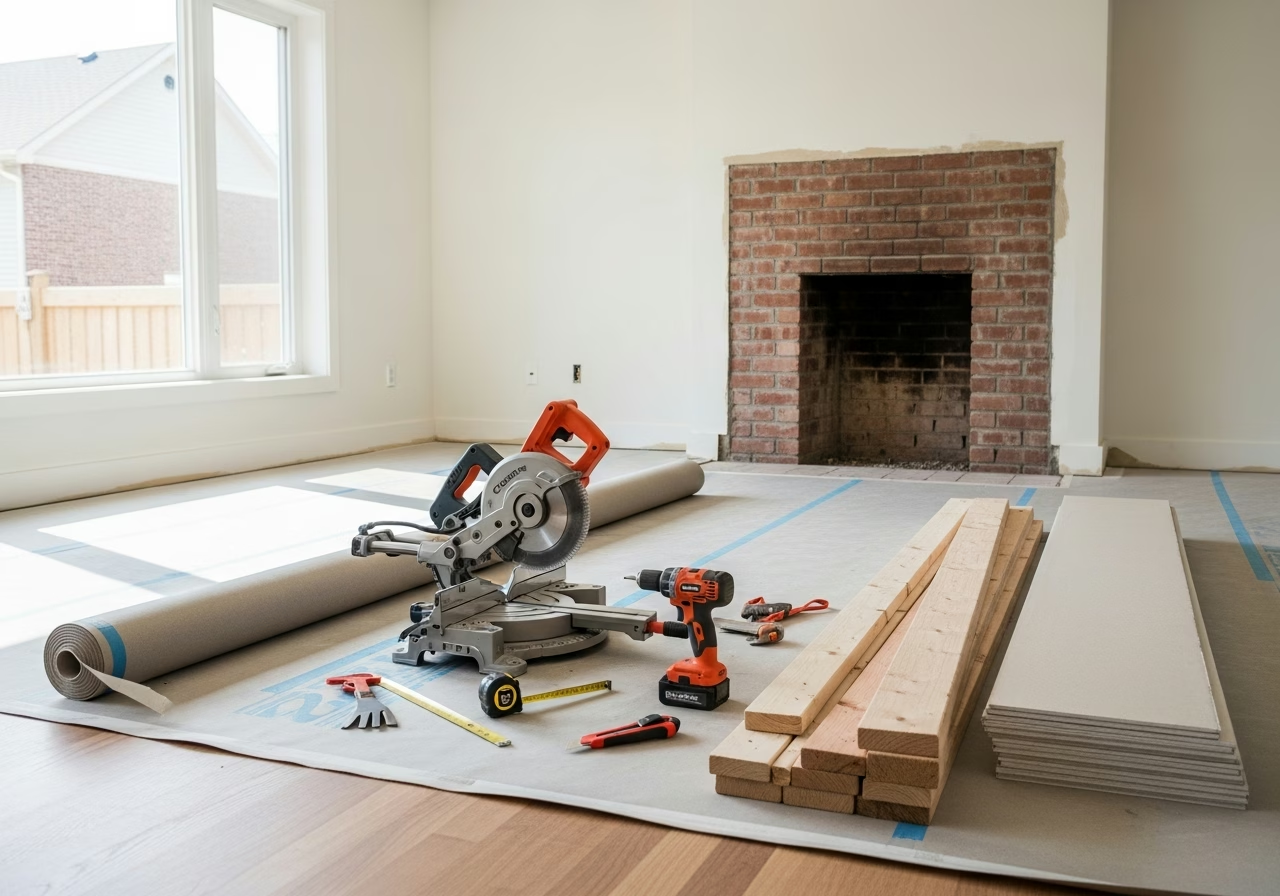
Steel W-Beam — When Span or Load Demand It
Steel wide-flange (W-section). Hot-rolled structural steel in standard sizes like W8x18 (8 inches deep, 18 lb/ft), W10x26, W12x40. The shape is far more efficient per pound than LVL — a W10x26 carries loads that would require 4-ply LVL or wouldn't be possible at that span at all. Span range: 14–24 ft is the steel sweet spot in residential. Smaller W6 and W8 shapes for moderate spans, W10 and W12 for longer or heavier conditions. Cost: higher than LVL. A 16 ft W8x24 steel beam, fabricated with bearing plates and bolt holes, runs $2,500–$4,500 in 2026 plus crane or specialty install. Lead time: 1–2 weeks for fabrication. The fabricator cuts to length, drills bolt patterns per engineer drawings, welds connection plates, and primes. Toronto suppliers we use regularly include Russel Metals, Salit Steel, and various GTA fabricators. Install: harder than LVL. Steel is heavy (a 16 ft W8x24 weighs ~380 lb), needs four to six bodies or a beam lift, must be wrapped with fire-rated drywall (typically 5/8 Type X) per code, and connections must be precise. Ceiling impact: depth varies with shape. W8 = 8 inches, W10 = 10 inches, W12 = 12 inches. Steel can sometimes embed within smaller joist depths than equivalent-capacity LVL because steel carries more load per inch of depth — useful when a flush install is required and joists are 2x10. Where it fits: spans over 14 ft, two-storey-above conditions, heavy roof loads, or where a shallower beam profile is needed for ceiling clearance. Where it doesn't: small spans (overkill, expensive), aesthetic exposed-beam designs (cold, industrial), DIY-friendly small projects.Glulam — When You Want the Beam Visible
Glued Laminated Timber. Multiple layers of dimensional lumber (typically 2x6 or 2x8) glued together with structural adhesive into a large beam. Engineered for predictable strength and dimensional stability. Beautiful when sanded, stained, and left exposed. Span range: 14–28 ft+ depending on cross-section. Glulams come in larger cross-sections than LVLs (5-1/8 x 18 inches and beyond). Cost: generally the most expensive of the three. A 20 ft Glulam exposed beam runs $3,500–$6,500+ in materials, plus the upcharge for finish-grade appearance and careful handling during install. Lead time: 2–4 weeks, ordered to size from suppliers like Western Archrib, Nordic Structures, or QB Corporation. Custom-cut and finished. Install: moderate difficulty. Heavy but lighter than equivalent steel. Requires careful protection during install — Glulam is the finished surface, not something to be wrapped over later. Ceiling impact: typically larger than LVL or steel because the design intent is exposed. 18 inch deep Glulams as bulkhead-style decorative beams are a popular Toronto open-concept aesthetic in modern farmhouse and Scandi-inspired interiors. Where it fits: wider spans where the homeowner wants the beam to be a feature, not hidden. Vaulted ceilings, contemporary farmhouse, modern minimalist with one statement wood element. Where it doesn't: tight ceiling height conditions where every inch of clearance matters, traditional finished-flat-ceiling aesthetic, budget-constrained projects."Anthrax" Steel — The Heavy Stuff
You'll occasionally hear the term used by older Toronto contractors for industrial-grade heavy steel sections — W14, W16, or larger — used in unusual conditions or commercial conversions. In residential it almost never comes up. If your engineer is spec'ing W14 or larger, the project is genuinely unusual (very wide span, very heavy load above) and the cost moves into the $20,000+ beam-only territory. The dedicated Microllam vs Parallam vs Anthrax post covers when this comes up in real Toronto projects.
Need professional home renovation?
Call RenoHouse at 289-212-2345 or get a free estimate today.
Get Free Estimate →How the Engineer Chooses
Your PEng will run beam calculations based on:

- Tributary load above (roof, ceiling, second floor, anything else carried)
- Span between supports
- Allowable deflection (typically L/360 for residential)
- Ceiling space available for beam depth
- Connection conditions at each end (post to foundation, hanger from above)
LVL is selected first if it works because it is cheapest and fastest. Steel is selected when LVL won't fit the span/depth/load triangle. Glulam is selected when both work but the design wants exposed wood.
Bulkhead vs Flush Affects All Three
Independent of material, you decide whether the beam drops below the ceiling (bulkhead) or sits within the joist depth (flush). See Bulkhead vs Flush Beam Design for that decision in detail. Bulkhead is universally cheaper. Flush is universally cleaner-looking. The cost delta is typically $2,500–$5,000 on the same beam material.
Which One for Your Project
Quick rule of thumb for typical Toronto homes:
- Spans under 14 ft, single storey above: LVL bulkhead unless you really want clean ceiling.
- Spans 12–16 ft, want clean ceiling: LVL flush, 3-ply.
- Spans 14–20 ft: Steel W-beam, almost always.
- Spans 18 ft+ with statement aesthetic: Glulam exposed.
- Spans 20 ft+, no aesthetic preference: Steel, every time.
Sources & References
Authoritative sources cited in this guide:
- Ontario Building Code — OBC official text
- Toronto Building Permits — City permit portal
- Tarion New Home Warranty — Ontario new-build warranty regulator
- HCRA — Home Construction Regulatory Authority — Ontario builder/vendor licensing
Continue Reading