RenoHouse

Names That Sound Similar But Aren't
Spend any time around Toronto framers and structural engineers and you'll hear three terms thrown around for beams: Microllam, Parallam, and "Anthrax" steel. They are not the same product, not the same material family in some cases, and not interchangeable. This post explains what each actually is, when each is specified, and what it means for your Toronto renovation budget.
For the broader beam comparison see LVL vs Steel vs Glulam. For the wall removal context start with the pillar guide.
Microllam — The LVL Standard
What it is: Microllam is a brand name (Weyerhaeuser) for Laminated Veneer Lumber (LVL). Thin layers of softwood veneer (usually Douglas fir or southern yellow pine) are peeled, dried, oriented with grain in the same direction, and glued under heat and pressure into a dimensionally stable structural beam.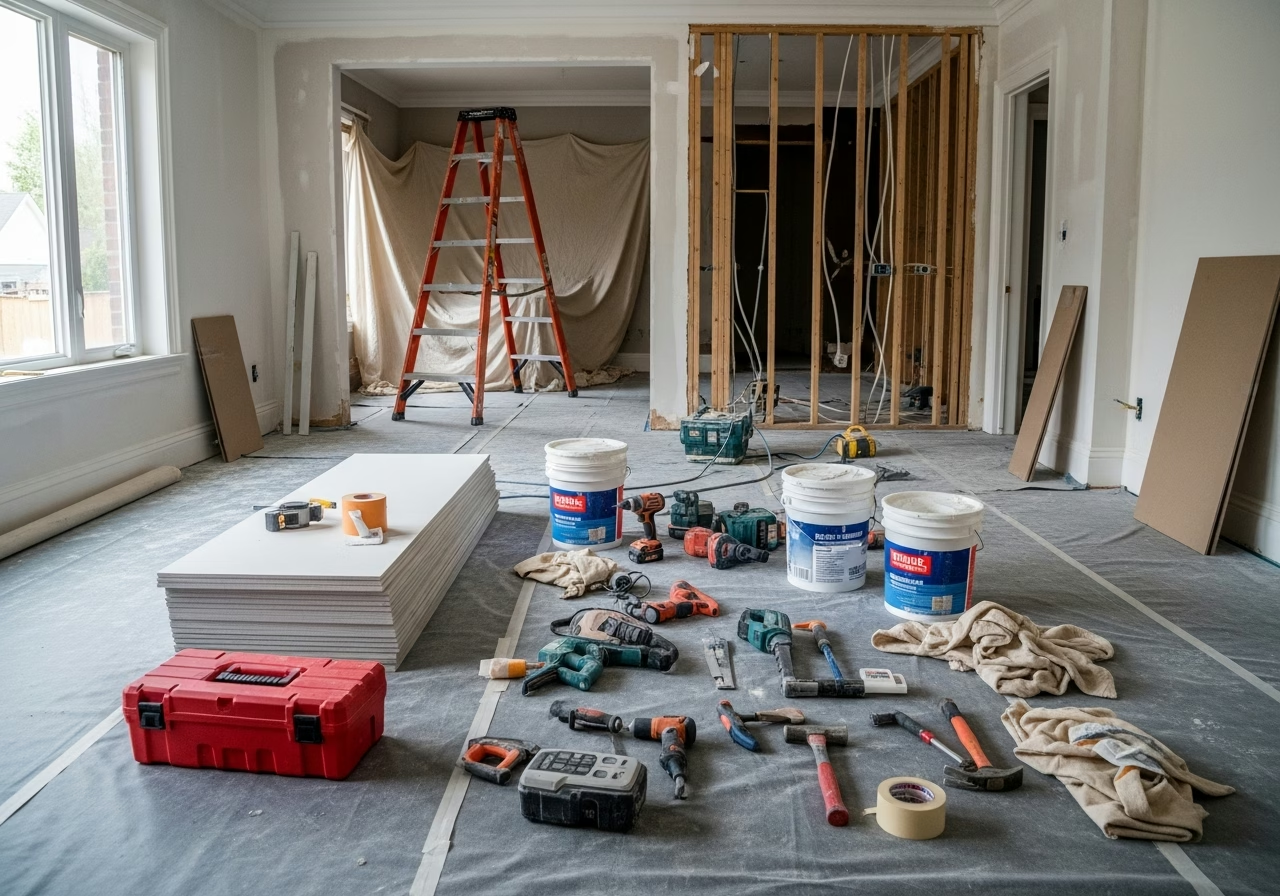
- Logs peeled into 1/8 inch thick veneer sheets
- Veneers dried, sorted, and graded
- Adhesive applied (typically phenolic resin)
- Veneers stacked grain-parallel
- Pressed at high temperature and pressure into 4 ft wide billets
- Billets sawn into beam widths (1-3/4 inch is the standard residential ply)
Parallam — PSL, Not Quite the Same
What it is: Parallam is also a Weyerhaeuser brand name, but for Parallel Strand Lumber (PSL) — a different engineered wood product. Long strands of veneer (typically 2.5 ft long, 1/8 inch thick) are oriented parallel and bonded with adhesive into very large cross-sections. How it's made:- Same starting material as LVL (peeled veneer)
- But veneer is cut into long strands rather than kept as full sheets
- Strands oriented parallel with adhesive
- Pressed into large cross-section billets (up to 11 inch x 19 inch and beyond)
- Cut to engineered sizes
- Larger cross-sections available — a single Parallam member can replace multi-ply LVL
- Higher unit cost than LVL
- Slightly higher capacity per cubic inch in some loading conditions
- Better behaviour at point loads (post bearing on top of beam)
- Available in both natural and treated for exposed/exterior applications
"Anthrax" Steel — Heavy Industrial Sections
What it is: "Anthrax" is not a product brand — it's a colloquial term older Toronto contractors use for very heavy industrial-grade structural steel sections, typically W14, W16, W18, or larger I-beams used in commercial or industrial conversions. The term traces to early steel-mill product naming in some sources, and it has become trade slang for "the heavy stuff." What it actually is: Standard ASTM A992 (or A36) wide-flange structural steel, just in larger and heavier sections than typical residential. Where it shows up in Toronto residential:- Commercial-to-residential conversions (warehouse loft conversions in the East End, King West)
- Very long spans (24 ft+) carrying heavy loads
- Multi-storey conditions where lighter steel won't satisfy deflection criteria
- Custom architectural projects with cantilevers or unusual structural forms
Which One for Your Project?
A simplified decision tree for typical Toronto residential 2026:
Need professional home renovation?
Call RenoHouse at 289-212-2345 or get a free estimate today.
Get Free Estimate →- 1. Span under 14 ft, single-storey above, normal loading: LVL (Microllam or competitor brand). Multi-ply 1-3/4 inch deep beams.
- 2. Span 12–18 ft, want single-member or point-load condition: Parallam.
- 3. Span 14–20 ft, normal-to-heavy load: Steel W8 or W10.
- 4. Span 18 ft+, exposed aesthetic intended: Glulam (different product family — see LVL vs Steel vs Glulam).
- 5. Span 20 ft+, heavy loads, multi-storey conditions: Heavier steel (W12, W14, sometimes "Anthrax"-class).
Your engineer makes the actual selection based on calculations, but knowing the language helps you understand the quote and ask intelligent questions.
Common Brand Equivalents
You'll see different brand names from different suppliers. Functionally equivalent for residential design:
- LVL: Microllam (Weyerhaeuser), Versa-Lam (Boise Cascade), Roseburg LVL, Pacific Woodtech LVL
- PSL: Parallam (Weyerhaeuser) — Parallam is essentially the only mainstream PSL brand in Toronto residential supply
- Glulam: Western Archrib, Nordic Structures, QB Corporation (different product class entirely)
- Steel: generic ASTM A992 or A36 wide-flange — sourced from any structural steel supplier
The engineer typically specifies "LVL of equivalent capacity" or "PSL" rather than a specific brand, and the contractor sources whatever's available.
Cross-Linking the Decision
Beam material is one of three big decisions in load-bearing wall removal. The other two:
- Bulkhead vs flush: see Bulkhead vs Flush Beam Toronto Design
- Standalone vs kitchen reno bundle: see Load-Bearing Removal During Kitchen Renovation
Ready to Spec Your Beam
We coordinate with engineers regularly enough that we can usually estimate beam type at the consultation visit, before formal engineering. Book a load-bearing wall consultation and we'll give you a probable beam type, span estimate, and budget range based on your specific wall.
Sources & References
Authoritative sources cited in this guide:
- Ontario Building Code — OBC official text
- Toronto Building Permits — City permit portal
- Tarion New Home Warranty — Ontario new-build warranty regulator
- HCRA — Home Construction Regulatory Authority — Ontario builder/vendor licensing
Continue Reading