RenoHouse

# Multigenerational Suite Permits Toronto: Process and Timelines 2026
Quick answer. A legal in-law suite in Toronto requires the same permit chain as any secondary suite: a building permit, an electrical permit (ESA notification), a plumbing permit, and an HVAC permit when applicable. The process is well-established and predictable, but the timeline depends heavily on whether the project triggers any zoning variances or ...A legal in-law suite in Toronto requires the same permit chain as any secondary suite: a building permit, an electrical permit (ESA notification), a plumbing permit, and an HVAC permit when applicable. The process is well-established and predictable, but the timeline depends heavily on whether the project triggers any zoning variances or structural reviews.
This post walks through the full permit process for a Toronto multigenerational suite in 2026 — what is required, who submits what, the realistic timelines, and the cost stack.
Honest Positioning
RenoHouse coordinates the building permit, ESA notification, and plumbing permit as part of the project. ESA and plumbing permits are mandatory for any kitchenette and bathroom addition. We do not provide tax advice; the MHRTC claim is filed by the homeowner's CPA using the construction documentation we provide.
The Five Permits
1. Building Permit (City of Toronto)
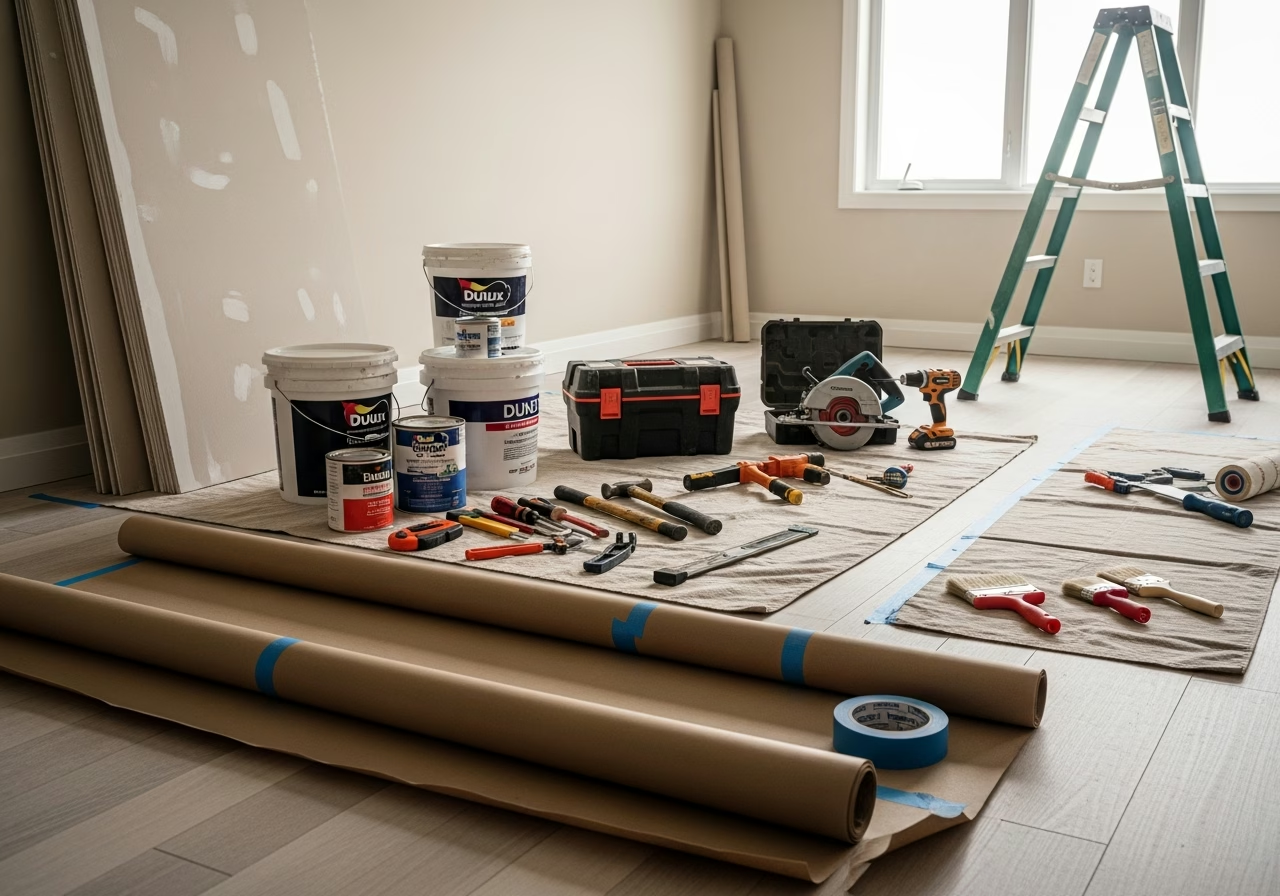
The umbrella permit. Required for any structural change, new partition walls, new windows or doors, change of use, or addition of a dwelling unit.
Application package:- Site plan showing the home, the lot, setbacks.
- Floor plans showing existing and proposed conditions.
- Cross-section showing fire separation assemblies.
- Engineering letters (if structural changes).
- Specifications for fire-rated assemblies, soundproofing, insulation.
- Mechanical plan (HVAC routing, exhaust fans).
- Plumbing rough-in plan.
- Electrical single-line diagram.
- Energy efficiency design summary (SB-12 compliance for any envelope changes).
2. Electrical Permit (ESA Notification)
ESA (Electrical Safety Authority) notification is the mechanism. The licensed electrician on the project files the notification. Mandatory for any new circuit, sub-panel, or fixture relocation.
Inspections:- Rough-in inspection (after wiring is run, before drywall).
- Final inspection (after fixtures and devices are installed).
3. Plumbing Permit (City of Toronto)
Required for any new fixture (toilet, sink, tub, shower, dishwasher) or any change to drain, vent, or supply piping. A new kitchenette and bathroom both clearly trigger this.
Inspections:- Underground rough (before slab pour, if applicable).
- Above-ground rough (drain, waste, vent before drywall).
- Final inspection (after fixtures installed).
4. HVAC Permit (City of Toronto)
Required for new ductwork, new heating or cooling equipment, or significant modifications to existing systems. A simple ductwork extension to a new suite often falls under the building permit; a separate HVAC system or major equipment swap may require its own permit.
Fees: $200-$500 typical.5. Fire Safety Review
Not always a separate permit, but the building department reviews fire separation assemblies between dwelling units. The reviewer confirms:
- 45-minute fire separation between dwelling units (1-hour in some configurations).
- ULC-listed assembly used (e.g., resilient channel + 5/8" Type-X drywall + mineral wool batt).
- Self-closing door at any connecting opening (or no opening at all).
- Smoke alarms interconnected between units.
- CO alarms where fuel-burning appliances are present.
This is part of the building permit review, not a separate fee in most cases.
Need professional home renovation?
Call RenoHouse at 289-212-2345 or get a free estimate today.
Get Free Estimate →When Zoning Compliance Becomes a Problem
Most Toronto in-law suites comply with zoning out of the box because:
- Toronto Zoning Bylaw 569-2013 permits secondary suites in most residential zones.
- The 2023 multiplex bylaw expanded permissions further (up to 4 units in many zones).
- Bill 23 (provincial) reinforced the right to secondary suites province-wide.
Trouble arises when the project triggers:
- Setback variance — a new walkout or addition encroaches on a side or rear yard setback.
- Coverage variance — total building coverage exceeds the allowed percentage.
- Floor space index variance — total floor area exceeds the allowed FSI.
- Height variance — additions exceed allowed building height.
- Front yard parking — losing a driveway or yard area.
Variances go to Committee of Adjustment. Timeline: 2-4 months. Fees: $1,500-$3,500. Plus the chance of denial or amendment.
A pre-application zoning check at the start of design is essential. RenoHouse runs this check before any drawings are stamped.
The Realistic Timeline
A typical Toronto in-law suite, assuming no Committee of Adjustment:
| Phase | Duration |
|---|---|
| Pre-design and feasibility | 1-2 weeks |
| Design and drawings | 3-4 weeks |
| Permit submission | 1 week |
| Permit review | 4-8 weeks |
| Permit issued | — |
| Demolition and structural | 1-2 weeks |
| Framing, rough plumbing, rough electrical, rough HVAC | 2-3 weeks |
| Rough inspections | 1 week |
| Insulation, fire/sound assemblies, drywall | 2 weeks |
| Finishes (kitchen, bathroom, flooring, paint) | 3-4 weeks |
| Final inspections (ESA, plumbing, building) | 1 week |
| Total elapsed | 18-26 weeks |
If a Committee of Adjustment hearing is triggered, add 8-16 weeks.
What Drawings Are Required
The minimum drawing set for a Toronto in-law suite permit:
- Site plan (1:200 or 1:100). Shows lot, building, setbacks, parking, walkways.
- Existing floor plans of all affected floors.
- Proposed floor plans of all affected floors with new walls, doors, fixtures, dimensions.
- Cross-section showing fire separation assemblies, ceiling heights, structural components.
- Elevation drawings if exterior is modified (new door, walkout, addition).
- Electrical plan showing fixtures, switches, outlets, panel location, sub-panel if applicable.
- Plumbing plan showing fixture locations, supply, drain, vent.
- Mechanical plan showing HVAC routing, exhaust fans, supply registers.
- Structural details for any beam, header, or load-bearing modification.
For underpinning or foundation work, a stamped engineering drawing is required.
For an addition, the drawings expand to include foundation plan, framing plan, roof plan, and exterior envelope details.
Cost Stack — Permits and Approvals
| Item | Cost (CAD) |
|---|---|
| Pre-application zoning check | $0-$500 |
| Architectural drawings (basement suite) | $2,500-$4,500 |
| Architectural drawings (main-floor suite) | $4,000-$7,000 |
| Architectural drawings (addition) | $7,000-$14,000 |
| Structural engineering (underpinning) | $2,500-$5,000 |
| Structural engineering (header/beam) | $800-$1,800 |
| Building permit fee | $2,200-$3,800 |
| ESA notification | $300-$600 |
| Plumbing permit | $400-$800 |
| HVAC permit | $200-$500 |
| Committee of Adjustment (if needed) | $1,500-$3,500 |
| Subtotal (typical, no variance) | $8,900-$22,000 |
For a typical basement suite without variance, $9,000-$13,000 in permits and design is realistic.
Common Permit Mistakes
- Skipping the plumbing permit on a kitchenette. It is mandatory. An unpermitted kitchen plumbing install can void insurance and trigger orders to remove.
- Skipping ESA notification on a new sub-panel. Same problem.
- Not engineering the underpinning. Toronto building inspectors will reject foundation work without a stamped engineering letter.
- Designing without verifying setbacks. A 3-week-late discovery that the new walkout encroaches on the side yard setback triggers a Committee of Adjustment hearing.
- Submitting drawings without fire separation detail. Plan reviewers will return the application.
- Ignoring smoke and CO interconnection. Easy to fix, easy to overlook.
Inspection Pass Tips
The fastest path through inspections:
- Be present at rough inspections. RenoHouse PMs attend every rough inspection. Questions get resolved on the spot.
- Complete sub-trade work fully before requesting inspection. Half-done work is a guaranteed reschedule.
- Have drawings on site. The inspector references them.
- Maintain good relationships with the local inspector. They are not adversaries; they are checking that the work is safe.
What RenoHouse Handles
On a typical project:
- Pre-application zoning compliance check.
- Architectural drawings (in-house or partner architect).
- Structural engineering coordination.
- Permit submission and follow-up.
- Trade coordination through inspections.
- Final paperwork package for the homeowner (permits, ESA certificates, plumbing inspection passes, as-built drawings).
The homeowner provides the final paperwork package to their CPA for the MHRTC claim.
Next Steps
The permit process is predictable when scoped correctly. The biggest risk is variance triggers; a pre-application check eliminates surprises.
Book a scoping visit at /services/home-renovation/multigenerational-inlaw-suite. For the pillar guide, see Multigenerational In-Law Suite Toronto: 2026 Complete Guide. For the cost-only comparison, see In-Law Suite Cost Toronto: Comparison. For multiplex zoning context, see Multiplex Conversion Toronto: 2026 Complete Guide.
Sources & References
Authoritative sources cited in this guide:
- Ontario Building Code — OBC official text
- Toronto Building Permits — City permit portal
- Tarion New Home Warranty — Ontario new-build warranty regulator
- HCRA — Home Construction Regulatory Authority — Ontario builder/vendor licensing
Continue Reading