RenoHouse

# Pre-Listing Renovation Mistakes Toronto Sellers Make (2026)
Quick answer. Most pre-sale renovation projects in Toronto deliver positive ROI, and the cost-versus-lift math we cover in pre-sale renovation cost vs ROI holds for the great majority of homes in the right price band and starting condition.Most pre-sale renovation projects in Toronto deliver positive ROI, and the cost-versus-lift math we cover in pre-sale renovation cost vs ROI holds for the great majority of homes in the right price band and starting condition. But about one in five projects we see — usually projects we did not coordinate, often projects the seller drove themselves before calling for help — destroy ROI through one of a handful of repeating mistakes.
This piece catalogues the eight mistakes that most reliably cost Toronto sellers money in pre-listing renovation in 2026, and what the right move looks like instead.
Mistake 1: Over-Spec for the Price Band
The single most-common ROI-destroying mistake is spending too much on the renovation relative to the home's price ceiling. A $48,000 cosmetic kitchen makes sense in a $2.4M Forest Hill home where the lift will be $80,000 to $130,000. The same $48,000 spend on a $1.1M Etobicoke home destroys ROI — the lift will be at most $30,000 to $40,000.
The fix: size the renovation budget against the expected sale price using the brackets in the pre-sale renovation cost vs ROI piece. Sub-$1.0M homes get Tier 1 ($5K to $12K). $1.5M to $2.0M homes get Tier 2 ($20K to $35K). Above $2.8M, Tier 3 to Tier 4 ($45K to $80K).
The signal that you are over-spec: when the renovation budget exceeds 4 percent of expected sale price for sub-$1.5M homes, or 3 percent for higher-priced homes. Above those ratios, the math gets tight fast.
Mistake 2: Personality Colours
Sellers who paint a "feature wall" navy or terracotta or sage in the dining room or primary bedroom are saving the buyer the cost of a painter, but at the price of narrowing the buyer pool. The buyer who reads the colour as "outdated" in the next listing cycle (and personality colours date faster than neutrals) takes a quiet $5,000 to $15,000 mental discount off the offer.
The fix: stay with warm white, cool white, or soft greige across the entire interior. Reserve personality for the buyer to add after move-in. Colour standards for 2026 Toronto pre-sale are covered in pre-listing paint refresh.
Mistake 3: Painting Cabinets With Brush Only
Cabinet doors painted onsite with a brush show brush marks in any photograph with raking light. The DIY brush finish reads as "the seller did this themselves" — which signals to the buyer that the rest of the renovation is also DIY-grade and prompts a discount.
The fix: cabinet doors come off, go to a spray booth (offsite or onsite-tented), get sprayed with three coats of conversion varnish or pigmented water-based 2K, cure 24 to 48 hours, and reinstall. Brush is fine for the cabinet boxes (they show less in photos). Detailed cabinet paint process is in kitchen pre-sale cosmetic and the partner team breakdown for east-side projects is in cabinet painting Whitby.
Mistake 4: Wrong Sequence of Trades
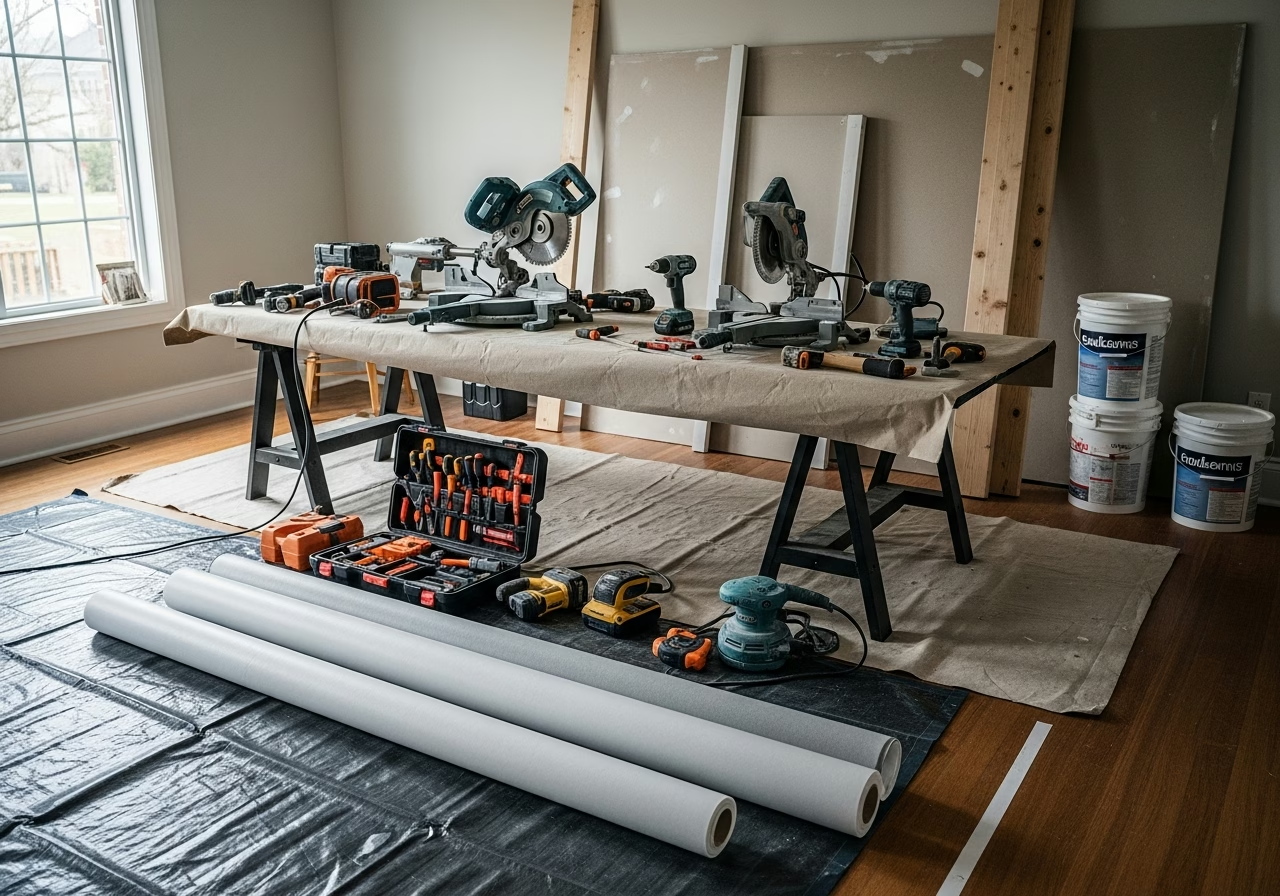
Sellers running their own pre-sale projects often paint walls before flooring, install hardware before paint, and refinish hardwood after wall paint. Each of these creates extra labour cost, more callbacks, and a less polished finish.
The right sequence:
- 1. Demolition and dust-generating work first.
- 2. Drywall repair and skim coat.
- 3. Cabinet prep.
- 4. Ceiling paint.
- 5. Wall paint.
- 6. Trim paint.
- 7. Cabinet door install.
- 8. Counter install.
- 9. Hardware install.
- 10. Flooring install (last).
A sequence error costs 5 to 15 percent of total renovation budget in rework and lost time.
Mistake 5: Ignoring the Inspection Risk
In Toronto's 2026 market, more buyers (and more buyer's agents) are conducting pre-offer or post-offer home inspections. A $40,000 cosmetic renovation over a home with knob-and-tube electrical, galvanized supply piping, asbestos in popcorn ceilings, or visible foundation issues does not change the inspection report. The buyer deducts full repair cost from the offer regardless of how nice the kitchen looks.
Need professional home renovation?
Call RenoHouse at 289-212-2345 or get a free estimate today.
Get Free Estimate →The fix: identify systems issues before scoping cosmetic work. If the home has known issues, the seller has three options:
- 1. Fix the issues before listing (escalates the project beyond cosmetic and changes the math).
- 2. Disclose the issues and price the home accordingly (this is the seller's realtor's call, not ours).
- 3. List as-is and let the market price the issues.
A pre-listing inspection by a third party (about $500 to $900 in 2026 Toronto) often pays for itself by surfacing surprises before the buyer's inspector does.
Mistake 6: Replacing Refinishable Hardwood
Original red oak or maple hardwood under 40 years of use is almost always refinishable. Replacing it with engineered hardwood costs 2 to 3 times more, takes 3 to 5 days longer, and in heritage neighbourhoods (Forest Hill, Lawrence Park, Rosedale, the Beaches) actively reduces the home's perceived value because the buyer pool reads original hardwood as "character" and engineered hardwood as "renovation."
The fix: lift a corner of the existing covering before quoting. If hardwood is present and sound, refinish. The cost difference between refinishing $4,500 versus replacing $9,500 to $14,500 is substantial. Detailed flooring decisions in pre-sale flooring refresh.
Mistake 7: Skipping Curb Appeal
Sellers running their own renovation often spend everything inside and skip the front door, walkway, and garden. The first photo in the Realtor.ca listing is the front of the home, and the buyer scroll past on a tired exterior happens in less than two seconds.
Curb appeal is the cheapest line item in the budget and the highest-percentage ROI. A $1,200 to $3,500 curb appeal package is rarely the wrong call. Detailed scope in curb appeal pre-sale.
Mistake 8: Ignoring Popcorn Ceilings
Toronto homes built between 1960 and 1985 frequently have popcorn ("acoustic spray") ceilings. Buyers in the $1.5M-plus band read popcorn as outdated regardless of how clean the rest of the home is. Removal is a 2 to 4 day job at $3 to $5 per sqft and is one of the higher-ROI Tier 1 or Tier 2 adds.
A note on safety: popcorn ceilings installed before 1980 may contain asbestos, and a Designated Substance Survey (DSS) under Ontario Regulation 278/05 is required before removal in any pre-1990 home. The DSS itself is $400 to $700 and the abatement cost depends on results. We coordinate this through licensed partners — see popcorn ceiling removal Scarborough for east-side project detail.
The fix: scope popcorn removal in any pre-sale plan for a 1960s-to-1985 home, and budget the DSS upfront.
Mistake 9: DIY Cabinet Paint
A repeat in spirit of mistake 3, but worth its own line. Sellers who attempt to paint cabinets themselves to save $1,500 in labour usually deliver a finish that requires another $2,500 to $4,500 of professional rework or a $4,000 reduction in the kitchen's perceived value. Cabinet paint is not a DIY job for pre-sale.
Mistake 10: Over-Personalizing the Layout
A seller who wants to "open up" the kitchen by removing a load-bearing wall, or who wants to convert a dining room to a home office, or who wants to add a barn door to the primary bedroom — these are personalization moves that may or may not match the next buyer's taste. Personalization in pre-sale narrows the buyer pool and is rarely the right move.
The fix: keep the layout neutral. Remove walls only where the comp set in the neighbourhood is overwhelmingly open-concept. Keep the dining room as a dining room. Keep the bedroom doors as bedroom doors. Personalization is the buyer's job, not the seller's.
Mistake 11: Ignoring the Stager
Sellers who scope renovation without the stager's input often paint a colour the stager later asks to change, install flooring in a tone that fights the staging palette, or finish the kitchen in a way that does not photograph with the staging accessories. The result is either a repaint, a re-stage, or a compromised photo.
The fix: bring the stager into the conversation in the first week of scoping. The stager's colour and tone preferences get integrated into the renovation scope so we paint, floor, and counter once.
Mistake 12: Cheap Light Fixtures
Pendants, vanity lights, and exterior lights at the $35-each big-box price band photograph as "rental property." Mid-grade fixtures at $150 to $400 each photograph as "renovated." The cost difference across a typical home is $800 to $2,500 — small in the context of the full renovation budget, large in the photo impression.
The fix: budget for mid-grade fixtures throughout. Detailed fixture standards in kitchen pre-sale cosmetic and bathroom pre-sale makeover.
Mistake 13: Not Coordinating With the Realtor's Calendar
A pre-sale renovation finished two weeks after the realtor's preferred listing date is a $0 ROI renovation. The 2026 Toronto market has clear seasonal windows (spring for detached, year-round for condo with softness in December), and missing the window means listing into a tougher market.
The fix: build the renovation calendar backwards from the listing date the realtor recommends. If the calendar will not fit, either trim the scope or accept a later listing date deliberately.
Mistake 14: Using a Friend's Brother-in-Law's Trade
Pre-sale work has to be high-finish quality because it is photographed and inspected by professional buyers. Trades who do not normally work in this segment (volume residential, builder-grade) often deliver finishes that read as builder-grade in photos.
The fix: use trades who work in finished residential renovation, not new construction. The cost difference is 10 to 25 percent, and the photo impression difference is much larger.
For the pillar pre-sale picture, see pre-sale renovation Toronto 2026 guide. For the as-is alternative, see pre-sale vs as-is decision. For the budget tiers, see pre-sale budget tiers.
If you are about to scope a pre-listing renovation and want a sanity check before committing budget, the pre-sale renovation package service page is the starting point.
Sources & References
Authoritative sources cited in this guide:
- Ontario Building Code — OBC official text
- Toronto Building Permits — City permit portal
- Tarion New Home Warranty — Ontario new-build warranty regulator
- HCRA — Home Construction Regulatory Authority — Ontario builder/vendor licensing
Continue Reading