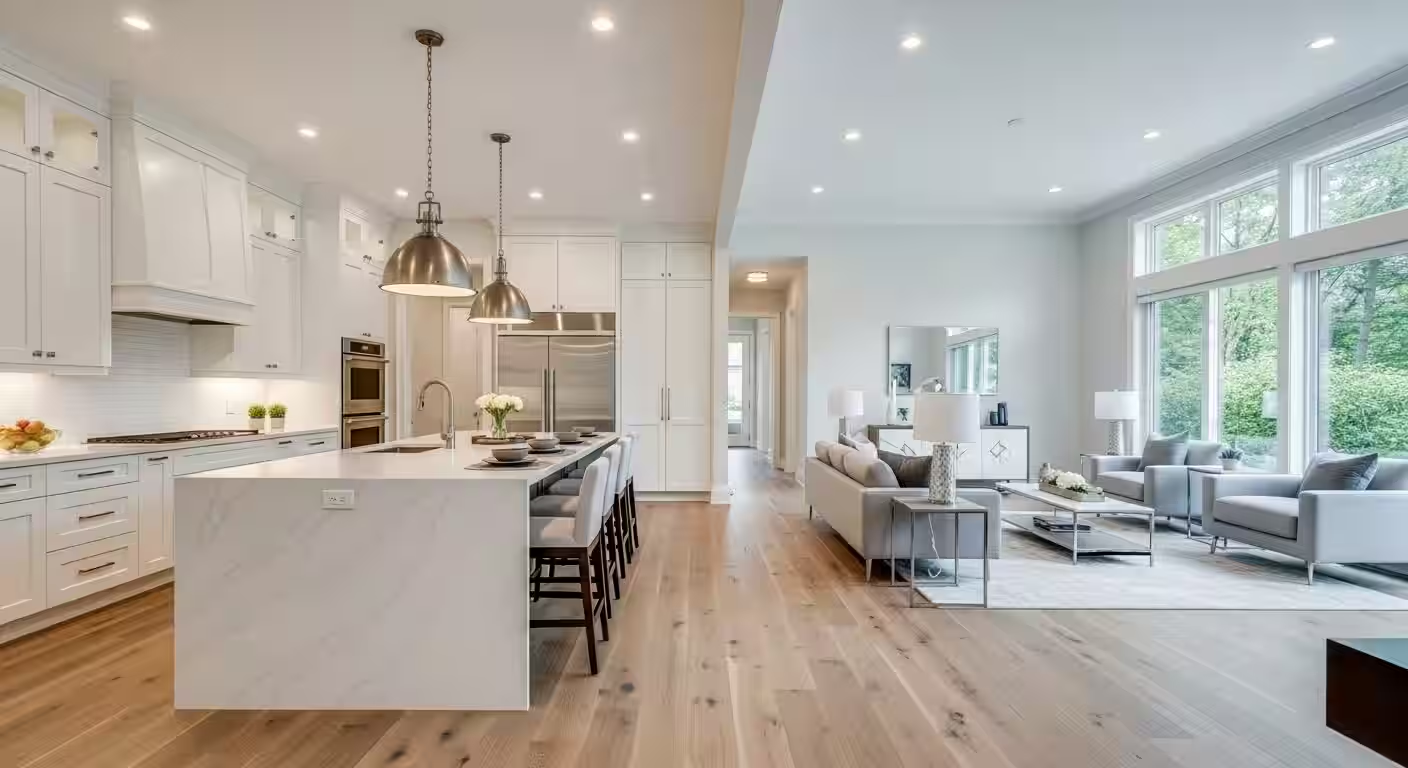
RenoHouse

# Pre-Sale Renovation Toronto 2026: Complete Guide
Quick answer. If you are preparing to list a Toronto home in 2026, you have already had the conversation with your realtor about what to "freshen up" before the photographer arrives. That phrase — freshen up — covers an enormous range, from a $4,000 paint job to a $48,000 cosmetic kitchen, bathroom, and flooring package.If you are preparing to list a Toronto home in 2026, you have already had the conversation with your realtor about what to "freshen up" before the photographer arrives. That phrase — freshen up — covers an enormous range, from a $4,000 paint job to a $48,000 cosmetic kitchen, bathroom, and flooring package. The right answer depends on the listing price, the neighbourhood, the buyer pool, and the calendar between today and your target listing date.
This RenoHouse pillar guide is the working document we wish more sellers had before the first quote. It covers what TRREB market data actually shows about pre-listed renovated homes versus as-is listings, the four cosmetic budget tiers we see most often in Toronto, the ROI math that holds up after closing costs, and how the coordination loop with your realtor and stager actually runs in practice.
A note on our role. RenoHouse is a renovation project coordination firm. We are not real estate agents, we do not list homes, and we do not provide market opinions on your asking price. We refer sellers to realtor partners (Bosley, Sotheby's International Canada, Royal LePage Signature Realty, Chestnut Park, Re/Max Realtron, Forest Hill Real Estate Services) who handle that side of the transaction. We coordinate cosmetic renovation, manage the trade sequence, and work with the stager your realtor selects. We are not a brokerage, and the new construction warranty program (Tarion) does not apply to our work because pre-sale projects are renovation only, not new builds.Why Pre-Sale Renovation Became a Standard Toronto Workflow
Through 2024 and into 2026, the Toronto Regional Real Estate Board (TRREB) data shows a widening gap between pre-listed renovated homes and as-is listings on two metrics: final sale price relative to list price, and days on market.
In a balanced-to-seller market like the one TRREB has reported through spring 2026, pre-listed renovated homes in core Toronto neighbourhoods are clearing 5 to 10 percent above their list price, while comparable as-is listings of similar age and footprint are selling at or just under list. The days-on-market gap is even more pronounced: pre-listed renovated homes are moving in 15 to 25 days on average, while as-is listings of similar profile are sitting 35 to 50 days before an accepted offer.
The mechanism is straightforward. Toronto buyers in the $1.2M to $2.5M range — the bulk of detached and semi-detached transactions in Forest Hill, Lawrence Park, Rosedale, the Beaches, Riverdale, High Park, and Lawrence Manor — are dual-income professionals who do not want to coordinate trades on their first home. They will pay a measurable premium for "move-in ready" presentation, especially in kitchens, bathrooms, and flooring. The pre-sale renovation captures that premium directly into the sale price.
That said, the math is not universal. There are four scenarios where pre-sale renovation either underperforms or actively destroys value, and we cover those in the dedicated pieces on pre-sale renovation cost vs ROI, pre-listing renovation mistakes, and pre-sale vs as-is decision. The pillar logic only holds when the home has solid bones and the cosmetic work addresses what photographs and showings reveal first.
The Four Toronto Budget Tiers
Almost every pre-sale renovation we coordinate falls into one of four tiers. The dollar bands are 2026 Toronto labour and material costs, including project coordination, permits where applicable, and contingency.
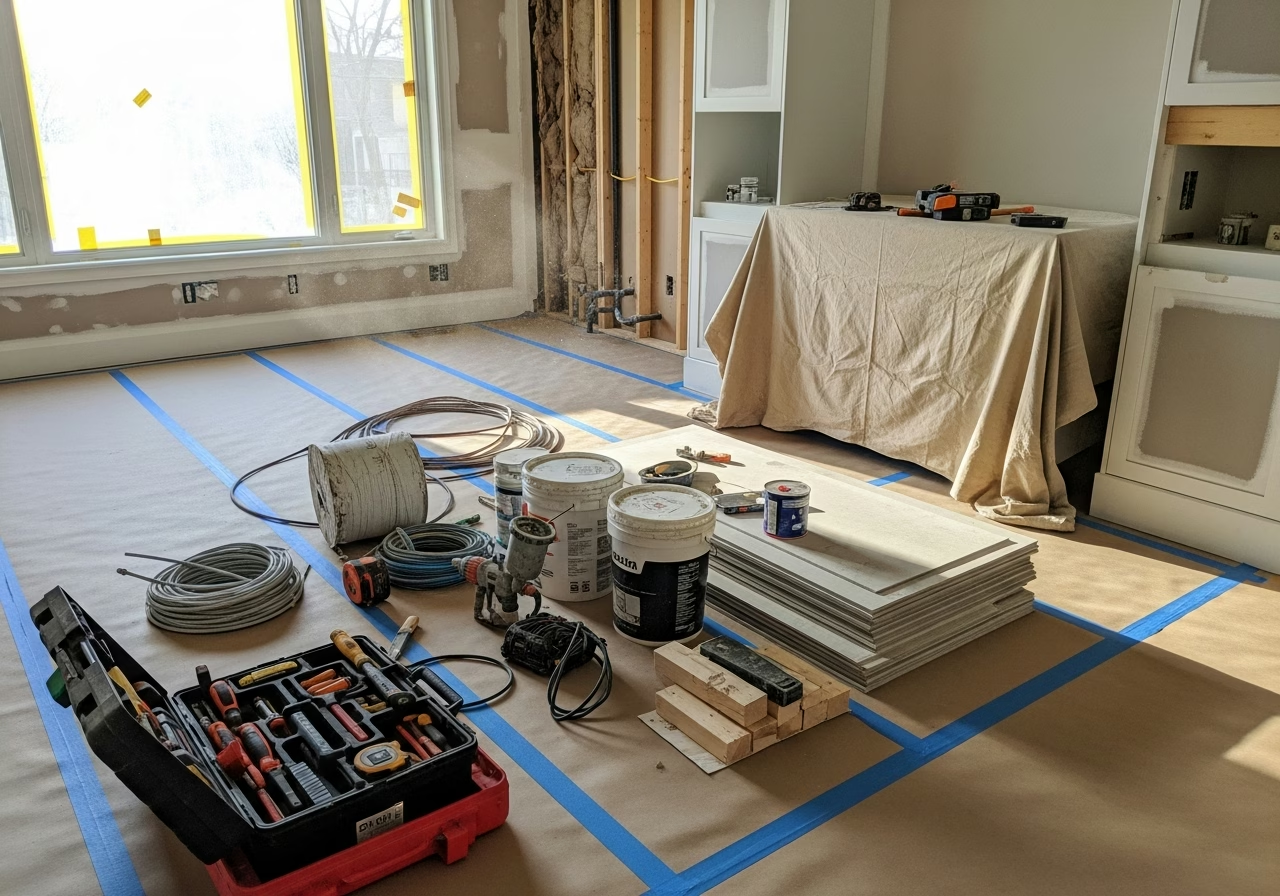
Tier 1: $5,000 to $15,000 — Paint and Light Refresh
This is the floor of pre-sale work. The package usually covers full interior repaint in current neutral palette, baseboard and trim touch-up, light fixture replacement in the foyer and dining areas, deep cleaning, and minor flooring repair (squeaks, transitions, scratch fill). It does not include flooring replacement, kitchen, or bathroom work. Detailed costing is in the pre-listing paint refresh piece, with broader market data in our painting cost Toronto reference.
This tier is the right choice for homes priced under $1.1M, condos under $700K, and homes where the kitchen and bathrooms are already in acceptable cosmetic condition. Expected ROI: paint alone returns 1.4x to 2.0x its cost in faster sale and modest price lift.
Tier 2: $15,000 to $30,000 — Paint Plus Flooring Plus Cosmetic Kitchen or Bathroom
The most common tier. Adds flooring replacement (engineered hardwood on main, carpet refresh upstairs, or LVP throughout) and one of two cosmetic upgrades: a refaced or repainted kitchen with new hardware and counters, or a bathroom vanity-and-tile refresh. Tier 2 is the default for homes in the $1.1M to $1.8M band — Riverdale semis, High Park starter detached, Beaches bungalows, Lawrence Manor mid-century homes.
Need professional home renovation?
Call RenoHouse at 289-212-2345 or get a free estimate today.
Get Free Estimate →Expected ROI in Tier 2 is the strongest in the entire pre-sale playbook: $20,000 to $25,000 of cosmetic spend often delivers $40,000 to $80,000 of price lift in the right neighbourhood, plus the days-on-market reduction.
Tier 3: $30,000 to $50,000 — Full Cosmetic Plus Curb Appeal
Adds the second cosmetic upgrade (so kitchen *and* bathroom both get touched), curb appeal work (front door, exterior paint accents, walkway pressure-wash and seal, garden refresh, exterior light fixtures), and minor structural items where they affect presentation: load-bearing wall removal between kitchen and dining was traditionally Tier 4 territory but has migrated into Tier 3 for Forest Hill and Lawrence Park homes where open-concept is buyer-expected.
Tier 3 fits homes priced $1.8M to $3M. Expected ROI: 1.5x to 2.5x on the cosmetic spend, with the strongest returns when the neighbourhood comp set is already showing renovated kitchens.
Tier 4: $50,000 plus — Full Cosmetic with Limited Structural
Above $50,000, you are no longer in cosmetic territory. This is selective full renovation: kitchen replacement (not refacing), bathroom gut-and-tile, hardwood throughout, possibly a wall removal, possibly a front facade refresh. Tier 4 is the right choice for homes priced over $3M, for homes where the existing kitchen is dated to the point of being a deal-breaker, and for sellers with a 60-to-90 day timeline rather than 30. We treat Tier 4 as the boundary case where renovation crosses into "small full reno" territory and the math has to be checked carefully against just listing as-is and discounting the price.
What Each Room Actually Needs
The cluster pieces in this series go room-by-room. The short version:
Kitchen — In Toronto pre-sale, the kitchen is the photo that sells the home. The choice is between repainting cabinets, refacing cabinets, or replacing cabinets entirely. For homes under $2M with cabinet boxes in good condition, repainting (often coordinated through partners like the cabinet painting team in Whitby for clients on the east side) is the highest-ROI option. New hardware, new counters (quartz remnants in the $1,500 to $3,000 range), and updated lighting complete the package. Detailed playbook in kitchen pre-sale cosmetic. Bathroom — New vanity, new mirror, new lighting, refreshed grout, and a deep clean handle 70 percent of pre-sale bathroom work. Tile replacement is reserved for Tier 3 and up. Full playbook in bathroom pre-sale makeover. Flooring — Engineered hardwood refinishing where the existing floor is sound; replacement only where damage is severe. Carpet refresh upstairs is almost always Tier 1 or 2 territory. Detailed types and decisions in pre-sale flooring refresh. Curb appeal — Front door paint or replacement, walkway pressure-wash, garden refresh, exterior light fixtures, and a tidy lawn. The buyer's first photograph and first impression are this. Strategy in curb appeal pre-sale. Ceilings — Toronto homes built between 1960 and 1985 frequently have popcorn ceilings. Buyers in the $1.5M-plus band read popcorn as "old," and removal is a high-ROI Tier 1 or 2 add. Coordination with our partner team (see popcorn ceiling removal in Scarborough for east-side projects) is straightforward — it is a 2-to-4 day job depending on home size.The Realtor Coordination Loop
The pre-sale renovation we coordinate is rarely just "you and us." There are usually three or four players: the seller, the listing realtor, RenoHouse, and the stager (whose engagement the realtor manages). Sometimes a fifth player — a pre-listing inspector — is also involved.
The healthy workflow is:
- 1. Realtor walks the home with the seller and identifies cosmetic priorities and a target list price. This is the realtor's job and not ours.
- 2. Realtor or seller refers RenoHouse for a renovation coordination scope and budget. We walk the home, propose tier, line-item the scope, and price it.
- 3. Stager walks the home (often the same week) and identifies furniture, art, and decor changes. Some stagers also have opinions on paint colour — we coordinate this with the realtor's preferred palette so we paint once.
- 4. Seller approves scope and budget, sets a target listing date, and we work backwards from there.
- 5. Trades execute in the right sequence (paint after dust-generating work, flooring late, hardware last).
- 6. Stager moves in the day or two before photography.
Detailed workflow notes for the realtor brokerages we work with are in pre-sale Bosley Sotheby's realtor coordination, and the staging-versus-renovation budget allocation question is covered in staging vs renovation.
The 30-Day Calendar
For a Tier 2 pre-sale package, 30 days is the realistic floor for Toronto. A typical schedule:
- Days 1 to 3 — Walkthrough, scope finalization, contracts, deposit. Order long-lead items (vanity, light fixtures, hardware, counter remnant).
- Days 4 to 7 — Demolition, popcorn ceiling removal if scoped, minor electrical (light fixture rewires, switch and outlet replacements), patching.
- Days 8 to 12 — Cabinet prep and paint (or refacing install), bathroom vanity install, tile and grout work where scoped.
- Days 13 to 18 — Wall paint coats, trim paint, ceiling paint. This is the longest single phase.
- Days 19 to 23 — Flooring install. Hardwood and engineered hardwood take 3 to 5 working days for a full main floor.
- Days 24 to 26 — Hardware install (cabinet pulls, door hardware, towel bars), final electrical (fixture install), counter install.
- Days 27 to 28 — Site cleaning, touch-ups, walkthrough with realtor and seller.
- Days 29 to 30 — Stager move-in, photography, listing prep.
Tier 1 packages (paint and light refresh only) compress to 10 to 14 days. Tier 3 packages stretch to 35 to 45 days. Tier 4 is 60 to 90 days. Detailed scheduling notes are in pre-sale renovation timeline.
When Pre-Sale Renovation Is the Wrong Choice
Pre-sale renovation is *not* always the right call. Four scenarios where as-is listing is the better economic decision:

- 1. The home has structural or systems issues (foundation movement, knob-and-tube electrical, galvanized supply piping, asbestos in popcorn ceilings) that any reasonable buyer will inspect. Cosmetic work over those issues is wasted spend, and the work to fix them is a different category of project.
- 2. The neighbourhood comp set has moved past the home's footprint. A two-bedroom bungalow in Lawrence Park surrounded by recent four-bedroom rebuilds is going to a builder regardless of how nice the kitchen is.
- 3. The seller's timeline does not allow it. Estate sales, divorce sales, and job relocations often have a 14-day window — too short for anything beyond a paint and clean.
- 4. The seller's budget is leveraged. Borrowing $40,000 against home equity to pre-renovate makes sense when the projected price lift is $80,000. It does not make sense when the projected lift is $25,000 and the home is going to a discount-conscious buyer.
The decision framework is in pre-sale vs as-is decision, and the most expensive mistakes we see are catalogued in pre-listing renovation mistakes.
Condo Pre-Sale: A Different Game
Toronto condo pre-sale is a separate playbook. Smaller scope, tighter rules (condo board move-in/move-out windows, freight elevator booking, in-suite work hour restrictions), different buyer expectations (buyers expect newer kitchens and bathrooms more often in condos than in detached homes). The condo pre-sale piece in pre-sale condo renovation covers the budget bands ($3,000 to $25,000), the building-by-building rules in core downtown towers, and the cosmetic work that actually moves condo sale prices.
Neighbourhood Patterns
Across the Toronto neighbourhoods where we coordinate the most pre-sale work — Forest Hill, Lawrence Park, Rosedale, the Beaches, Riverdale, High Park, Lawrence Manor — the patterns are consistent:
- Forest Hill, Lawrence Park, Rosedale: Tier 3 and Tier 4 default. Buyer pool expects renovated kitchens and primary bathrooms. Hardwood throughout is non-negotiable. Curb appeal matters more than in any other neighbourhood — heritage character has to be preserved while presentation is updated.
- The Beaches, Riverdale: Tier 2 default. Buyers expect modern kitchens and bathrooms but accept older windows and mechanicals. Open-concept main floor is highly valued.
- High Park: Tier 2 to Tier 3, often skewing toward Tier 3 for homes near the park. Original hardwood refinishing is preferred over replacement where possible.
- Lawrence Manor: Tier 2 default. Mid-century homes where the buyer pool is split between renovators and end-users. Cosmetic wins.
How RenoHouse Coordinates the Project
Our role on a pre-sale renovation is project coordination, not real estate or staging. Specifically:
- We walk the home with the seller (and often the realtor) and propose a scoped tier.
- We line-item the scope and provide a fixed-price quote, broken out by trade.
- We sequence the trades and book them on the calendar, working backwards from the target listing date.
- We coordinate with the stager the realtor selects on paint colour, flooring tone, and any final-week move-in details.
- We hold the project on schedule and on budget, and we communicate weekly (or more often if the scope is tight) with the seller and realtor.
- We do not list the home, market it, advise on price, or take any portion of the sale.
- We do not provide staging furniture, art, or accessories. Staging is your realtor's responsibility.
If you are at the stage of preparing a Toronto home for a 2026 listing and want a tier-and-budget assessment, the pre-sale renovation package service page is the starting point. Walk-throughs are typically free, and we usually have a written scope and quote back to you within five business days.
The next-best read for context is the cost-versus-ROI breakdown in pre-sale renovation cost vs ROI and the budget tier deep-dive in pre-sale budget tiers.
Sources & References
Authoritative sources cited in this guide:
- Ontario Building Code — OBC official text
- Toronto Building Permits — City permit portal
- Tarion New Home Warranty — Ontario new-build warranty regulator
- HCRA — Home Construction Regulatory Authority — Ontario builder/vendor licensing
Continue Reading