RenoHouse

# Radon Mitigation Toronto: The Complete 2026 Guide
Quick answer. In 2026, radon is the second leading cause of lung cancer in Canada after smoking, and roughly 19% of GTA homes test above the Health Canada guideline of 200 Bq/m3 (Health Canada Cross-Canada Radon Survey, 2009-2011, with subsequent regional sampling reinforcing the figure).In 2026, radon is the second leading cause of lung cancer in Canada after smoking, and roughly 19% of GTA homes test above the Health Canada guideline of 200 Bq/m3 (Health Canada Cross-Canada Radon Survey, 2009-2011, with subsequent regional sampling reinforcing the figure). The guideline was lowered from 800 Bq/m3 to 200 Bq/m3 in 2007 to align with WHO recommendations, and the Ontario Building Code has since added mandatory radon rough-ins for new homes — a quiet acknowledgement that this is a structural problem, not a freak occurrence.
This is the RenoHouse pillar guide for radon testing and mitigation in Toronto for 2026. We cover the science in plain language, the Health Canada guideline and how it compares to WHO, the real cost of long-term testing and sub-slab depressurization mitigation, how to evaluate a C-NRPP-certified professional, the neighbourhoods in the GTA that test high, and how to sequence radon work with basement finishing or underpinning so you do not pay twice.
Honest Positioning: Who Does What on a RenoHouse Radon Project
We need to be clear up front. RenoHouse is a renovation contractor, not a stand-alone radon testing or mitigation company. On a radon project, we coordinate C-NRPP-certified radon professionals — firms like Pinchin, EHS Partnerships, and Radonova — who handle the long-term testing, the mitigation system design, the post-mitigation re-test, and the certification paperwork. Our role is project coordination across the renovation envelope: scoping the basement slab and sump configuration, sequencing the radon mitigation rough-in before the slab is poured or before drywall closes the rim joist, managing the interaction between the radon fan and the HRV/ERV, and finishing the basement to a clean look once the active system is verified working.
The C-NRPP (Canadian-National Radon Proficiency Program) certification is the only credential Health Canada recognizes for residential radon work. Anyone designing a mitigation system in your home should hold either a C-NRPP Mitigation Specialist or C-NRPP Measurement Professional credential depending on the scope. RenoHouse does not hold those credentials and we do not pretend to. We hire them, sequence them, and finish around their work.
Why Radon Is a Toronto Problem, Not Just a Rural Problem
The cliche is that radon is a problem in granite-rich areas like the Canadian Shield, and that Toronto on its sedimentary basin is largely fine. The data does not support that. Radon comes from the natural decay of uranium in soil, and uranium is present in trace amounts in nearly all soils across Ontario — including the glacial till and shale-derived clays that underlie Toronto. The variable is not whether radon is being produced, but whether it can accumulate inside a particular home.
Three Toronto factors push accumulation higher than national averages:
- Tight building envelopes. Decades of energy-efficiency upgrades — newer windows, sprayed rim joists, weather-stripping, and HRV-based new construction — reduce passive ventilation. Radon that would have leaked out at low levels in a 1950s drafty home now accumulates to 200-600 Bq/m3 in the same footprint after retrofit.
- Finished basements as living space. Toronto homeowners spend more time in basements than national norms — basement apartments, home theatres, gyms, second suites. The exposure pathway is more aggressive here than in markets where the basement is unfinished storage.
- Specific GTA geology pockets. Higher test rates appear repeatedly in neighbourhoods built over Don Valley fill and ravine edges, Etobicoke creek-side bungalow zones, and the shale-rich strata along the North York TTC tunnel corridor. These are not "danger zones" — plenty of homes test fine — but they are zones where every homeowner should test before assuming the issue is rural.
The consequence is that a home in Leaside or East York can test at the same radon level as a home in Sudbury, even though the regional averages differ. Test the house, not the postal code.
The Health Canada 200 Bq/m3 Guideline: What It Actually Means
The Canadian residential radon guideline is 200 Bq/m3 (becquerels per cubic metre) measured as an annual average in the lowest occupied area of the home, by long-term (90-day minimum) test during the heating season. Each phrase matters:
- Annual average. Radon levels swing seasonally and even daily — short-term variations of 2-5x are common. A short-term snapshot can mislead. Long-term tests integrate exposure across at least 90 days.
- Lowest occupied area. That usually means the basement, but only if it is occupied for at least 4 hours per day. A storage-only basement is excluded; a basement gym, suite, or laundry-with-occupied-time is included.
- Long-term test, heating season. Health Canada specifies a minimum 90-day test, ideally during winter (October to April) when houses are closed up and radon accumulates most. Summer-only tests systematically underestimate annual exposure.
The 200 Bq/m3 threshold sits between the WHO recommendation of 100 Bq/m3 and the older Canadian guideline of 800 Bq/m3 (active until 2007). The 2007 reduction was driven by epidemiological data showing measurable lung-cancer risk increases starting around 100-150 Bq/m3 with no safe lower bound. In practical terms:
- Below 200 Bq/m3: no Health Canada action required, but mitigation may still be worthwhile for long-term occupants.
- 200-600 Bq/m3: mitigation recommended within 2 years.
- Above 600 Bq/m3: mitigation recommended within 1 year. WHO would say sooner.
Mitigation systems routinely reduce levels from 400-1,200 Bq/m3 down to under 100 Bq/m3 in a single intervention. The technology works.
Testing Toronto Homes: Long-Term, Short-Term, DIY, Professional
Four testing pathways are realistic for a Toronto homeowner.
DIY Long-Term Alpha-Track Kit ($50-$80)
Sold by Take Action on Radon, Radon Environmental, AccuStar, and Radonova. You hang the kit in the basement for 91+ days, mail it to the lab, receive a result. This is the gold-standard inexpensive test — sufficient for almost all homeowners who are not in a real-estate transaction.
Continuous Radon Monitor ($200-$400 device)
Airthings Wave Radon, Corentium Home, EcoQube. A consumer-grade electronic monitor that gives a rolling 7-day average and a long-term average. Useful for ongoing monitoring after mitigation, less authoritative than alpha-track for the initial long-term test, but excellent for verifying that a mitigation system continues to work.
Need professional home renovation?
Call RenoHouse at 289-212-2345 or get a free estimate today.
Get Free Estimate →Professional Long-Term Test ($250-$500)
A C-NRPP Measurement Professional installs calibrated detectors, oversees the 90+ day exposure, and issues a report. Required for some real-estate transactions and the basis for mitigation system design.
Professional Short-Term Test ($150-$300, 2-7 days)
Used in real-estate due diligence where 90 days is impossible. Less reliable than long-term, but if the short-term test reads above 200 Bq/m3 it is a strong indicator. If it reads between 100-200 Bq/m3, a long-term follow-up is appropriate.
For most Toronto homeowners not in a transaction, the DIY long-term alpha-track kit is the right starting point. Spend $60, get a 91-day average, and use that result to decide whether to proceed to professional design.
Sub-Slab Depressurization: The Default Toronto Mitigation Method
Roughly 90% of Toronto residential mitigations use sub-slab depressurization (SSD). The system reverses the pressure differential that draws radon out of soil into the home.
How it works:
- A suction point is cored through the basement slab, usually near the perimeter or at an existing sump. A 4-inch PVC pipe is sealed into the core hole and extends down into the gravel sub-base.
- The pipe runs vertically through the home — sometimes inside a closet or service chase, sometimes externally on the side of the house — to an attic or rooftop radon fan rated 60-200 W draw.
- The fan runs continuously, pulling air from beneath the slab and exhausting above the roofline (Health Canada specifies discharge above the eave and away from windows).
- A manometer (U-tube pressure gauge) on the pipe in the basement provides at-a-glance verification that the fan is moving air.
The pressure under the slab drops below the pressure inside the basement, so soil-gas radon is intercepted and exhausted before it enters the home. A correctly installed SSD system reduces radon by 80-99% in most Toronto homes, taking a 600 Bq/m3 reading down to 30-80 Bq/m3.
Variations on the default:
- Sub-membrane depressurization (SMD) for crawl spaces with no slab — a sealed vapour barrier is installed and depressurized.
- Drain-tile depressurization in homes with an active perimeter weeping-tile loop discharging to a sump.
- Block-wall depressurization for older homes with hollow concrete-block walls acting as radon channels (common in some 1950s-1960s GTA stock).
Active basement pressurization is occasionally used as a second-stage measure when SSD alone cannot get below 200 Bq/m3 — typically in tight homes with second basements or unusual foundation geometry. HRV-based mitigation is sometimes proposed as a single-stage solution in very airtight new construction; it is rarely sufficient as a stand-alone fix and is best treated as a complement to SSD.
Real Toronto Mitigation Costs in 2026
Costs assume a single detached or semi-detached home with a typical basement footprint and one suction point. The C-NRPP-certified mitigation contractors RenoHouse coordinates with quote in this range as of Q2 2026:
- Standard sub-slab depressurization, single suction point, interior pipe routing through closet/utility room, attic-mounted fan: $2,200-$3,200.
- SSD with exterior pipe routing (less aesthetic disruption inside, more weather-exposed pipe): $2,500-$3,800.
- Multi-suction-point SSD (large basements, additions, multi-zone slabs): $3,500-$5,500.
- Block-wall depressurization add-on: $800-$1,500.
- Sub-membrane depressurization for crawl space: $3,000-$5,000.
- Post-mitigation long-term re-test (required to verify): $250-$400.
Add electrical work if a dedicated 15A circuit for the fan is not already available ($300-$600). Add finishing carpentry if the pipe needs to be enclosed in a soffit or chase after the fact ($400-$1,200, often handled in a subsequent renovation).
The total realistic budget for a Toronto homeowner going from "test result above 200 Bq/m3" to "verified mitigation working" is $2,500-$5,000 all-in for the typical case. Compare this to many other home health upgrades — it is one of the highest-ROI safety investments per dollar in the residential market.
Sequencing Radon Work With Basement Renovation
This is where RenoHouse adds the most value, and where homeowners most often pay twice if they get the order wrong.

The optimal sequence:
- 1. Long-term test BEFORE any basement renovation begins. A 91-day alpha-track during the heating season. Cost: $60-$80.
- 2. If above 200 Bq/m3, design mitigation BEFORE the slab is opened or new finishes go in. Sub-slab depressurization is dramatically cheaper to install in an unfinished basement than after drywall, flooring, and ceilings are in.
- 3. Radon mitigation install at the rough-in stage of the basement renovation. Pipe is routed through the planned mechanical chase. Fan is installed in the attic.
- 4. Basement finishing proceeds normally, with the manometer location pre-planned so it is visible without being an eyesore.
- 5. Post-mitigation long-term re-test after the basement is closed up — minimum 91 days, ideally during the next heating season.
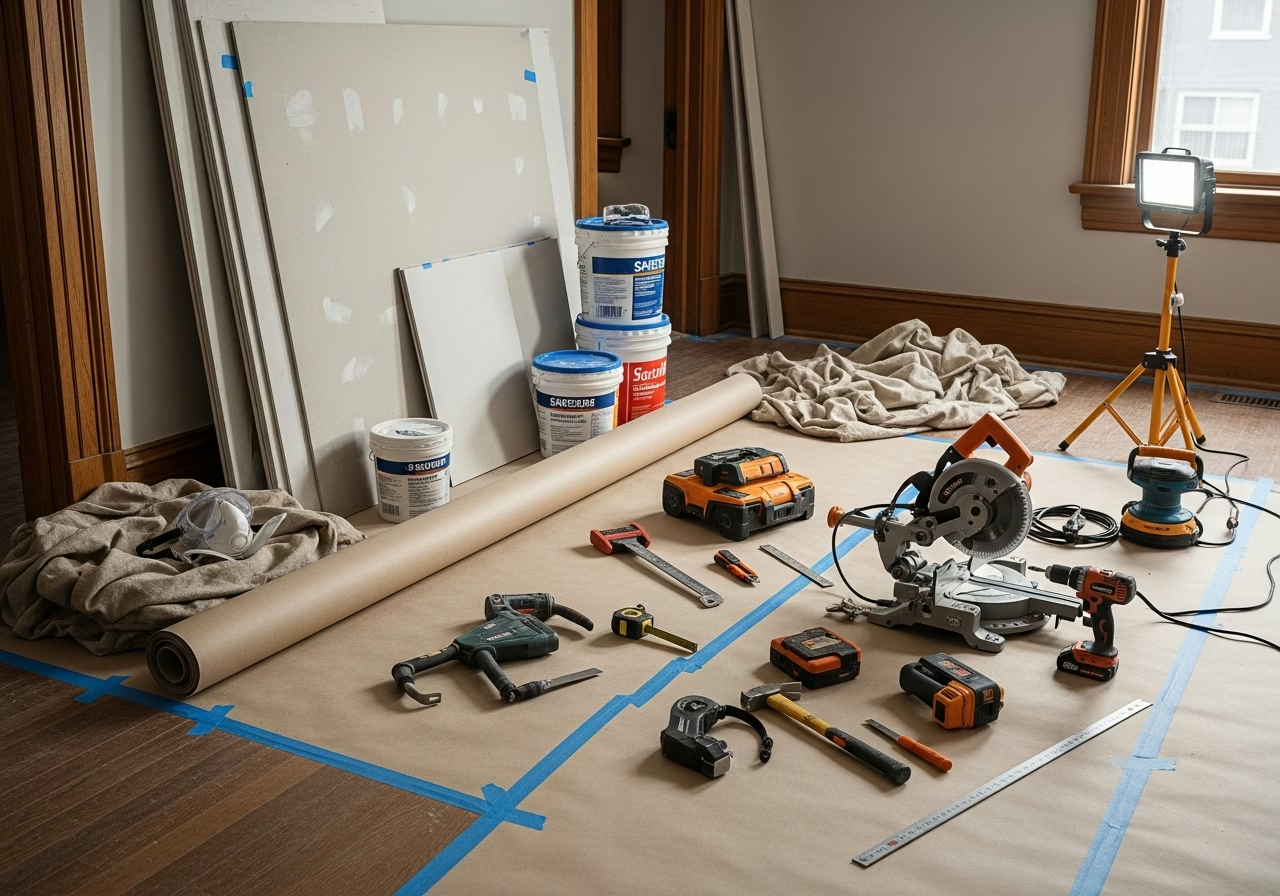
If the basement is already finished when the high test result comes in, mitigation is still very feasible — exterior pipe routing minimizes interior disruption — but the cost premium is typically $500-$1,500 versus an unfinished install. Pair this guide with our Basement Underpinning Toronto: 2026 Complete Guide if you are considering increasing basement ceiling height in the same project; the slab work is the natural moment to add a radon suction point. If you are planning a wellness-focused basement build-out, see our Basement Sauna Installation Toronto 2026 — saunas are tight, low-air-exchange spaces and benefit disproportionately from documented radon control.
C-NRPP Certification: The Only Credential That Matters
Health Canada explicitly recognizes C-NRPP (Canadian-National Radon Proficiency Program) as the residential radon credential. There are two tiers relevant to homeowners:
- C-NRPP Measurement Professional — qualified to install, oversee, and report long-term and short-term testing.
- C-NRPP Mitigation Specialist — qualified to design, install, and verify mitigation systems.
Some firms hold both. Pinchin, EHS Partnerships, and Radonova are among the larger Ontario-active firms that RenoHouse coordinates with; many independent C-NRPP-certified specialists also operate across the GTA. Ask for the C-NRPP certification number before signing a contract. Verify on the C-NRPP public registry. A radon mitigation system installed without C-NRPP oversight is not invalid, but it is not eligible for the documentation real-estate buyers and insurers increasingly want to see.
For the deeper dive into selecting a certified pro, see our cluster post C-NRPP-Certified Radon Professional Toronto: How to Hire.
Common Mistakes Toronto Homeowners Make
Six mistakes we see repeatedly:
- 1. Sealing cracks instead of mitigating. Caulking floor cracks and sump lids reduces radon by 5-15% at most. SSD reduces it by 80-99%. Sealing is a complement, not a substitute. See Radon Resealing Cracks vs Active Mitigation.
- 2. Trusting a 2-day short-term test as definitive. Short-term tests have a place in real-estate transactions but are not reliable for the "do nothing vs spend $3K" decision.
- 3. Testing only in summer. Summer levels run 30-50% lower than winter in most Toronto homes. A summer test that reads 150 Bq/m3 may correspond to a winter level of 250-300.
- 4. Letting an HVAC company quote a "radon system" without C-NRPP certification. Many do excellent HVAC work and have no business designing radon mitigation.
- 5. Skipping the post-mitigation test. Without a verified post-test, you have a fan running but no proof the system reduced exposure.
- 6. Believing that a new energy-efficient home is automatically safe. OBC mandatory rough-ins for new builds make activation cheaper, but newer tight homes often test higher than older drafty ones until the rough-in is activated. See Radon and Energy-Efficient Homes: The Toronto Irony.
When to Test, When to Mitigate, When to Wait
Concrete decision framework:
- Test now if you have not tested in the last 5 years; you are buying or selling; you have just done energy-efficiency upgrades; you spend more than 4 hours/day in the basement.
- Mitigate within 1 year if your long-term result is above 600 Bq/m3.
- Mitigate within 2 years if your result is 200-600 Bq/m3.
- Re-test in 5 years if your result is below 200 Bq/m3 and you have not made envelope changes.
- Always re-test 91+ days after a mitigation system is installed and after any major renovation.
Next Steps
If you have not tested, order a $60 alpha-track kit from Take Action on Radon or Radonova and hang it in your basement during the next heating season. If you already have a result above 200 Bq/m3, the next step is a C-NRPP-certified mitigation design. RenoHouse coordinates the testing, the certified design, the mitigation install, and the surrounding renovation work — all on a single timeline so you do not manage parallel projects.
For the cluster posts, see:
- Radon Testing Toronto: Cost and Where to Buy Kits
- Radon Mitigation System Cost Toronto
- Sub-Slab Depressurization Explained for Toronto Homes
- Radon Levels Across the GTA: Why 19% of Homes Test Above
- Health Canada 200 Bq/m3 Explained
- Short-Term vs Long-Term Radon Tests in Toronto
- Radon Mitigation Mistakes Toronto Homeowners Make
- Radon in Toronto Condos: Feasibility and Limits
- Radon During Basement Finishing in Toronto
- Hiring a C-NRPP-Certified Radon Professional in Toronto
- Sealing Cracks vs Active Mitigation
- Radon and Energy-Efficient Homes: The Toronto Irony
- Radon and Real-Estate Disclosure in Toronto
To start a coordinated radon test-and-mitigation project, visit our radon mitigation and testing service page.
Sources & References
Authoritative sources cited in this guide:
- Ontario Building Code — OBC official text
- Toronto Building Permits — City permit portal
- Tarion New Home Warranty — Ontario new-build warranty regulator
- HCRA — Home Construction Regulatory Authority — Ontario builder/vendor licensing
Continue Reading