RenoHouse

# Sealing Cracks vs Active Radon Mitigation: What Actually Works
Quick answer. The single most common DIY response to a high radon test in Toronto is to caulk every visible crack in the basement slab and seal the sump-pit lid. It feels like a thrifty, sensible response — radon comes through cracks, so block the cracks.The single most common DIY response to a high radon test in Toronto is to caulk every visible crack in the basement slab and seal the sump-pit lid. It feels like a thrifty, sensible response — radon comes through cracks, so block the cracks. The reality is that crack-sealing alone reduces radon by 5-15% in most homes, while active sub-slab depressurization reduces it by 80-99%. Sealing has a role, but it is a complement to active mitigation, not a substitute.
This post explains why sealing produces such modest results and where it does add value.
The Pressure Differential Problem
Radon does not enter a home because cracks exist. It enters because the home is at lower pressure than the soil beneath. Stack effect (warm air rising), bath fans, dryer vents, furnace combustion, and HRV imbalance all depressurize the home relative to the soil. Soil gas — including radon — flows from the higher-pressure soil into the lower-pressure basement through whatever pathways are available.
Those pathways include:
- Visible slab cracks (a small fraction of total entry).
- The slab-to-foundation-wall joint (often the largest single pathway).
- Plumbing and electrical penetrations.
- Sump pits.
- The slab itself, which is more porous than people realize.
- Hollow concrete-block foundation walls.
- Basement window wells with earthen floors (rare but real).
When you caulk the visible cracks, you close one of these pathways. The pressure differential is unchanged. Soil gas finds the next-easiest pathway and continues to enter the home.
The Math on Crack-Sealing Alone
Field studies and C-NRPP-published mitigation literature consistently show:
- Comprehensive crack-sealing including slab-wall joint and sump-pit lid: 5-15% reduction.
- Crack-sealing only at visible interior slab cracks: 2-8% reduction.
- Crack-sealing combined with active sub-slab depressurization: 85-99% reduction (essentially the same as SSD alone, but with cleaner pressure-field development).
For a home reading 600 Bq/m3:
- Crack-sealing alone brings it to 510-570. Still well above guideline.
- SSD alone brings it to 30-100. Well below guideline.
- SSD plus crack-sealing brings it to 30-90, with slightly more reliable pressure-field across the slab.
Where Sealing Genuinely Helps
Sealing has three legitimate roles in a radon project.
Need professional home renovation?
Call RenoHouse at 289-212-2345 or get a free estimate today.
Get Free Estimate →1. As a Complement to Active Mitigation
When SSD is installed, sealing the slab-wall joint, sump-pit lid, and major slab cracks helps the system develop a more uniform pressure field across the under-slab space. The fan moves less air to achieve the same pressure differential, the system runs more efficiently, and the post-mitigation result is more robust.
A C-NRPP-certified mitigation install almost always includes sealing of the major joints and the sump-pit lid as part of the package.
2. As an Interim Measure Before Mitigation
If a homeowner has tested high and is awaiting a mitigation install (3-8 weeks lead time is typical), sealing can shave 5-15% off exposure during the wait. It does not solve the problem but it modestly reduces near-term dose.
3. As a Post-Mitigation Maintenance Step
Years after a mitigation install, new slab cracks can develop from settling. Re-sealing as part of routine maintenance keeps the SSD pressure field operating efficiently.
Where Sealing Does Not Help
Six places sealing is not the right tool:
- 1. As a standalone solution above 200 Bq/m3. Won't get you below the guideline. Don't try.
- 2. As a substitute for diagnostic testing. A 4-day post-sealing test that reads 180 (down from 220) is meaningless variance, not proof of effectiveness. Long-term tests show sealing delivers low single-digit-percent reductions in most cases.
- 3. In homes with hollow-block foundation walls. Block walls are a parallel radon pathway through the wall cores; surface sealing of cracks in the block face does little.
- 4. In crawl spaces. A crawl space needs a sealed sub-membrane, not crack-sealing.
- 5. Around plumbing penetrations using ordinary household caulk. Use polyurethane sealant or radon-rated sealant; standard latex caulk fails within months.
- 6. Around the perimeter of a basement window if the window is opened occasionally. Sealing here closes a ventilation path that you actually want.
What Materials to Use If You Are Going to Seal
If you are doing complementary sealing as part of a planned mitigation project (or as an interim measure), use:
- Polyurethane sealant (Sikaflex, Tremco, or equivalent) for slab cracks and joints. Standard exterior-grade polyurethane caulk.
- Hydraulic cement for larger cracks (more than 5mm wide).
- Radon-rated sump-pit lid with sealed grommets for the sump-discharge pipe. Several manufacturers; cost roughly $80-$150.
- Self-adhesive radon-membrane tape for sealing membrane-to-membrane joints in crawl-space sub-membrane systems.
Avoid:
- Standard latex caulk. Fails within months.
- Expanding spray foam at the slab-wall joint. Tends to pull away from concrete over time.
- Generic plumber's putty at penetrations. Not formulated for the conditions.
DIY Sealing Done Right
If you are sealing as a complement or interim measure, the practical sequence:
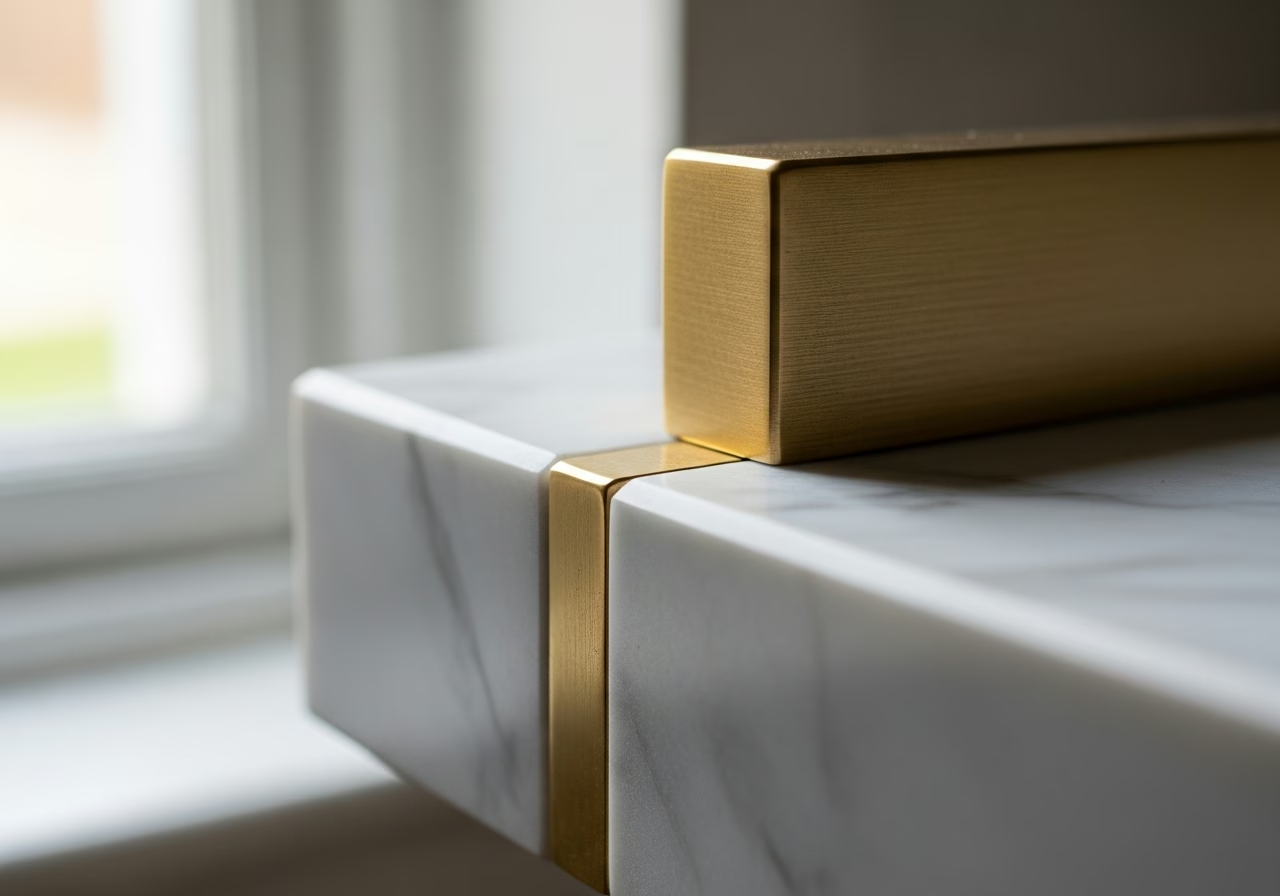
- 1. Vacuum and clean the slab thoroughly. Sealants do not bond to dust.
- 2. Identify and clean every visible crack in the slab, the slab-wall joint around the entire perimeter, the sump-pit lid, and all plumbing/electrical penetrations.
- 3. Apply polyurethane sealant in a continuous bead, tooled smooth.
- 4. For larger cracks (>5mm), pre-fill with hydraulic cement before sealant.
- 5. Replace any unsealed sump-pit lid with a radon-rated sealed lid.
- 6. Allow 24 hours before normal occupancy.
A weekend of work, $80-$150 in materials. A reasonable thing to do as a complement to mitigation. Not a replacement for mitigation.
The Honest Takeaway
The sentence to take from this post: active sub-slab depressurization is the answer; sealing is a useful complement. A C-NRPP-certified mitigation install for $2,500-$3,800 reliably brings a 600 Bq/m3 home below 100. A weekend of caulking for $150 brings it to 510-570 and leaves you with the same fundamental problem.
For the active mitigation deep-dive, see Sub-Slab Depressurization Explained for Toronto Homes. For the cost detail, see Radon Mitigation System Cost Toronto. For the full mistake catalogue, see Radon Mitigation Mistakes Toronto Homeowners Make.
How RenoHouse Approaches Sealing in a Mitigation Project
The C-NRPP-certified specialists RenoHouse coordinates with always include slab-wall joint sealing, major crack sealing, and sump-pit lid sealing as part of the mitigation install. Homeowners do not need to do this work separately. If a homeowner has already done DIY sealing before engaging us, that work is not wasted — it tends to reduce the workload of the mitigation install, not duplicate it.
See Also
- Radon Mitigation Toronto: The Complete 2026 Guide
- Sub-Slab Depressurization Explained for Toronto Homes
- Radon Mitigation Mistakes Toronto Homeowners Make
- Radon and Energy-Efficient Homes: The Toronto Irony
To get an active mitigation system designed and installed correctly, visit our radon mitigation and testing service page.
Sources & References
Authoritative sources cited in this guide:
- Ontario Building Code — OBC official text
- Toronto Building Permits — City permit portal
- Tarion New Home Warranty — Ontario new-build warranty regulator
- HCRA — Home Construction Regulatory Authority — Ontario builder/vendor licensing
Continue Reading