RenoHouse

# Restoration Cost vs Renovation Cost in Toronto: Why Insurance Rebuilds Cost More
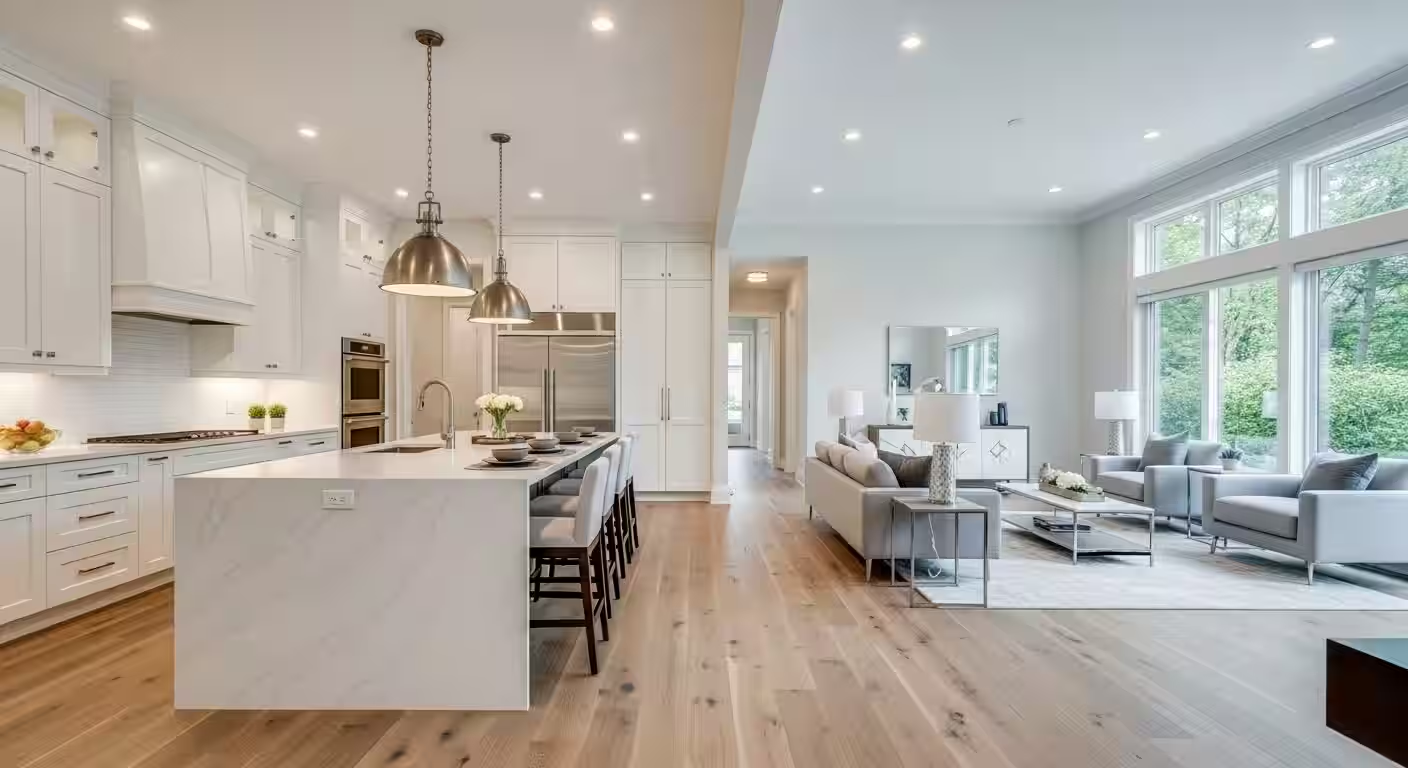
Quick answer. A Toronto homeowner finishing a kitchen rebuild after a fire claim might pay $48,000 for a kitchen that, on paper, looks identical to a $34,000 voluntary renovation in the same neighbourhood. The math seems wrong — same kitchen, same finishes, same square footage.A Toronto homeowner finishing a kitchen rebuild after a fire claim might pay $48,000 for a kitchen that, on paper, looks identical to a $34,000 voluntary renovation in the same neighbourhood. The math seems wrong — same kitchen, same finishes, same square footage. But the pricing difference is real, persistent, and rooted in structural differences between insurance-funded restoration and out-of-pocket renovation.
This post explains why insurance restoration rebuilds in Toronto typically cost 20–40% more per square foot than equivalent voluntary renovations, where the cost difference goes, and how homeowners can think about the gap when planning a rebuild. For the broader restoration lifecycle, see Fire & Water Damage Restoration Toronto 2026: Complete Guide.
RenoHouse's role: we perform both — voluntary renovations and insurance-funded restoration rebuilds. The same crew, the same finish quality. The pricing differences below reflect industry-wide structural realities, not contractor markup.Why the Gap Exists
Five structural factors drive restoration rebuilds higher than voluntary renovations:
1. Mandatory remove-and-replace of undamaged adjacent material. When a kitchen floor is destroyed by water, the carrier pays to replace it — but flooring transitions don't usually stop at the room boundary. A homeowner doing a voluntary renovation can choose to feather the new flooring into the existing. An insurance-funded restoration replaces the entire affected continuous floor surface for visual continuity, even if 60% of it wasn't physically damaged. 2. Xactimate pricing. The standard estimating software used by all major Canadian carriers (Aviva, Intact, TD, Wawanesa, Belair, Co-operators, RSA) prices on a strict line-item basis: every demo task, every install task, every labour minute, every disposal trip. Voluntary renovations bundle. Restoration unbundles. Bundled pricing typically beats unbundled pricing by 10–20% on identical scope. 3. Code upgrades. Restoration triggers current building code on any rebuilt element. A 1995 kitchen rebuilt in 2026 needs GFCI outlets where original construction didn't have them, AFCI breakers on bedroom circuits, range circuits sized to current spec, and so on. Voluntary renovations can sometimes navigate around code triggers; restoration cannot. Most Toronto policies include $10,000–$25,000 of "Code Upgrade" coverage to address this — but the cost is real. 4. Restoration-grade specifications. A voluntary renovation can use standard paper-faced drywall, standard fiberglass insulation, and standard latex paint. A post-water-loss rebuild often specifies paper-free gypsum (DensArmor Plus, Mold Tough), antimicrobial-treated framing, and shellac-encapsulation primer. These materials cost 25–60% more than standard. 5. Documentation, scoping, and adjuster coordination overhead. Every line item is documented, photographed, sometimes re-scoped after change orders. The contractor carries an administrative burden that voluntary renovations don't include. This typically adds 5–10% to the project labour cost — built into Xactimate's overhead-and-profit calculation.Where the Money Actually Goes
A side-by-side comparison of identical scopes:
- Demo: $1,500
- Plumbing rough-in: $2,200
- Electrical rough-in: $1,400
- Tile (floor + tub surround): $4,800 (materials + labour)
- Vanity, countertop, faucet: $2,800
- Toilet: $400
- Fixtures and accessories: $800
- Drywall and paint: $1,400
- Final cleaning and miscellaneous: $700
- Subtotal: $16,000
- Contractor overhead and profit: $3,200
- Total: ~$19,200
- Demo: $1,800 (more thorough; Xactimate-priced)
- Plumbing rough-in: $2,200
- Electrical rough-in: $1,800 (current code: GFCI, AFCI, fan-light combo)
- Tile (floor + tub surround): $5,400 (full mortar bed, premium membrane to current standard)
- Vanity, countertop, faucet: $2,800
- Toilet: $400
- Fixtures and accessories: $900
- Drywall and paint: $2,200 (paper-free gypsum, encapsulation primer, two paint coats)
- Antimicrobial treatment: $300
- Final cleaning and miscellaneous: $900
- Documentation, photo logs, adjuster coordination: $600
- Subtotal: $19,300
- Contractor overhead and profit (Xactimate standard 20%): $3,860
- Total: ~$23,160
The gap: about $3,960, or 21% more for the insurance rebuild. Same finished bathroom; different cost structure.
What the Homeowner Actually Pays Out of Pocket
Here's where the framing matters. The voluntary renovation is 100% homeowner-paid at $19,200. The restoration rebuild is insurance-paid at $23,160 — minus the deductible. So even though the restoration rebuild costs more on paper, the homeowner's out-of-pocket is dramatically lower.
For a typical Toronto water claim with a $1,000 deductible:
- Voluntary renovation: $19,200 out of pocket.
- Restoration rebuild: $1,000 deductible + perhaps $1,500 in upgrades-beyond-pre-loss = ~$2,500 out of pocket.
The "insurance pays more" framing is technically correct but misleading from the homeowner's perspective. The homeowner pays far less.
Need professional home renovation?
Call RenoHouse at 289-212-2345 or get a free estimate today.
Get Free Estimate →When Homeowners Pair Renovation with Restoration
A common Toronto pattern: a water claim destroys a 1990s kitchen, and the homeowner uses the rebuild as the opportunity for a planned upgrade.
How it works:
- The carrier scopes the rebuild on a "like-kind and quality" basis. Insurance pays the cost of restoring to pre-loss condition.
- The homeowner pays the difference for upgrades.
- The contractor manages both billing tracks.
Example: a water-damaged 1995 maple-shaker kitchen. Carrier approves $42,000 for like-kind cabinet replacement, basic countertop, basic backsplash. Homeowner wants quartz countertop and custom-painted cabinets, total cost $58,000. The carrier pays $42,000 directly to the contractor; the homeowner pays the $16,000 difference. The result is a $58,000 kitchen for $16,000 + the deductible.
This arrangement requires careful scope documentation and a contractor experienced in dual-billing. Not every contractor handles it cleanly. Done well, it's the most economical path to a kitchen upgrade for any homeowner who has experienced a covered loss.
Things That Are More Expensive in Restoration That Aren't About Markup
Several restoration line items genuinely cost more than the voluntary renovation equivalent — not because of markup, but because of what's actually being done:
Demolition — restoration demolition is more thorough (cut-back to dry substrate, antimicrobial treatment, bag-and-disposal of all wet material). Voluntary renovation demolition can sometimes leave existing material in place. Drywall — paper-free gypsum costs more than standard. Mold-resistant primer adds a step. Multiple paint coats are standard rather than optional. Disposal fees — Cat 3 (sewer) and contaminated debris disposal costs more per yard than standard renovation debris. Mobilization — restoration projects often happen on tight insurer-driven timelines, sometimes with overtime or weekend work. Specialty trades — IICRC-certified mitigation, AMRT-certified mold remediation, and FSRT-certified fire restoration all carry specialty pricing.These aren't padding; they're the cost of doing the work to industry standard.
Where Adjusters Push Back
Common scope-pricing disputes between contractors and adjusters in Toronto:
- Drywall scope — contractor wants more demo; adjuster wants less.
- Cabinet replacement vs salvage — adjuster prefers salvage where possible.
- Code upgrade allocation — what's covered under Code Upgrade vs the dwelling claim.
- Soft-content cleaning vs replacement — some adjusters push hard for off-site cleaning of textiles vs replacement.
- Match coverage — when matching tile, flooring, or paint to existing isn't possible, the carrier may approve full-room replacement.
A restoration-experienced rebuild contractor handles these conversations on the homeowner's behalf, supported by IICRC documentation and Xactimate-aligned scope. For the broader claim mechanics, see Insurance Claims for Water Damage in Toronto.
What Drives the 40% Upper End of the Gap
Most Toronto restoration rebuilds run 20–25% over equivalent voluntary renovations. The 35–40% upper end shows up in specific scenarios:
- Heritage Conservation District homes — additional approvals, like-quality matching of historic finishes.
- Pre-1990 homes with asbestos — Type 2 or Type 3 abatement during demolition. See Asbestos Abatement Toronto 2026: Complete Guide.
- Sewer-backup losses — Cat 3 protocol, full demolition of porous materials, antimicrobial treatment, full HVAC decontamination.
- High-end finishes — when matching pre-loss premium finishes, sourcing and labour both spike.
The Cost Comparison That Actually Matters
For a homeowner deciding whether to file a claim, the comparison isn't "restoration cost vs renovation cost." It's:
- Out-of-pocket if I file: deductible + upgrades + premium impact over future years.
- Out-of-pocket if I don't file: the entire repair cost.
For most Toronto water and fire losses above $5,000–$8,000, filing is the right financial choice. Below that threshold, the deductible + premium impact may exceed the loss, and self-pay can make sense — particularly for losses that don't risk mold or structural damage if delayed slightly.
A restoration-experienced contractor (RenoHouse on the rebuild side) can help model the comparison before you file.
Next Steps
If you're facing a covered loss, RenoHouse handles the rebuild side at standard Xactimate pricing, with insurance coordination and direct billing where supported. If you're considering combining the rebuild with planned upgrades, we'll model both billing tracks.
Get a restoration consultationRelated Reading
- Fire & Water Damage Restoration Toronto 2026: Complete Guide
- Fire Damage Restoration Cost in Toronto
- Insurance Claims for Water Damage in Toronto
- Direct Billing for Insurance Restoration in Toronto
Sources & References
Authoritative sources cited in this guide:
- Ontario Building Code — OBC official text
- Toronto Building Permits — City permit portal
- Tarion New Home Warranty — Ontario new-build warranty regulator
- HCRA — Home Construction Regulatory Authority — Ontario builder/vendor licensing
Continue Reading