RenoHouse

# Restoration vs Replacement in Toronto: When to Save and When to Rebuild
Quick answer. A surprisingly large fraction of any restoration project's cost — sometimes 30–50% — comes down to the salvage-vs-replace decision on each affected material. Save too aggressively and you end up with hidden moisture, mold, and a homeowner calling about a smell three months later.A surprisingly large fraction of any restoration project's cost — sometimes 30–50% — comes down to the salvage-vs-replace decision on each affected material. Save too aggressively and you end up with hidden moisture, mold, and a homeowner calling about a smell three months later. Replace too aggressively and the claim balloons unnecessarily, and the adjuster pushes back on scope.
This post walks through the decision framework IICRC-certified restoration teams in Toronto use to decide what to dry, clean, or save vs what to demolish and replace. The framework is essentially the IICRC S500 (water) and S540 (trauma/biohazard) standards, applied to the materials in a typical Toronto home. For the broader restoration lifecycle, see Fire & Water Damage Restoration Toronto 2026: Complete Guide.
RenoHouse's role: the salvage-vs-replace decisions are made jointly between the IICRC-certified mitigation team (Restorx Disaster Restoration, ServiceMaster Restore, Steamatic, FirstOnSite, PuroClean), the adjuster, and (for the rebuild side) RenoHouse. The mitigation team owns the technical call on salvageability; RenoHouse owns the practical rebuild quality once the call is made.The Three Decision Inputs
Every salvage-vs-replace decision rests on three inputs:
1. Water category. Per IICRC S500, water is classified as Category 1 (clean), Category 2 (grey), or Category 3 (black). Higher category = more discard. 2. Material porosity. Porous materials (carpet padding, fiberglass insulation, particleboard) absorb water and contamination quickly and rarely dry to a defensible standard. Non-porous materials (tile, sealed concrete, glass) clean easily. Semi-porous materials (drywall, hardwood) sit in between. 3. Time-to-mitigation. Materials wet under 24 hours have a much higher salvage rate than materials wet over 72 hours. The clock runs against salvage from the moment of loss.The matrix:
| Category × Time × Porosity | Salvage Decision |
|---|---|
| Category 1, <24h, non-porous | Always salvage |
| Category 1, <24h, porous | Often salvage |
| Category 1, >72h, porous | Often replace (mold risk) |
| Category 2, any time, porous | Often replace |
| Category 3, any time, porous | Always replace |
Below, the material-by-material guidance.
Drywall
The most common affected material in any Toronto water loss.
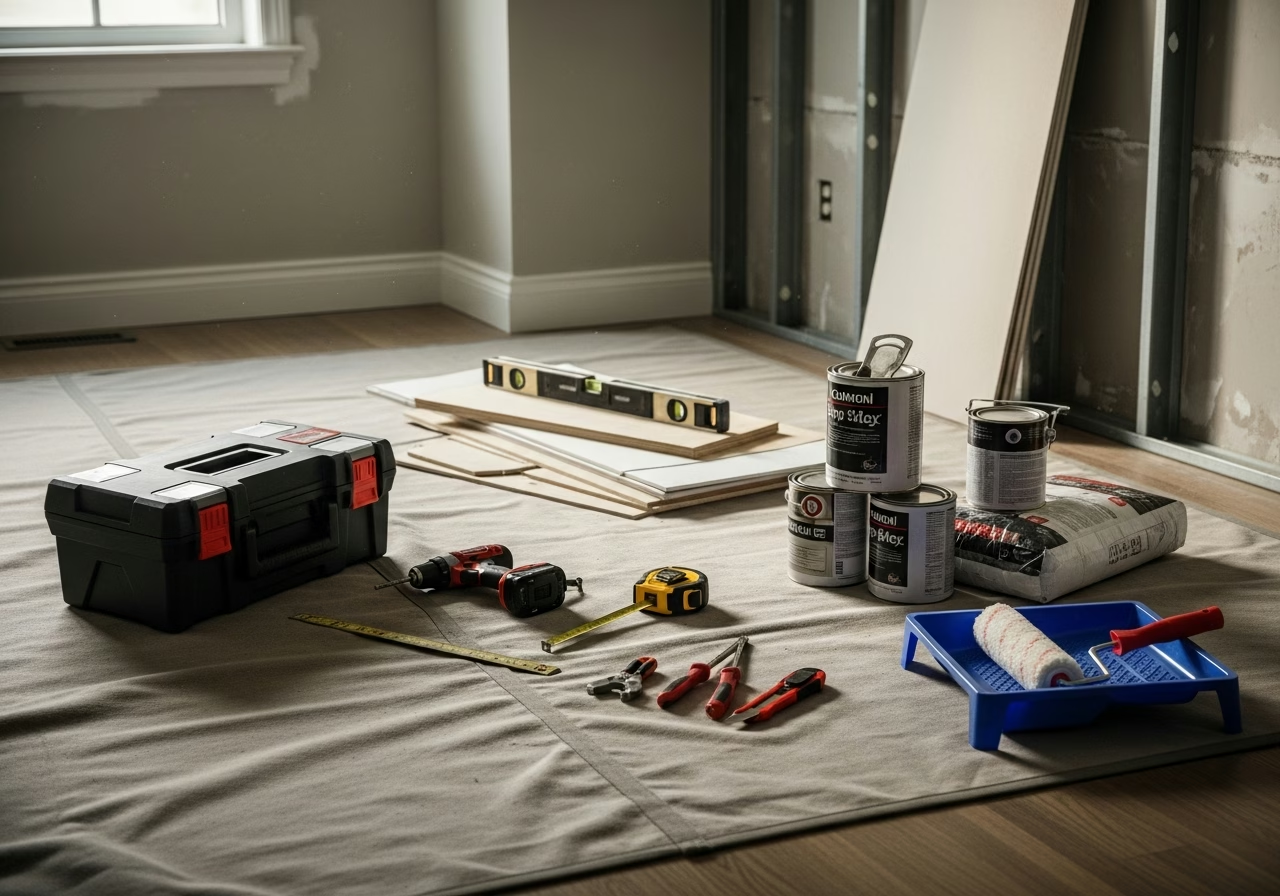
- Full removal: Category 3, paper-faced gypsum with visible growth, drywall in contact with sewage, or drywall already showing biological staining at scoping.
- Flood-cut only: Category 1, paper-faced gypsum dried within 48 hours, no biological staining at the cut line.
- Save in place: Category 1 dry within 24 hours, no insulation behind, mid-wall surface only (not in contact with floor or ceiling).
For the rebuild after, paper-free gypsum (DensArmor Plus, Mold Tough) is a worthwhile upgrade in damp-prone areas.
Need professional home renovation?
Call RenoHouse at 289-212-2345 or get a free estimate today.
Get Free Estimate →Hardwood Floors
The decision Toronto homeowners ask about most.
Solid hardwood. Often salvageable if dried within 72 hours. Process:- Floor planks may cup or crown initially as moisture distributes through the wood.
- Over 7–14 days of controlled drying (often with desiccant dehumidifiers and Dri-Eaz Dragon heat drying), the cupping/crowning typically resolves.
- Once moisture content reaches 7–12% (matching surrounding interior wood), a sand-and-refinish restores the floor.
- Cost vs replace: sand-and-refinish runs $3–6 per sq ft; replace runs $10–18 per sq ft. Strong economic case to save.
Carpet and Padding
A clear hierarchy:
- Padding — almost always replaced. Padding is highly porous and rarely dries to standard.
- Carpet face — Category 1: salvageable with extraction, antimicrobial, and re-installation over new pad. Category 2: usually replaced. Category 3: always replaced.
- Tack strip and transitions — replaced with the carpet.
The carpet save can run $4–8 per sq ft (extraction, antimicrobial, re-stretch over new pad) vs $7–14 per sq ft replacement. Worth saving when feasible; high carpet quality and Cat 1 conditions favour saving.
Insulation
Almost always discarded.
Fiberglass batts. Wet fiberglass loses R-value, becomes mold habitat, and rarely dries inside a wall cavity. Replaced. Cellulose insulation. Highly absorbent, slumps when wet, mold-prone. Replaced. Closed-cell spray foam. Sometimes salvageable. Closed-cell foam has near-zero water absorption, so a brief water exposure may not require replacement. Adjusters increasingly accept salvage with documented moisture readings. Open-cell spray foam. Behaves more like a sponge. Usually replaced after sustained exposure.Subfloor (OSB / Plywood)
The hidden cost driver in many Toronto water losses.
Plywood subfloor, Category 1, dried promptly. Usually salvageable. Dries from both sides if accessible. OSB subfloor, Category 2 or 3, or saturated >72h. Usually replaced. OSB swells more than plywood and rarely returns to flat. Subfloor under tile. Often forced replacement: removing the tile to inspect the subfloor is costly, and re-tiling is part of the scope anyway. Sometimes adjusters approve "save the tile, replace the subfloor under it" but this is technically difficult and rarely a clean save.Cabinetry
Highly material-dependent.
Particleboard / MDF cabinets. Almost always replaced when bottom panels or toe-kick are saturated. Particleboard swells, loses structural integrity, and never returns to original dimension. Plywood-box cabinets. Often salvageable if face frame and door are solid wood and the box is plywood. The toe-kick is usually replaced; the box itself dries. Solid-wood cabinets. Most salvageable category. Removed, dried off-site, re-finished, and re-installed. Cabinet doors and drawer fronts. Usually salvageable across all box types if not warped at scoping.Trim, Doors, and Hardware
Solid-wood baseboard and casing. Salvageable in Category 1; remove, dry, reinstall. MDF baseboard and casing. Usually replaced; MDF swells unrecoverably. Solid-wood interior doors. Salvageable; remove, dry, possibly re-finish. Hollow-core interior doors. Usually replaced if water reached them; the cardboard internal grid disintegrates. Hardware (hinges, knobs, locks). Usually salvageable in Category 1; replaced in Category 3.HVAC
Ductwork (sheet metal). Salvageable in Category 1 with cleaning. Often replaced in Category 3 due to interior insulation contamination.
Contents (Personal Property)
A separate scope, but the same logic:
- Hard goods (furniture, electronics, dishware) — salvageable in Category 1 with cleaning; case-by-case in Category 2; usually replaced in Category 3.
- Soft goods (clothing, drapes, upholstery, mattresses) — pack-out for off-site cleaning in Category 1 or 2; replaced in Category 3.
- Books and paper — desiccant drying possible but expensive; often replaced.
- High-value or sentimental items — itemized for specialist restoration even when general salvage isn't economic.
Insurance Implications
The carrier reviews salvage-vs-replace decisions as part of the scope review:
- A reputable mitigation team documents *why* each replacement decision was made (Category, time, material, moisture readings, growth observations).
- When the homeowner wants to save more aggressively than the mitigation team recommends (e.g., keep the original hardwood at risk of future cupping), it becomes a documented homeowner choice — and a documented limitation on the warranty.
- When the homeowner wants to upgrade ("replace the laminate with hardwood while we're at it"), the upgrade portion is paid out-of-pocket.
For the broader claim mechanics, see Insurance Claims for Water Damage in Toronto.
Common Toronto Disputes
The salvage-vs-replace decisions that most often produce homeowner-adjuster disputes:
- Hardwood saving — adjusters lean toward replacement; well-documented mitigation can argue for sand-and-refinish save.
- Cabinet saving — adjusters often approve box-keep with door replacement; some homeowners want full replacement because the cabinets are dated.
- Subfloor scope — easy to underscope; thermal imaging post-extraction often reveals more than visual inspection.
- Insulation extent — easy to underscope; opening one wall cavity often reveals saturation in adjacent cavities.
A restoration-experienced rebuild contractor (RenoHouse on the rebuild side) reviews these decisions at scope-write time and flags concerns to the adjuster before rebuild begins.
Next Steps
The salvage-vs-replace decisions are made during mitigation, before rebuild begins. Once the scope is agreed, RenoHouse executes the rebuild — drywall, paint, flooring, cabinetry, finishes — with insurance coordination and direct billing where supported.
Get a restoration consultationRelated Reading
- Fire & Water Damage Restoration Toronto 2026: Complete Guide
- Insurance Claims for Water Damage in Toronto
- Restoration Cost vs Renovation Cost: The Difference
Sources & References
Authoritative sources cited in this guide:
- Ontario Building Code — OBC official text
- Toronto Building Permits — City permit portal
- Tarion New Home Warranty — Ontario new-build warranty regulator
- HCRA — Home Construction Regulatory Authority — Ontario builder/vendor licensing
Continue Reading