RenoHouse

# Soundproofing Condo Strata Rules Toronto: What Is and Is Not Allowed 2026
Quick answer. Toronto condo soundproofing renovations live and die by the renovation request approval from the condo corporation. Even a perfectly designed scope — STC 50 demising wall, IIC 60 underlayment, room-within-room ceiling — gets stopped at the property manager's desk if the application is incomplete, the materials don't meet the building'...Toronto condo soundproofing renovations live and die by the renovation request approval from the condo corporation. Even a perfectly designed scope — STC 50 demising wall, IIC 60 underlayment, room-within-room ceiling — gets stopped at the property manager's desk if the application is incomplete, the materials don't meet the building's bylaw, or the work crosses into common-element territory without board approval. In 2026 Toronto condo boards have become noticeably more rigorous about renovation paperwork, particularly after several high-profile strata lawsuits over impact-noise complaints.
This post is the practical guide to what your Toronto condo corporation will and will not approve, the typical renovation request workflow, and the most common reasons soundproofing scopes get rejected. For pillar context see Acoustic Soundproofing Renovation Toronto. For the condo upstairs-noise scope specifically see Condo Soundproofing Toronto: Stop the Upstairs Neighbour.
Honest Positioning
Standard renovation work. RenoHouse handles renovation request preparation, board liaison, sub-trade coordination, scheduling within bylaw hours, and final completion documentation. We do not provide legal opinions on strata bylaw interpretation; for ambiguous cases we recommend a brief consultation with a condo lawyer.
The Renovation Request Workflow
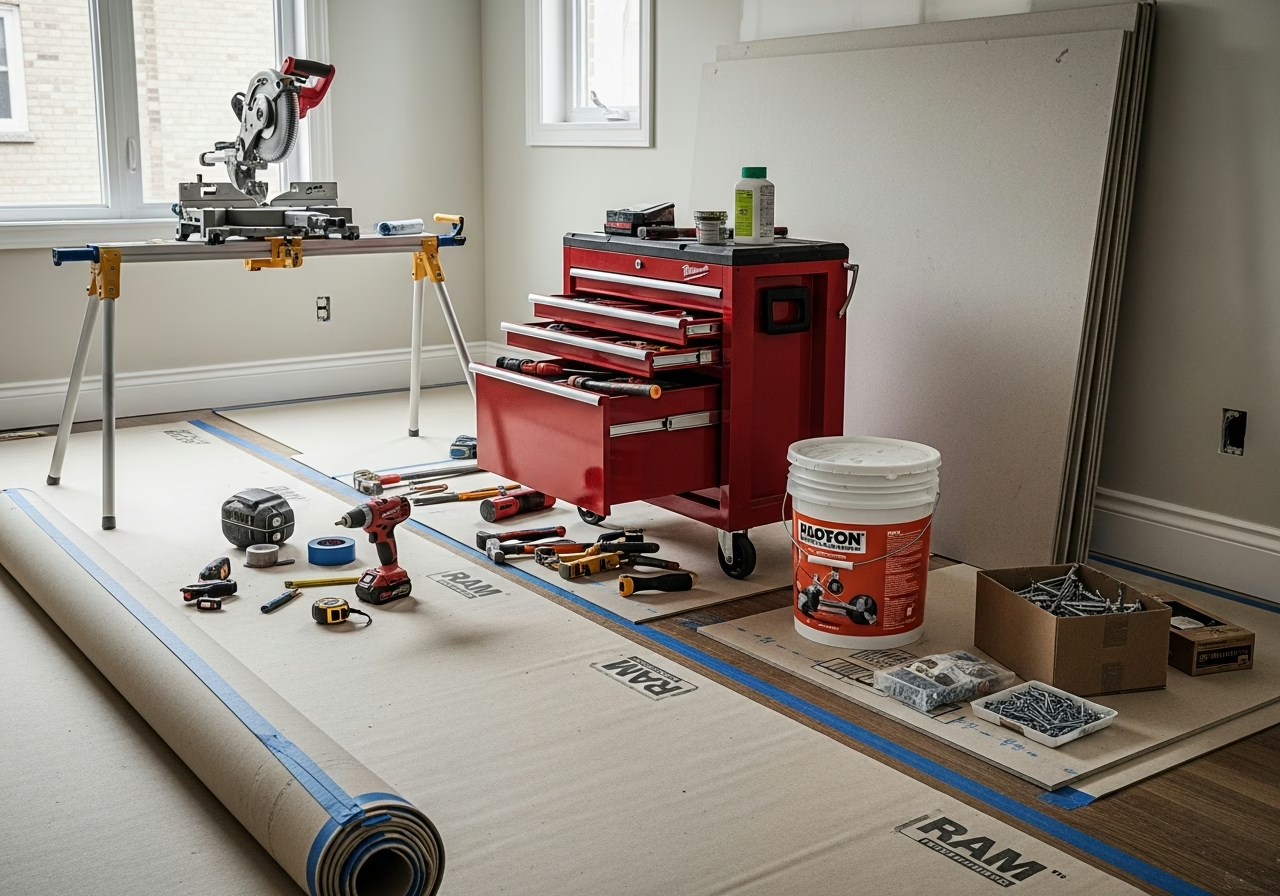
Every Ontario condo corporation has a renovation request process governed by its Declaration, Bylaws, and Rules. The typical workflow:
- 1. Owner submits a renovation request form to the property manager with: scope description, drawings or sketches, contractor name and licence/insurance, expected start and end dates.
- 2. Property manager reviews against bylaws. Common checks: hours of work, days of work, dust/noise mitigation, common-element implications, renovation deposit ($500-2,500), certificate of insurance.
- 3. Board reviews technical scope if it touches structure, common elements, or specialized scope (soundproofing falls here for ceiling work).
- 4. Approval letter issued with conditions: hours, dust barriers, elevator booking, completion timeline, post-completion inspection.
- 5. Work proceeds under the approval terms.
- 6. Post-completion inspection by property manager or board representative; deposit returned if no damage to common elements and bylaw was followed.
Typical timeline from submission to approval: 2-6 weeks depending on board meeting schedule.
What Soundproofing Scopes Usually Fall Within Unit Boundaries
The legally important distinction in Ontario condos: unit vs common element. The unit owner controls the unit; the corporation controls the common elements. Renovation scope inside the unit is the owner's prerogative subject to bylaw restrictions; scope into the common element requires board approval as a separate matter.
For a typical Toronto concrete-slab condo, the common element typically includes:
- The structural concrete slab (ceiling and floor).
- The exterior building skin including windows (in many corporations).
- Demising walls between units (the centreline is usually the boundary, but practical implications vary).
- Plumbing and HVAC trunk lines that serve more than one unit.
Soundproofing scopes that are clearly inside the unit:
- New drywall layers added on the unit-side of a demising wall, with framing built off the existing wall, not penetrating it deeply.
- Floor underlayment + new flooring on top of the existing slab.
- Door upgrades (the door slab is unit; the door frame is sometimes unit, sometimes common element — verify in the declaration).
- Solid-core door replacement.
Scopes that touch common element and need board approval:
- Drilling into the slab (ceiling fixtures, hanging ceiling assemblies). Most bylaws limit slab penetration to 1-1.5 inches max for fasteners.
- Modifying windows or window frames. Most corporations own the exterior of the window assembly.
- HVAC duct modifications if the duct serves more than one unit.
- Hanging anything from the slab beyond the corporation's approved fastener depth.
A common Toronto issue: a condo owner wants to install a decoupled drop ceiling for upstairs-noise treatment, and the AcoustiClips need to be screwed into something. Screwing into the existing ceiling drywall (which sits on the slab in most buildings) is fine — that drywall is part of the unit. Screwing into the slab itself is common-element work and requires explicit board approval.
The IIC Underlayment Bylaw
The most enforced soundproofing bylaw in Toronto condos: hard-surface flooring requires a published-listing underlayment with IIC ≥ X, where X depends on the building.
Need professional home renovation?
Call RenoHouse at 289-212-2345 or get a free estimate today.
Get Free Estimate →Typical X values:
- 1990s buildings: IIC 50.
- 2000s buildings: IIC 55.
- 2010s+ premium buildings: IIC 60.
The renovation request must include:
- The specific underlayment product (manufacturer + SKU).
- The published listing showing the IIC rating with the chosen flooring type.
- Installation details (manufacturer spec).
Common rejection reasons:
- Underlayment is a "moisture barrier" foam, not an acoustic product. Not eligible.
- Published listing IIC is on a different flooring type than what is being installed. (E.g., the underlayment shows IIC 55 with carpet but only IIC 48 with hardwood. The bylaw checks the hardwood case.)
- Underlayment is a generic 3mm felt with no published listing at all.
Acceptable products: Pliteq GenieMat, Maxxon Acousti-Mat, Quiet Walk Plus, Regupol Sonus, Felt-Right with proper documentation. See Floor Soundproofing Toronto for the full product reference.
Hours of Work
The standard Toronto condo bylaw:
- 9 AM to 5 PM weekdays only for noisy work (drilling, hammering, demolition, drywall hanging).
- No weekend or holiday work in most buildings.
- Quiet finishing work (painting, trim install, vacuuming) sometimes permitted longer hours but rarely overnight.
Some buildings tighten further (10 AM to 4 PM, or no work on certain days). Read the bylaw.
The implication for soundproofing scopes: a project that would take 1.5 weeks in a detached home often takes 3-4 weeks in a downtown Toronto condo because of restricted hours. Budget the labour accordingly.
Renovation Deposit and Insurance
Typical Toronto requirements:
- Renovation deposit: $500-2,500 returnable on satisfactory completion.
- Certificate of insurance from the contractor: $2M general liability minimum, naming the corporation as additional insured.
- WSIB clearance certificate for the contractor.
- Elevator booking and pad protection.
RenoHouse maintains insurance and WSIB at the levels required for downtown Toronto condo work and provides the certificates as part of the renovation request package.
Common Reasons Soundproofing Scopes Get Rejected
Patterns from RenoHouse application history:
- Slab penetration not approved. Owner wants AcoustiClips in the ceiling, application doesn't address slab fastening. Resubmit with fasteners detailed to penetrate only the existing ceiling drywall.
- Underlayment not bylaw-compliant. Selected product is below the building's IIC minimum or has no published listing. Resubmit with an approved product.
- HVAC modification without board engineering review. Owner wants to add a silencer duct in a shared trunk. Depending on the corporation, this needs a mechanical engineer's letter.
- Window upgrade requested without exterior approval. Most corporations own the exterior face of the window. Window replacement typically requires board approval as a common-element modification.
- Contractor insurance insufficient. $1M general liability is below most Toronto condo standards; $2M is required.
- Work hours non-compliant. Initial schedule shows weekend work; needs revision.
- No dust mitigation plan. Corporations want explicit poly barrier, HEPA vacuum, daily cleanup.
A well-prepared application addresses all of these proactively and is approved on first submission roughly 70% of the time. Application revisions add 2-4 weeks each.
Multiplex and Townhouse Strata
Toronto stacked-townhouse and multiplex-style condo corporations (POTL, common-element condos) have their own variations. Often the soundproofing requirements are stricter (these buildings typically have higher floor-to-floor noise transmission than concrete-slab high-rises) and the demising-wall scope is closer to a multiplex licensing scenario.
For these buildings, the OBC 9.11 STC 50 mandate applies to the original construction and may already be in the building's drawings. Renovation scope that affects demising walls is rarely permitted; most soundproofing work in these buildings is interior comfort upgrades.
Working with the Property Manager
Practical advice from RenoHouse project history:
- Submit early. Don't wait until you want to start work. Submit 4-6 weeks ahead.
- Be specific. Vague "minor soundproofing" descriptions get bounced; "Pliteq GenieMat RST-02 underlayment + 3/8" engineered hardwood per attached manufacturer spec" gets approved.
- Include drawings or photos. Even hand sketches showing what is being done and where.
- Address common-element implications proactively. If your scope might touch the slab, say so and provide the fastener detail.
- Provide all documents in one package. Insurance, WSIB, contractor name, references, drawings, product spec, schedule, dust plan.
A pre-submission conversation with the property manager (15 minutes) is often the difference between first-pass approval and three rounds of revision.
Next Step
The condo strata layer is real and it is increasingly enforced. For a Toronto condo soundproofing project, factor 3-6 weeks of approval lead time into the schedule, choose bylaw-compliant materials, and prepare a complete application. RenoHouse handles the renovation request package as part of standard scope.
For pillar context see Acoustic Soundproofing Renovation Toronto. For specific scopes see Condo Soundproofing Toronto: Stop the Upstairs Neighbour and Floor Soundproofing Toronto. Or book a condo soundproofing consultation through the home renovation service page.
Sources & References
Authoritative sources cited in this guide:
- Ontario Building Code — OBC official text
- Toronto Building Permits — City permit portal
- Tarion New Home Warranty — Ontario new-build warranty regulator
- HCRA — Home Construction Regulatory Authority — Ontario builder/vendor licensing
Continue Reading