RenoHouse

# Vented vs Unvented Crawl Space Toronto: Why Encapsulation Won the Argument
Quick answer. For most of the 20th century, Toronto crawl spaces were built vented — open to the outdoors through screened wall vents — on the theory that moisture would escape and the cavity would stay dry. Building science research from the 1990s and 2000s overturned that theory.For most of the 20th century, Toronto crawl spaces were built vented — open to the outdoors through screened wall vents — on the theory that moisture would escape and the cavity would stay dry. Building science research from the 1990s and 2000s overturned that theory. In a humid summer climate (and Toronto qualifies), vented crawls actually pull in more moisture than they release. The current consensus is that an unvented (conditioned, encapsulated) crawl performs better on humidity, energy, mold, and durability metrics.
This post explains why, what the OBC implications are, and how the transition is handled in older Toronto homes. For the full project context, see the pillar Crawl Space Encapsulation Toronto Complete Guide. For the encapsulate-or-convert decision, see Crawl Space vs Basement Toronto Difference.
The Vented Theory and Why It Failed
The original logic for vented crawls:
- Water vapor migrates from soil into the crawl.
- Outdoor air passing through wall vents flushes the vapor.
- The crawl stays dry-ish.
The problem with this logic in Toronto: in summer, outdoor air is warmer and more humid than the crawl space air. When you flush the cool crawl with warm humid air, the vapor condenses on the cold joists, subfloor, and any cold pipes. The crawl becomes wetter, not drier.
Field measurements in vented Toronto crawls in July and August routinely show 75% to 90% RH on joist surfaces. Mold growth thresholds are crossed for weeks at a time.
The Unvented (Conditioned) Approach
The encapsulated assembly:
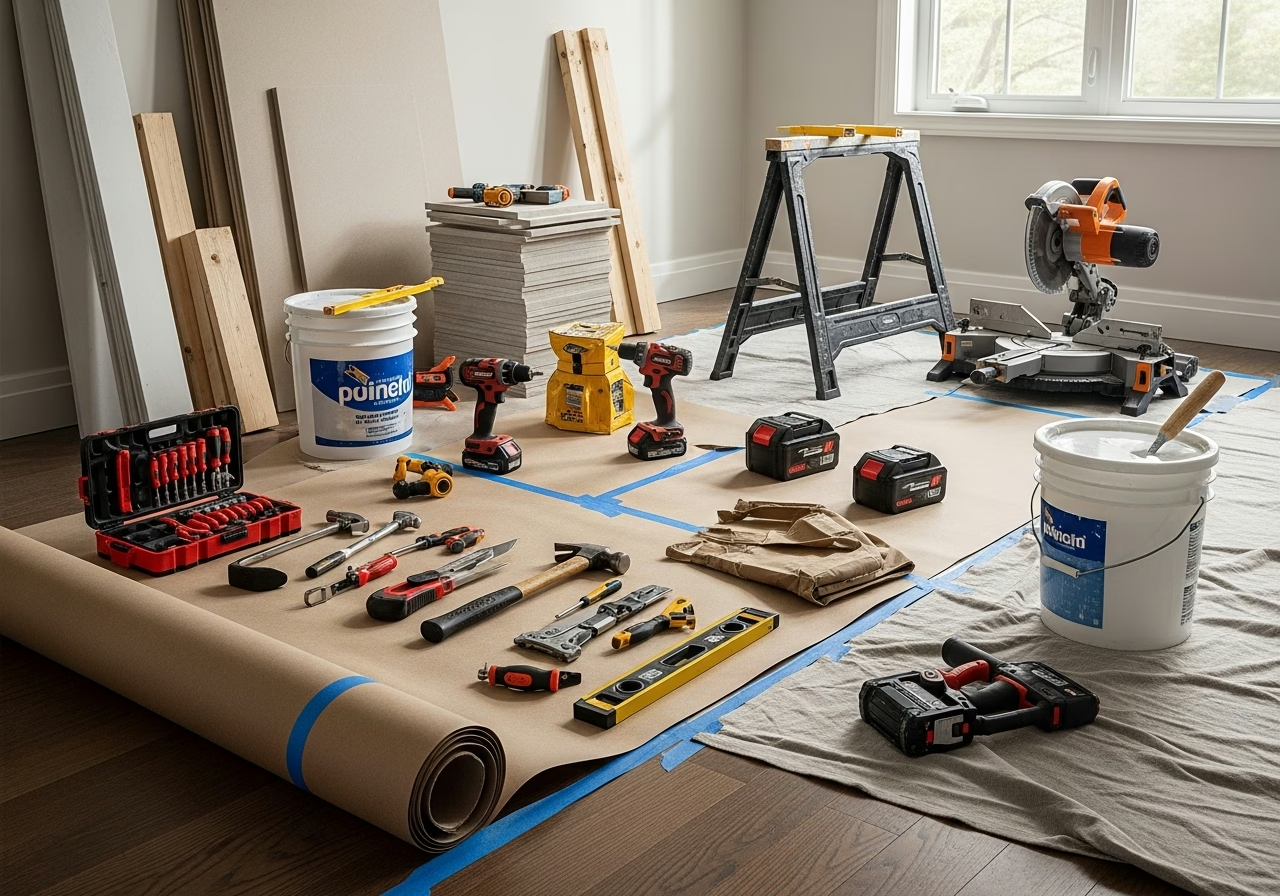
- Vapor barrier on the floor and walls (no soil-vapor entry).
- Sealed wall vents (no humid summer air entry).
- Foam-board insulation on walls (thermal boundary at the foundation).
- Active dehumidifier (controls residual humidity to 50% RH year-round).
- Often connected to the home HVAC system (small supply register or return grille).
The crawl is now part of the conditioned envelope, like a basement. Humidity is managed. Joists stay dry. Pipes stay above freezing. Energy losses through the floor and rim joist drop substantially.
Building Science Authorities
The evidence base for unvented crawls in cold-humid climates:
Need professional home renovation?
Call RenoHouse at 289-212-2345 or get a free estimate today.
Get Free Estimate →- Building Science Corporation (Lstiburek, Joseph). The seminal research from 2000-2010 showing vented crawls underperform unvented in humid summer climates.
- US DOE Building America program. Large-scale field studies confirming the result across the US Midwest and Northeast.
- National Research Council Canada. Concurring studies for Canadian climate zones.
- NRCan EnerGuide and Greener Homes program. Treats encapsulated crawls as part of the conditioned envelope for rebate purposes.
The science is settled. Vented crawls are no longer a defensible default in Toronto.
OBC Implications
Ontario Building Code 9.18 covers crawl spaces. The relevant subsections:
- 9.18.4 Drainage. Required regardless of vented or unvented.
- 9.18.5 Vapor barrier. Required at the soil interface.
- 9.18.6 Insulation. Required at the wall (unvented) or at the floor above (vented), with R-value targets per climate zone.
- 9.18.7 Ventilation. Vented crawls need a minimum ventilation rate; unvented crawls need to be air-sealed and have a moisture management strategy (typically a dehumidifier or HVAC connection).
Both vented and unvented are code-compliant in Ontario. The choice is performance-driven, not code-driven.
What Happens to the Existing Vents
In a Toronto encapsulation, the old wall vents are sealed:
- 1. Hardware cloth backing for rodent exclusion (in case the seal ever fails).
- 2. Rigid foam plug cut to fit the vent opening.
- 3. Polyurethane sealant around the perimeter.
- 4. Vapor barrier wraps over the sealed vent on the interior face.
We do not leave the vents open and rely on the dehumidifier to compensate. Open vents in an encapsulated crawl undermine the entire system.
HVAC Integration: Optional but Useful
In a fully encapsulated crawl, two strategies for air movement:
- Dehumidifier-only. A crawl-rated dehumidifier (Aprilaire E080, Santa Fe Compact 70, AlorAir Sentinel HDi65) provides circulation and humidity control. No HVAC connection needed. This is our default. See Crawl Space Dehumidifier Toronto Comparison.
- HVAC-connected. A small supply register from the home's existing forced-air system provides circulation. Requires sealed return path and balanced airflow. Adds energy load on the HVAC but does provide tempered air.
We use HVAC integration in roughly 15% of Toronto encapsulations, typically on Tier 3 jobs where the homeowner specifically requests it.
Combustion Air Considerations
Older Toronto homes with atmospherically-vented gas appliances (mid-efficiency furnace, gas water heater) may rely on the crawl space as a combustion-air source. Sealing the crawl without addressing combustion air is dangerous.
Our checklist before sealing vents:
- Furnace type (90%+ AFUE direct-vent is fine; mid-efficiency atmospheric needs combustion air rebalancing).
- Water heater type (power-vent or direct-vent is fine; atmospheric needs combustion air).
- Spillage testing on the as-found system.
- Provision of dedicated combustion air (PVC duct from outdoors to mechanical room) where needed.
If the home has an atmospheric appliance with no dedicated combustion air, we coordinate the combustion air work with a TSSA-G2 licensed gas fitter before encapsulation.
Honest Positioning
The vented-vs-unvented debate is not actually a debate among current building science professionals — unvented won. Where the discussion still happens is in DIY forums and among older contractors who learned the vented model decades ago. We install unvented (encapsulated) systems exclusively in Toronto.
The exception: a crawl space that has known asbestos or vermiculite that the homeowner is not budget-ready to abate. In that case we recommend leaving the crawl as-is (vented) until the abatement can be funded. Encapsulating over an asbestos-containing space is not acceptable. See Crawl Space Asbestos Vermiculite Toronto.
Transition Timing
For Toronto homeowners whose crawl is currently vented and dry-ish:
- If you plan to sell within 12 to 36 months, encapsulate now. The documentation pack is worth more than the cost.
- If you plan to stay 5+ years, encapsulate now. Energy savings, comfort, and durability all compound over years.
- If the home is a tear-down or major-addition candidate, defer the encapsulation until the larger project.
Get a Vented-to-Unvented Quote
Free crawl inspection with vented-state documentation and unvented-conversion scope at /services/home-renovation/crawl-space-encapsulation. We give you the full transition plan in writing including combustion-air check, vent-sealing detail, and dehumidifier spec before any deposit.
Sources & References
Authoritative sources cited in this guide:
- Ontario Building Code — OBC official text
- Toronto Building Permits — City permit portal
- Tarion New Home Warranty — Ontario new-build warranty regulator
- HCRA — Home Construction Regulatory Authority — Ontario builder/vendor licensing
Continue Reading