RenoHouse

# Generator Noise and Toronto Bylaw Compliance: Placement and Mitigation 2026
Quick answer. The City of Toronto noise bylaw caps continuous mechanical equipment at 45 dBA at the property line during nighttime hours. A standby generator running at full load produces 65-72 dBA measured at 7 metres. The math is solvable on most Toronto lots, but only with deliberate placement, the right cabinet, and occasionally an acoustic mitigation.The City of Toronto noise bylaw caps continuous mechanical equipment at 45 dBA at the property line during nighttime hours. A standby generator running at full load produces 65-72 dBA measured at 7 metres. The math is solvable on most Toronto lots, but only with deliberate placement, the right cabinet, and occasionally an acoustic mitigation. This post is the homeowner-facing noise-compliance framework.
For the broader standby generator context, start with our Standby Generator Installation Toronto Complete Guide.
RenoHouse Position
Noise bylaw compliance is part of the siting analysis we walk through with the homeowner before the contract is signed. The licensed gas fitter and electrician execute the install at the agreed location. RenoHouse owns the bylaw analysis and the conversation with the homeowner about neighbour exposure. The actual dBA measurement during commissioning is straightforward (any sound-level meter app on a phone produces a usable reading) and the manufacturer's published cabinet dBA at 7 m is the starting point.
What the Toronto Bylaw Actually Says
The City of Toronto noise bylaw (Chapter 591 of the Toronto Municipal Code) regulates continuous mechanical noise at the property line. The widely cited 45 dBA threshold applies during nighttime hours (typically 11 p.m. to 7 a.m., though the exact hours vary by zoning district). Daytime thresholds are higher (typically 50-55 dBA depending on zoning).
Critical to understand:
- The threshold is measured at the property line, not at the generator itself or at the neighbour's window.
- The threshold applies to continuous mechanical equipment, which a generator running during an outage qualifies as. Brief weekly self-tests (5-15 minutes) are typically not the source of complaints; multi-hour outage runs are.
- The bylaw is complaint-driven. A unit that runs without complaint for years is effectively compliant in practice; a unit that triggers a complaint gets measured against the threshold.
How dBA Drops with Distance
Sound pressure level drops approximately 6 dB with each doubling of distance from a point source. A unit measured at 70 dBA at 7 m will be approximately:
- 64 dBA at 14 m.
- 58 dBA at 28 m.
- 52 dBA at 56 m.
On a typical Toronto 25-50 ft lot the generator is rarely more than 10-15 m from any point on the lot line. A 70 dBA cabinet at 7 m measures roughly 65-67 dBA at 12 m — over the 45 dBA night threshold without mitigation.
That is why placement, not just brand, drives compliance. A unit placed 8 ft from the lot line is in trouble. A unit placed 25 ft from the lot line is comfortably compliant for most cabinets.
Manufacturer dBA Ratings
Major brand cabinet noise ratings at 7 m, full load (2026 spec sheets, approximate):
- Generac Guardian 14kW: 67-69 dBA.
- Generac Guardian 16kW (Synergy enclosure): 65-67 dBA.
- Generac Guardian 22kW (Synergy enclosure): 67-69 dBA.
- Kohler 14RESA: 64-66 dBA.
- Kohler 20RCA (liquid-cooled): 62-65 dBA.
- Kohler 26RCA (liquid-cooled): 63-66 dBA.
- Cummins QuietConnect 13: 64-66 dBA.
- Cummins QuietConnect 20: 62-65 dBA.
- Briggs and Stratton Fortress 17kW: 67-70 dBA.
Kohler RCA and Cummins QuietConnect are 2-4 dBA quieter than Generac at the same kW class — meaningful in a tight Toronto lot.
Need professional renovation?
Call RenoHouse at 289-212-2345 or get a free estimate today.
Get Free Estimate →Placement Strategy on a Typical Toronto Lot
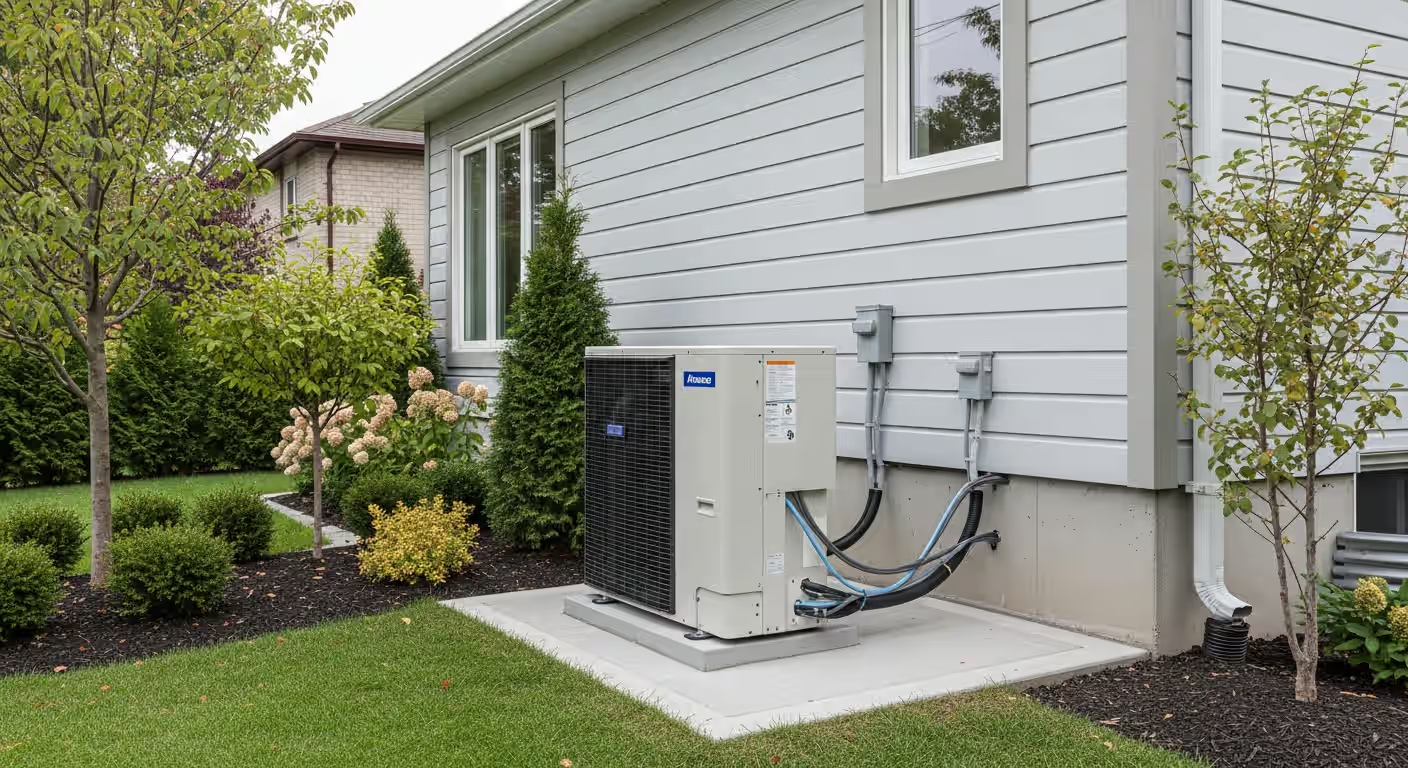
For a Toronto detached on a 25-40 ft frontage and 100-130 ft depth, the typical placement options:
- Side yard mid-lot. Most common. Unit sits between the home and the lot line, mid-block. Distance to lot line: 4-8 ft on most lots. dBA at lot line: marginal without other mitigation.
- Side yard rear. Unit sits at the rear of the side yard, behind the home. Distance to lot line: 6-12 ft. Distance to nearest neighbour bedroom: typically 25-40 ft (rear bedrooms are uncommon on the neighbour's side). Best practical placement for noise on most lots.
- Backyard. Unit sits in the rear yard, against the home or against a rear fence. Distance to lot line: 15-30 ft on standard lots. Often the best placement for noise but the worst for gas line length and exhaust orientation toward the homeowner's own outdoor space.
- Front yard. Rare but legal in some zoning. Unit sits in the front yard, often beside the driveway. Setbacks from the street and the front door must be honoured. Aesthetic compromise.
The right answer depends on the lot. We walk this with the homeowner during the site visit.
Orientation Matters
A generator's air intakes are typically on the long side of the cabinet; the exhaust is at one end. Orientation affects both compliance and neighbour relations:
- Exhaust pointed at the lot line: worst case. Direct exhaust noise toward the neighbour. Avoid.
- Exhaust pointed at the homeowner's home: acceptable, since exhaust noise reflects back at the home rather than the lot line.
- Exhaust pointed away from both: ideal. Often achieved by orienting the cabinet end toward the rear of the lot.
- Air intakes pointed at the lot line: secondary concern. Less directional than exhaust but still adds 1-2 dBA at the lot line.
The licensed installer orients the cabinet during the pad placement. The homeowner gets to weigh in.
When You Need Acoustic Mitigation
Three Toronto scenarios where acoustic mitigation beyond placement is warranted:
- Narrow lot (under 25 ft frontage). A semi-detached on a 17-22 ft lot frequently cannot achieve enough lot-line distance to comply with the cabinet's bare dBA. Acoustic enclosure or sound wall recommended.
- Bedroom alignment. The neighbour's bedroom window is positioned directly across from the generator placement, with no other compliant placement available. Mitigation recommended.
- Particularly noise-sensitive neighbour relationship. Even if the bylaw is met on paper, a 65 dBA continuous sound at the lot line is meaningful. Some homeowners invest in mitigation for the relationship rather than the bylaw.
Acoustic Mitigation Options
Three approaches in increasing cost order:
- Sound wall or fence. A solid wood or composite fence between the generator and the lot line, taller than the cabinet, with sound-absorbing material on the generator side. Reduces lot-line dBA by 5-10 dBA for $1,500-$3,500 depending on length and finish.
- Acoustic enclosure (factory). Some manufacturers offer factory-spec acoustic enclosures that reduce cabinet dBA by 6-12 dBA. Cost premium $2,500-$5,000 over the standard cabinet.
- Custom acoustic enclosure (after market). A purpose-built acoustic shelter around the generator, with sound-absorbing panels and properly sized ventilation. Reduces dBA by 10-15 dBA for $3,500-$7,500. The most aggressive mitigation; rarely needed in Toronto residential.
The cheapest effective mitigation on most Toronto lots is the sound wall option. We recommend it routinely on tight-lot installs.
Self-Test Schedule
Standby generators run a weekly self-test of 5-15 minutes. The default is typically Wednesday 11 a.m. We recommend keeping it mid-day on a weekday — far from sleep hours, well-justified as standard maintenance, minimal neighbour exposure.
Reasons to change the schedule:
- The default conflicts with the neighbour's home-based work or sleep schedule (e.g., a shift-worker neighbour who sleeps weekday mornings).
- The homeowner is rarely home during the default time and prefers to be present for the test.
The schedule is configured in the generator's controller and can be changed at any time.
What Triggers a Bylaw Complaint
In our experience the noise complaints that reach the City of Toronto's bylaw enforcement are concentrated in three patterns:
- Long outage events. A generator running for 36+ hours during a winter storm, audible through closed windows in the neighbour's home. This is the most common trigger.
- Bad placement. A unit installed within 5 ft of a neighbour's bedroom window, which would have been obvious during siting if it had been considered.
- Pre-existing relationship tension. A neighbour relationship that was already strained before the generator. The unit becomes the new battlefield.
Avoiding the first is hard (you cannot control the weather). Avoiding the second is easy with deliberate siting. The third is a relationship problem, not a generator problem.
What Happens If a Complaint Is Filed
If a complaint is filed:
- A bylaw inspector visits during a generator-running event (typically a weekly self-test if the unit is consistent, or during the next outage).
- The inspector measures dBA at the lot line with a calibrated meter.
- If the reading exceeds the threshold, the homeowner receives a notice with a remediation timeline (typically 60-90 days).
- The homeowner remediates (relocation, sound wall, or acoustic enclosure).
- A re-inspection confirms compliance.
Cost of remediation: $1,500-$5,000 depending on the chosen approach. Far more expensive than getting it right at the start.
Our Coordination Approach
For a Toronto standby generator project, RenoHouse walks the noise analysis with the homeowner during the site visit, before placement is finalized. We use the cabinet's published dBA at 7 m, the actual lot-line distance, and the orientation as inputs. We recommend mitigation when warranted. The licensed Master Electrician and gas fitter execute the install at the agreed location.
For a project quote, visit our standby generator installation service page. For permits and inspections, see Standby Generator Permits: TSSA, ESA, and Toronto Bylaw Compliance. For installation mistakes to avoid, see Generator Installation Mistakes: What Toronto Homeowners Get Wrong.
Sources & References
Authoritative sources cited in this guide:
- Electrical Safety Authority (ESA) — Ontario electrical regulator
- Ontario Electrical Safety Code — OESC Section 26 / latest amendments
- Canadian Electrical Code Part I (CSA C22.1) — CEC standard
- NRCan — Electric Vehicle Resources — NRCan EV/charging programs
Continue Reading