RenoHouse

# Home Battery & Powerwall in Toronto 2026: The Complete Guide
Quick answer. A home battery used to be a luxury for off-grid cottages. In 2026, it has become one of the smartest electrical upgrades a Toronto homeowner can make — and the math finally works for grid-tied houses. Between Toronto Hydro's Ultra-Low Overnight (ULO) rate, the federal Greener Homes Loan, the 2022 Derecho that left 1.2 million ...A home battery used to be a luxury for off-grid cottages. In 2026, it has become one of the smartest electrical upgrades a Toronto homeowner can make — and the math finally works for grid-tied houses. Between Toronto Hydro's Ultra-Low Overnight (ULO) rate, the federal Greener Homes Loan, the 2022 Derecho that left 1.2 million Ontario households without power, and the arrival of the Tesla Powerwall 3, batteries are now mainstream electrical work.
This pillar guide covers every angle: how home batteries work, the three brands worth your money in Toronto (Tesla Powerwall, FranklinWH, Enphase IQ Battery), realistic installed costs, the ESA permit and CEC Section 64 process, and where the real return on investment comes from.
We are an ESA-licensed Master Electrician and manufacturer-certified installer (Tesla Certified, Enphase Premier, FranklinWH Authorized). Everything you read here is what we tell our own customers in their kitchen. No hype, no rebate fairy tales.
Why Toronto Homeowners Are Installing Batteries in 2026
Three things changed at once.
1. The May 2022 Derecho. A line of straight-line winds tore across southern Ontario and left 1.2 million households in the dark — many for 3 to 7 days. Aging trees, an aging grid, and climate-driven storms mean Toronto is no longer a "set and forget" power region. Home batteries are now part of resilience planning the same way sump pumps and backwater valves are. 2. Toronto Hydro Ultra-Low Overnight (ULO) rate. Since 2023, Toronto Hydro has offered a four-tier time-of-use rate. The spread is dramatic: 2.4 cents/kWh midnight–7am, versus 28.6 cents/kWh peak. That is a 12x difference — and a battery that charges at night and discharges during peak captures the entire spread on every cycle. 3. The Greener Homes Loan. Up to $40,000 interest-free over 10 years now explicitly covers home battery storage as an eligible measure. A typical Powerwall 3 install lands inside that envelope with room left for solar or a heat pump.If you have not read our Standby Generator Installation Guide, the [Heat Pump Conversion Guide](/blog/heat-pump-conversion-toronto-2026-complete-guide), or the EV Charger Installation Guide, bookmark them — these systems all interact with your battery and your electrical service.
How a Home Battery Actually Works
A home battery is three things in one cabinet:
- 1. Lithium-ion battery cells (LFP — lithium iron phosphate — in all three brands we install)
- 2. A bidirectional inverter that converts DC battery to AC house current and back
- 3. A control board with a transfer switch that disconnects you from the grid during an outage and runs your house from the battery
The system sits between your meter and your panel. It charges from the grid (or solar), and during an outage it "islands" — your house keeps running while the rest of the street goes dark. When the grid returns, it re-synchronizes and reconnects automatically.
The headline numbers homeowners ask about are kWh (how much energy it stores) and kW (how much power it can deliver at one moment). A fridge needs about 0.15 kW. A heat pump compressor on startup might pull 5–8 kW. An induction range on full boil pulls 7 kW. Sizing is about both.
The Three Batteries Worth Installing in Toronto
We have installed all three. Here is the honest comparison.
| Battery | Capacity | Continuous Power | Peak Power | Solar Inverter Built In | Installed Cost (CAD) |
|---|---|---|---|---|---|
| Tesla Powerwall 3 | 13.5 kWh | 11.5 kW | 30 kW (10s) | Yes (20A DC PV) | $15,500 |
| Tesla Powerwall 2 | 13.5 kWh | 5 kW | 7 kW (10s) | No | $14,000 |
| FranklinWH aPower 2 | 15 kWh | 12 kW | 20 kW (10s) | No | $13,500 |
| Enphase IQ Battery 5P | 5 kWh per unit | 3.84 kW per unit | 7.68 kW per unit | No (microinverter ecosystem) | $4,500 per unit |
| LG ESS Home 8/10/16 | 8 / 10 / 16 kWh | 5–7 kW | 7–11 kW | Yes (hybrid models) | $11,000 – $18,000 |
For full head-to-head detail, read our Tesla Powerwall vs FranklinWH vs Enphase comparison. For the Powerwall 2 vs 3 question specifically, see Tesla Powerwall 3 vs 2 in Toronto.
What a Powerwall Costs Installed in Toronto
A single Tesla Powerwall 3 installed runs $15,500 all-in for a typical Toronto semi or detached. Here is where the dollars go:
Need professional renovation?
Call RenoHouse at 289-212-2345 or get a free estimate today.
Get Free Estimate →| Line Item | Typical Cost (CAD) |
|---|---|
| Powerwall 3 hardware | $11,200 |
| Gateway, conduit, disconnect, breakers | $1,200 |
| ESA permit + inspection | $250 – $400 |
| Master Electrician labour (1.5–2 days, 2 techs) | $2,200 – $2,800 |
| Wall-mount or floor stand + seismic bracket | $150 – $300 |
| Commissioning, app setup, customer walkthrough | included |
| Total installed (single unit, no panel upgrade) | $15,500 |
Add $2,500–$5,500 if your service needs a 200A upgrade. Add $800–$1,500 if your run from gateway to panel is long or requires drywall repair. For the full breakdown including multi-unit and stacked configurations, read Home Battery Cost Toronto Installation.
Solar or No Solar? Both Make Sense in Toronto
Most homeowners assume a battery only makes sense with solar. In Toronto in 2026, that is no longer true.
With solar: You store excess daytime production and use it at night. You also gain blackout autonomy — your panels keep producing during an outage instead of shutting down for grid safety. Read Powerwall with Solar Panels in Toronto. For solar PV pairing, the installation must be done by an NRCan-registered installer to qualify for federal incentives — that is a separate registration from ESA Master Electrician. Without solar (grid-only): You charge from the ULO 2.4 cents overnight rate and discharge during the 28.6 cents peak. You also get full outage backup. The math is genuinely good in Toronto because the ULO spread is so wide. Read Powerwall Without Solar — Grid-Charge Toronto and the dedicated ULO Arbitrage analysis.ESA Permits, CEC Section 64, and Why Certification Matters
A home battery is not a plug-in appliance. It is a permanent electrical installation regulated under the Electrical Safety Authority (ESA) and the Canadian Electrical Code (CEC). Specifically:
- CEC Section 64-200 — Energy storage systems for residential use. Covers location, ventilation, working clearances, disconnect requirements, and labelling.
- CEC Section 26 — Installation of electrical equipment (inverters, gateways).
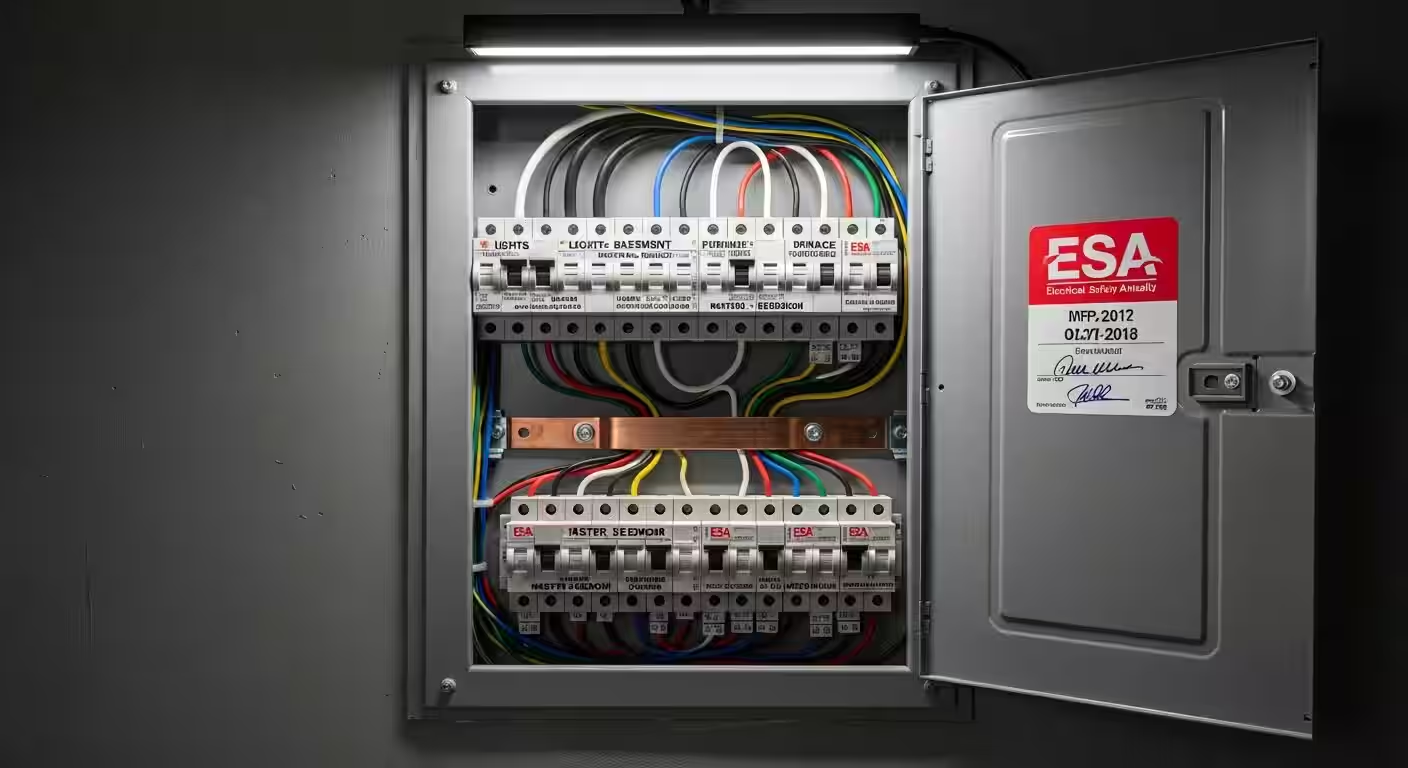
- ESA Notification of Work required before any battery install. Typical Toronto permit fee: $250–$400.
- Master Electrician must pull and close the permit.
- Manufacturer-certified installer required for warranty (Tesla Certified Installer, Enphase Premier Installer, FranklinWH Authorized — these are vendor programs that protect your warranty).
If a contractor offers to install a Powerwall without an ESA permit, walk away. We have seen uninspected battery installs that were scrapped on resale because the buyer's home inspector flagged the unpermitted electrical work. Full process detail in Home Battery Permit & ESA Toronto.
Whole Home or Essential Loads?
The biggest sizing question after "which brand" is "what does the battery back up?"
Whole home backup means every circuit in your panel runs during an outage. This requires either a battery (or stacked batteries) sized to your full peak load, or a smart load controller that sheds non-essential circuits dynamically. Tesla and FranklinWH both offer whole-home solutions; FranklinWH includes a smart panel out of the box. Essential loads backup means a sub-panel with only critical circuits (fridge, furnace fan, internet, a few outlets, sometimes a sump pump). Cheaper, smaller battery, but you lose air conditioning and electric ranges during outages.Read the full breakdown in Whole Home vs Essential Loads Battery Backup.
What Happens During a Power Outage
The Powerwall detects grid loss in under 100 milliseconds and seamlessly transitions your house to battery. Lights blink (or do not blink at all if you are running a Powerwall 3). The fridge keeps cooling. The furnace fan keeps moving heat. Internet stays on if you have a UPS on the modem.
How long does it last? A 13.5 kWh Powerwall 3 powers an average Toronto house at idle (about 0.5 kW continuous) for roughly 24 hours. With heavy loads like AC or electric heat, it might be 6–10 hours. Pair with solar, and it can run indefinitely as long as the sun shows up.
The full outage scenario walkthrough is in Powerwall During a Power Outage in Toronto, and we compare battery vs whole-home generator in Powerwall vs Standby Generator in Toronto.
ROI and Payback in Toronto
Honest answer: a battery rarely pays back faster than 8–12 years on ULO arbitrage alone. With outage avoidance value (say, $1,500 of saved food, hotel, sump backup), and the Greener Homes Loan financing the unit at zero interest, the picture improves substantially. Pairing with solar shortens payback to 6–9 years for many Toronto homes.
Full numbers, sensitivity analysis, and worked examples in Home Battery ROI Toronto Payback.
Condos: Can You Even Have a Powerwall?
Short answer: usually no, but there are exceptions for stacked townhouses, ground-floor stacked units with private mechanical rooms, and condo-corp-approved bulk installations. We have done a handful in Toronto and it is always a six-month conversation with the board, the property manager, and a Master Electrician peer review. Full feasibility framework in Powerwall Condo Feasibility Toronto.
Common Installation Mistakes We Fix
After years of installs, the same mistakes show up. Undersized service. Battery installed in an unconditioned garage that drops below the cell operating range. Gateway placed without considering Wi-Fi reach. No surge protection on the grid side. Installer who skipped the ESA permit. Wrong location for working clearances under CEC 64-204.
The full list with photos is in Powerwall Installation Mistakes in Toronto. Read it before you sign anything.
What "ESA Master Electrician + Manufacturer-Certified" Actually Means
There are three layers of qualification a Toronto battery installer needs:
- 1. ESA-licensed Master Electrician — provincial requirement to pull permits and supervise battery installations.
- 2. Manufacturer certification — Tesla Certified Installer, Enphase Premier Installer, or FranklinWH Authorized Installer. This is what protects your hardware warranty. Tesla's certification in particular requires recertification, training on the Powerwall 3 platform, and a minimum number of installs per year.
- 3. NRCan-registered installer — required only if you are pairing solar PV for federal incentive eligibility. Separate program.
We hold all three for the systems we install. Always ask for ESA contractor licence number, manufacturer certification ID, and a Notification of Work number for your permit.
Next Steps
If you are within 6 months of a roofing project, a service upgrade, or a heat pump install, the battery decision should be folded into all of them — wiring runs, panel sizing, and roof penetrations are far cheaper to coordinate than to redo.
Book a home battery and Powerwall consultation and we will walk your panel, your roofline (for solar pairing), your ULO usage data, and design a system that actually pays back in your house, not in a brochure.
Sources & References
Authoritative sources cited in this guide:
- Electrical Safety Authority (ESA) — Ontario electrical regulator
- Ontario Electrical Safety Code — OESC Section 26 / latest amendments
- Canadian Electrical Code Part I (CSA C22.1) — CEC standard
- NRCan — Electric Vehicle Resources — NRCan EV/charging programs
Continue Reading