RenoHouse

# HRV Condo Installation Toronto: Low-Rise and High-Rise Retrofits
Quick answer. Most Toronto condos built between 2005 and 2020 in King West, Liberty Village, CityPlace, the Distillery, and along the Yonge corridor were designed with bathroom exhaust ducts but no balanced fresh-air supply.Most Toronto condos built between 2005 and 2020 in King West, Liberty Village, CityPlace, the Distillery, and along the Yonge corridor were designed with bathroom exhaust ducts but no balanced fresh-air supply. The building relies on corridor pressurization to push fresh air into each unit when the suite door is opened or when bath fans run. In practice, that system underperforms: hallway air is stale, suite-door undercuts are too tight, and bath fans are often disabled. The result is poor IAQ in tight modern condos. The fix is an in-suite HRV or ERV. This guide walks through the condo-specific path. For the pillar guide, see HRV & ERV Installation Toronto: The Complete 2026 Guide.
Why Condo HRV Retrofits Matter
A typical 700 sqft Toronto 1-bedroom condo with two occupants and the bedroom door closed accumulates CO2 to 1,800-2,400 ppm by morning. The same suite, post-renovation with new windows and air-sealing, can climb past 3,000 ppm. The OBC 2024 mandate does not always reach existing condos formally, but the IAQ symptoms are real and the rebate stack still applies on most retrofit paths.
The Three Condo Constraints
Condo retrofits add three constraints on top of a normal HRV install:
1. Outdoor Hood Penetrations
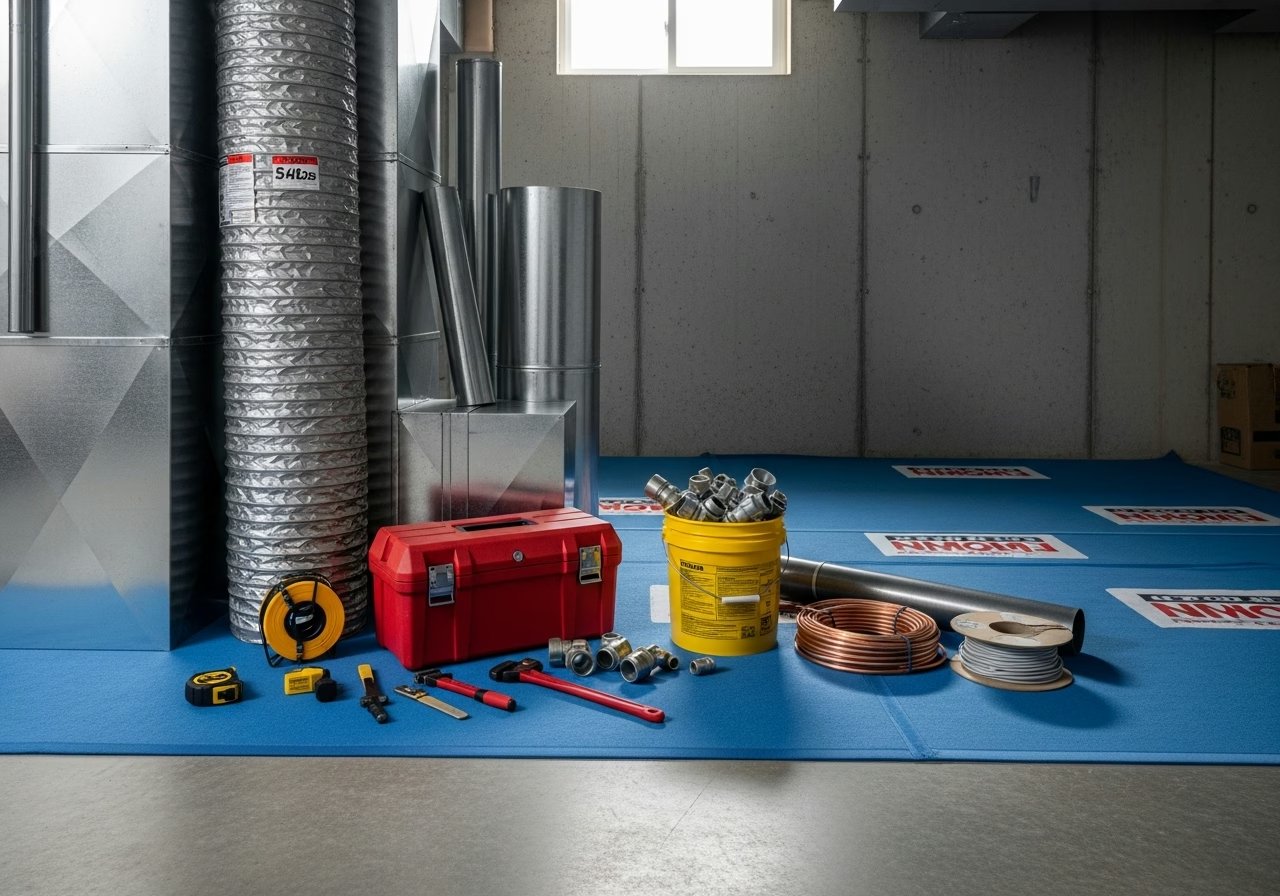
The HRV needs a fresh-air intake and an exhaust hood, both venting to the exterior. Most condo boards prohibit drilling new penetrations through the building envelope.
Workarounds:
- Through the balcony slab. Some boards allow penetrations through the underside of the balcony if they do not cross to the unit below.
- Through the existing range-hood or dryer exhaust corridor. Where the building already has a venting shaft, a compact HRV may share the path (verify with mechanical engineer).
- Through the existing balcony glazing track. Some installers route a discreet pipe through a non-load-bearing balcony component.
- Compact unit with single-point ventilation through one existing penetration. Premium units (Renewaire EV90, some Panasonic Intelli-Balance variants) consolidate intake and exhaust into a single split duct.
2. Mechanical Space
Most Toronto condos have minimal mechanical space. The HRV must fit:
- Above the laundry stacking unit.
- Inside a closet.
- Above a drop ceiling in the entry corridor.
- Mounted to a kitchen ceiling soffit.
Compact units (Panasonic Intelli-Balance 100 at about 26 by 24 by 12 inches) fit most of these spaces. Full-size units (Lifebreath 200, Venmar AVS) often do not.
3. Board Approval
Toronto condo boards have authority over the building envelope, common elements, and any modification that affects neighbouring units. Approval typically requires:
- A scope letter from the homeowner.
- Mechanical drawings stamped by a P.Eng.
- Insurance certificate from the contractor.
- Confirmation that the work does not affect fire separation, structure, or shared services.
- Sometimes: pre- and post-installation acoustic test.
Approval timeline: 2-8 weeks. Some boards say no.
The Compact Unit Shortlist
For Toronto condos, four units dominate:
- Panasonic Intelli-Balance 100 — most quoted. Compact (24 by 26 by 12 inches), 100 CFM, ECM, very quiet at 0.4 sones.
- Renewaire EV90 — single-point ventilation through one wall. 90 CFM. Useful where two penetrations are not allowed.
- vanEE C100 — Quebec-built compact, value tier.
- Broan AI Series compact — sized for 2-bedroom condos.
For brand detail, see Panasonic vs Lifebreath vs Venmar HRV.
Need professional renovation?
Call RenoHouse at 289-212-2345 or get a free estimate today.
Get Free Estimate →Typical Toronto Condo Install Tiers
1-Bedroom (550-750 sqft) — $3,500-$5,500
Compact HRV/ERV (Panasonic Intelli-Balance 100 or Renewaire EV90), single-point ventilation where feasible, supply to bedroom and living area, exhaust from bathroom.
2-Bedroom (800-1,100 sqft) — $4,800-$7,500
Slightly larger compact unit, supply to two bedrooms plus living area, exhaust from main bathroom plus laundry.
Larger / Townhouse-Condo (1,200-1,800 sqft) — $5,800-$9,500
Full-size compact unit (Panasonic Intelli-Balance 200 or Lifebreath 200 ATH where space allows), full ducted distribution.
For full cost detail, see HRV Installation Cost Toronto Comparison.
The Board-Approval Playbook
Step by step:
- 1. Initial site visit. RenoHouse plus HVAC-licensed installer assess mechanical room, ductwork access, and exterior hood options.
- 2. Preliminary design. TSSA-registered design sub prepares concept drawing.
- 3. Scope letter to board. Homeowner submits the proposed scope plus drawings.
- 4. Board review and Q&A. Property manager forwards to building engineer; engineer reviews. Common questions: fire separation impact, exterior aesthetics, noise.
- 5. P.Eng-stamped drawings. If the board accepts in principle, a P.Eng prepares stamped mechanical drawings.
- 6. Final approval and conditions. Insurance certificate, work-hours restrictions, parking and elevator coordination.
- 7. Permit (Toronto Building). MVDS submission for OBC 2024 compliance.
- 8. Install. Typically 2-4 days; coordinated with elevator booking.
- 9. Commissioning and balancing. CSA F326 report.
- 10. Closeout to board. Final inspection sign-off.
Total elapsed time: 6-12 weeks from initial visit to commissioned install.
Boards That Typically Say Yes
- Newer corporations (post-2015) that already see HRV/ERV as part of envelope upgrades.
- Boards with active envelope-improvement plans (e.g., post-spray-foam exterior re-cladding).
- Buildings where one or two units have already been retrofitted (precedent).
Boards That Typically Say No
- Heritage-designated buildings (King West conversions of warehouse stock).
- Buildings with strict fascade aesthetics (no exterior penetrations allowed).
- Smaller older corporations with limited engineering capacity to review.
For the no path: a high-MERV portable HEPA in each room is the next-best IAQ option. Not a substitute for balanced ventilation but it manages allergens and PM2.5.
Where the Hood Goes
Three placement options on a typical Toronto condo:
- Through the balcony glass railing system. Discreet; works on many post-2010 buildings.
- Through the side wall of the balcony enclosure. Visible but acceptable.
- Through the underside of the upper balcony slab. Hidden; requires structural sign-off.
Avoid:
- Front fascade penetration (almost always rejected).
- Bedroom window through-wall (acoustically poor).
- Above HVAC condenser (re-entrains AC heat).
Acoustic Considerations
Condo neighbours are close. Two acoustic risks:
- Unit noise into the suite. Compact units at 0.4-0.7 sones at low speed are barely audible. Older PSC units at 1.2+ sones are intrusive.
- Exhaust noise to the neighbour's balcony or unit. A poorly-located exhaust hood blasts neighbouring units.
Best practice: vibration-isolation mounts on the HRV, acoustic-lined supply ducts in the first 6 feet, and an exhaust hood placed away from neighbouring openings.
Insurance and Trades
Most condo boards require:
- Contractor general liability of $2-5 million.
- Workers compensation (WSIB) clearance.
- Proof of HVAC license for the installer.
- TSSA registration where gas-line work is involved (typically not on HRV install).
RenoHouse coordinates with HVAC-licensed installers who carry the required certificates.
Cost After Rebates
Federal Greener Homes Loan applies to condo HRV/ERV installs when bundled with another eligible measure (e.g., new windows or attic-equivalent envelope work). The Ontario HRS rebate is harder to claim on condo retrofits because corporate audits cover the building, not individual units. Toronto HELP applies in some cases.
For the rebate walkthrough, see HRV Greener Homes Rebate Toronto.
Final Word
Toronto condo HRV retrofits are doable but constrained. The right path is a compact unit, a board-approved hood location, and a HVAC-licensed installer with condo experience. RenoHouse coordinates the design, board package, permit, and install. Expect 6-12 weeks elapsed and 2-4 days of in-suite work.
Book at /services/hvac-energy/hrv-erv-installation. For deeper reads, see HRV & ERV Installation Toronto: The Complete 2026 Guide, Panasonic vs Lifebreath vs Venmar HRV, HRV Installation Cost Toronto Comparison. Related: HVAC Thermal Audit (FLIR).
Sources & References
Authoritative sources cited in this guide:
- NRCan — Heating and Cooling — NRCan heating/cooling guidance
- Canada Greener Homes Loan — Federal energy retrofit financing
- CSA F326 (Mechanical Ventilation) — Residential HRV/ERV standard
- Enbridge Home Renovation Savings (HRS) program — Provincial heat pump rebate
- TSSA Fuel Safety — Ontario fuel/gas regulator
Continue Reading