RenoHouse

# HRV & ERV Installation Toronto: The Complete 2026 Guide
Quick answer. Toronto's housing stock is getting tighter every year. Air-sealing programs under Ontario HRS and Toronto HELP have driven measured blower-door results from 5-8 ACH50 in a typical 1960s semi down to 1.5-3 ACH50 in retrofitted homes, and new builds under Ontario Building Code 2024 routinely hit 1.0-2.0 ACH50.Toronto's housing stock is getting tighter every year. Air-sealing programs under Ontario HRS and Toronto HELP have driven measured blower-door results from 5-8 ACH50 in a typical 1960s semi down to 1.5-3 ACH50 in retrofitted homes, and new builds under Ontario Building Code 2024 routinely hit 1.0-2.0 ACH50. The unintended consequence is that the same houses that used to leak fresh air through every window frame now starve themselves of it. CO2 climbs over 1,500 ppm in bedrooms overnight. Cooking moisture condenses on windows. Volatile organic compounds from finishes and cleaners linger for days instead of hours. The Ontario Building Code response, effective January 1, 2024, is a mandatory mechanical ventilation requirement on new construction and on retrofits that hit a measured envelope tightness of 1.5 ACH50 or lower. The ventilation device of choice in Toronto's climate is the HRV (Heat Recovery Ventilator) or ERV (Energy Recovery Ventilator).
This is the RenoHouse pillar guide for HRV and ERV installation in Toronto for 2026. We cover the OBC 2024 mandate in plain language, real CAD costs by tier, the CSA F326-M91 ventilation standard, brand comparison across Panasonic, Lifebreath, Venmar, vanEE, Broan, and Aldes, ductwork design realities, the HRV-versus-ERV decision tree for Toronto's climate, the Canada Greener Homes Loan up to $40,000 interest-free, the Ontario HRS rebate up to $1,500 for HRV/ERV, condo-specific retrofits, and the deep-retrofit bundle that pairs HRV with attic insulation, air-sealing, and a heat pump. For the head-to-head decision, see HRV vs ERV Toronto: Which to Choose. For costs, see HRV Installation Cost Toronto: Tier-by-Tier Comparison.
Honest Positioning: Who Does What on a RenoHouse HRV Project
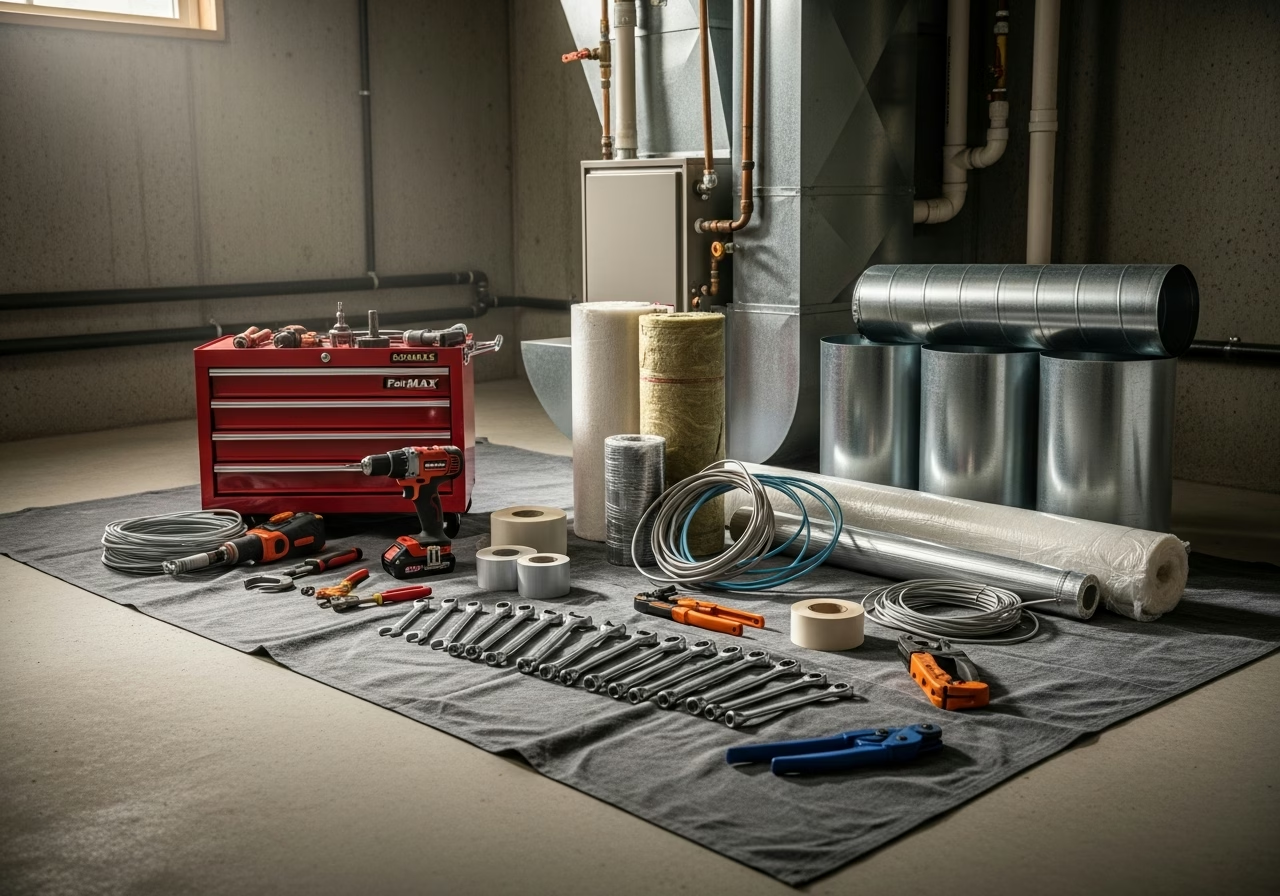
We need to be clear up front. RenoHouse is a renovation contractor, not a stand-alone HVAC dealer. On an HRV or ERV install, we coordinate HVAC-licensed installers who handle the equipment placement, refrigerant-free duct connections, balancing, and CSA F326 commissioning. Ductwork design on retrofits is partnered with TSSA-registered subcontractors and, where required, a Mechanical Ventilation Design Summary (MVDS) is signed off by a qualified designer. Our role is project coordination across the whole retrofit: scoping the building envelope, sequencing the HRV install with attic-insulation and air-sealing work, integrating the unit with the existing furnace or heat pump, managing the EnerGuide pre- and post-audit, and submitting the rebate paperwork. The mechanical balancing and the final permit sign-off are signed off by the certified specialists. That division of labour is how we keep both the technical work clean and the project timeline honest.
OBC 2024: What Actually Changed
Ontario Building Code 2024 took effect on January 1, 2024. The ventilation provisions tightened in three ways:
- New homes: A balanced mechanical ventilation system with heat or energy recovery is mandatory. Exhaust-only ventilation no longer satisfies the principal ventilation requirement.
- Retrofits and major renovations: Where post-renovation blower-door testing measures the envelope at 1.5 ACH50 or lower, mechanical ventilation that meets CSA F326 is required. Practically, any deep retrofit that includes attic spray foam, comprehensive air-sealing, or new triple-pane windows will hit that threshold.
- Mechanical Ventilation Design Summary (MVDS): Permit reviewers now expect a one-page MVDS that documents the principal ventilation rate (CFM per bedroom plus base), the exhaust ventilation rate, balanced supply, and the equipment selected.
The CSA F326 standard sets the design and commissioning rules: minimum airflow per occupant, maximum imbalance between supply and exhaust (typically within 10 percent), required filtration, and a balanced commissioning report.
For the OBC walkthrough, see OBC 2024 HRV Requirement Toronto Explained.
The Three Tiers of Toronto HRV/ERV Installs
Tier 1: Furnace-Tied HRV — $2,800–$4,500
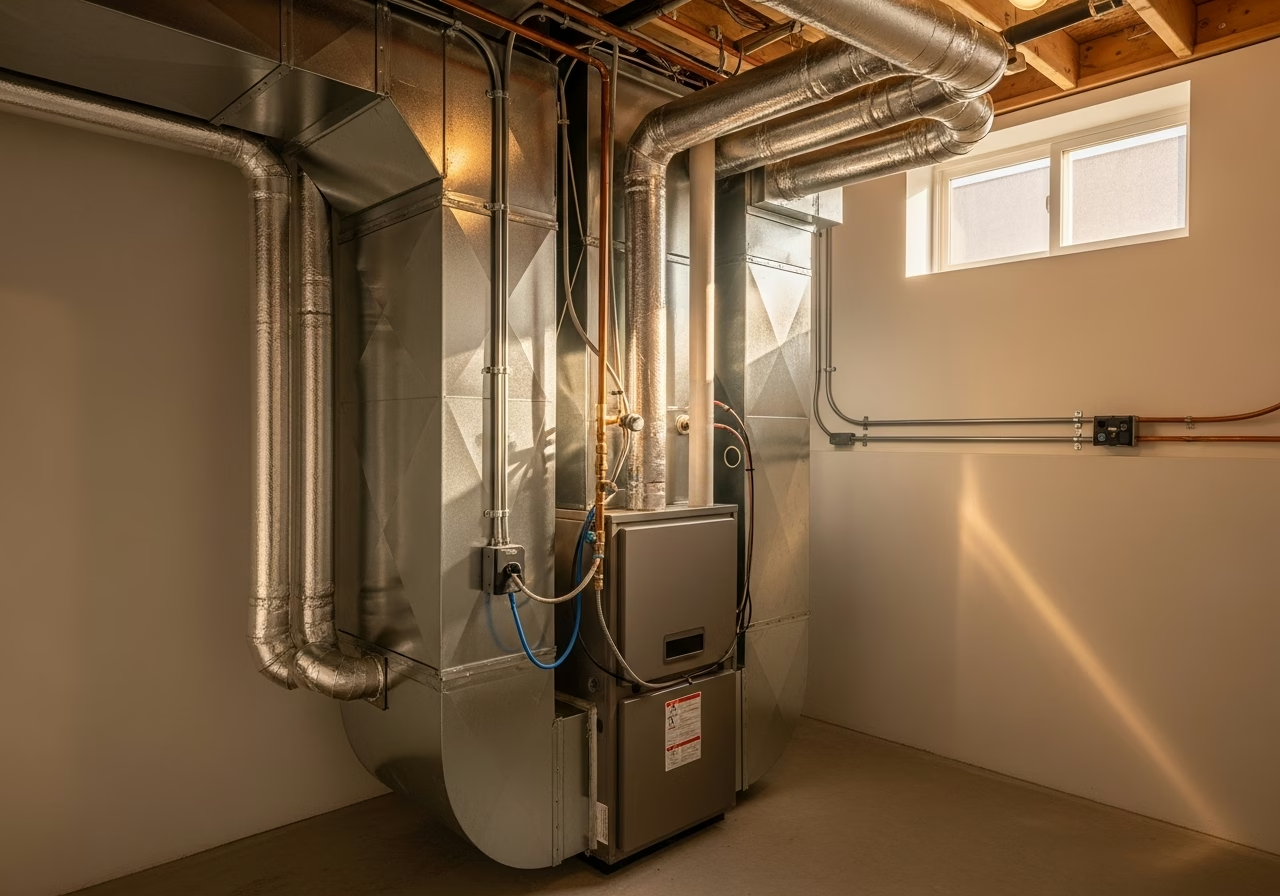
The entry tier and the most common Toronto retrofit. The HRV ties into the existing furnace return-air plenum on the supply side and a dedicated exhaust grille pulls stale air from the upstairs hallway or main bathrooms. The furnace blower distributes the fresh air through the existing ductwork.
What is included:
- One HRV core unit (typical 100-200 CFM nominal).
- Insulated 6-inch supply and exhaust ducts to exterior hood.
- Tie-in to existing furnace return plenum.
- Dehumidistat or wall control.
- Balanced commissioning per CSA F326.
- Permit and MVDS where required.
Best for: existing forced-air homes where the furnace blower is already running on continuous-low-speed or ECM mode.
Limitations: depends on furnace blower for distribution; cannot run independently when furnace is off (or imposes parasitic blower load if it does).
Tier 2: Fully Ducted HRV/ERV — $4,500–$7,500
The mid tier and the OBC 2024 reference design. The HRV has its own dedicated supply ducts to bedrooms and main living areas and dedicated exhaust ducts from bathrooms, kitchen (range hood remains separate), and laundry. Independent of the furnace.
What is included:
- HRV or ERV core unit (150-250 CFM).
- Dedicated supply ductwork (typically 5 or 6 inch insulated) to each bedroom plus main living area.
- Dedicated exhaust ducts from bathrooms, laundry.
- Two exterior hoods (intake and exhaust) with minimum 6-foot separation.
- Boost switches in bathrooms.
- ECM motors; balanced commissioning.
- MVDS and permit.
Best for: new builds, gut renovations, deep retrofits, and any home where the existing duct system is undersized for added supply.
Tier 3: Premium HEPA / Cold-Climate ERV — $6,500–$11,000+
The premium tier pairs a high-efficiency core (Lifebreath ATH series, Venmar AVS HEPA, Panasonic Intelli-Balance 200) with HEPA filtration, frost-free defrost cycles tested to -25 C, and smart controls integrated to a home automation hub.
Typical scope:
- Premium HRV/ERV with 80-85 percent sensible recovery, HEPA on supply.
- Smart controls (CO2, VOC, humidity sensing) with auto-boost.
- Zoned dampers in larger homes (3,000+ sqft).
- Dedicated condensate pump and trap.
- Integration with smart thermostat (ecobee, Honeywell T10).
Best for: allergy and asthma households, homes near major traffic corridors, premium new builds, deep-retrofit bundles funded by the Greener Homes Loan.
HRV vs ERV: The Toronto Decision
This is the single most asked question. The short version:
- HRV transfers heat only between the exhaust and supply air streams. It does not transfer moisture. In dry winters, the HRV exhausts indoor humidity along with stale air, which can over-dry the home.
- ERV transfers heat and moisture. In summer, it keeps outdoor humidity from blasting indoors. In winter, it preserves indoor humidity by not dumping it outside.
For Toronto specifically:
Need professional renovation?
Call RenoHouse at 289-212-2345 or get a free estimate today.
Get Free Estimate →- If the home runs above 35 percent RH through winter (well-occupied, lots of cooking, plants), an HRV is fine and slightly cheaper.
- If the home runs below 30 percent RH through January and February (dry, fewer occupants, electric heat), an ERV holds humidity better.
- For summer humidity control (Toronto often sits 60-90 percent outdoor RH June through August), an ERV is meaningfully better.
- Modern Toronto practice is increasingly ERV-default, especially in tight new builds and condos. About 60-70 percent of our 2026 retrofits spec ERV.
For the full decision tree, see HRV vs ERV Toronto: Which to Choose.
The 2026 Toronto Money Pipe: Stacking Programs
Canada Greener Homes Loan — Up to $40,000 Interest-Free, 10-Year Term
HRVs and ERVs qualify under the federal NRCan loan when bundled with at least one other eligible measure (insulation, windows, air-sealing, or a heat pump). Interest-free, 10-year amortization, no prepayment penalty.
Ontario HRS — Up to $1,500 for HRV/ERV
Enbridge Home Renovation Savings (HRS) pays up to $1,500 toward an HRV or ERV when paired with envelope measures and a pre- and post-retrofit EnerGuide audit. Stackable with the Greener Homes Loan.
Toronto HELP — Home Energy Loan Program
City of Toronto loan attached to the property tax bill. 2-3 percent interest, 5-20 year terms. HRV/ERV eligible as part of a broader retrofit. Repayment travels with the property.
Ontario HRS — Home Renovation Savings Program
Ontario provincial program launched January 2025. HRV/ERV included in eligible measures, capped at $10,000 across the bundle.
For the rebate walkthrough, see HRV Greener Homes Rebate Toronto.
Brands That Work in Toronto
- Panasonic Intelli-Balance 100 / 200 — proven cold-climate performance, ECM motors, very quiet, smart-home integration. Strong choice in tight condos and bedrooms-adjacent installs.
- Lifebreath RNC 10 / 200 ATH — Ontario-built, deep dealer network, the ATH variant adds an active humidity transfer core for dry winters.
- Venmar AVS HEPA series — premium HEPA filtration on supply, top-tier choice for allergy households.
- vanEE V100H / G2400 — Quebec-built, value tier with solid sensible recovery in the 70-78 percent range.
- Broan AI Series — smart controls with CO2 and humidity sensing, mid-tier price point.
- Aldes M3000 — European-style fully ducted system, strong in new-build townhomes and custom builds.
For the full head-to-head, see Panasonic vs Lifebreath vs Venmar HRV: Toronto Comparison.
Sizing for Toronto: CSA F326 Math
The principal ventilation rate under CSA F326 follows a simple formula: 5 L/s (about 10 CFM) per primary bedroom plus 5 L/s for each additional bedroom plus 5 L/s for each additional habitable room, with adjustments for floor area. A typical Toronto 1,800 sqft three-bedroom semi lands at:
- 3 bedrooms: 15 L/s base.
- Plus living, dining, basement rec: another 15 L/s.
- Total principal: roughly 30 L/s or 60 CFM continuous.
A 100-150 CFM HRV is appropriate, with boost capacity to 200 CFM for cooking and shower events. Always size off the actual MVDS, not a guess.
Ductwork Realities
The biggest install pitfall is undersized exhaust runs. A 4-inch flex line cannot carry 60 CFM at the required static pressure, yet that is what we frequently see in older Toronto homes where contractors tried to squeeze the HRV in without upsizing.
Common issues:
- 4-inch flex where 5 or 6 inch is needed.
- Sharp 90-degree elbows on flexible duct (each one adds 15-25 feet equivalent length).
- Exterior hoods less than 6 feet apart (intake re-entrains exhaust).
- Intake located near gas furnace or fireplace flue.
- Dryer exhaust within 10 feet of fresh-air intake.
For ductwork best practice, see HRV Ductwork Design Toronto Renovation.
Toronto Climate Considerations
Toronto winters touch -25 C and summers run 60-90 percent humidity. Two consequences:
- Frost defrost cycles matter. Cheap HRVs cycle aggressively below -10 C, dropping ventilation rates. Premium units (Panasonic Intelli-Balance, Lifebreath ATH) hold steady ventilation to -25 C with electric pre-heat or recirculation defrost.
- Summer humidity matters. ERVs keep outdoor moisture from dumping into a tight home in July. HRVs do not.
For frost and condensation management, see HRV Condensation Prevention Toronto Winter.
Condos and Townhomes: A Different Path
Many Toronto condos (King West, Liberty Village, CityPlace) ship with bathroom exhaust ducts and a make-up air corridor pressurization system but no balanced HRV/ERV in unit. Retrofits are constrained:
- Outdoor hood placement requires condo-board approval.
- Some buildings forbid through-wall penetrations.
- Compact units (Panasonic Intelli-Balance 100, Renewaire EV90) fit in a closet or above the laundry.
For condo specifics, see HRV Condo Installation Toronto.
Maintenance: The Forgotten Cost of Ownership
A poorly maintained HRV stops working. Filter dust loads back-pressure the fan. Cores grow biofilm. Drains clog.
Annual maintenance:
- Filter replacement every 3-6 months (washable on some units).
- Core washing once a year (typically removable, gentle soap rinse).
- Drain trap inspection seasonally.
- Exterior hood screen cleaning twice yearly.
Total annual cost: $40-$120 in filters plus 30 minutes of homeowner time, or $180-$280 for a service visit.
For the schedule, see HRV Maintenance and Filter Cleaning Toronto.
Common Mistakes to Avoid
- 1. Buying an HRV when an ERV is the right choice for the home.
- 2. Tying into the furnace return without verifying the furnace is on continuous fan.
- 3. 4-inch ductwork on a 100+ CFM unit.
- 4. Intake hood within 6 feet of exhaust hood.
- 5. Skipping the balancing report (CSA F326 commissioning).
- 6. Ignoring outdoor air quality near major traffic corridors.
- 7. No dedicated boost switch in bathrooms.
- 8. Forgetting condensate trap and drain.
- 9. Cheaping out on the unit (sub-65 percent recovery).
- 10. Skipping the MVDS and getting flagged at permit review.
- 11. Installing in unconditioned space without freeze protection.
For the full breakdown, see HRV Installation Mistakes Toronto.
Pairing With Other Energy Work
The deep-retrofit bundle pairs the HRV with envelope and HVAC work in this sequence:
- 1. Pre-retrofit EnerGuide audit (week 0).
- 2. Air-sealing and attic insulation (weeks 1-2). Tightens the envelope.
- 3. Blower-door test (week 2). Confirms whether the 1.5 ACH50 threshold is reached.
- 4. HRV/ERV install (week 3, HVAC-licensed sub).
- 5. Heat pump or furnace tie-in (week 3-4, parallel).
- 6. Post-retrofit EnerGuide audit + rebate filing (week 5).
Pair the work with a thermal audit before and after — see our HVAC Thermal Audit (FLIR) service to verify the system is balanced and there are no duct leaks showing on infrared imaging.
When an HRV Is Not the Right Call
HRVs are not universal. Cases where the math does not work in Toronto 2026:
- Pre-1920 home with no air-sealing, blower-door over 5 ACH50, and no plan to tighten. The home already over-ventilates.
- Single-room cottage or seasonal dwelling. Spot exhaust is enough.
- Hydronic-heated home with no return-air ducting and no plan to add it. A fully ducted HRV is the only path and adds $7K+ to the project.
For the cost math, see HRV Installation Cost Toronto Comparison.
Final Word
OBC 2024 made HRVs mandatory in new builds and in retrofits that tighten the envelope. The federal Greener Homes Loan funds the install at 0 percent interest. Ontario HRS knocks $1,500 off the net cost. Indoor air quality, comfort, and code compliance all line up on the same page. The right unit, the right CFM, and the right ductwork design are what separate a good retrofit from a noisy, unbalanced, condensation-prone install. RenoHouse coordinates the whole stack.
Book at /services/hvac-energy/hrv-erv-installation. For deeper reads, see HRV vs ERV Toronto: Which to Choose, OBC 2024 HRV Requirement Toronto Explained, HRV Installation Mistakes Toronto, and HRV Greener Homes Rebate Toronto. For envelope verification before install, see HVAC Thermal Audit (FLIR).
Related Guides in This Series
Continue reading our complete coverage of this niche:
- Signs You Need an HRV in Toronto: 11 Indoor Air Quality Red Flags
- HRV Energy Recovery Efficiency Explained: SRE, ASE, and What Toronto Homeowners Should Know
- HRV vs Bath Fan vs Range Hood Toronto: Why You Need All Three
Sources & References
Authoritative sources cited in this guide:
- NRCan — Heating and Cooling — NRCan heating/cooling guidance
- Canada Greener Homes Loan — Federal energy retrofit financing
- CSA F326 (Mechanical Ventilation) — Residential HRV/ERV standard
- Enbridge Home Renovation Savings (HRS) program — Provincial heat pump rebate
- TSSA Fuel Safety — Ontario fuel/gas regulator
Continue Reading