RenoHouse

# HRV Installation Mistakes Toronto: 12 Pitfalls That Kill Performance
Quick answer. A correctly installed HRV disappears. The home just feels right. A poorly installed HRV announces itself: humming, condensation streaks down windows, frost on the exhaust hood, bedrooms that still feel stuffy by morning. This guide is the punch list of the twelve most common Toronto install pitfalls and how to avoid them.A correctly installed HRV disappears. The home just feels right. A poorly installed HRV announces itself: humming, condensation streaks down windows, frost on the exhaust hood, bedrooms that still feel stuffy by morning. This guide is the punch list of the twelve most common Toronto install pitfalls and how to avoid them. For the pillar guide, see HRV & ERV Installation Toronto: The Complete 2026 Guide.
1. Undersized Ductwork
The single most common Toronto install failure. A 100+ CFM unit hooked up to 4-inch flex line. The fan over-works, the home does not get its design CFM, and the unit hums at every speed.
Fix: 5-inch flex carries 60-80 CFM at acceptable static pressure; 6-inch carries 100-130 CFM. Trunk sizing follows the unit's nameplate. For ductwork detail, see HRV Ductwork Design Toronto Renovation.
2. Intake and Exhaust Hoods Too Close
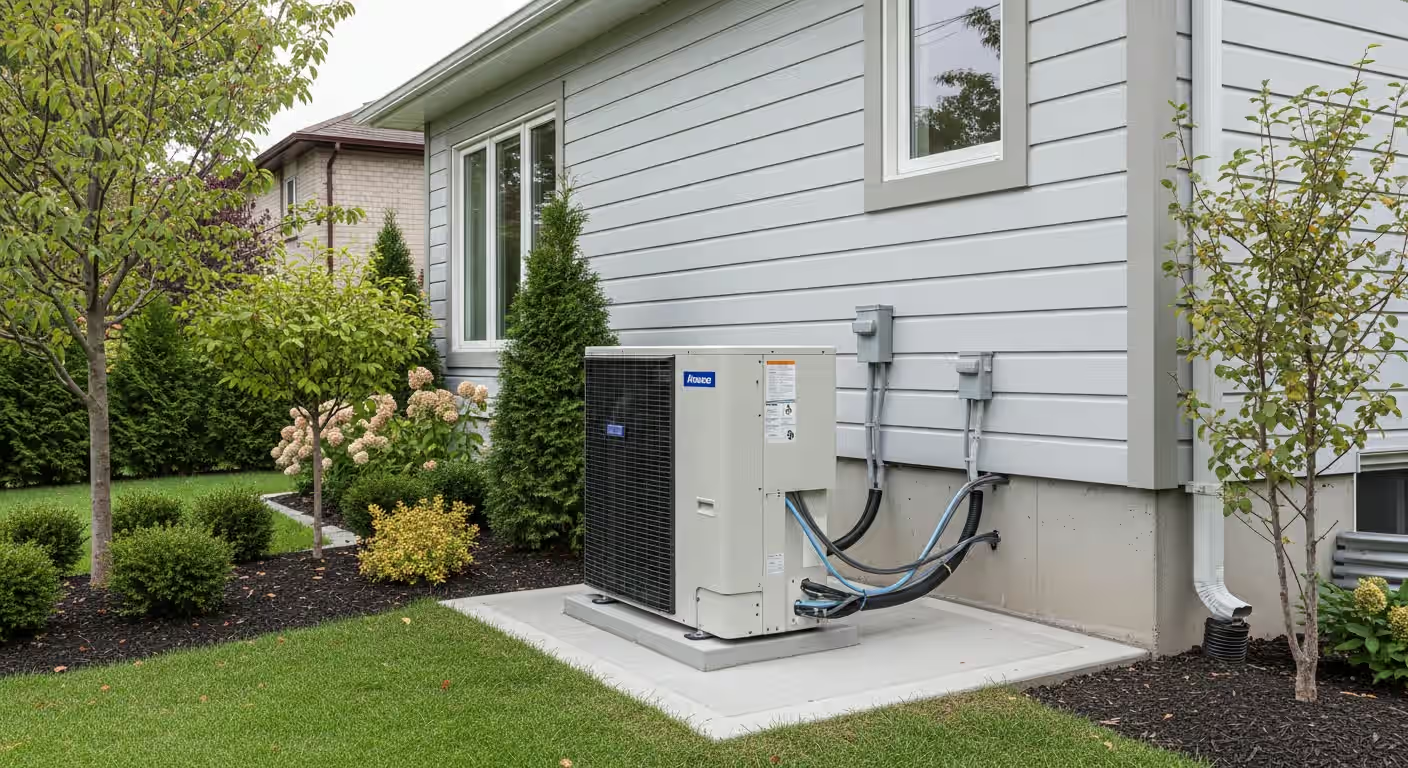
Code requires 6 feet minimum separation. We see installs where both hoods are on the same wall, 3-4 feet apart, because that was the easiest path through the rim joist.
Consequence: re-entrainment. The unit pulls just-exhausted humid stale air back into the supply stream. Indoor air quality degrades. In winter, the intake louvers ice up first.
Fix: 8-10 feet of separation, ideally on different elevations. North-side intake, south or west-side exhaust.
3. Range Hood Routed Through HRV
Some installers try to consolidate kitchen exhaust into the HRV path. The HRV core is not designed for grease.
Consequence: the heat exchanger fouls in months. Recovery efficiency drops. The unit becomes a fire risk.
Fix: range hood exhausts directly to exterior on its own duct. The HRV picks up background kitchen air at 30-50 CFM continuous. For trade-offs, see HRV vs Bath Fan vs Range Hood Toronto.
4. No MVDS Submitted with Permit
OBC 2024 requires a Mechanical Ventilation Design Summary. Permits without one are held until the MVDS is filed.
Consequence: 2-4 week permit delays at minimum.
Fix: prepare MVDS with the HVAC installer (or partnered TSSA-registered designer) before permit submission. For OBC details, see OBC 2024 HRV Requirement Toronto Explained.
5. CSA F326 Commissioning Skipped
A balanced HRV install requires a final commissioning report: measured supply CFM, measured exhaust CFM, imbalance under 10 percent, static pressure under 0.5 in. wc, sound levels.
Consequence: unbalanced systems pressurize or depressurize the home. Negative pressure pulls outdoor air through every leak (including back-drafting gas appliances). Positive pressure forces moisture into wall cavities.
Fix: insist on a written commissioning report at handover. Reputable installers do this as standard.
6. Mounted in Unconditioned Attic Without Freeze Protection
A unit installed in an uninsulated attic in Toronto will see -25 C ambient. The drain pan freezes; the core ices; the unit fails.
Need professional renovation?
Call RenoHouse at 289-212-2345 or get a free estimate today.
Get Free Estimate →Consequence: dead unit by mid-January.
Fix: install in conditioned space (basement, mechanical room) or, if attic must be used, encapsulate in an insulated enclosure with freeze protection on the drain.
7. No Boost Switch in Bathrooms
Continuous low-CFM ventilation is fine for background load; a shower needs 80-150 CFM spike for 20-30 minutes.
Consequence: bathroom humidity does not clear. Mildew on grout and ceilings. Window condensation in adjacent rooms.
Fix: timer switch in each bathroom that triggers HRV boost; or humidity-sensing auto-boost. $80-$400 per zone.
8. Continuous Fan Mode Not Enabled on Furnace (Furnace-Tied Installs)
A furnace-tied HRV depends on the furnace blower running continuously to distribute fresh air. If the furnace is set to "auto" mode (fan only during heat or cool calls), the HRV supplies air into a static plenum.
Consequence: fresh air sits in the trunk; bedrooms get nothing.
Fix: configure the furnace for continuous-fan low-speed (most ECM blowers support this). Verify at install.
9. Drain Line Without P-Trap
The HRV drain port connects to the home drainage. Without a P-trap, sewer gas can backflow.
Consequence: stale or sewer-like smell from the supply registers.
Fix: standard P-trap on the drain line, primed with water. Inspect annually.
10. Insufficient Supply to Bedrooms
A common shortcut: tie one supply register to the upstairs hallway and call it a day. Bedrooms with closed doors at night get nothing.
Consequence: CO2 climbs to 1,500+ ppm overnight. Stuffy mornings. Headaches.
Fix: dedicated supply registers in each bedroom. Door undercuts (3/4 inch minimum) so air can return.
11. ERV Specified When HRV Was Right (Or Vice Versa)
The biggest equipment-selection mistake. ERV in a leaky high-occupancy home over-conserves moisture and triggers mold. HRV in a tight low-occupancy home over-dries and triggers static and dry skin.
Fix: use the decision tree. For most Toronto retrofits in 2026, ERV is the default. For older leaky homes with high occupancy, HRV. See HRV vs ERV Toronto: Which to Choose.
12. No Pre/Post Blower-Door Test on a Deep Retrofit
The Ontario HRS rebate (up to $1,500 on HRV) requires pre- and post-retrofit EnerGuide audits including blower-door testing. Skip the audit and lose the rebate.
Consequence: $1,500 of left-on-the-table rebate plus inability to verify the OBC 2024 trigger threshold (1.5 ACH50).
Fix: schedule the pre-audit before any envelope work, the post-audit after all measures are complete. RenoHouse coordinates with EnerGuide-certified energy advisors.
For the rebate walkthrough, see HRV Greener Homes Rebate Toronto.
Honourable Mentions
A few additional pitfalls that come up regularly:
- Filter spec too low. MERV 8 minimum on supply; MERV 13 recommended for allergy households.
- Wrong unit size. 200 CFM unit on a 1,000 sqft condo (oversized) or 100 CFM unit on a 3,000 sqft detached (undersized).
- Soft-mounted HRV transmitting vibration. Use vibration-isolation hangers.
- Insufficient slack on flex duct connections. No service loop; replacement is harder.
- Outdoor hood without bird and rodent screen. Animals nest in the duct.
- No condensate pump where there is no gravity drain. Water on the floor at first thaw.
How to Audit a Quote Against These Pitfalls
Ask the installer:
- 1. What size flex on the supply trunk and the branches?
- 2. Where will the intake and exhaust hoods sit on the exterior, and how far apart?
- 3. Is there an MVDS on this scope?
- 4. Will there be a CSA F326 balancing report at commissioning?
- 5. Is the existing furnace blower set to continuous-fan low-speed?
- 6. Where will the drain go, and is there a P-trap?
- 7. Are there boost switches or humidity sensors in each bathroom?
- 8. Are the supply registers in each bedroom or only in the hallway?
- 9. Is this an HRV or ERV, and why is that the right choice for my home?
- 10. Is the pre/post EnerGuide audit included for the HRS rebate?
A quote that addresses 8 of these 10 explicitly is from an installer who has done this before. A quote that hand-waves through them is the one that will become a winter call-back.
Final Word
The pitfalls are not subtle. Most are caught in a 30-minute design review with the installer. A complete MVDS plus CSA F326 commissioning eliminates 80 percent of them. The remaining 20 percent come from craft on install day. RenoHouse coordinates HVAC-licensed installers and TSSA-registered design subs to get the design and the field work both right.
Book at /services/hvac-energy/hrv-erv-installation. For deeper reads, see HRV & ERV Installation Toronto: The Complete 2026 Guide, HRV Ductwork Design Toronto Renovation, OBC 2024 HRV Requirement Toronto Explained. Related: HVAC Thermal Audit (FLIR).
Sources & References
Authoritative sources cited in this guide:
- NRCan — Heating and Cooling — NRCan heating/cooling guidance
- Canada Greener Homes Loan — Federal energy retrofit financing
- CSA F326 (Mechanical Ventilation) — Residential HRV/ERV standard
- Enbridge Home Renovation Savings (HRS) program — Provincial heat pump rebate
- TSSA Fuel Safety — Ontario fuel/gas regulator
Continue Reading