RenoHouse

# Panasonic vs Lifebreath vs Venmar HRV: Toronto Comparison 2026
Quick answer. If you are quoting an HRV or ERV install in Toronto in 2026, three brands account for roughly 70 percent of the market: Panasonic, Lifebreath, and Venmar. Each takes a different design philosophy. This guide breaks the head-to-head down across price, recovery efficiency, cold-climate behaviour, controls, and dealer support so you can read...If you are quoting an HRV or ERV install in Toronto in 2026, three brands account for roughly 70 percent of the market: Panasonic, Lifebreath, and Venmar. Each takes a different design philosophy. This guide breaks the head-to-head down across price, recovery efficiency, cold-climate behaviour, controls, and dealer support so you can read a quote with the right context. For the pillar guide, see HRV & ERV Installation Toronto: The Complete 2026 Guide.
The Three Brands at a Glance
| Brand | Country of Build | Strength | Typical Toronto Price (Tier 2 Install) |
|---|---|---|---|
| Panasonic Intelli-Balance | Japan / North America | Quietest, smartest controls, ECM | $5,200-$7,400 |
| Lifebreath | Ontario, Canada | Local dealer network, robust build, ATH humidity transfer | $4,500-$6,800 |
| Venmar AVS | Quebec, Canada | HEPA option on supply, premium IAQ | $5,800-$8,200 |
Panasonic Intelli-Balance 100 / 200
Panasonic ships two main models in the Toronto market:
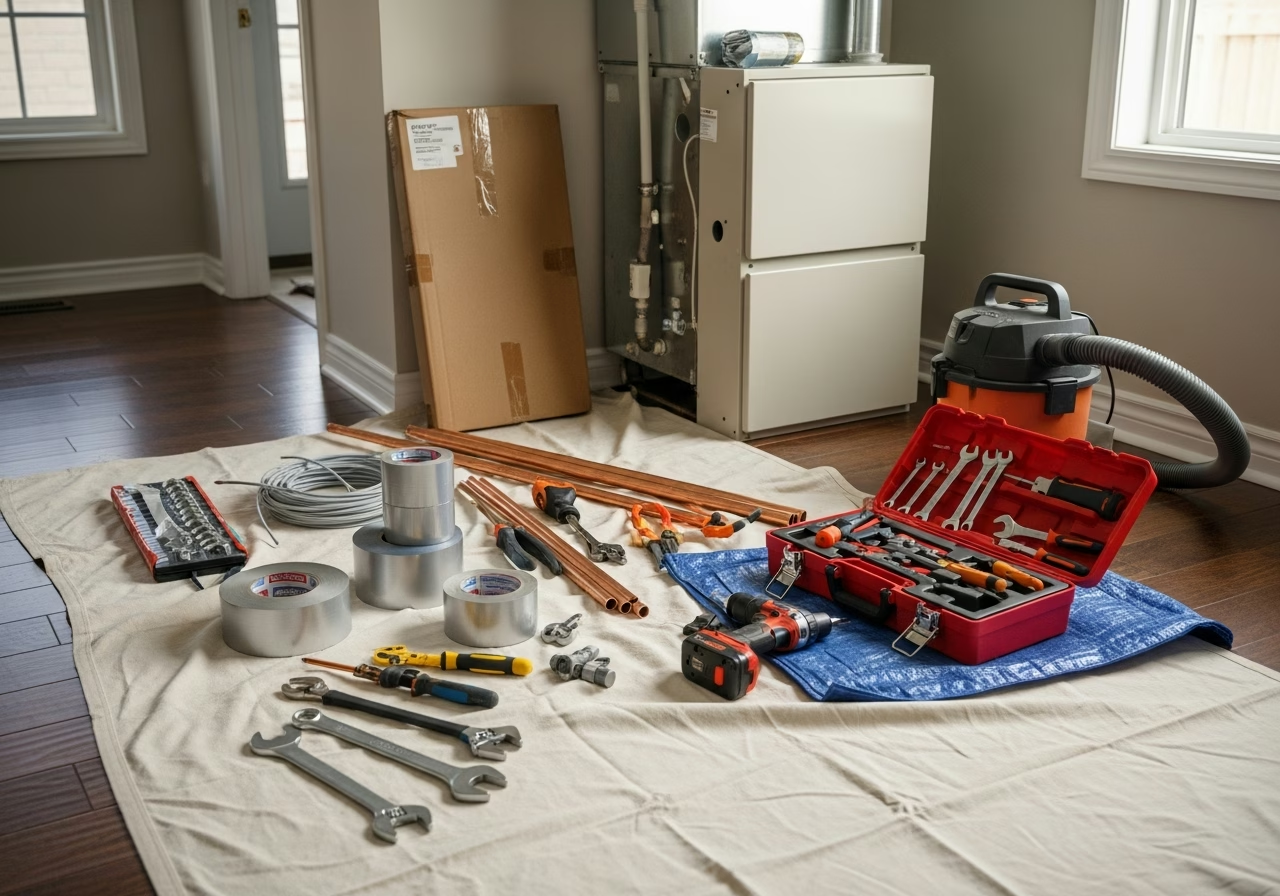
- Intelli-Balance 100 — 100 CFM nominal, ECM motors, very quiet (0.4-0.6 sones at low speed), wall-mount or duct-mount. Excellent for condos and townhomes.
- Intelli-Balance 200 — 200 CFM nominal, more capacity for larger detached homes.
Strengths:
- Quietest in class. Many condo retrofits land here purely for the noise floor.
- Modulating ECM motors. Continuous low-CFM ventilation with on-demand boost.
- Robust cold-climate defrost. Frost defrost cycle holds steady ventilation to -25 C.
- Strong smart-home integration. CO2 and humidity sensor add-ons feed auto-boost logic.
- 90 percent sensible recovery efficiency on the ERV variant in published HVI ratings.
Weaknesses:
- Higher equipment cost. $200-$500 more than equivalent Lifebreath at the unit level.
- Smaller GTA dealer network than Lifebreath. Some installers do not stock or service.
Best fit: condos, townhomes, premium new builds, allergy households. The Intelli-Balance 100 is our default pick for Toronto condo retrofits.
Lifebreath RNC 10 / 200 ATH
Ontario-built, Lifebreath is the most commonly installed brand in the GTA market. Two key models:
- Lifebreath RNC 10 — 130-160 CFM nominal HRV, basic but reliable, the volume tier.
- Lifebreath 200 ATH — Active humidity transfer ERV, 200 CFM nominal, the Lifebreath answer to dry winters.
Strengths:
- Strongest dealer and parts network in Ontario. Service is fast.
- Built in London, Ontario. Shorter parts lead time.
- ATH variant offers strong winter humidity retention.
- Simple controls. Fewer failure points.
- Mid-tier price point. Best value-per-CFM in the comparison.
- Up to 84 percent sensible recovery on the 200 ATH.
Weaknesses:
- Noisier than Panasonic at equivalent CFM (typically 0.7-1.0 sones at low speed).
- Smart-home integration weaker. No native Apple Home or Google Home support; relies on third-party module.
- Aesthetics dated. The unit is fine in a mechanical room but obvious if exposed.
Best fit: detached and semi-detached homes, gut renovations, value-conscious deep retrofits.
Need professional renovation?
Call RenoHouse at 289-212-2345 or get a free estimate today.
Get Free Estimate →Venmar AVS Series
Quebec-built, Venmar takes a premium-IAQ approach. Two key models:
- Venmar AVS HRV — 130-220 CFM nominal, sensible-only recovery, basic version.
- Venmar AVS HEPA — adds HEPA filtration on the supply side, premium tier.
Strengths:
- HEPA on supply is the cleanest air available in a residential ventilator.
- Strong build quality. Stainless heat exchanger on premium tier.
- Constructo airflow design reduces duct losses.
- Solid cold-climate frost defrost.
- 75-83 percent sensible recovery depending on model.
Weaknesses:
- Highest price tier of the three.
- HEPA replacement cartridges are $90-$140 each, replaced every 1-2 years.
- Smart controls available but less polished than Panasonic.
- Larger physical footprint than Panasonic at equivalent CFM.
Best fit: allergy and asthma households, homes near major traffic corridors, premium new builds where IAQ is the headline feature.
Recovery Efficiency: What the Numbers Mean
Sensible Recovery Efficiency (SRE) measures the percentage of heat retained between the exhaust and supply streams. HVI publishes ratings for all three brands. Higher is better, but with diminishing returns.
| Model | Sensible Recovery | Latent Recovery (ERV) |
|---|---|---|
| Panasonic Intelli-Balance 100 ERV | 90 percent | 60 percent |
| Lifebreath RNC 10 HRV | 78 percent | n/a |
| Lifebreath 200 ATH | 84 percent | 55 percent |
| Venmar AVS HRV | 80 percent | n/a |
| Venmar AVS HEPA ERV | 78 percent | 50 percent |
The 10-12 percentage-point spread between top and bottom translates to about $20-$45 per year in heating energy on a typical Toronto winter — small in absolute terms but a tiebreaker on otherwise close quotes.
For the technical math, see HRV Energy Recovery Efficiency Explained.
Cold-Climate Behaviour
Toronto winters touch -25 C. Two defrost strategies separate good HRVs from cheap ones:
- Recirculation defrost. Air re-routes inside the unit; ventilation to the home pauses. Used on lower-tier units.
- Pre-heat defrost. A small electric pre-heater warms incoming air to prevent frost. Ventilation continues uninterrupted.
Panasonic Intelli-Balance uses electric pre-heat plus modulation. Lifebreath 200 ATH uses recirculation defrost; lower-tier RNC 10 also uses recirculation. Venmar AVS HEPA uses recirculation with timed cycles.
In a typical Toronto winter, recirculation defrost cycles every 30-60 minutes when below -10 C. Ventilation to the home is paused for 4-6 minutes per cycle, dropping average ventilation rate by 10-15 percent. For most homes this is acceptable; for tight new builds with high occupancy, the Panasonic pre-heat advantage matters.
For frost management, see HRV Condensation Prevention Toronto Winter.
Controls and Smart-Home Integration
| Brand | Wall Control | App | CO2 Sensor | Auto-Boost | Smart-Home |
|---|---|---|---|---|---|
| Panasonic | Standard | Native iOS/Android | Optional add-on | Yes | Apple Home, Google Home |
| Lifebreath | Standard | Third-party module | Optional add-on | Limited | Limited |
| Venmar | Standard, premium options | Native | Optional add-on | Yes | Limited |

Panasonic is the best-integrated. Lifebreath catches up if integration through ecobee or Google Nest is acceptable.
Dealer and Service Network in GTA
- Lifebreath: dozens of authorized dealers across the GTA. Parts and service typically available within 24-48 hours.
- Panasonic: smaller network of HVAC dealers, some refrigeration and ventilation specialists. Parts via factory channel; 3-5 days typical.
- Venmar: wide network through Reliance, Enercare, and independent specialists. Parts through Quebec channel.
For a retrofit where the install team is already in place, all three are serviceable. For a stand-alone install, Lifebreath has the strongest after-sale ecosystem in the GTA.
Toronto Real-World Picks by Home Type
- King West / Liberty Village condo (1-2 bedroom, 700-1,000 sqft): Panasonic Intelli-Balance 100 ERV.
- Riverdale semi (3 bedroom, 1,500-1,800 sqft) tied to existing furnace: Lifebreath RNC 10 HRV or 200 ATH ERV.
- North York detached (4 bedroom, 2,500+ sqft) deep retrofit: Lifebreath 200 ATH ERV or Panasonic Intelli-Balance 200 ERV.
- Forest Hill custom new build (3,500+ sqft): Venmar AVS HEPA ERV or Panasonic Intelli-Balance 200 ERV with HEPA add-on.
- Etobicoke bungalow (2 bedroom, 1,100 sqft) furnace-tied: Lifebreath RNC 10 HRV.
Other Brands Worth Knowing
- vanEE V100H / G2400 — Quebec-built (same parent as Venmar), value tier with 70-78 percent SRE. Solid budget choice.
- Broan AI Series — smart sensing built in, mid-tier.
- Aldes M3000 — European design, fully ducted, niche but excellent in custom builds.
Final Word
For most Toronto retrofits, Lifebreath is the value pick and Panasonic is the premium pick. Venmar wins on HEPA filtration where IAQ is the primary driver. RenoHouse coordinates the unit selection with HVAC-licensed installers based on home type, occupancy, and rebate strategy.
Book at /services/hvac-energy/hrv-erv-installation. For deeper reads, see HRV & ERV Installation Toronto: The Complete 2026 Guide, HRV vs ERV Toronto: Which to Choose, HRV Energy Recovery Efficiency Explained. Related: HVAC Thermal Audit (FLIR).
Sources & References
Authoritative sources cited in this guide:
- NRCan — Heating and Cooling — NRCan heating/cooling guidance
- Canada Greener Homes Loan — Federal energy retrofit financing
- CSA F326 (Mechanical Ventilation) — Residential HRV/ERV standard
- Enbridge Home Renovation Savings (HRS) program — Provincial heat pump rebate
- TSSA Fuel Safety — Ontario fuel/gas regulator
Continue Reading