RenoHouse

# Powerwall in a Toronto Condo: Is It Even Possible?
Quick answer. The short answer: usually no, but there are exceptions. Most Toronto high-rise condos cannot host a Powerwall because of fire code, electrical service routing, condo-corp restrictions, and lack of suitable mounting space. Some stacked townhouses and ground-floor units can.The short answer: usually no, but there are exceptions. Most Toronto high-rise condos cannot host a Powerwall because of fire code, electrical service routing, condo-corp restrictions, and lack of suitable mounting space. Some stacked townhouses and ground-floor units can. This guide covers the realistic feasibility framework, the cases that work, and how to navigate the condo-corp approval process if your unit qualifies.
For the broader battery context, see Home Battery & Powerwall Toronto Complete Guide. For modular battery options that fit tighter spaces, see the Enphase section in Tesla vs FranklinWH vs Enphase.
Why Most Toronto Condos Cannot Host a Battery
1. Electrical Service RoutingIn a typical Toronto high-rise, your unit is fed from a building riser through a meter in a service room. Adding a battery means tapping the riser between the meter and your unit panel — physically and legally complicated, and almost always blocked by the condo corporation.
2. Fire Code (Ontario Building Code, Toronto Fire Services interpretation)A lithium-ion battery in a multi-unit residential building triggers additional fire-rating requirements. Most condo mechanical rooms and storage lockers are not rated for energy storage system installation. Toronto Fire Services would need to review and approve a specialized installation — typically declined for individual units in shared buildings.
3. Condo Corporation RestrictionsMost condo declarations explicitly prohibit modifications to electrical systems beyond the unit panel. Adding a battery upstream of (or even at) the unit panel typically requires condo-board approval, which is rarely granted.
4. Physical SpaceA Powerwall 3 weighs 130 kg and needs 900 mm front clearance. Most condo storage lockers and utility closets are too small. Wall-mounting on common-element walls is prohibited.
5. Insurance RequirementsThe condo corporation's master insurance policy may explicitly exclude lithium-ion battery installations in individual units. Even with personal homeowner policy in place, the master policy controls the building.
Cases That Actually Work in Toronto
1. Stacked Townhouse (Bayview Village, Yonge-Eglinton, Liberty Village)
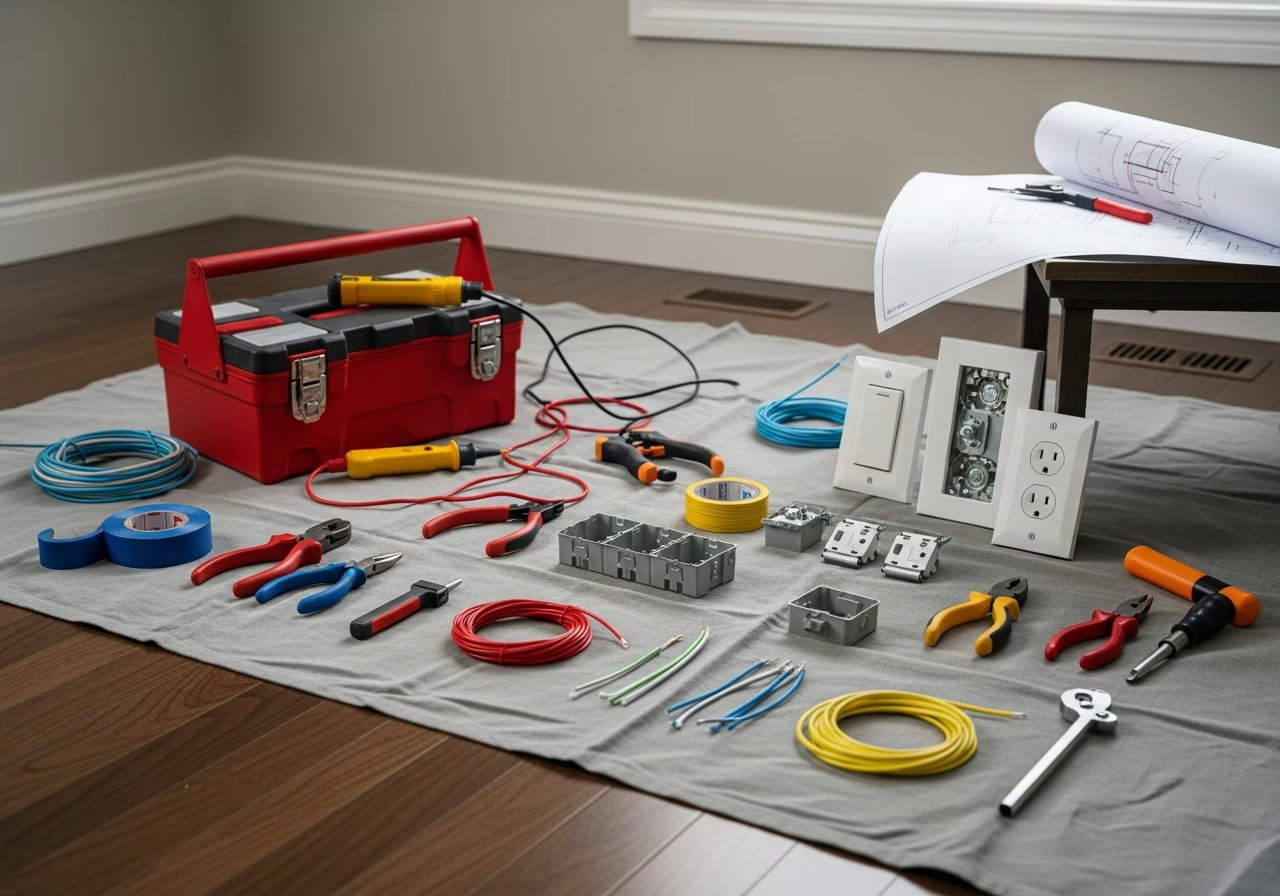
A stacked townhouse with its own front-door electrical service, a private mechanical room or basement utility area, and no shared common-element walls at the install location can sometimes work. Key indicators:
- Your hydro meter is dedicated to your unit (not in a shared meter room)
- Your unit has a basement, mechanical room, or attached private storage
- The condo declaration treats your unit as functionally separate (some stacked townhouses are technically condos but operate like freehold)
- Your insurance and the condo's policies allow battery installation with documentation
We have completed three stacked townhouse Powerwall installs in Toronto. Each took 4-6 months of condo-board approval before electrical work started. Worth it for the right customer.
2. Ground-Floor Condo with Private Mechanical Room
Rare. Some older Toronto condos (1980s-1990s) included private mechanical rooms with individual unit furnaces or electrical service entrances. If your unit has this, plus the condo corp approves, an Enphase IQ Battery 5P system (modular, smaller form factor) can fit.
3. Penthouse with Roof Access
Theoretical — we have not done one. Some Toronto penthouses have private rooftop access where a battery and solar could potentially be installed. The structural review, fire code, and condo-corp coordination would be a 12+ month project.
Need professional renovation?
Call RenoHouse at 289-212-2345 or get a free estimate today.
Get Free Estimate →4. Boutique Low-Rise Condos (4-6 Units)
Buildings with 4-6 individually serviced units sometimes operate more like a multi-unit residential than a high-rise. If each unit has dedicated electrical service and mechanical space, batteries become more feasible — though still subject to fire code and condo-board review.
What Definitively Does Not Work
- High-rise apartments (32+ floors with shared service rooms): no
- Loft conversions with shared electrical infrastructure: no
- Most mid-rise condos (6-30 floors): no
- Townhouses with shared firewalls and common-element electrical: no
- Any unit where you cannot point to a dedicated meter and dedicated mechanical space: no
If we cannot install legally and safely, we will tell you in the first phone call.
The Condo Corp Approval Process
Assuming you have a feasible unit, the approval process looks like this:
Step 1: Engage the Property Manager (Month 1)Send a written request describing the proposed installation, including manufacturer specs, ESA compliance details, fire code review, and your insurance coverage. Property manager forwards to the condo board.
Step 2: Condo Board Review (Month 1-3)The board may consult their lawyer, engineer, and master insurer. Some boards reject outright; others request a peer-reviewed engineer's letter (typical cost $1,500-$3,500). We have engaged peer reviewers on previous projects.
Step 3: Toronto Fire Services Review (Month 2-4)For lithium-ion installations in multi-unit buildings, Toronto Fire Services may require a Fire Code Compliance Letter from a licensed engineer. This adds ~$2,000-$4,000 to the project.
Step 4: ESA Permit and Master Electrician (Month 4-5)Once condo-board approval is in writing, we file the ESA Notification of Work under the Master Electrician's licence. CEC Section 64-200 applies as in any battery install. See Home Battery Permit & ESA Toronto.
Step 5: Installation (Month 5-6)Standard battery install, with extra documentation for the condo manager and fire services file.
Step 6: Insurance Update (Month 6)Update your condo unit owner policy and provide closed permits and certifications to the condo's master insurer.
Total timeline: 4-6 months for a successful project. Plan accordingly.
Cost Premium for Condo Installs
Compared to a typical detached home install ($15,500 for Powerwall 3), condo installs typically run:
| Adder | Cost |
|---|---|
| Engineering peer review | $1,500-$3,500 |
| Fire Code Compliance Letter | $2,000-$4,000 |
| Condo legal review (if required by board) | $500-$2,000 |
| Extra labour for restricted-access install | $500-$1,500 |
| Total premium | $4,500-$11,000 |
Realistic delivered cost for a condo-feasible Powerwall 3: $20,000-$26,000. The Greener Homes Loan still applies if your unit is owner-occupied.
Modular Battery as the Condo Specialist
When space is the limiting factor, the Enphase IQ Battery 5P is the most condo-friendly option:
- Each unit is 5 kWh / 3.84 kW, smaller form factor than Powerwall 3
- Stacks vertically or horizontally to fit available space
- Lower per-unit weight (~30 kg) — easier in tight access
- Modular installation lets you start with one and grow
For a condo with limited but real available space, 2-3 IQ Battery 5P units can often fit where a Powerwall 3 cannot.
Alternatives if a Battery Isn't Feasible
If your condo doesn't qualify, your resilience options are:
- Portable battery generator (EcoFlow Delta Pro, Bluetti AC500, etc.) — 3-7 kWh, plug-in, no permit needed in your unit
- UPS for critical electronics (modem, computer, medical equipment)
- Building-level backup generator (some Toronto condos have these for elevators and life safety; doesn't cover individual units)
These don't approach the capability of a Powerwall, but they cover the basics.
Future Outlook
Toronto Fire Services and the Ontario Building Code are evolving on energy storage in multi-unit buildings. By 2027-2028 we expect clearer pathways for condo battery installations, particularly in newer buildings designed with energy storage compatibility. Toronto is behind cities like Vancouver and San Diego where condo-friendly battery rules already exist.
If you live in a high-rise condo and want resilience now, the realistic answer is portable battery + UPS for critical loads. If you live in a stacked townhouse or ground-floor condo with private mechanical space, a battery may be possible — book a feasibility consultation.
Book a Feasibility Review
We do free 30-minute condo feasibility consultations. We will review your unit's electrical service routing, available mounting space, and condo declaration extracts to give you a realistic feasibility verdict before you spend any money. Book a home battery consultation.
Sources & References
Authoritative sources cited in this guide:
- Electrical Safety Authority (ESA) — Ontario electrical regulator
- Ontario Electrical Safety Code — OESC Section 26 / latest amendments
- Canadian Electrical Code Part I (CSA C22.1) — CEC standard
- NRCan — Electric Vehicle Resources — NRCan EV/charging programs
Continue Reading