RenoHouse

# Powerwall Without Solar in Toronto: Grid Charging on ULO
Quick answer. The conventional wisdom says "a battery without solar makes no sense." That was true in California in 2018. It is not true in Toronto in 2026. The Toronto Hydro Ultra-Low Overnight (ULO) rate creates a price spread between off-peak and on-peak electricity that is so wide a battery can earn its keep on arbitrage alone, with full ou...The conventional wisdom says "a battery without solar makes no sense." That was true in California in 2018. It is not true in Toronto in 2026. The Toronto Hydro Ultra-Low Overnight (ULO) rate creates a price spread between off-peak and on-peak electricity that is so wide a battery can earn its keep on arbitrage alone, with full outage backup as a free bonus.
This guide is for the homeowner asking "can I just get the battery and skip the solar?" Yes — and here is when it makes sense.
For the broader picture, see Home Battery & Powerwall Toronto Complete Guide. For the dedicated arbitrage math, see Powerwall [Toronto Hydro ULO Arbitrage](/blog/powerwall-toronto-hydro-ulo-arbitrage).
The Toronto ULO Price Spread
Toronto Hydro Ultra-Low Overnight time-of-use rate, 2026:
| Period | Hours | Rate (¢/kWh) |
|---|---|---|
| Ultra-low overnight | Midnight – 7am, every day | 2.4¢ |
| Weekend off-peak | All other hours, weekends | 7.6¢ |
| Mid-peak | 7am–4pm and 9pm–midnight, weekdays | 12.2¢ |
| On-peak | 4pm–9pm, weekdays | 28.6¢ |
The spread between 2.4¢ overnight and 28.6¢ peak is 26.2¢/kWh — roughly a 12x ratio. Most other Canadian utilities have a 2x or 3x ratio. Toronto's ULO is uniquely arbitrage-friendly, and Tesla, FranklinWH, and Enphase apps all support time-based charge/discharge schedules natively.
How the Arbitrage Works
Each night between midnight and 7am, the battery charges from the grid at 2.4¢/kWh. Each weekday between 4pm and 9pm, the battery discharges to power your house, displacing 28.6¢/kWh grid electricity. The battery captures the spread on every cycle.
For a Powerwall 3 (13.5 kWh usable) cycling once daily Monday–Friday only:
- Charge cost: 13.5 kWh × 2.4¢ = 32.4¢
- Displaced peak grid cost: 13.5 kWh × 28.6¢ = $3.86
- Daily net savings: $3.54
- Annual savings (5 weekdays × 50 weeks): $885
Real-world adjustments knock this down some:
- Round-trip efficiency (89%) eats about 10% of the spread
- Some weekdays your peak load is lower than 13.5 kWh — you can't capture full discharge
- Weekend rates are flatter — less arbitrage opportunity
Realistic annual ULO arbitrage for a Powerwall 3 in a typical Toronto home: $650–$850/year. Full sensitivity analysis in Powerwall Toronto Hydro ULO Arbitrage.
Need professional renovation?
Call RenoHouse at 289-212-2345 or get a free estimate today.
Get Free Estimate →When Grid-Only Battery Makes the Most Sense
Five scenarios where we recommend battery without solar:
1. Your Roof Is Not Solar-Friendly
North-facing main slope, heavy tree shading, heritage district restriction, flat roof with structural concerns, or shingles that need replacement first. If solar is 5+ years away or impossible, the battery still earns its keep on ULO arbitrage and outage protection.
2. You Live in Toronto and Have Lost Power Recently
The May 2022 Derecho took out 1.2 million households for 3 to 7 days. Ice storms, summer thunderstorms, and aging grid infrastructure mean Toronto outages are not rare events. If you have $1,500+ of food spoilage risk, a sump pump that must keep running, or medical equipment, the resilience argument alone justifies the battery.
3. You Are Planning Solar in 2027–2028 But Want Battery Now
Install a Powerwall 3 today with the integrated solar inverter dormant. When you add solar later, the inverter is already there — no second visit, no second permit. This is the single biggest reason Powerwall 3 wins over Powerwall 2 for "battery first, solar later" customers.
4. You Are Doing a Service Upgrade Anyway
If you are upgrading 100A → 200A for a heat pump or EV charger, the marginal cost of also installing battery infrastructure (gateway location, conduit pre-runs) is small. Bundling reduces total install cost by $800–$1,500 vs separate visits.
5. You Want to Use the Greener Homes Loan
The Canada Greener Homes Loan covers home battery storage as a standalone measure. If you have already done a heat pump and want to absorb the remaining loan capacity into a battery, the math works without solar.
When Grid-Only Battery Does NOT Make Sense
Be honest about the cases where a battery without solar is the wrong call:
- You almost never lose power (you live near a hospital or major substation) and your peak usage is low — payback may be 15+ years
- You have flat all-year electricity rates (not on ULO) — this would mean choosing a different rate plan, which we recommend doing before the battery decision
- You have a generator already and your outage tolerance is solved — see Powerwall vs Standby Generator Toronto for the comparison
- Your installed cost would require service upgrade plus battery plus drywall plus subpanel and your annual savings will be under $500
ULO Setup: Get the Rate Right Before You Install
To capture ULO pricing, you must:
- 1. Switch your Toronto Hydro plan to ULO (call 416-542-8000 or use My Toronto Hydro). It is a no-cost plan change. Most Toronto residential customers are still on the default tiered rate.
- 2. Wait for the next billing cycle for ULO to activate
- 3. Configure your battery's schedule to charge midnight–7am and discharge during peak
We program the schedule during commissioning and walk customers through the app. Tesla, FranklinWH, and Enphase apps all handle this in 5 minutes.
Whole-Home Backup vs Essential Loads on a Grid-Only Battery
Without solar, your battery only has what it stored from the grid. So during a multi-day outage, you have:
- Day 1: Full battery (13.5 kWh) — runs essential loads ~24 hours
- Day 2: Empty until grid returns
Without solar regeneration, you cannot extend beyond your stored kWh. This means essential loads only is the smart configuration for grid-charged batteries, unless you have a generator backup behind the battery (rare but possible). Read Whole Home vs Essential Loads for the sub-panel design.
ESA Permit and Master Electrician (Same as With-Solar)
Grid-only battery installation is regulated identically to solar-paired battery:
- CEC Section 64-200 energy storage compliance
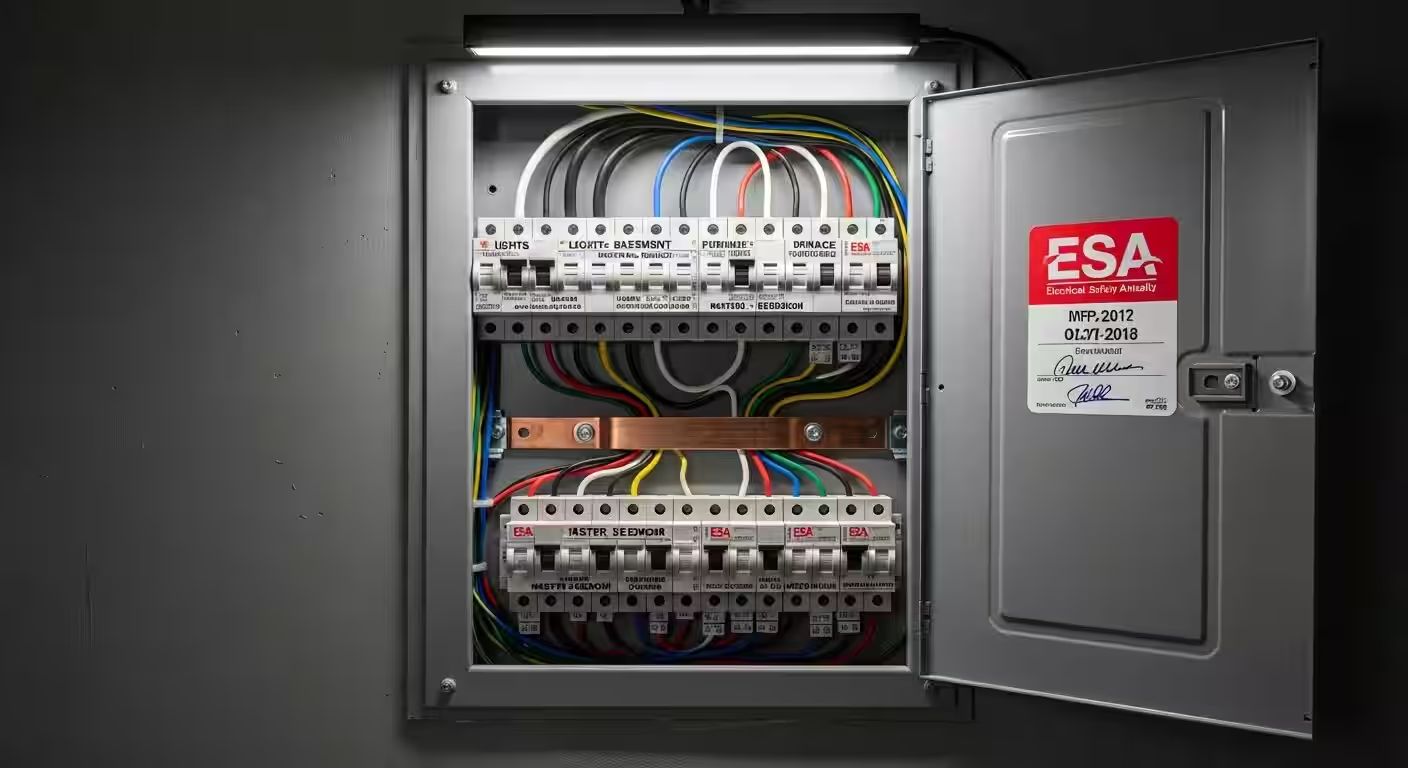
- ESA permit ($250–$400) pulled by Master Electrician
- Manufacturer-certified installer (Tesla Certified, FranklinWH Authorized, Enphase Premier) for warranty validity
The only difference vs solar pairing: no NRCan registration is needed for the installer because you are not installing solar PV. This actually simplifies the project — fewer parties, faster permitting. See Home Battery Permit & ESA Toronto for the full process.
Real Toronto Install: High Park Semi, Powerwall 3, No Solar
3,100 sq ft semi in High Park, 200A panel, central AC, gas heat, tree-shaded roof (solar not viable). Customer wanted outage protection after losing power for 4 days in 2022 Derecho.
- Powerwall 3 single unit in basement utility room
- ESA permit pulled, single inspection
- ULO rate plan switched 6 weeks before install
- Charge schedule: midnight–7am
- Discharge schedule: 4pm–9pm weekdays
- Installed cost: $15,500
- Year 1 ULO arbitrage savings: $720
- Outage backup: 24 hours typical, 36 hours essential-only
Customer projects 10-year payback on arbitrage alone. The August 2024 storm that took out the area for 18 hours? They were the only house on the block with the lights on. That moment alone, in their words, "made the whole thing worth it."
Get a Quote
A grid-only battery install is the simplest battery project we do — no roof work, no NRCan coordination, just a clean ESA-permitted electrical job. Book a home battery consultation and we will look at your panel, ULO usage data, and outage tolerance — then recommend the right size unit.
Sources & References
Authoritative sources cited in this guide:
- Electrical Safety Authority (ESA) — Ontario electrical regulator
- Ontario Electrical Safety Code — OESC Section 26 / latest amendments
- Canadian Electrical Code Part I (CSA C22.1) — CEC standard
- NRCan — Electric Vehicle Resources — NRCan EV/charging programs
Continue Reading