RenoHouse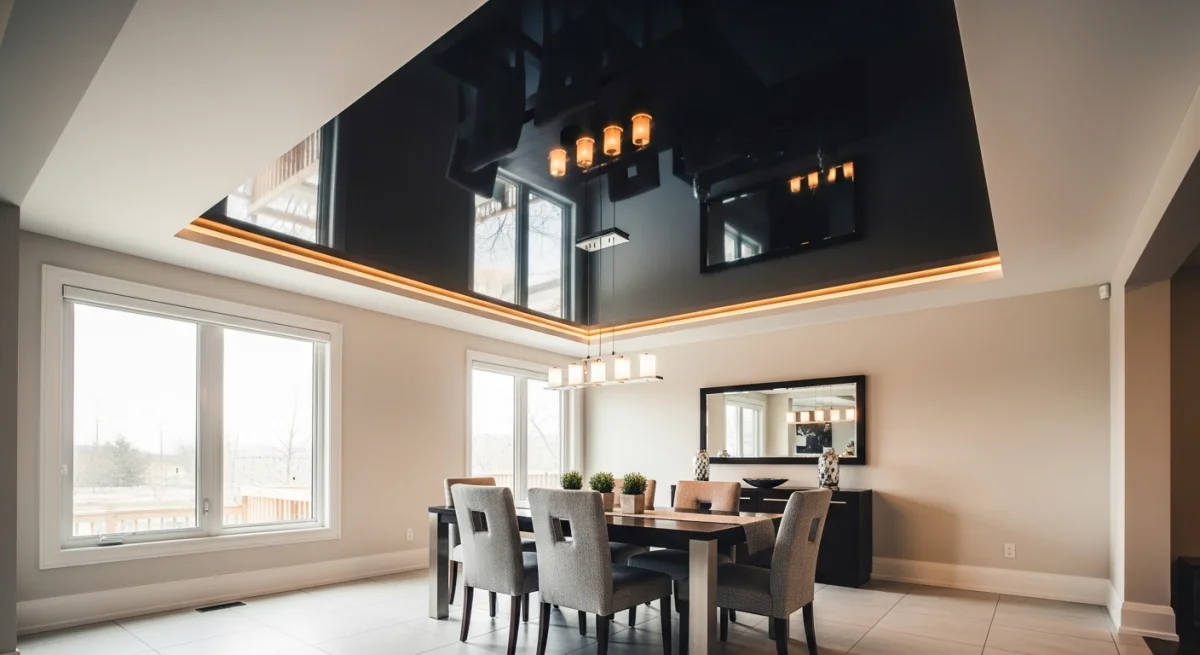

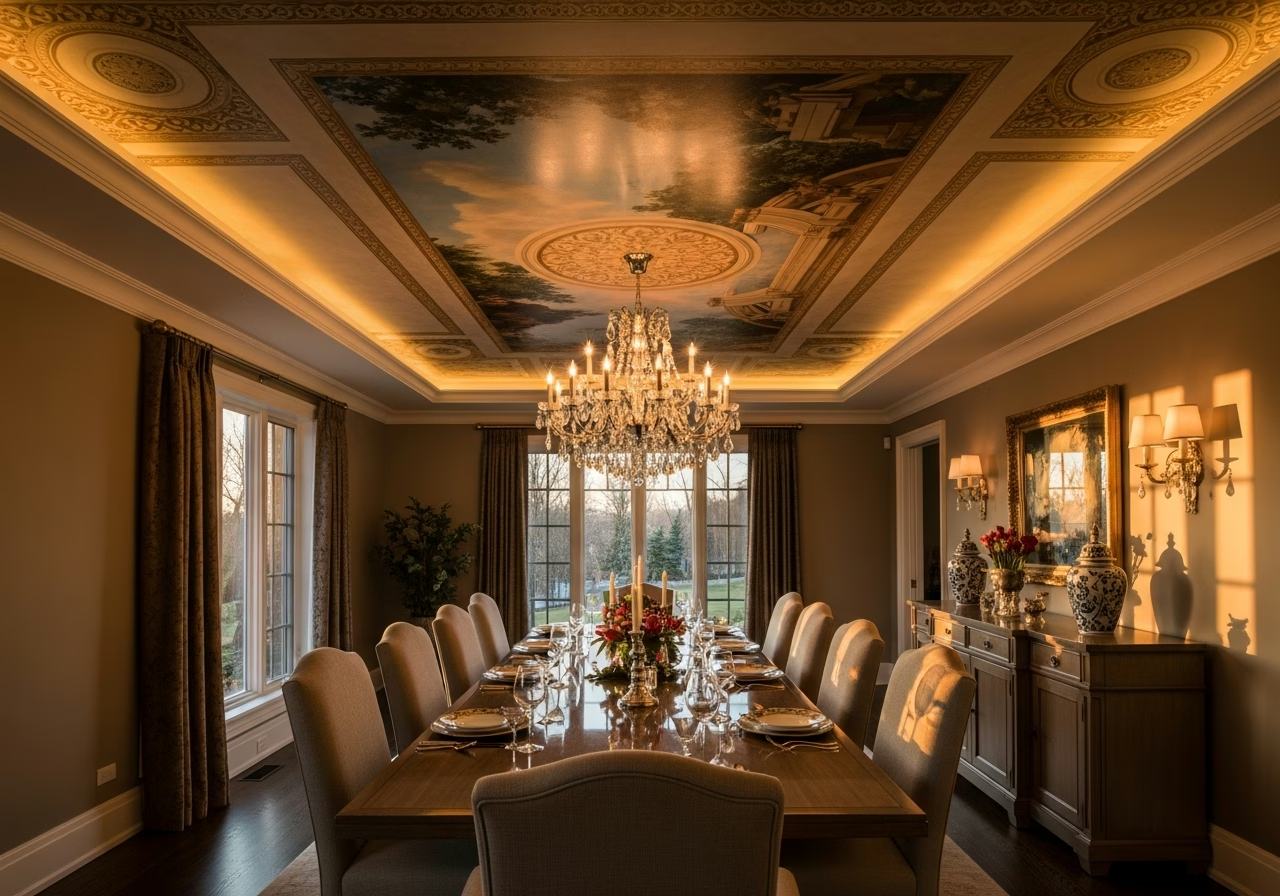
The dining room is the most ceremonial room in a Toronto home, and stretch ceilings deliver disproportionate impact here. The dining room's defining feature is the chandelier or central pendant, and stretch ceiling design naturally orients around that focal point. Whether you lean toward a Russian-Canadian crystal chandelier with cove lighting, a printed Renaissance fresco for traditional spaces, or a clean modernist matte ceiling with concealed perimeter LED, the dining room is where stretch ceiling design becomes architectural.
This article walks through the four dining room patterns we install most often, chandelier weight and structural considerations, dining-specific lighting choices, and 2026 Toronto installed pricing.
Pattern 1: Glossy Center with Crystal Chandelier and Perimeter Cove
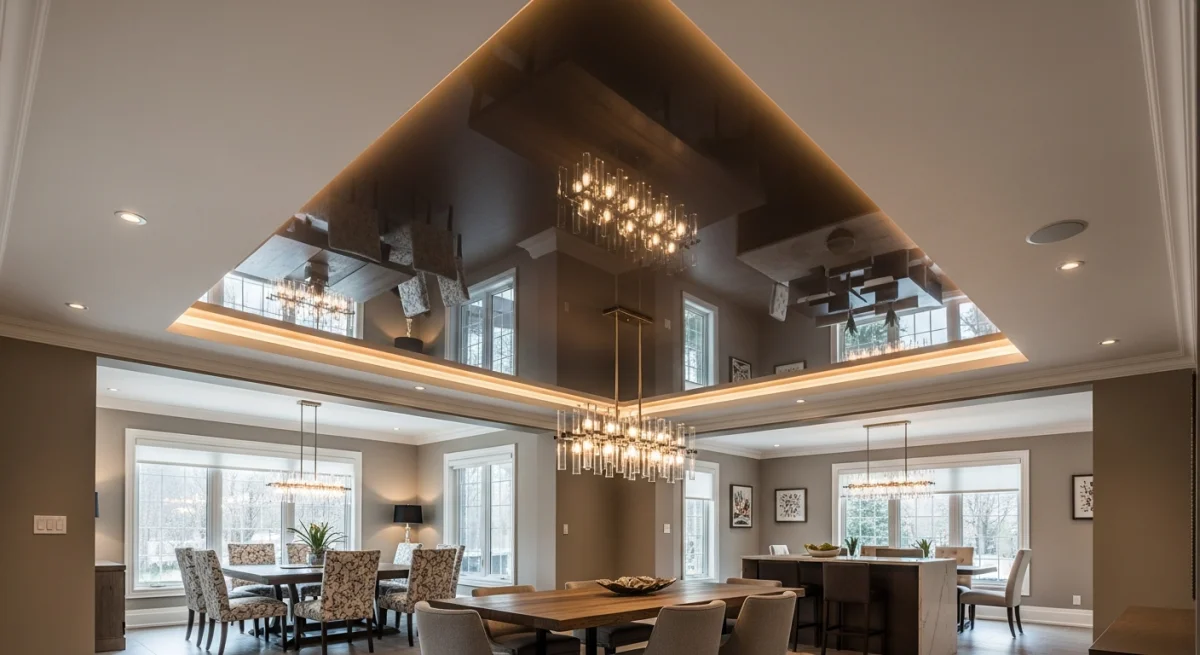
The Russian-Canadian dining room standard. Two-level construction: a central recessed inset of glossy PVC where a crystal chandelier hangs, surrounded by a higher matte or satin border with concealed RGB or warm white cove LED in the step. The chandelier reflects in the glossy center and visually doubles in apparent crystal mass.
This pattern dominates dining rooms across Thornhill, Vaughan, North York, Richmond Hill, and the Bathurst corridor. About 65 percent of our Russian-Canadian dining room installs use this configuration.
Chandelier specifications: crystal weight typically 25 to 80 lbs; structural support plate required (added to joists above before the membrane install). Lighting: warm 2700 K filament-style LEDs or actual incandescent for the chandelier; dimmable via Lutron Caseta. Cove LED: 2700 K warm white default with optional RGB for special-occasion ambience.
2026 pricing: $5,500 to $11,000 for a typical 150 to 200 sqft dining room.
Pattern 2: Single-Level Matte with Concealed Perimeter LED
The Anglo-Canadian designer alternative. Single-level matte PVC, a clean rectangle of warm white or soft cream, with a low-profile concealed cove LED at the perimeter providing indirect uplight. The chandelier is the only direct-light fixture; the cove provides the ambient glow.
This pattern reads sophisticated and modern. Pairs with linen-textured walls, painted millwork, and contemporary chandeliers (Roll & Hill, Apparatus, Bocci). Less expensive than Pattern 1 because there is no two-level framing.
2026 pricing: $2,800 to $4,800 for a 150 to 200 sqft dining room.
Pattern 3: Printed Renaissance Fresco
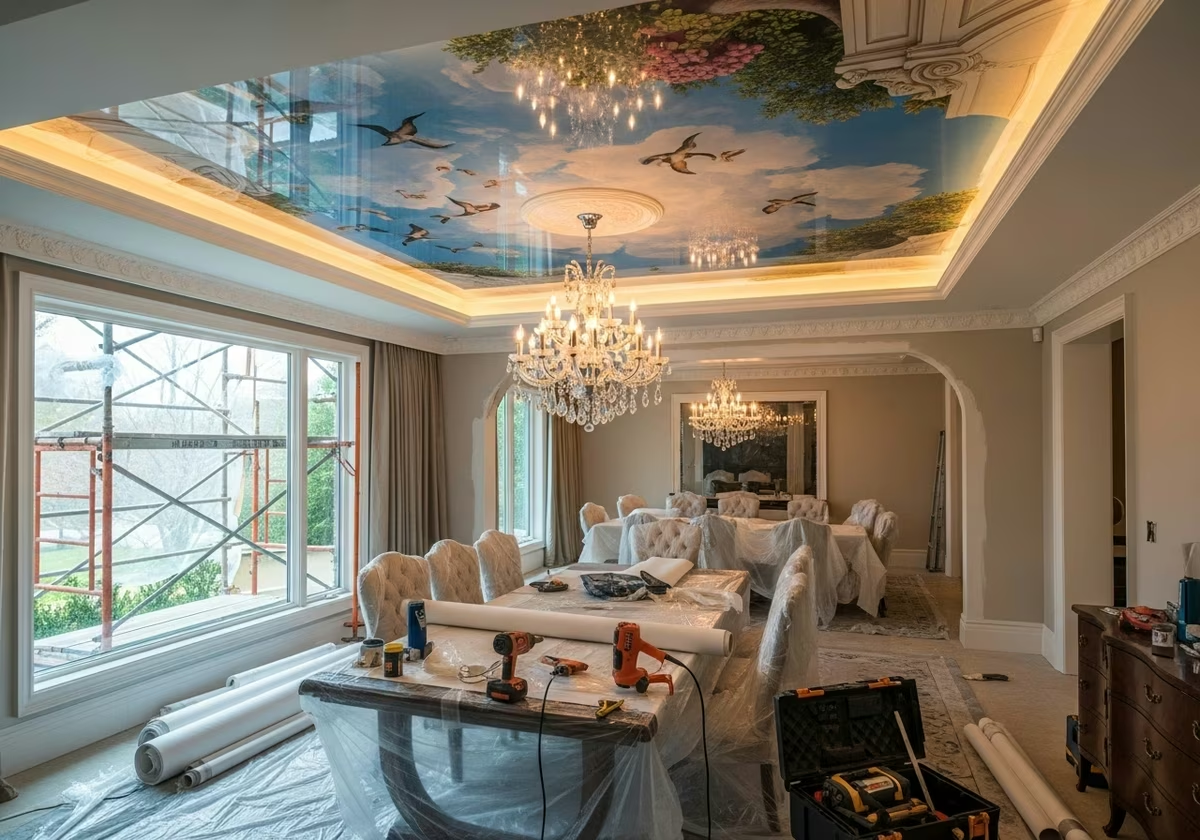
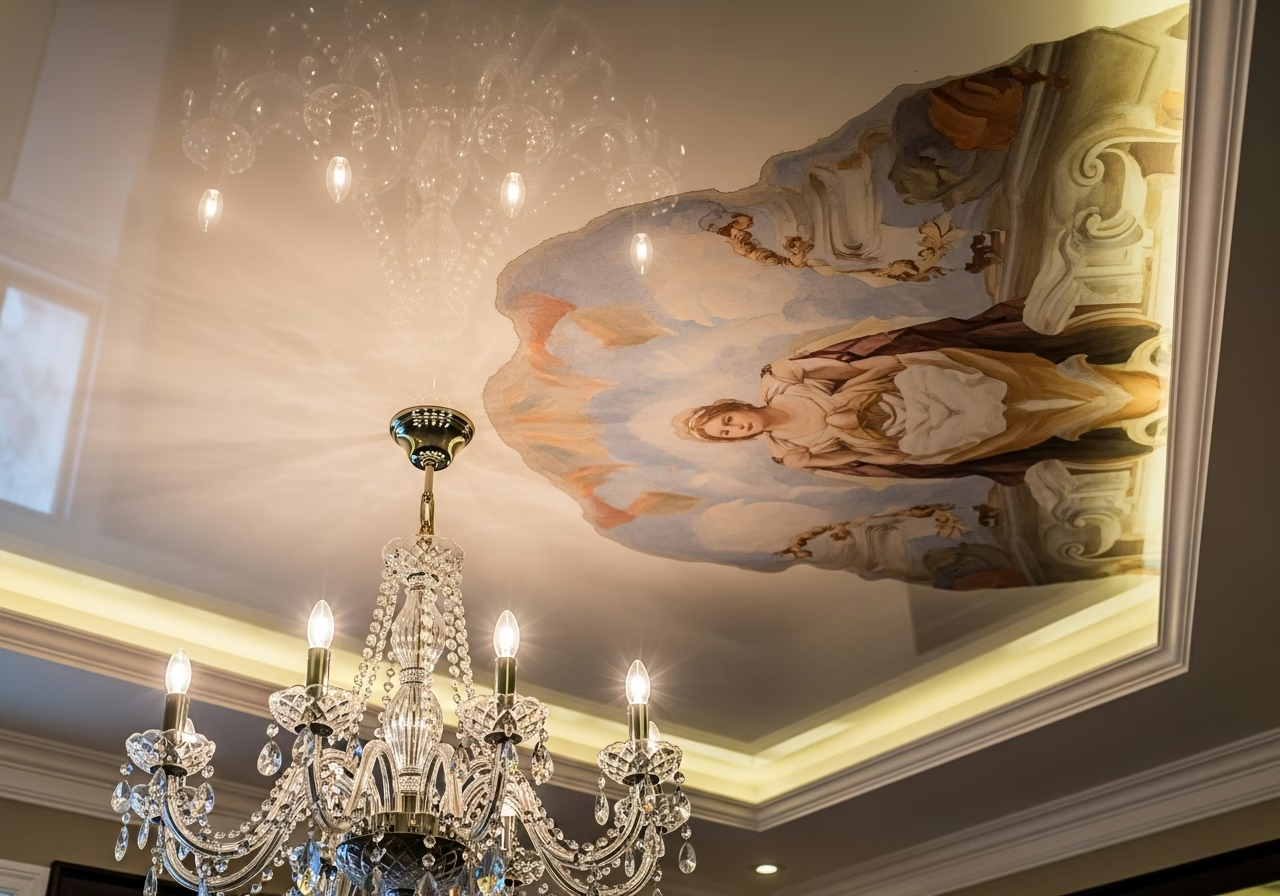
The traditional luxury choice. A photo-printed PVC or fabric ceiling depicting a Renaissance fresco (Sistine Chapel-style cherubs and clouds with original composition to avoid copyright), framed by ornate gold-leaf perimeter molding installed on the existing ceiling above the membrane perimeter.
Print resolution 1200+ dpi. Common in Toronto Russian-Canadian luxury homes, classical-design homes in Forest Hill and Lawrence Park, and high-end heritage condo conversions. The fresco visible during dinner becomes the conversation centerpiece.
Need professional renovation?
Call RenoHouse at 289-212-2345 or get a free estimate today.
Get Free Estimate →The printed membrane sits on a single level (no two-level framing); the visual drama comes from the print itself. The chandelier hangs from a structural plate, with the membrane cut around the downrod.
2026 pricing: $4,500 to $9,500 for a 150 to 200 sqft printed fresco dining room.
Pattern 4: Backlit Translucent Center Panel
The modern luxury alternative to a fresco. A translucent rectangular panel forms the center of the ceiling, backlit at 3000 K from an LED panel array in the plenum. Surrounding ceiling is matte PVC. The chandelier still hangs from the center, with the backlit panel framing it.
This requires 9 foot or higher original ceiling because the backlit panel drops 30 to 50 cm. In Toronto detached homes with 9 to 10 foot dining room ceilings (built post-2000) this works beautifully; in older 8-foot dining rooms it is too low.
2026 pricing: $7,500 to $14,000 for a 150 to 200 sqft dining room with backlit center.
Chandelier Structural Support
Dining room chandeliers are heavier than living room pendants. Crystal chandeliers commonly 30 to 80 lbs, sometimes more. Standard ceiling boxes (4-inch round) are rated for up to 50 lbs static load; heavier fixtures need a fan-rated box (rated 70 lbs) or a custom-fabricated steel support plate spanning multiple joists.
Stretch ceiling installation does not affect the structural support \u2014 the chandelier mounts to the original ceiling above and the membrane is cut around the downrod. But the structural support has to be in place before the membrane is installed, because once the membrane is up, accessing the box requires removing and reinstalling the membrane.
We coordinate the structural assessment during the laser-measurement visit. If the existing ceiling box is inadequate for the planned chandelier weight, we add the support plate ($200 to $600 depending on access and joist configuration) before the stretch ceiling install. This adds half a day to the timeline but is unavoidable for heavy fixtures.
Lighting Choices
Acoustic Considerations
Dining rooms with hard floors (engineered hardwood, tile) and a dining table for 8+ generate flutter echo. An acoustic perforated fabric stretch ceiling (Newmat Acoustic, Clipso Acoustic-810) backed by 100 mm Rockwool plenum reduces dining-conversation echo significantly.
Premium over standard PVC: $5 to $10 per square foot. We recommend the acoustic upgrade specifically for entertaining-heavy households where dining conversations regularly span 90 to 180 minutes. The audio comfort difference at year 1 is noticeable.
2026 Installed Pricing Summary
For a typical Toronto dining room stretch ceiling:
- Single-level matte with cove: $2,800 to $4,800 (150-200 sqft)
- Two-level glossy center with crystal chandelier: $5,500 to $11,000
- Printed Renaissance fresco single-level: $4,500 to $9,500
- Backlit translucent center with surrounding matte: $7,500 to $14,000
- Acoustic perforated upgrade: add $5 to $10 per square foot
- Heavy chandelier structural plate: add $200 to $600
- Pot light pass-through: $40 to $80 each
What to Avoid
- Heavy chandelier (50+ lbs) on a standard ceiling box. Add a structural support plate first.
- Cool white (4000+ K) for the chandelier. Wrong for dining; use 2700 K warm.
- Glossy PVC ceiling with no chandelier center. Without a focal fixture, glossy alone reads empty in dining rooms.
- Backlit translucent in sub-9-foot dining rooms. Headroom math fails.
- Cove LED that defaults to RGB color cycling. Set warm 2700 K as default; use color modes only for occasions.
Russian-Canadian vs Anglo-Canadian Aesthetic
Russian-Canadian Toronto households favor: two-level glossy with crystal chandelier, perimeter cove with optional RGB, sometimes printed fresco. The crystal chandelier is rarely optional \u2014 it is the centerpiece. Specifying the dining room verbally to a Russian-speaking installer: "двухуровневый натяжной потолок с глянцевым центром, хрустальная люстра, подсветка по периметру."
Anglo-Canadian Toronto households favor: single-level matte with concealed perimeter LED, modern (non-crystal) pendant, sometimes printed fresco for traditional homes. Less ornate, more linear.
Both aesthetics are well-supported by our installer network; we match the crew to the design.
Honest Install Trade-Offs
Dining room install: 3 to 5 hours for single-level, 6 to 9 hours for two-level. Heat-stretch process raises ambient temperature to 50 to 70 degrees Celsius. Mandatory ventilation. We do not recommend asthma-sensitive family members be present during install. Premium A+ certified MSD or Pongs PVC returns to baseline air quality within 24 hours of install.
For dining rooms with antique furniture, Persian rugs, or fragile artwork on the walls, we apply additional drop-cloth and plastic protection during the heat phase. Heat does not damage furniture below 70 degrees Celsius but extra protection is warranted for high-value contents.
Related Reading
For the full stretch ceiling room-by-room pillar, see the by-room guide. For the often-adjacent living room (in open-plan layouts), see the living room stretch ceiling guide. For kitchen installs in open-plan kitchen-dining layouts, see the kitchen stretch ceiling guide.
Get a Dining Room Stretch Ceiling Quote
We coordinate vetted installer crews including bilingual Russian-English teams across Toronto, Vaughan, North York, Thornhill, Richmond Hill, Markham, Oakville, and Mississauga. Free in-home measurement, design consultation including chandelier compatibility assessment.
Request a dining room stretch ceiling quote.