RenoHouse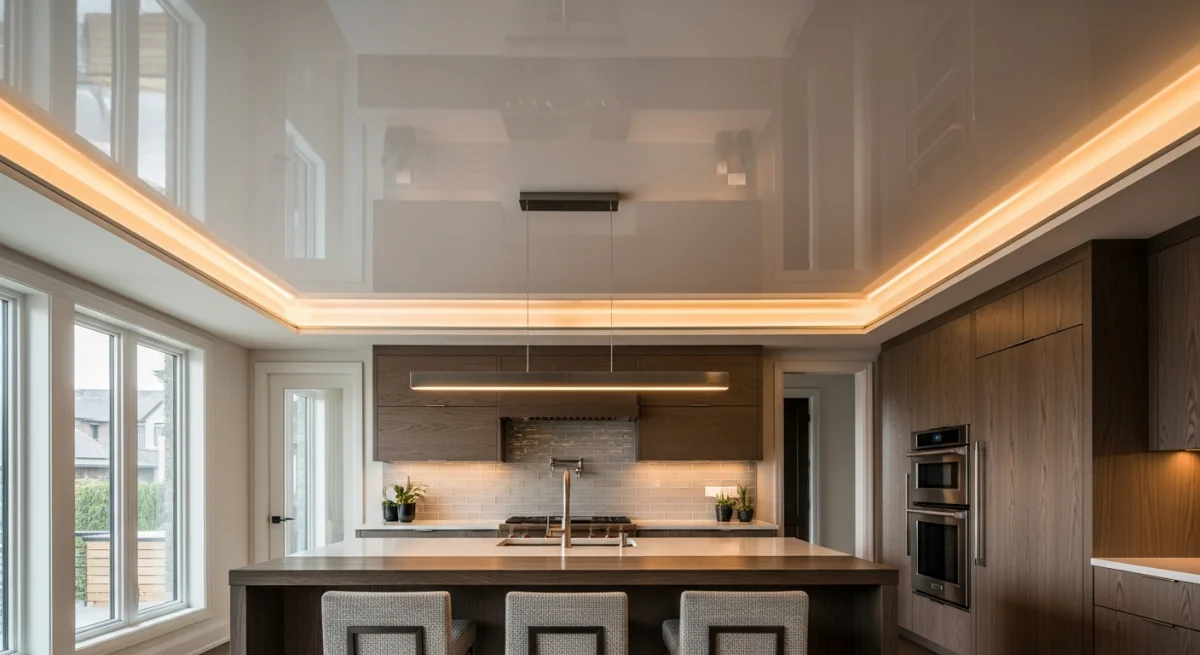

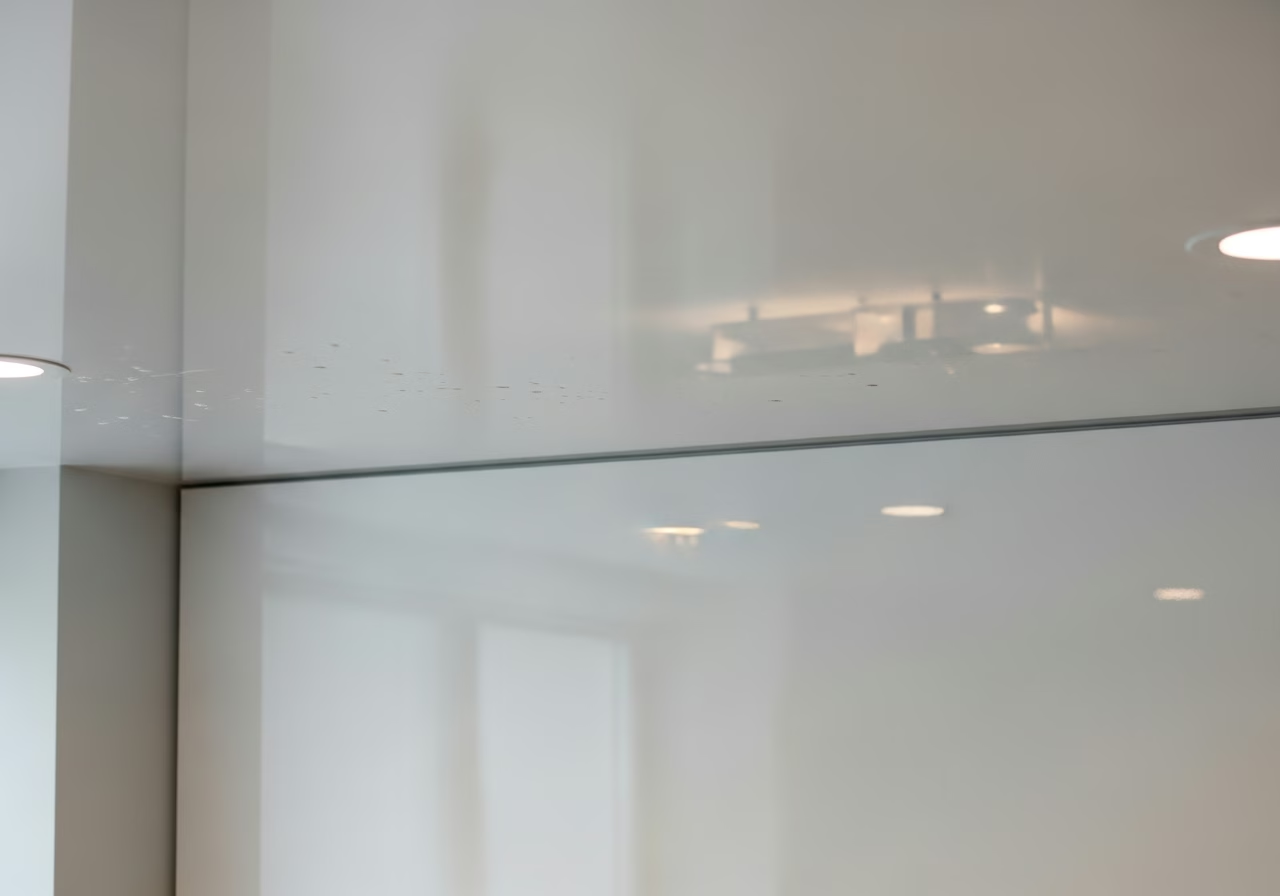
Kitchens are the trickiest stretch ceiling room. Unlike bathrooms (where PVC is unambiguously right) or master bedrooms (where glossy wins), kitchens punish the wrong finish choice. Cooking grease aerosolizes during pan-frying, sauteing, and high-heat searing, then deposits on every horizontal surface in the room \u2014 including the ceiling. Glossy PVC shows every grease droplet under direct light. Matte and satin finishes hide grease and clean as easily.
This article walks through which finish to pick for which kitchen, why backlit translucent panels are the premium upgrade for open-plan kitchens, and what a Toronto kitchen stretch ceiling install costs in 2026.
The Grease Problem (And Why Stretch Ceiling Still Wins)
Painted drywall in a Toronto kitchen does the worst possible job with grease: the porous paint film absorbs aerosolized cooking oil, then yellows over time. By year 3 in a heavy-cooking household, the ceiling around the stove has visibly yellowed and cannot be fully cleaned without repainting. Cleaning chemicals like TSP partially remove the surface grease but leave the absorbed oil behind.
PVC stretch ceiling, by contrast, is a continuous non-porous membrane. Grease lands on the surface and stays on the surface. A microfiber cloth with mild dish soap and warm water removes 95 percent of grease in one pass. Heavy buildup yields to a 1:1 dilution of degreaser (Krud Kutter, Mr. Clean Magic Eraser at low pressure). The membrane survives this cleaning indefinitely; the warranty is 10 years on the membrane regardless of cleaning frequency.
So the question is not whether to use stretch ceiling in the kitchen \u2014 it is which finish.
Finish Selection: Matte and Satin Win
Backlit Translucent Above the Island
The premium upgrade for open-plan kitchens is a backlit translucent stretch ceiling panel above the kitchen island. A translucent PVC or fabric membrane (Cosmolight, Barrisol Lumiere, Descor Backlit) is mounted 30 to 50 cm below an LED panel array in the plenum. The result: a uniform glowing surface above the island that mimics a natural skylight at 3000 K.
Specifications we use for kitchen island backlit:
Need professional renovation?
Call RenoHouse at 289-212-2345 or get a free estimate today.
Get Free Estimate →- Translucent membrane 50 to 75 percent light transmission, A+ certified.
- 3000 K LED panel array, 70+ CRI minimum (CRI matters for food appearance \u2014 low-CRI light makes vegetables look dull and meat look grey).
- Dimmable via Lutron Caseta or Lumaris, 0 to 100 percent.
- 30 to 50 cm plenum depth required between the existing ceiling and the new translucent membrane.
Backlit pricing in 2026: $25 to $45 per square foot of translucent panel installed. A typical kitchen island is 30 to 60 square feet, so the backlit panel costs $750 to $2,700 added to the base stretch ceiling. The visual effect is striking and is one of the top photographed Toronto kitchen designs in our portfolio.
Headroom note: backlit translucent eats 30 to 50 cm of plenum, plus 25 to 40 mm for the membrane. In a kitchen with 8-foot original ceiling, this is too much drop \u2014 the island workspace becomes claustrophobic. Backlit only makes sense in 9-foot or higher original kitchen ceilings.
Acoustic Perforated for Open-Plan Kitchens
A growing pattern in Toronto open-plan condo and townhouse kitchens: microperforated acoustic stretch ceiling (Newmat Acoustic, Clipso Acoustic-810) backed by 100 mm Rockwool. The kitchen-living open plan generates significant flutter echo because hard surfaces (stone counters, tile floor, glass doors) bounce sound. Acoustic ceiling kills 60 to 80 percent of that echo, making conversation across the island much easier.
Acoustic upgrade premium: $5 to $10 per square foot over standard PVC. Worth it for open-plan layouts; not necessary for closed galley kitchens.
Pot Lights and Range Hood
Most Toronto kitchens have 4 to 8 recessed pot lights and a vented range hood (or downdraft) over the stove. Each fixture passes through the stretch ceiling using a plastic ring. The range hood ductwork lives in the plenum above the membrane; the hood face plate sits flush against a stretch ceiling cutout.
Critical specification: range hood must be vented to the exterior, not a recirculating hood. A recirculating hood pushes cooking grease back into the kitchen air, which then deposits on the ceiling at 3x the rate. We strongly recommend upgrading to an externally vented hood before the stretch ceiling install if your kitchen currently has a recirculating one. This pairs with the broader kitchen renovation considerations covered in our Toronto kitchen renovation cost guide.
Pot light pass-through pricing: $40 to $80 each. Range hood pass-through: $80 to $150. In-ceiling speaker pass-through: $50 each.
2026 Installed Pricing
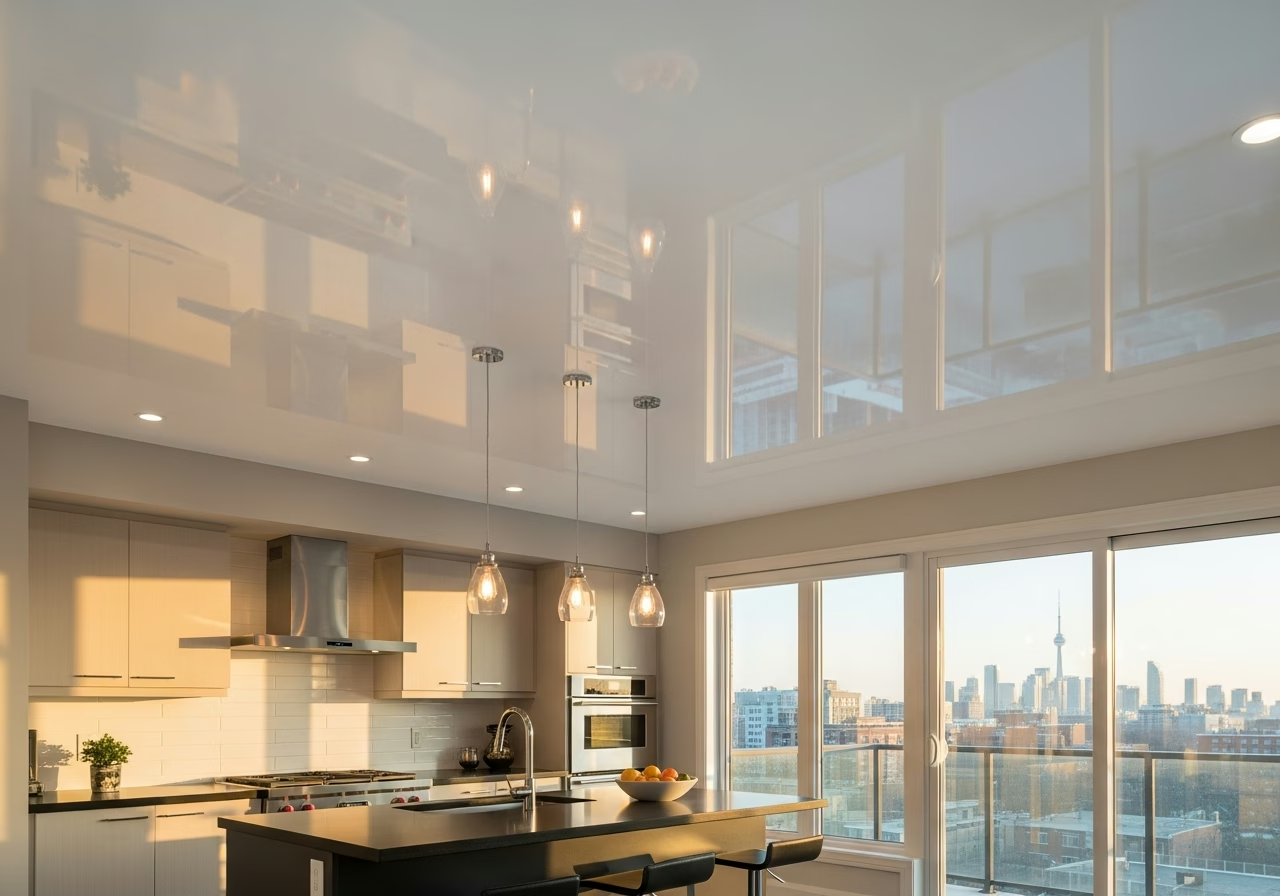
For a typical Toronto kitchen stretch ceiling install:
- Galley kitchen 60-100 sqft, matte PVC, 4 pot lights: $850 to $1,500.
- Standard kitchen 100-150 sqft, satin PVC, 6 pot lights, range hood pass-through: $1,400 to $2,400.
- Open-plan kitchen 200-300 sqft, satin PVC, 8 pot lights, hood, speakers: $2,400 to $4,200.
- Premium open-plan with backlit island panel: add $750 to $2,700 to base.
- Acoustic perforated upgrade: add $5 to $10 per square foot.
What to Avoid
- Glossy PVC over the stove in a heavy-cooking kitchen. You will clean it monthly. Specify matte or satin instead, save the glossy for living rooms.
- Fabric stretch ceiling in any kitchen. Fabric is breathable and will absorb cooking grease into the membrane structure. Hot-water cleaning can partially restore but the long-term result is yellowing.
- Dark color PVC over a stove. Dark glossy or matte ceilings show grease droplet trails worse than white. Stay with bright white, cream, or light grey in cooking zones.
- Recirculating range hood combined with stretch ceiling. The grease-load increase is 3x. Vent externally first.
- Backlit panels in kitchens with 8-foot original ceilings. The headroom math fails.
Russian-Canadian Aesthetic Note
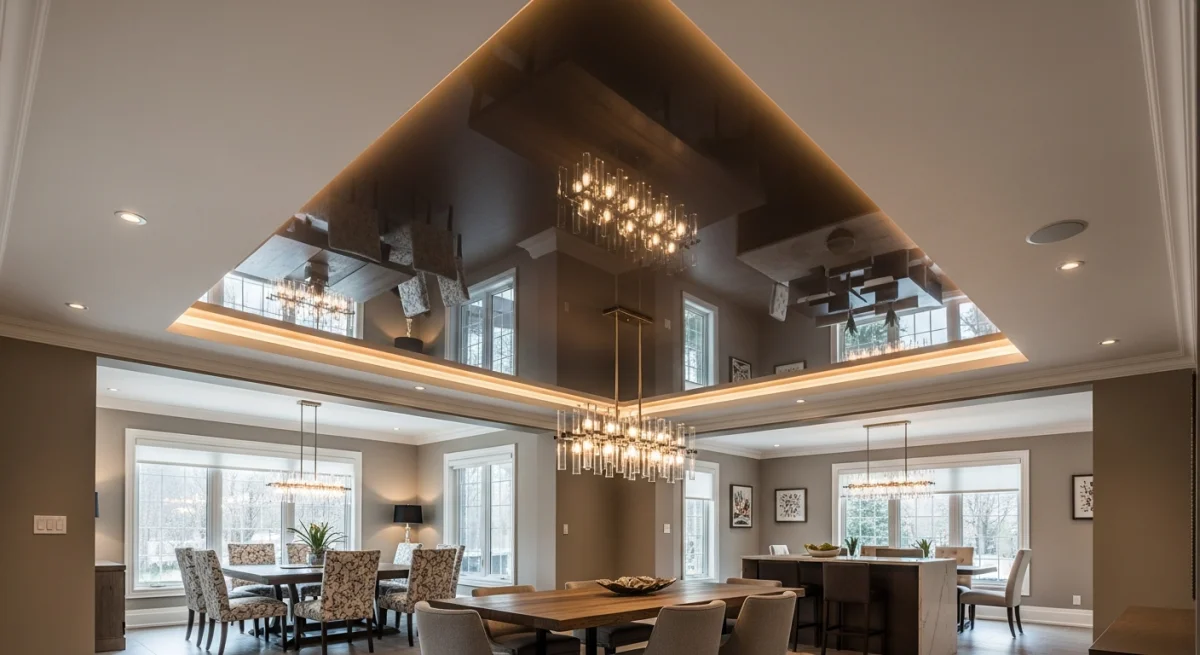
In Russian-Canadian Toronto kitchens, two-level designs with a center matte panel and surrounding glossy border are common, often with a chandelier mounted to the original ceiling above the kitchen table (not above the stove). This pattern works because the chandelier zone is far from the cooking grease zone. Single-tone matte over the whole ceiling is the more pragmatic default in heavy-cooking kitchens.
Honest Install Trade-Offs
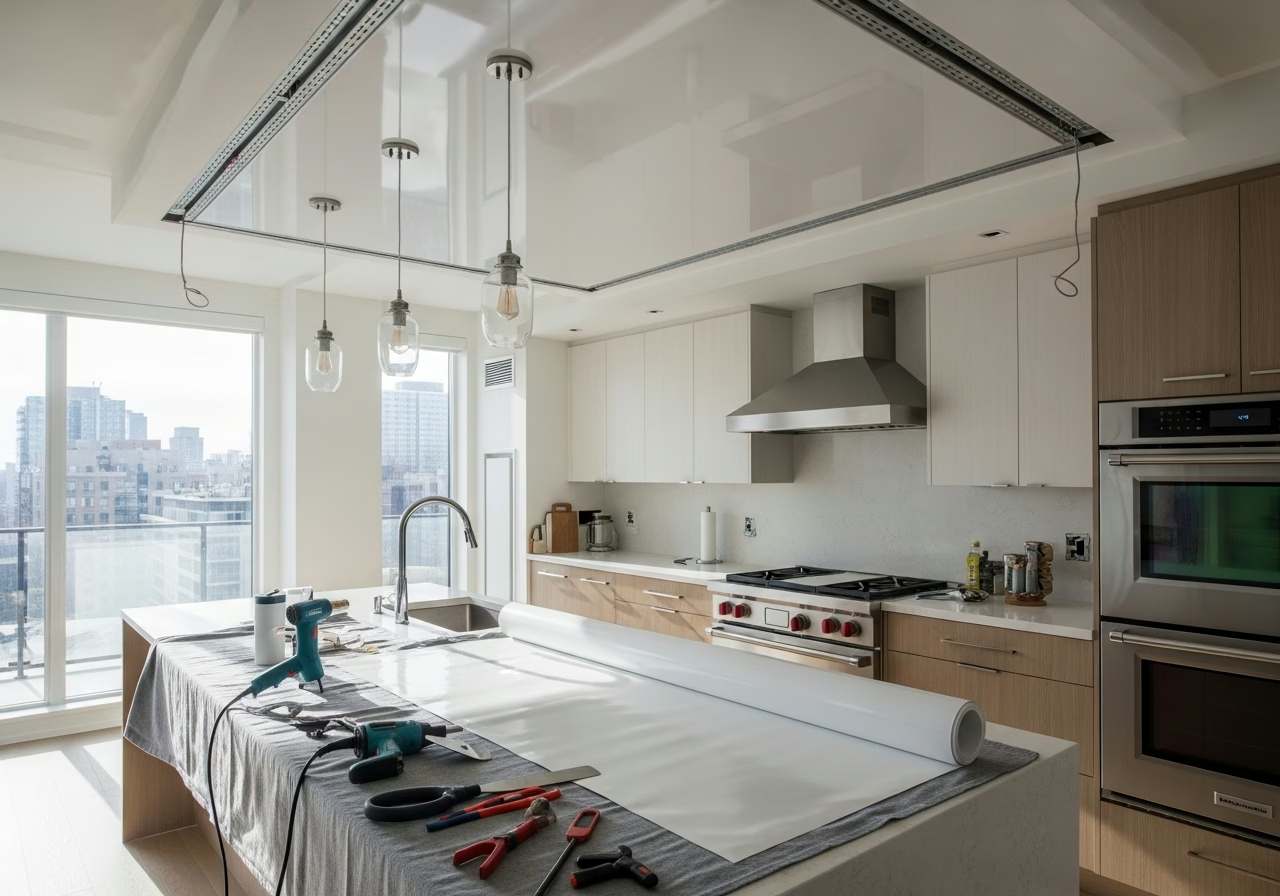
PVC kitchen install is the same heat-stretch process as other rooms: 2 to 3 hours, room temperature 50 to 70 degrees Celsius during the heat phase, mandatory ventilation. Disconnect smoke detectors temporarily during install (they will trigger from the heat). Re-test all detectors after install completion. We never recommend the install proceed if anyone in the household has asthma or severe allergies; reschedule for a day when sensitive family members are out.
The membrane is dimensionally stable up to 50 degrees Celsius surface temperature. Standard kitchen cooking does not heat the ceiling membrane that high (the heat rises into the range hood, not into the ceiling). Direct contact between the membrane and any heat source above 50 degrees is the failure mode \u2014 do not install the membrane within 30 cm of an unvented heat source above.
Related Reading
For the full room-by-room stretch ceiling pillar, see the by-room guide. For dining room installs that often pair with kitchen installs in open-plan layouts, see the dining room stretch ceiling guide. For full Toronto kitchen renovation pricing context, see our kitchen renovation cost article. For the master bedroom that often follows a kitchen stretch ceiling install, see the master bedroom guide.