RenoHouse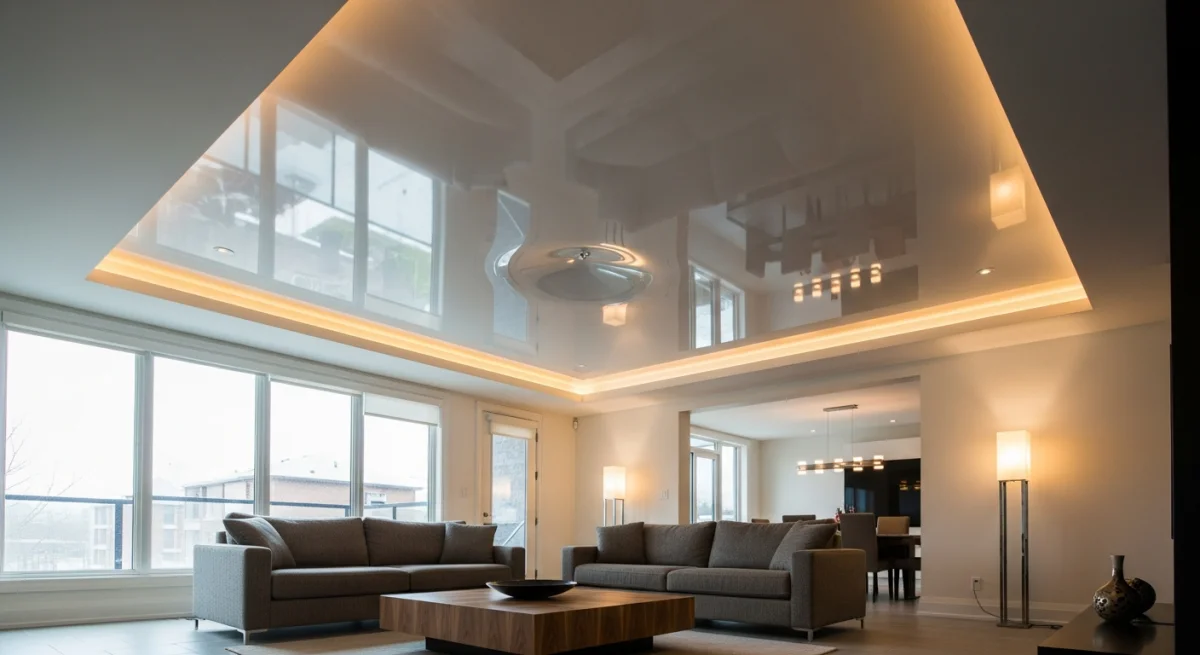

# Stretch Ceiling Water Leak Resilience: How PVC Holds 100 Litres Per Square Metre
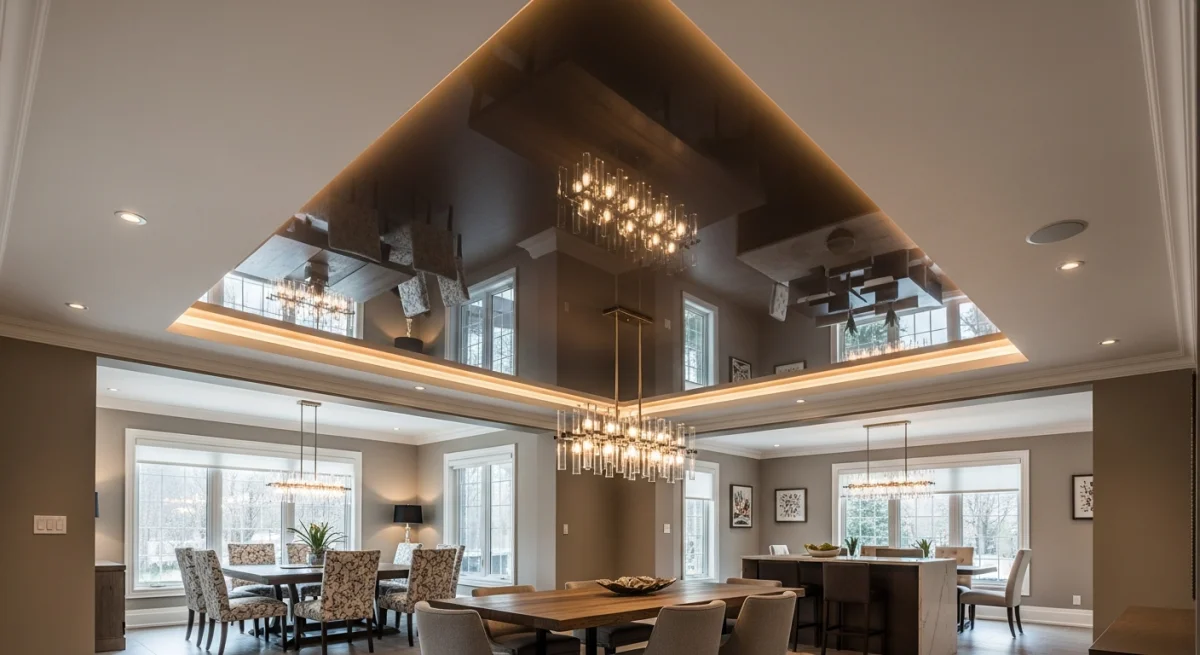
Toronto has approximately 440,000 condo units (CMHC 2025 estimate), with the majority over 15 years old. Upstairs leaks - dishwasher hose pop, toilet supply line failure, washing machine overflow, hot water tank rupture - are not rare events. They are recurring. The water comes through the slab and pools above your ceiling. With drywall, you face mould, insurance claims, hardwood floor replacement, and weeks of remediation. With PVC stretch ceiling, you face a 2-3 hour service call. This is the single feature that makes stretch ceiling the right answer for Toronto condos.
For broader category context, see our Toronto stretch ceiling complete guide. Related: stretch ceiling vs drywall, PVC vs fabric.
The Mechanics: Why PVC Holds Water
PVC stretch ceiling membrane is 100% impermeable. Water cannot pass through it. The membrane is also elastic - it stretches under load. When water pools above the ceiling from an upstairs leak:
- 1. The water exits the upstairs source and travels through the concrete slab cavity (or wood joist cavity in detached homes).
- 2. It accumulates above the PVC membrane.
- 3. The membrane stretches downward under the weight, balloon-style. The harpoon edge stays locked in the aluminum perimeter track.
- 4. The ballooned membrane contains the water like a giant droplet.
- 5. Capacity is approximately 100 litres per square metre depending on canvas tension, span, and thickness. A 200 sqft (18.5 m²) ceiling can hold roughly 1,800 litres.
The room below stays dry. Floor, furniture, electronics, art - untouched.
This is not theoretical. This is documented behaviour, observed routinely by Toronto installers, and the foundation of why PVC stretch ceiling is the correct ceiling product for any condo with overhead leak risk.
Real-World Capacity by Room Size
| Ceiling area (sqft) | Ceiling area (m²) | Approximate capacity (L) | Approximate capacity (gallons) |
|---|---|---|---|
| 100 | 9.3 | 900 | 240 |
| 150 | 13.9 | 1,400 | 370 |
| 200 | 18.5 | 1,800 | 480 |
| 300 | 27.8 | 2,800 | 740 |
| 400 | 37.1 | 3,700 | 980 |
| 600 | 55.7 | 5,500 | 1,450 |
A typical condo bathroom leak (toilet supply line failure, average 30-90 minutes before discovery) discharges 50-200 litres of water. Fully contained by even a small bathroom ceiling.
A washing machine overflow (typical 200-500 litres) is fully contained by a 100+ sqft laundry room ceiling.
A hot water tank rupture (typical 150-180 litres total tank capacity) is fully contained.
A dishwasher hose burst at peak fill (typical 50-100 litres before shut-off) is fully contained.
For most realistic single-event upstairs leaks in Toronto condos, the PVC stretch ceiling has more capacity than the leak source.
Need professional renovation?
Call RenoHouse at 289-212-2345 or get a free estimate today.
Get Free Estimate →What You See When It Happens
Picture a normal Tuesday evening in your Bathurst Corridor condo. You hear water running upstairs - longer than usual. You ignore it. 30 minutes later, you walk into your living room and notice the ceiling looks "bubbled" - a soft sag in one area, like a pillow pushing down from above.
That is exactly what is supposed to happen.
Touch it gently. The bubble is full of water - cool to the touch, soft and elastic. The water is held by the PVC membrane, suspended above your floor, contained.
Do not poke it. Do not try to drain it yourself with a knife. Do not panic.
What To Do (The 5-Step Response)
Step 1: Identify the source. Go upstairs. Knock on the unit above yours. The leak is almost certainly there - failed dishwasher hose, overflowing washing machine, toilet supply line, hot water tank. Ask them to turn off the water source immediately. Step 2: Notify the building. Call concierge or building management. They will dispatch the building plumber if needed and document the incident for insurance. Step 3: Document for insurance. Photograph the bubbled ceiling from multiple angles. Note the time the leak was discovered. Photograph the upstairs source if accessible. Save plumber and concierge incident reports. Step 4: Call RenoHouse for drainage. If your stretch ceiling was installed or coordinated by RenoHouse, our 24/7 emergency line dispatches a partner installer within 5 business days for non-emergency cases, or same-day for active leaks. The drainage service is included in our 10-year layered warranty for years 1-5; flat $200 fee for years 6-10. Step 5: File insurance claim with the upstairs neighbour. This is between their insurance and yours - typically a third-party claim against the upstairs unit's policy, since the leak originated there. Your policy may cover any uncovered loss as a backstop. The documentation from Step 3 supports the claim.The room below is fully usable through this entire process. You do not need to evacuate, vacate furniture, or relocate.
The Drainage Service: What Happens On Site
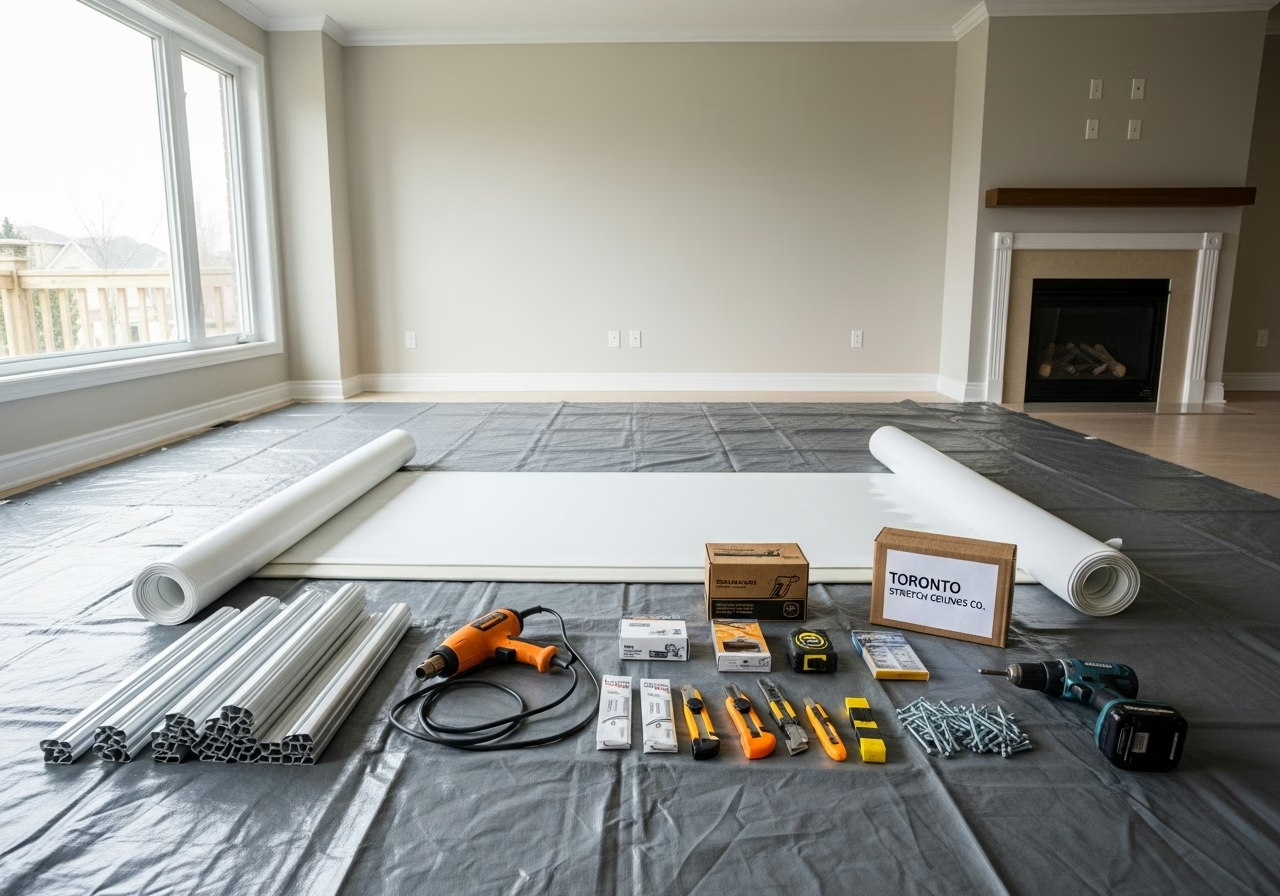
A trained installer arrives with:
- Wet/dry vacuum or pump.
- Buckets, towels, drop sheets.
- Heat gun (Master propane heater).
- Harpoon spatula.
- Replacement trim bead (in case of damage).
The procedure:
- 1. Drop sheets cover floor and protect contents.
- 2. Installer detaches one corner of the membrane from the harpoon track using the spatula.
- 3. The water drains through the corner gap into the wet vacuum or buckets. For a 1,500-2,000 L event, this takes 30-60 minutes.
- 4. The installer dries the cavity above with shop towels. Air movers may be added for 4-8 hours if humidity is high.
- 5. The membrane is heated to 50-60 degrees Celsius using the propane heater.
- 6. The installer re-stretches the membrane and re-engages the harpoon corner.
- 7. The trim bead is reinstalled.
- 8. Walkthrough with homeowner.
Total time: 2-3 hours from arrival. Total cost: $250-$400 (or $0 within RenoHouse warranty years 1-5).
After the service, the ceiling looks identical to before the leak. No visible damage, no replacement needed.
When the Membrane Cannot Be Saved
Rare scenarios where the membrane is replaced rather than re-tensioned:
- Punctured by debris. Sharp object came down with the water (broken plumbing fragment, fallen ceiling fixture). Replace the panel.
- Contaminated water. Sewage, oil, or chemical contamination. Replace.
- Multiple leak events. Same membrane has been drained 3+ times and shows fatigue at the harpoon weld. Replace.
- Severe yellowing from chemical contact. Some leak sources (cleaning chemicals, hot water with high mineral content) discolour PVC. Replace.
Replacement cost: $300-$700 in labour for a typical 200 sqft room (profile is reused). The RenoHouse warranty covers replacement labour for non-owner-caused damage in years 1-10.
Comparison to Drywall in the Same Scenario
Drywall ceiling, same upstairs leak:- Day 1: Brown water stains appear on the ceiling. The drywall absorbs water and softens.
- Day 2: Sagging visible. Water dripping through. Floor wet. Hardwood starts to warp.
- Day 3: Drywall fails. Section collapses, dropping wet drywall, insulation, and standing water onto floor and furniture.
- Day 4: Insurance adjuster arrives. Mould begins to seed in the wall cavity.
- Day 5-7: Mould remediation. Demolition of damaged drywall. Hardwood floor section removal.
- Week 2-3: Drying with industrial fans and dehumidifiers.
- Week 4-6: Drywall replacement, mud, sand, prime, paint. Hardwood replacement.
- Total cost: $8,000-$30,000 typical. Insurance claim with deductible. Multi-week disruption.
- Hour 1: Bubble appears. Source identified. Concierge notified.
- Hour 2-3: Insurance documentation. Source shut off.
- Day 1-5: RenoHouse drainage scheduled.
- Day 5: 2-3 hour service call. Drained, dried, re-tensioned.
- Total cost: $0-$400 (depending on warranty). One-day service. No mould.
The economic case is overwhelming for any condo unit with overhead leak risk.
Insurance Implications
Toronto condo policies (Tarion-style) typically include:
- Personal property coverage (your contents).
- Dwelling improvements coverage (upgrades you've made beyond builder-standard, including stretch ceiling).
- Loss of use coverage.
In a stretch ceiling leak event:
- The membrane is not damaged (no claim on your dwelling improvements).
- The drainage service may be partially covered as a "loss of use mitigation" expense.
- Your contents are not damaged (no contents claim).
- The upstairs neighbour's policy is the primary claim path for the leak source.
In our experience coordinating dozens of leak events for RenoHouse-installed ceilings, most leak events do not result in insurance claims at all because the damage is so contained that homeowners absorb the $250-$400 drainage cost rather than file. This is the opposite of drywall, where almost every upstairs leak triggers a full insurance claim.
Who Should Have PVC Stretch Ceiling Specifically for This Reason
- Toronto condo owners below the top floor in any building 15+ years old.
- Condo owners in older buildings (Bathurst Corridor, CityPlace, Liberty Village, King West) where building plumbing is aging.
- Owners with a history of upstairs leaks in their building.
- Owners with valuable contents (art, electronics, furniture, hardwood floors) where leak damage would be expensive.
- Owners with insurance deductibles of $2,500+ where avoiding claim filing has direct value.
- Owners renting out condos where tenant goodwill and repair downtime affect rental income.
For these scenarios, the leak resilience alone justifies the stretch ceiling investment. The aesthetic upgrades (glossy finish, height boost, modern look) are bonus.
How RenoHouse Coordinates Leak Response
Every RenoHouse-coordinated stretch ceiling project includes:
- 24/7 emergency contact for leak events.
- Partner installer dispatch within 5 business days non-emergency, same-week for active leaks.
- Drainage service included in years 1-5 of the 10-year layered warranty; $200 flat for years 6-10.
- Documentation support for insurance.
- Coordination with building management and condo board where applicable.
- Same partner installer firm services your ceiling for the duration of the warranty (or substitute if firm closes).
We have responded to dozens of leak events across Toronto. The system works.
Get a leak-resilient PVC stretch ceiling quote for any Toronto condo or detached home.FAQ
Will the bubble damage my floor when it sags? No. The membrane is held in tension by the harpoon track around the entire perimeter. The bubble extends downward but does not detach. It does not drop water on your floor. How fast does the membrane balloon? Slowly. Water accumulates at the rate of the leak source - typically 5-30 minutes from start to visible bubble for a normal household leak. Can I drain it myself? No. Cutting the membrane voids the warranty and creates uncontrolled water release. Call a professional. What if the leak is small and slow? A slow drip may not trigger a visible bubble. Look for discolouration on the ceiling surface or moisture above the membrane (sometimes visible at light fixtures). Address before the cavity grows mould. Does fabric stretch ceiling have the same property? No. Fabric is breathable - water passes through. Specify PVC for any room with overhead leak risk. Is there a maximum bubble size before the ceiling fails? Yes - the structural limit is approximately 100 L per square metre or 30-40 cm of vertical sag. Beyond this, the harpoon weld stresses. Call drainage immediately if sag is dramatic.Continue Reading