RenoHouse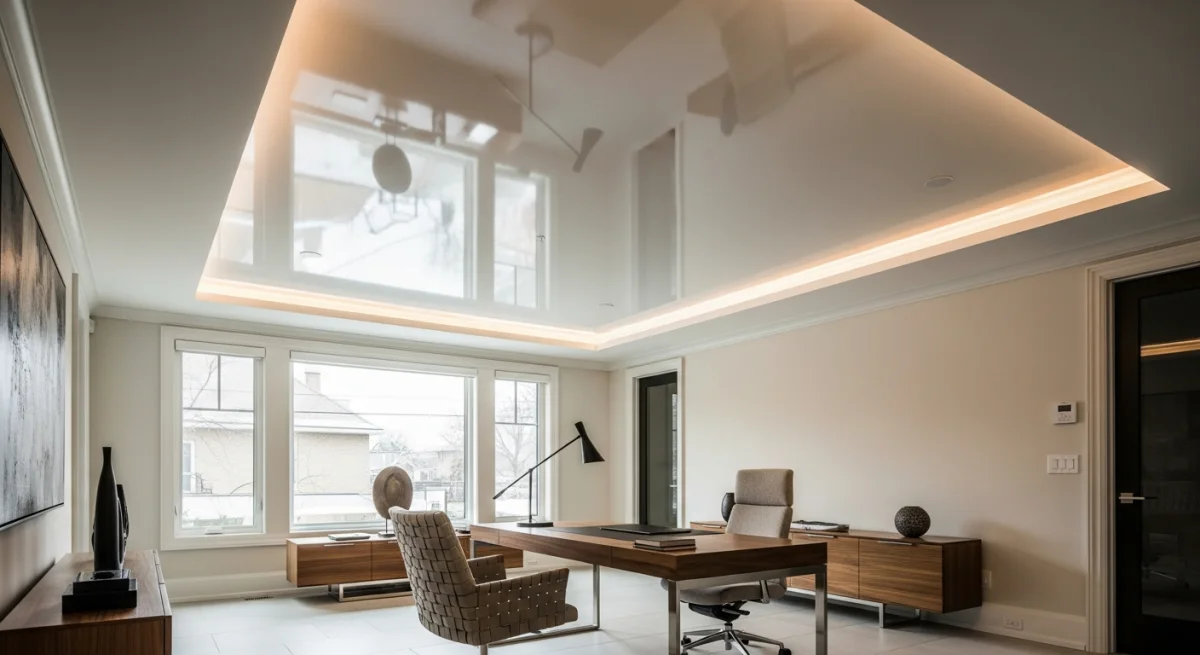

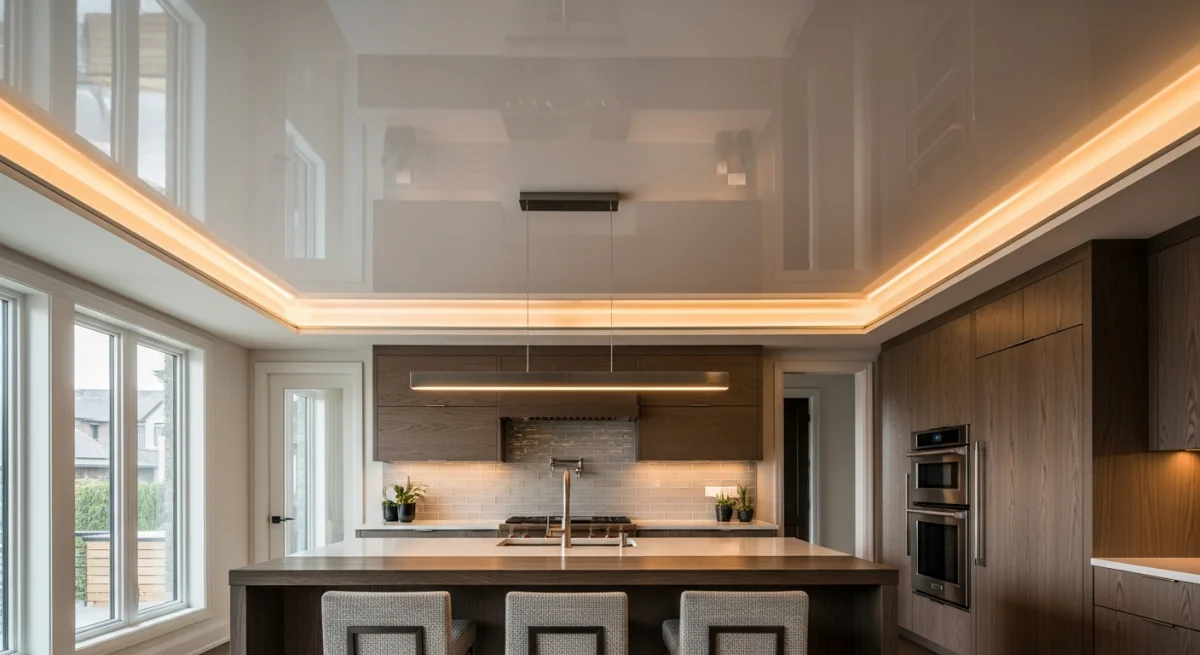
The home office is the only residential room where acoustic stretch ceiling routinely makes financial sense. The remote-work shift since 2020 has created a permanent demand for genuinely soundproofed home offices in Toronto: places where Zoom calls do not echo, podcasts can be recorded without flutter, and the rest of the household does not hear every conversation. Microperforated polyester fabric stretch ceilings (Newmat Acoustic, Clipso Acoustic-810, Descor Acoustic) deliver NRC 0.5 to 0.85 with 100 mm Rockwool plenum insulation \u2014 a meaningful step up from standard PVC at NRC 0.10.
This article walks through the acoustic specifications, when acoustic is worth it versus standard PVC, the visual difference of microperforation, and 2026 Toronto installed pricing.
NRC: What the Numbers Mean
Noise Reduction Coefficient (NRC) is a single-number rating for how much sound a surface absorbs across the speech frequency range (250 to 2000 Hz). NRC 0 means a perfect reflector (concrete, glass). NRC 1.0 means a perfect absorber (open space). Most ceiling materials fall between 0 and 1.
- Painted drywall: NRC 0.05 to 0.10. Almost a perfect reflector.
- Standard PVC stretch ceiling: NRC 0.10. Comparable to drywall.
- Plain polyester fabric stretch (no perforation): NRC 0.10 to 0.15. Marginal improvement.
- Microperforated fabric, no plenum insulation: NRC 0.30 to 0.45. Useful improvement.
- Microperforated fabric + 50 mm Rockwool plenum: NRC 0.55 to 0.70.
- Microperforated fabric + 100 mm Rockwool plenum: NRC 0.65 to 0.85.
- Acoustic ceiling tiles (Armstrong Cortega, Ultima): NRC 0.55 to 0.75. Comparable but visually inferior.
For a home office, the practical NRC target is 0.6 to 0.7. Below 0.5 the difference from standard PVC is barely perceptible. Above 0.7 you are paying premium money for marginal returns. Hit the 0.6 to 0.7 sweet spot with Newmat Acoustic or Clipso Acoustic-810 plus 100 mm Rockwool.
When Acoustic Is Worth It
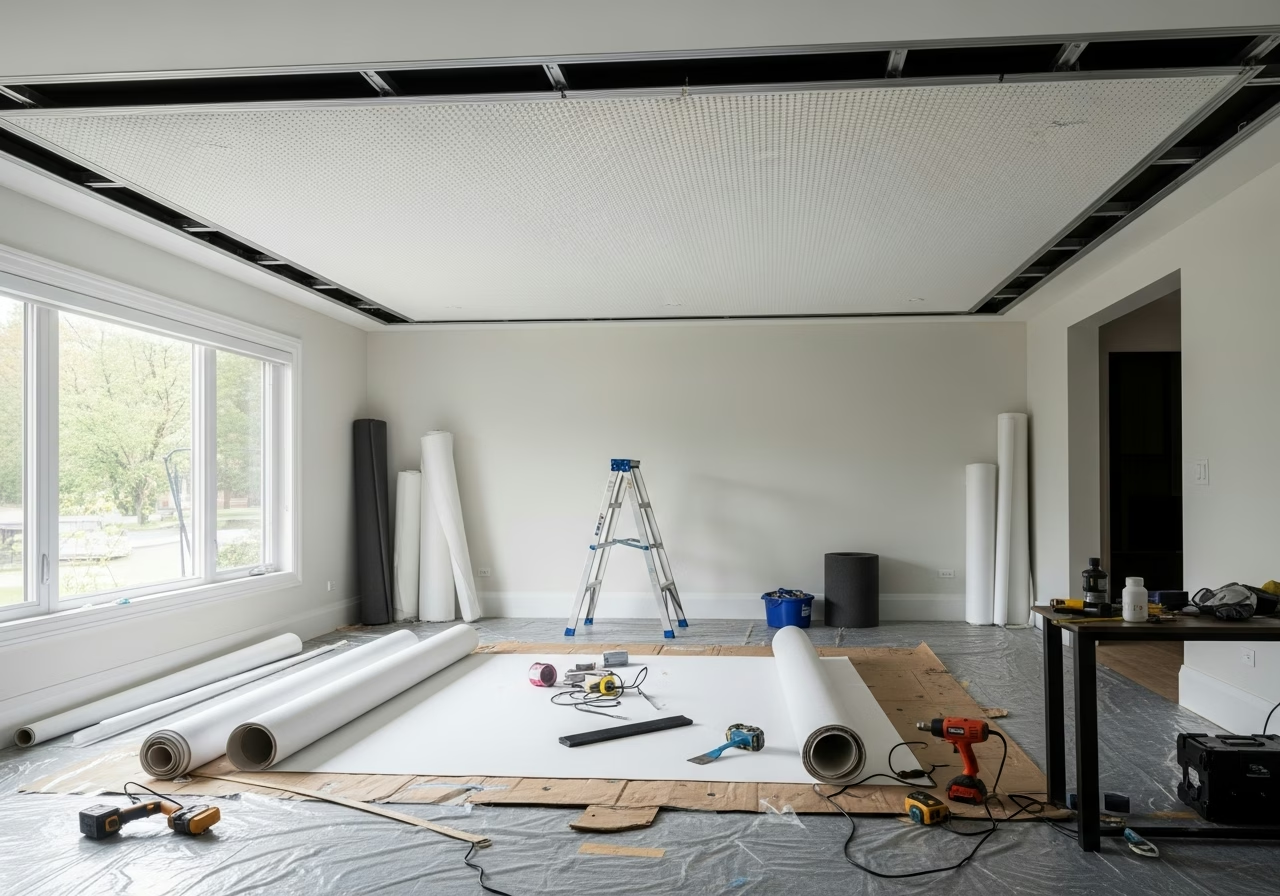
Acoustic stretch ceiling justifies the $5 to $10 per square foot premium over standard PVC in these scenarios:
- Zoom-call-heavy remote work. Daily 4+ hours of video calls. Echo is exhausting and unprofessional. Acoustic ceiling pays for itself in call quality.
- Podcast or video content production. Required if you record audio in the room. Without acoustic treatment the room reverb is audible in every recording.
- Music room or instrument practice. Piano, guitar, vocals \u2014 any sustained-tone instrument benefits enormously.
- Open-plan home office (no door). Sound carries to the rest of the home. Acoustic ceiling reduces transmission to adjacent rooms by 5 to 8 dBA.
- Office shared with sleeping family. A home office adjacent to a nursery or shared bedroom benefits massively.
Acoustic stretch ceiling does NOT justify the premium for:
- Quiet office work (writing, coding, reading) without calls
- Offices already treated with wall panels and floor carpet
- Rooms used 1 to 2 hours per day
- Closed offices with solid-core door and standard drywall walls (already adequately isolated)
Microperforation Visual Effect
Microperforated fabric has 0.4 to 1.0 mm pinholes in a dense pattern (typically 800 to 2,000 holes per square foot). At normal viewing distance (8+ feet) the perforations are invisible \u2014 the ceiling looks like plain matte fabric. Up close at 3 to 4 feet, the perforation pattern is faintly visible but reads as a subtle texture, not a defect.
Color: white, ivory, soft grey, or warm beige. Black acoustic perforated is also available for premium home theatre installs but rarely used in offices. The light-absorption characteristic of fabric (vs PVC) is a feature here \u2014 the ceiling reads as a sophisticated quiet finish, not a high-reflectance gloss.
Plenum Insulation Detail

The acoustic performance comes from the combination of perforation (which lets sound waves enter the cavity) and absorbent material above (which converts the sound to heat). The plenum is the cavity between the membrane and the original ceiling above.
Specifications we use:
Need professional renovation?
Call RenoHouse at 289-212-2345 or get a free estimate today.
Get Free Estimate →- 100 mm thick Rockwool Comfortbatt R14 or Roxul Safe'n'Sound, friction-fit between joists or laid on top of the original ceiling.
- Air gap between the Rockwool top and the membrane bottom: 3 to 8 cm.
- Total plenum depth required: 12 to 18 cm including the air gap and the Rockwool.
- Original ceiling height required: 8 feet 6 inches minimum to accommodate the plenum drop.
If your home office has 8-foot original ceiling, acoustic stretch is borderline (you lose roughly 18 cm to the plenum + membrane, leaving 6 feet 6 inches \u2014 just over OBC habitable minimum). Acceptable for offices; a closer call than for living rooms.
If your home office has 9 feet or higher, acoustic is comfortable and we recommend it strongly for any sound-sensitive work.
Lighting Considerations
Acoustic perforated fabric is sound-absorbent, which means it is also light-absorbent at the perforations. Pot lights and pendants pass through the membrane via standard plastic rings. Light bouncing off the ceiling (uplight) is reduced compared to PVC, so plan for slightly more direct downlighting.
For home offices we typically specify:
- 6 to 10 pot lights at 4000 K daylight color temperature (better for focused work than warm 2700 K, energizing during daytime)
- Dimmable via Lutron Caseta, set to 70 to 80 percent for typical work, 40 to 50 percent for evening calls
- One central pendant for general ambient
- Adjustable desk task lighting (separate from ceiling)
For circadian-friendly office lighting that shifts cooler in the morning and warmer in the evening, tunable white LED is worth the upgrade. Lutron Lumaris RGB+TW or Hue Color Ambiance can program a daily curve automatically.
Combining Acoustic Ceiling with Wall and Floor Treatment
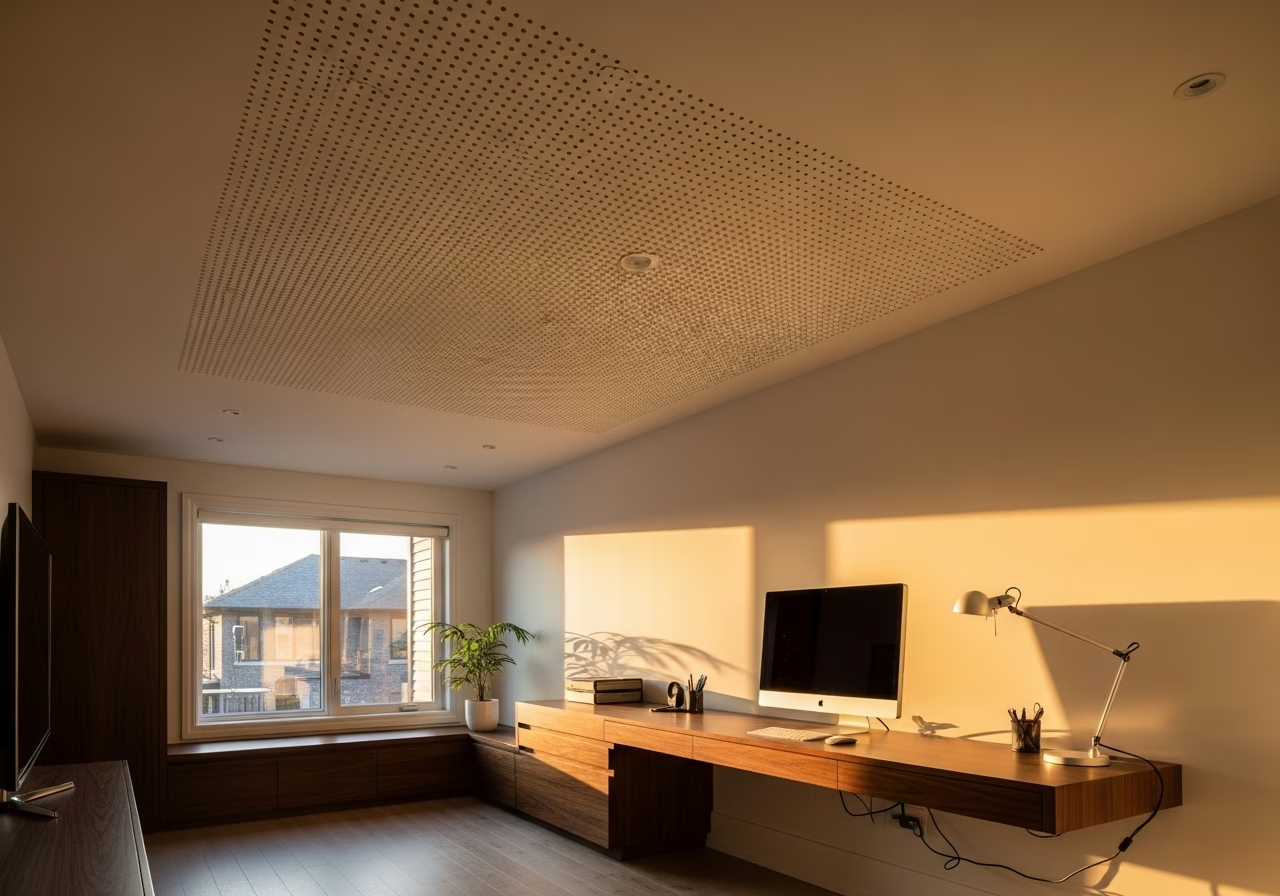
The ceiling alone is not enough for serious audio work. For a podcast-grade home office:
- Acoustic stretch ceiling: NRC 0.65 to 0.75
- Acoustic wall panels (one wall, behind the desk, 30 to 50 percent coverage): NRC 0.85+ panels, $200 to $800
- Carpet or large area rug: NRC 0.30 to 0.40
- Heavy curtains over windows: NRC 0.20 to 0.30
The combined Reverb Time (RT60) target for a 12x14 foot home office is 0.3 to 0.5 seconds. Acoustic ceiling alone gets you to 0.6 to 0.8 seconds. With wall treatment and floor, 0.3 to 0.4 seconds is achievable \u2014 podcast-grade.
For Zoom-only use without recording, ceiling alone is sufficient and the wall panels are optional.
2026 Installed Pricing
For a typical Toronto home office acoustic stretch ceiling:
- Standard home office 100-150 sqft, plain PVC matte (NRC 0.10): $1,400 to $2,400.
- Plain polyester fabric Clipso (no perforation, NRC 0.15): $2,800 to $4,500.
- Microperforated Newmat Acoustic + 100 mm Rockwool plenum (NRC 0.65-0.75): $3,500 to $5,500.
- Premium Clipso Acoustic-810 + 100 mm Rockwool (NRC 0.65-0.80): $4,000 to $6,200.
- Backlit translucent acoustic panel (premium designer): $6,500 to $10,000.
For a 100 to 150 sqft home office, acoustic stretch ceiling sits in the $3,500 to $5,500 range. The premium over standard PVC is $1,500 to $3,000 \u2014 worth it for daily-use professional offices, marginal for quiet-work-only offices.
What to Avoid
- Plain PVC for podcast or music recording. NRC 0.10 is functionally no acoustic treatment; you will hear flutter echo in recordings.
- Acoustic perforated PVC. This product exists but underperforms perforated fabric; specify fabric.
- Acoustic ceiling without plenum insulation. Saves money but cuts NRC in half. Always include 100 mm Rockwool.
- High-gloss anything in a home office. Reflects screens and creates eye fatigue. Always matte.
- 4000+ K cool white in the evening. Disrupts circadian rhythm. Use tunable white or default to 3000 K with separate task lighting.
Honest Install Trade-Offs
Polyester fabric acoustic stretch ceiling is cold-stretch \u2014 no propane heat gun, no 50 to 70 degree ambient temperature, no off-gassing concerns. This is one of the few stretch ceiling installs that is truly comfortable for asthma-sensitive households.
Install timeline is longer than PVC: 4 to 6 hours for a 150 sqft fabric acoustic ceiling versus 2 to 3 hours for PVC. The fabric is hand-trimmed at the perimeter using a hooked utility knife. The Rockwool plenum is laid first, then the fabric tensioned cold onto the wedge profile.
Warranty: 10 to 15 years from Clipso, Newmat, Descor. Significantly longer than PVC. We layer a 10-year RenoHouse-coordinated warranty over the manufacturer warranty.
Related Reading
For the full stretch ceiling room-by-room pillar, see the by-room guide. For basement home office installs (a common Toronto configuration), see the basement stretch ceiling guide. For master bedroom installs in the broader same-house renovation context, see the master bedroom stretch ceiling guide.
Get a Home Office Stretch Ceiling Quote
We coordinate vetted installer crews specializing in acoustic fabric installs across Toronto, Vaughan, North York, Thornhill, Richmond Hill, Markham, Oakville, and Mississauga. Free in-home measurement including acoustic assessment of your current room (RT60 measurement available on request). $2M general liability, WSIB clearance, premium fabric only.
Request a home office stretch ceiling quote.