RenoHouse

# Stretch Ceiling Financing and Payment in Toronto 2026: How GTA Buyers Actually Pay
Stretch ceiling installation costs in Toronto range from \$1,000-2,000 for an economy basement bedroom to \$8,000-15,000+ for a premium master suite with cove LED, multi-level framing, or fiber-optic star sky. At the lower end, most buyers pay out of pocket via e-transfer. At the higher end, financing becomes a real consideration — and RenoHouse coordinates 0%-for-12-months financing on qualifying premium installations through a vetted lender network.
This article covers how Toronto buyers actually pay for stretch ceiling projects in 2026, what financing options are available, and the math on each.
Most Common Payment Methods in 2026 Toronto
Across our installer network, the breakdown of payment methods on stretch ceiling projects looks roughly like this:
- E-transfer (50% deposit + 50% on completion): ~60% of jobs, primarily mid-tier and economy
- Cash-only (full payment day-of): ~20% of jobs, primarily Russian-community installer network for sub-\$2,500 economy projects
- Credit card (full or split): ~10% of jobs, primarily for sub-\$3,000 projects where the buyer wants the points/rewards
- Financing through Financeit, Snap Financial, or similar programs: ~5% of jobs, primarily for premium projects \$4,000+
- HELOC draw against home equity: ~3% of jobs, primarily for projects bundled with broader renovation
- 0% promotional financing (RenoHouse-coordinated lender network): ~2% of jobs, growing
The split is shifting toward financing as premium projects become more common and lenders enter the renovation space more aggressively.
E-Transfer (50/50 Split) — The Mid-Tier Default
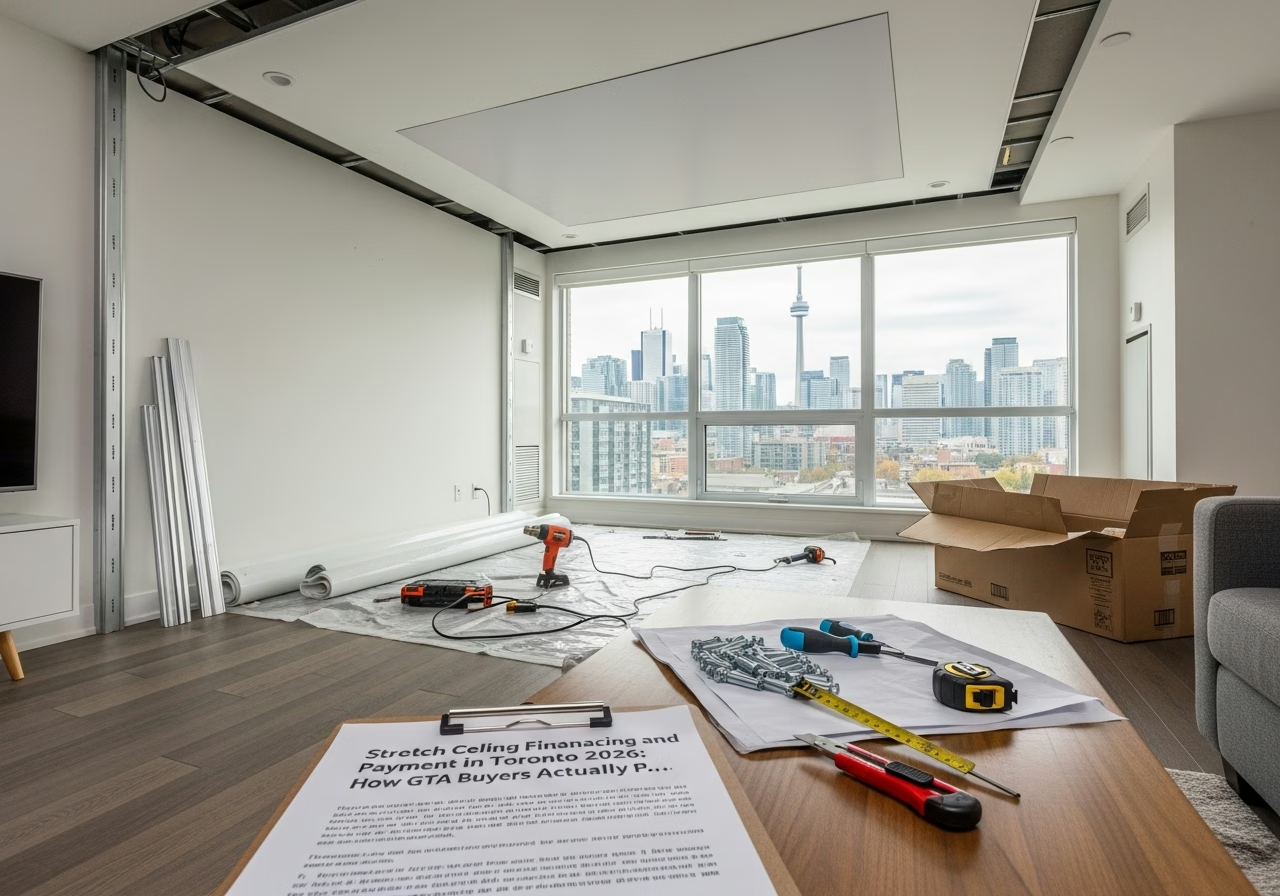
Standard payment structure for mid-tier projects (\$2,000-5,000):
- 50% deposit at quote signing or material order (typically 1-2 weeks before install)
- 50% balance on completion, after the homeowner inspects and signs off
This is the default for established Toronto fabricators and Russian-Canadian installer network mid-tier projects. The deposit funds material order; the balance covers labor.
Two practical notes:
- 1. Send e-transfer to a business name, not a personal name. Established installer LLCs accept e-transfers to the LLC account. Requests for e-transfer to a personal account are a yellow flag (suggests informal operation without proper accounting).
- 2. Keep the e-transfer reference and the invoice together. For warranty enforcement, resale documentation, and tax purposes (if HST is paid), the paper trail matters.
Cash-Only — The Economy Tier's Default
Cash payment is common in the Russian-Canadian installer network for economy-tier projects under \$2,500. The 10-13% "cash discount" is the buyer absorbing tax-evasion risk:
- No HST is collected (the 13% Ontario HST is not remitted to CRA)
- The labor portion of the job is often not declared as installer income
- No documented invoice exists, which means no warranty enforcement, no CRA tax-credit eligibility (e.g., home accessibility tax credit), and no resale renovation documentation
For a \$1,500 economy basement bedroom in a rental unit you plan to flip in 24-36 months, the cash discount math may make sense. For a \$4,000-6,000 master bedroom in a long-term home, the warranty and documentation tradeoff is rarely worth the savings.
Need professional renovation?
Call RenoHouse at 289-212-2345 or get a free estimate today.
Get Free Estimate →Credit Card — Points, Rewards, and Buyer Protection

For sub-\$3,000 projects, paying by credit card delivers:
- Cashback or points rewards (typically 1-3% of the purchase, so \$25-75 on a typical project)
- Buyer protection through the card issuer's chargeback rights — if the installer fails to deliver or delivers materially below spec, you have a recourse path
- HST documentation automatically captured in the credit-card statement
Most established Toronto fabricators accept credit card with a 2-3% surcharge to cover the merchant processing fee. For some buyers, the surcharge negates the points benefit; for others, the buyer-protection value outweighs the surcharge.
Financeit, Snap Financial, and Renovation-Specific Lenders
For premium projects \$4,000+, third-party renovation financing becomes a real option:
- Financeit: Largest renovation-financing platform in Canada. Up to \$80,000 on home improvement projects, terms 6-180 months, rates 6.99%-29.99% APR depending on credit profile. Many established Toronto installers have Financeit partnerships for instant in-quote financing.
- Snap Financial: Similar model, similar rate range. Strong on smaller renovation projects (\$2,000-25,000).
- EnerGuide-aligned lenders: Available for energy-efficient renovation packages where stretch ceiling is bundled with insulation, lighting, or HVAC upgrades.
The math: financing \$5,000 over 36 months at 12.99% APR adds about \$1,000 in interest over the term. Whether that is worth the cash-flow flexibility depends on the buyer's situation. For buyers with good credit (700+), better rates are available through the next category.
HELOC Draw Against Home Equity
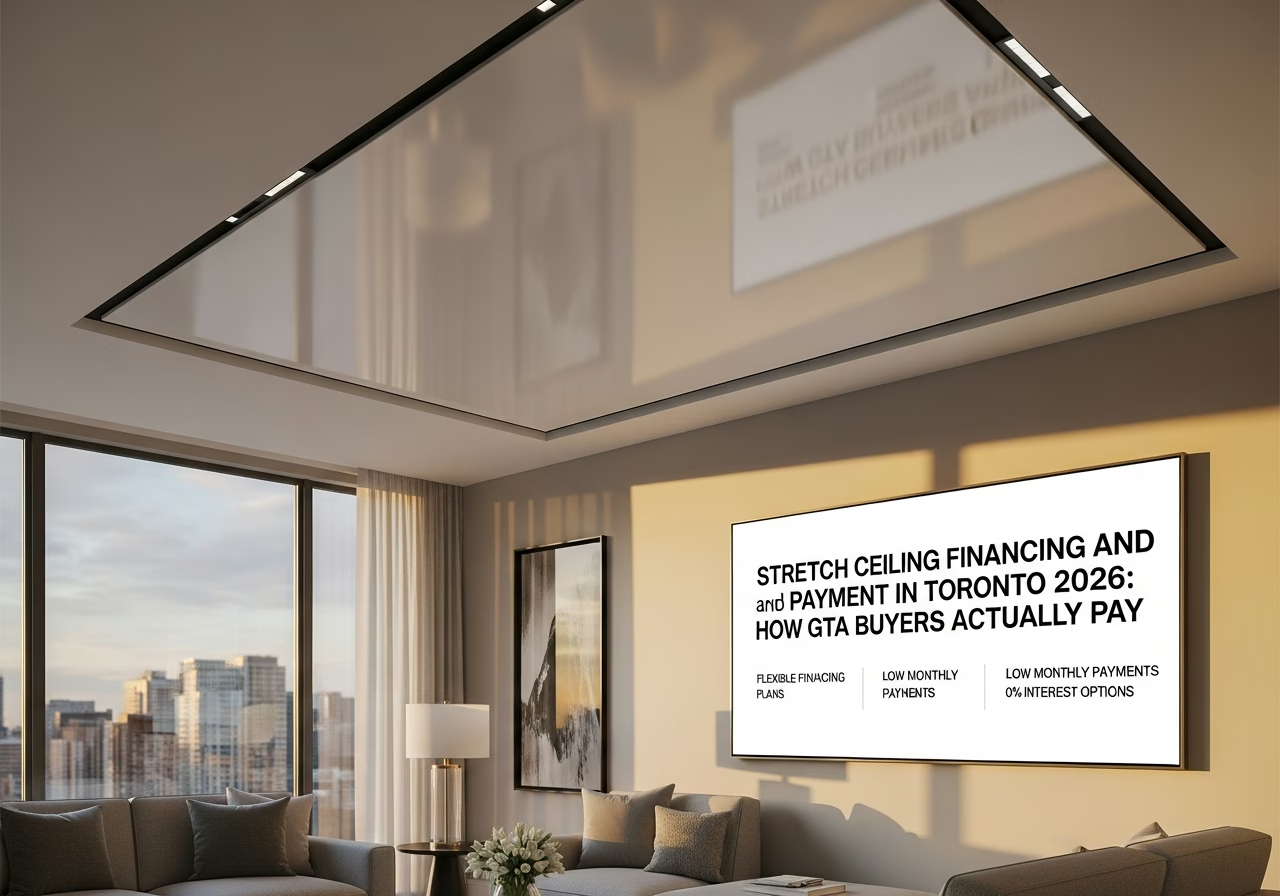
For homeowners with established home equity lines of credit, drawing against the HELOC is often the cheapest financing path:
- Rates currently 6.50-8.00% depending on lender and prime-rate movement
- Interest-only payments if desired, with principal repayment flexibility
- Tax-deductible interest if the project qualifies as a home-improvement renovation under specific CRA criteria (consult your tax advisor)
For a \$5,000 stretch ceiling project, HELOC at 7% interest paid over 24 months adds about \$370 in interest — materially cheaper than third-party renovation financing. The tradeoff: the HELOC must already be set up, and the renovation increases your secured debt against the home.
0% Promotional Financing Through RenoHouse-Coordinated Network
For qualifying premium installations \$4,000+, RenoHouse coordinates 0%-for-12-months financing through a vetted lender network. The structure:
- 0% APR for 12 months if paid in full within the promotional period
- Standard renovation-financing rate (typically 9.99-12.99%) if balance carries past 12 months
- No prepayment penalty — pay off any time without fees
- Quick approval — typically 24-48 hours from application
This is similar to the 0%-for-12-months financing common in the appliance, HVAC, and furniture-retail markets, applied to renovation. The lender absorbs the 12-month interest cost as a customer-acquisition expense; the homeowner gets cash-flow flexibility on a premium project.
Eligibility:
- Project must be \$4,000+
- Buyer credit profile typically 680+
- Project must be coordinated through RenoHouse with a participating installer
- Standard income and employment verification
For a buyer planning a \$8,000 master bedroom premium installation with cove LED, splitting the project across 12 months at 0% APR is meaningfully different from paying \$8,000 upfront in cash.
Payment Schedule for Premium and Multi-Room Projects
For projects exceeding \$8,000 or spanning multiple rooms, the payment schedule typically structures as:
- 30% deposit at quote signing
- 30% on material delivery to fabricator
- 30% on installation completion
- 10% retainage released after a 30-day inspection period
This structure protects both parties — the installer is funded for material and labor as the project progresses; the homeowner retains leverage on quality through the final retainage.
Tax Considerations
Three CRA-related considerations:
- 1. HST is fully recoverable for buyers using the home as a rental property (commercial use registration required).
- 2. Home Accessibility Tax Credit can apply to stretch ceiling work performed for seniors or persons with disabilities (renovations must improve accessibility). HST documentation is required.
- 3. Capital improvements may add to the home's adjusted cost base for capital gains purposes if the home is later sold and not the principal residence. HST-included documentation supports this calculation.
For all three, an HST-included invoice is the prerequisite. Cash-job documentation does not qualify.
Related Reading
- Cost & brands buying guide pillar
- Cost per sqft by tier
- Installation cost breakdown
- Quote questions to ask installer
Coordinate Financing With Your Stretch Ceiling Quote
If your project may benefit from 0%-for-12-months financing, RenoHouse can quote and coordinate the financing application together with the project quote. Approval typically takes 24-48 hours and we can provide the financed payment schedule alongside the project pricing. Request a stretch ceiling quote with financing options.