RenoHouse

# Stretch Ceiling Installation Cost Breakdown 2026: Where Every Dollar Goes
When you receive a stretch ceiling quote in Toronto for, say, \$3,000 on a 200 sqft master bedroom, where does that \$3,000 actually go? Most installer quotes are presented as a single line item ("stretch ceiling installation, 200 sqft"), which makes it nearly impossible to evaluate whether the price is fair, where there is room to negotiate, or what is included.
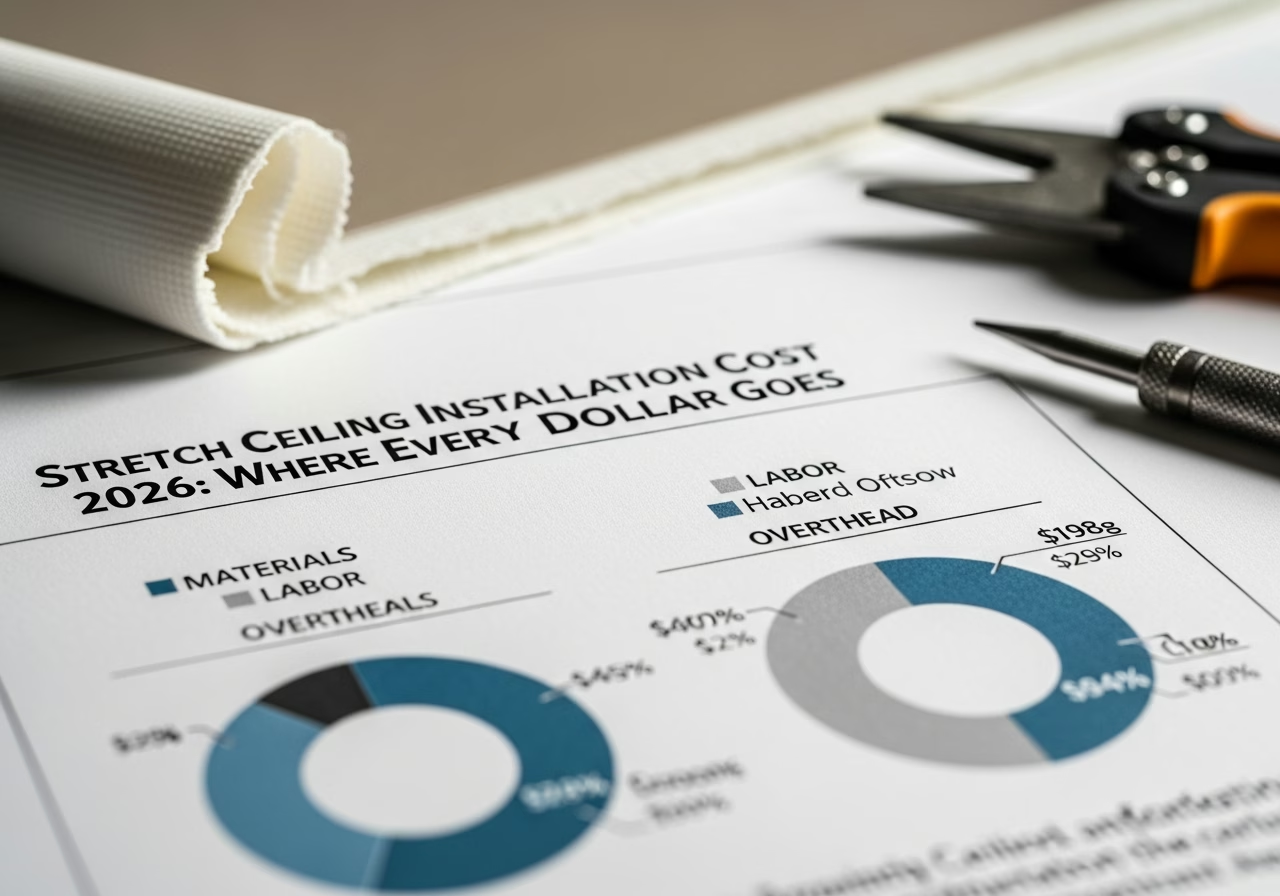
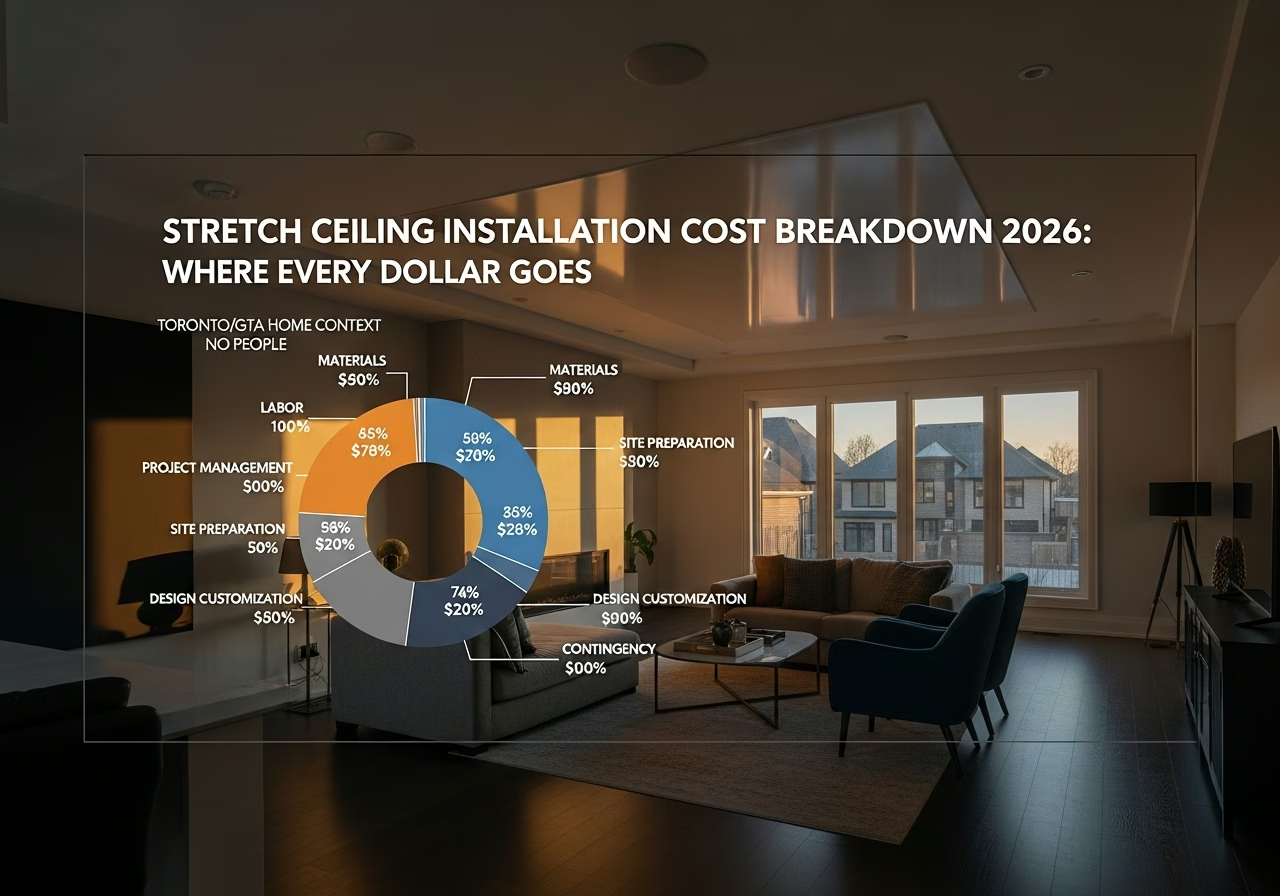
This article decomposes a typical Toronto/GTA mid-tier installation cost line by line, using real 2026 numbers from our installer network. The honest framework: roughly 40% material, 50% labor, 10% overhead — but the dollars within each bucket are worth understanding.
A 200 sqft Master Bedroom Mid-Tier Job — Decomposed
Total quote: \$2,900 + HST = \$3,277 all-in. Here is where each dollar lives:
Material (\$1,180 — about 40% of pre-HST)
| Component | Cost |
|---|---|
| Membrane (MSD premium PVC, 200 sqft + 5% waste = 210 sqft) | \$680 |
| Aluminum harpoon profile (60 linear feet at \$3.50/lf) | \$210 |
| Harpoon edge bead (welded to membrane edge by fabricator) | \$70 |
| Thermo-rings for chandelier and recessed-light cutouts (3 × \$25) | \$75 |
| Profile fasteners, sealant, miscellaneous consumables | \$45 |
| Membrane cost to installer (wholesale, before fabrication margin) | \$100 markup retained at fabricator level |
The membrane at retail is \$3.40/sqft installed-substrate cost; cost to the installer at wholesale is roughly \$2.20/sqft. The \$1.20/sqft fabrication margin pays for membrane welding, harpoon attachment, color matching, and inventory overhead.
Need professional renovation?
Call RenoHouse at 289-212-2345 or get a free estimate today.
Get Free Estimate →Labor (\$1,460 — about 50% of pre-HST)
| Activity | Time | Cost |
|---|---|---|
| Site arrival, setup, drop sheets, propane heater positioning | 30 min × 2 installers | \$80 |
| Profile mounting (60 linear feet, screw-fixed to wall studs) | 90 min × 2 | \$240 |
| Membrane heating with propane gun (room to 60 °C) | 25 min × 2 | \$70 |
| Membrane stretching and harpoon-into-track installation | 60 min × 2 | \$160 |
| Chandelier and recessed-light cutouts with thermo-ring welding | 45 min × 2 | \$120 |
| Cooling, final tensioning, perimeter trim | 20 min × 2 | \$50 |
| Cleanup, propane/equipment load-out | 30 min × 2 | \$80 |
| Travel to/from site (Vaughan/North York to Toronto, both ways) | 90 min × 2 | \$240 |
| Equipment amortization (heat gun, propane, ladders, drop sheets) | — | \$100 |
| Insurance, WSIB allocation, vehicle gas/maintenance | — | \$320 |
Two installers on-site for ~5 hours including travel, with another \$420 in equipment, insurance, and vehicle overhead allocated.
Overhead (\$260 — about 10% of pre-HST)
| Component | Cost |
|---|---|
| Sales/coordination (quote generation, customer communication, scheduling) | \$80 |
| Warehouse rent allocation (Vaughan storage unit, prorated per job) | \$40 |
| Warranty reserve (10-year warranty service fund) | \$80 |
| LLC overhead (accounting, insurance, registration) | \$60 |
HST (\$377)
13% Ontario HST on the \$2,900 pre-tax total.
What Changes When You Move Up or Down a Tier
Moving down to economy (\$1,200-1,500 for the same room)
- Membrane cost halves (\$340 vs \$680) — Halead or unbranded PVC at lower wholesale
- Profile cost stays roughly the same (\$210)
- Labor cost reduces marginally (\$1,200 vs \$1,460) — same time on-site but lower hourly rate, less established LLC overhead, often skipping insurance and WSIB allocation
- Overhead reduces dramatically (\$80 vs \$260) — economy installers operating leaner, often without warranty reserve
- HST often skipped on cash-discount jobs
The \$1,500 economy quote is achievable. What you lose: brand certification (no A+ documentation), warranty reserve (no 10-year service path), LLC continuity (smaller installer with higher dissolution risk).
Moving up to premium fabric (\$3,800-4,800 for the same room)
- Membrane cost roughly doubles (\$1,200 vs \$680) — Clipso fabric at \$5-6/sqft wholesale
- Profile cost similar (standard wedge track for fabric)
- Labor cost increases (\$1,800 vs \$1,460) — fabric install is slower (no heat gun, manual trim)
- Overhead increases (\$400 vs \$260) — fabricator margin chain through AV Style or equivalent
The \$4,500 premium quote pays for fabric instead of PVC, longer install time, and a more established fabricator chain.
What Drives Variance in Labor Hours
Five factors:
- 1. Room geometry. Rectangular rooms install in 4-5 person-hours total. L-shapes, niches, and curved profile runs add 1-2 person-hours per geometric complication.
- 2. Cutout count. Each chandelier or recessed-light cutout adds 15-30 minutes of careful labor. A kitchen with 6 recessed pots adds 1.5-3 person-hours over a bedroom with one chandelier.
- 3. Existing ceiling preparation. If the existing ceiling has popcorn, water damage, or sagging drywall, the prep time adds 1-3 hours. If asbestos abatement is required (pre-1980 GTA homes), that is a separate \$1,500-4,500 line item handled by abatement contractor before stretch ceiling install.
- 4. Profile choice. Standard harpoon profile installs faster than shadow-gap or LED-channel profile (which require more precise alignment). LED-channel profile adds 30-60 minutes over standard.
- 5. Travel distance. From the Vaughan/North York installer concentration to downtown Toronto is 30-60 minutes each way, which is built into typical GTA pricing. Sites further afield (Mississauga, Markham east of 404, Pickering) add 30-45 minutes per direction.
Hidden Cost Items That Sometimes Appear Separately
Six items that sometimes appear as separate line items in quotes (or that you should ask whether they are included):
- 1. HST — always ask whether the quote is pre-tax or all-in
- 2. LED strip and controller for cove lighting — often separately priced
- 3. Electrician coordination for new chandelier circuits or LED transformer hookup
- 4. Disposal of demoed ceiling material — usually included for stretch-over-existing, not for demo-and-replace projects
- 5. Multi-day install premium for staged installations across multiple rooms
- 6. After-hours / weekend install premium — typically 15-25%
Negotiating Levers — Where There Is Real Room
Three areas where there is honest negotiation room without compromising spec:
- 1. Time of year. January-February and July-August are slower seasons. Same-spec quotes can run 8-15% lower in off-season.
- 2. Multi-room bundles. Doing three rooms at once spreads travel and setup overhead across more work. Per-room pricing typically drops 8-12% on multi-room packages.
- 3. Standard color and standard profile. Custom RAL color matching and shadow-gap profile each add real cost. Sticking to standard catalog colors and standard profile saves \$300-800 on a typical job.
Three areas where there is no honest negotiation room without compromising:
- 1. Cutting HST. The 13% "discount" is the buyer absorbing tax-evasion risk, not a margin reduction.
- 2. Cutting warranty reserve. Lowering the warranty reserve is the installer reducing their service capacity, which means fewer claims will be honored.
- 3. Cutting insurance and WSIB. Lowering insurance allocation is the installer running uninsured, which exposes the homeowner if a worker is injured on site.
Related Reading
- Cost & brands buying guide pillar
- Cost per sqft by tier
- Quote questions to ask installer
- Stretch ceiling vs drywall comparison
Get an Itemized Quote
RenoHouse always issues itemized quotes that show the material, labor, and overhead components separately. If you have received single-line quotes elsewhere, use ours as a comparison baseline. Request an itemized stretch ceiling quote.