RenoHouse

# Translucent vs Opaque Stretch Ceiling: Backlight or Standard for Toronto Homes
When designing a stretch ceiling, one of the major branching decisions is whether to specify a standard opaque membrane (matte, satin, or glossy that blocks light) or a translucent backlit membrane (designed to transmit light from above, creating a glowing surface). The two products serve fundamentally different design intents - and most Toronto projects pick one or the other, not both. This guide explains the differences in light transmission, install method, application, and 2026 GTA cost.
For broader context, see our Toronto stretch ceiling complete guide. For the full backlit pillar, see LED backlit stretch ceiling Toronto guide.
The Quick Definition
Opaque stretch ceiling: standard PVC or fabric membrane that blocks light. Fixtures are installed below the membrane (cove lighting, pendants, pot lights cut through). The ceiling reflects ambient light from below; it does not emit light. Translucent stretch ceiling: PVC or fabric membrane engineered to transmit 30-75% of light from above. LED panels or strips are installed in the cavity above the membrane, lit at night to glow uniformly through the surface. The ceiling itself becomes the light source.The two products look identical when unlit (both read as a flat surface). When the LED array above the translucent ceiling is on, the difference is dramatic - the translucent membrane glows like a giant softbox.
Light Transmission Percentages
Translucent membrane comes in different transmission grades:
| Grade | Transmission % | Look |
|---|---|---|
| Heavy translucent | 65-75% | Bright, can show LED array shadows if uneven |
| Standard translucent | 50-65% | Smooth, even glow, hides minor LED unevenness |
| Diffused translucent | 35-50% | Softer, more milky, hides all light source detail |
| Lightly opaque (rare) | 15-30% | Subtle backlight effect, mostly opaque appearance |
For most residential applications, standard translucent at 50-65% transmission is the sweet spot - bright enough to read as luminous but diffused enough to hide LED panel boundaries.
For false-skylight applications (basement family rooms, kitchens, lobbies), heavier translucent (65-75%) maximizes brightness for daylight emulation.
For accent or mood lighting (dining rooms, master bedrooms), diffused (35-50%) reads softer and more atmospheric.
When To Pick Translucent
Translucent backlit stretch ceiling makes sense when:
Fake skylight in a basement. Toronto basements have no windows. A backlit translucent ceiling 80-120 cm wide, set into a recessed pocket, glows at 5000K daylight colour temperature - reads as a real skylight even at midnight. Common in finished basement family rooms and home theatres. Kitchen island uplift. Backlit panel above the kitchen island provides bright shadow-free task light over the workspace, plus dramatic visual impact. Pairs beautifully with marble or quartz islands. Cafe / restaurant atmosphere. A glowing translucent ceiling reads as inviting and modern. Used by Toronto cafes (King West, Yonge corridor), dental offices, and salons. Luxury foyer. Whole-foyer translucent ceiling creates a "lit from heaven" first impression for visitors. Whole-room daylight emulation. For windowless rooms (interior bathrooms, basement gyms), full-ceiling backlit translucent simulates daylight. False stained glass. Translucent membrane with custom UV-printed pattern (faux stained glass, geometric, custom imagery) backlit from above creates a stained-glass effect at $25-$45 per sqft.When To Pick Opaque
Standard opaque stretch ceiling makes sense when:
Need professional renovation?
Call RenoHouse at 289-212-2345 or get a free estimate today.
Get Free Estimate →Install Method Comparison
Opaque install: standard 25-40 mm profile drop. Membrane is installed below the structural ceiling. No additional cavity work. Total time: 2.5-3.5 hours for 200 sqft. Translucent install: profile drop is 30-50 cm to allow LED panel array space above the membrane. The structural ceiling above must be wired for LED panels (usually 600 mm × 600 mm or 1200 mm × 600 mm flat panels), reflective insulation backing, and accessible service panels for LED replacement. Total time: 1-1.5 days for 200 sqft.The deeper cavity is the major install difference. Translucent backlit eats 30-50 cm of ceiling height vs 25-40 mm for opaque.
Cost Breakdown (2026 GTA)
| Configuration | Cost per sqft installed |
|---|---|
| Opaque matte mid-tier | $9-$13 |
| Opaque satin mid-tier | $10-$14 |
| Opaque glossy mid-tier | $10-$15 |
| Opaque glossy premium (Clipso/Barrisol) | $18-$28 |
| Translucent only (no LED) | $14-$20 |
| Translucent with basic LED panel array | $25-$35 |
| Translucent with LED + RGB control | $32-$45 |
| Translucent with Lutron Lumaris RGB+TW | $40-$55 |
| Translucent with custom print backlit (faux stained glass) | $35-$55 |
For a 200 sqft master bedroom, opaque glossy mid-tier is $2,000-$3,000 vs translucent backlit with RGB at $6,400-$9,000 - the translucent option is 3x the cost.
For a 100 sqft basement false-skylight feature, translucent backlit at $25-$35 per sqft is $2,500-$3,500 - manageable as an accent feature within a larger basement renovation.
Mixing Both in One Home
Many premium Toronto projects use both products in a single home:
- Living room: opaque glossy with perimeter cove LED (mood lighting from below).
- Kitchen: opaque satin with backlit translucent island accent (task light from above).
- Master bedroom: opaque matte or satin (calm, no backlight).
- Master bathroom: opaque glossy (water resistance, mirror finish).
- Basement family room: opaque main + translucent false skylight pocket.
- Foyer: translucent backlit (statement first impression).
- Kids' room: opaque printed (cloud or galaxy theme).
The two products coexist beautifully. The decision is per-room, not whole-home.
LED Specifications for Translucent
LED choices for backlit translucent ceilings:
Single-colour LED panels (warm white 3000K or 4000K):- 600×600 mm or 1200×600 mm flat panels.
- Recessed into the cavity above the membrane.
- Cheapest option, even uniform light.
- Cost per ceiling area: $50-$120 per sqft of backlit zone for the LED panels alone.
- 2700-6500K range, adjusts throughout the day.
- Pairs with circadian-rhythm bedroom designs.
- Lutron Caseta or Hue compatible.
- Cost: $80-$180 per sqft.
- Strips arranged in grid pattern above the membrane.
- Full colour control, mood lighting.
- Cost: $100-$200 per sqft.
- Best colour science available.
- Lutron Lumaris or premium controllers.
- Cost: $200-$400 per sqft.
For false-skylight applications, single-colour 5000K daylight panels deliver the best skylight emulation. For mood lighting, RGBW.
Plenum Depth Requirements
Translucent backlit needs space above the membrane for LED arrays:
- Minimum cavity: 30 cm (12 inches) for single LED panel array.
- Standard cavity: 40 cm (16 inches) for spacious LED panel install with service access.
- Premium cavity: 50 cm (20 inches) for grid LED + diffuser layer + service access.
For 9-10 foot ceilings (typical Toronto detached and townhouses), 30-40 cm cavity reduces effective ceiling to 8-9 feet - workable.
For 8-foot Toronto condos, full-ceiling translucent backlit reduces effective ceiling to 6.5-7 feet - too low for most rooms. A small accent zone (over kitchen island, foyer) is more appropriate.
How Translucent Differs From Glossy
Sometimes confused: glossy opaque and translucent backlit can look similar at first glance.
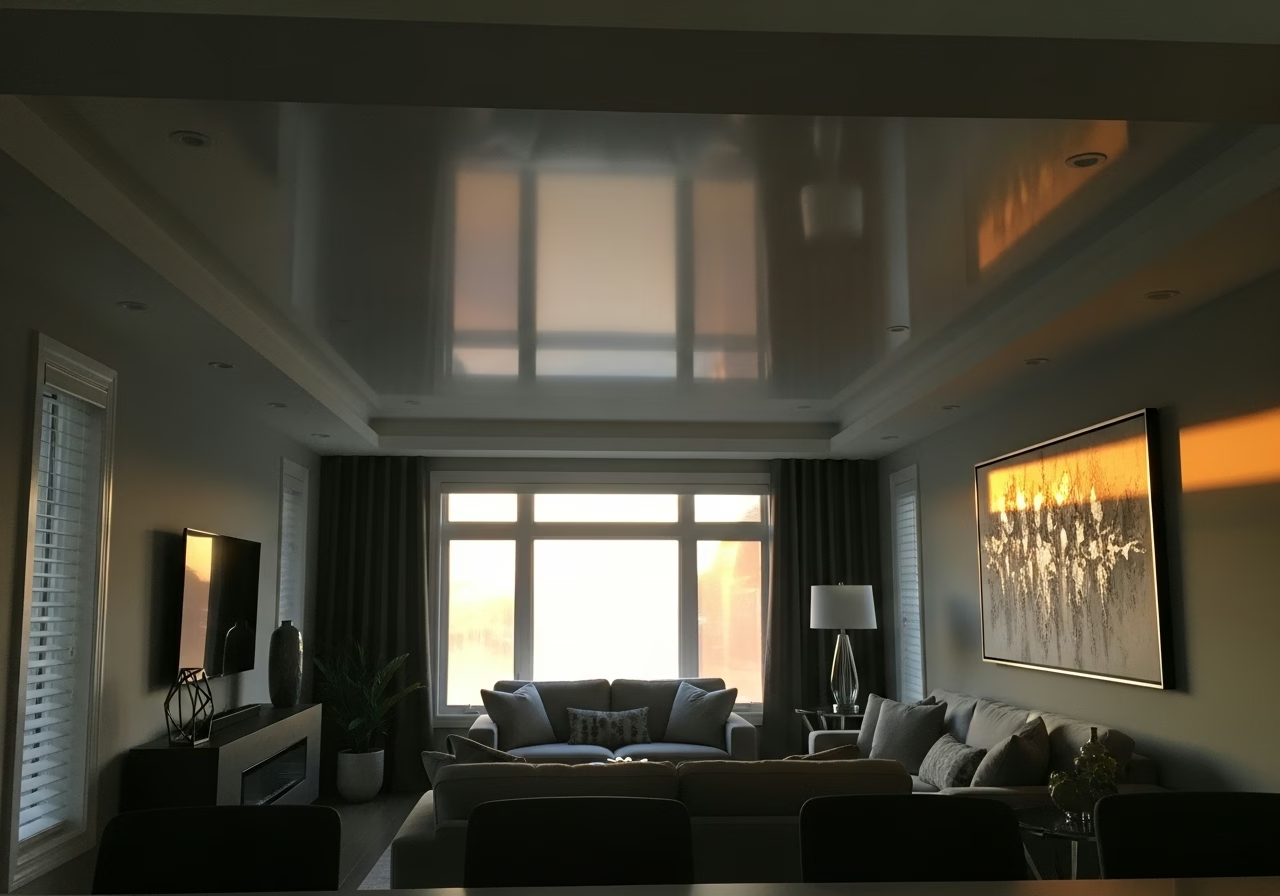
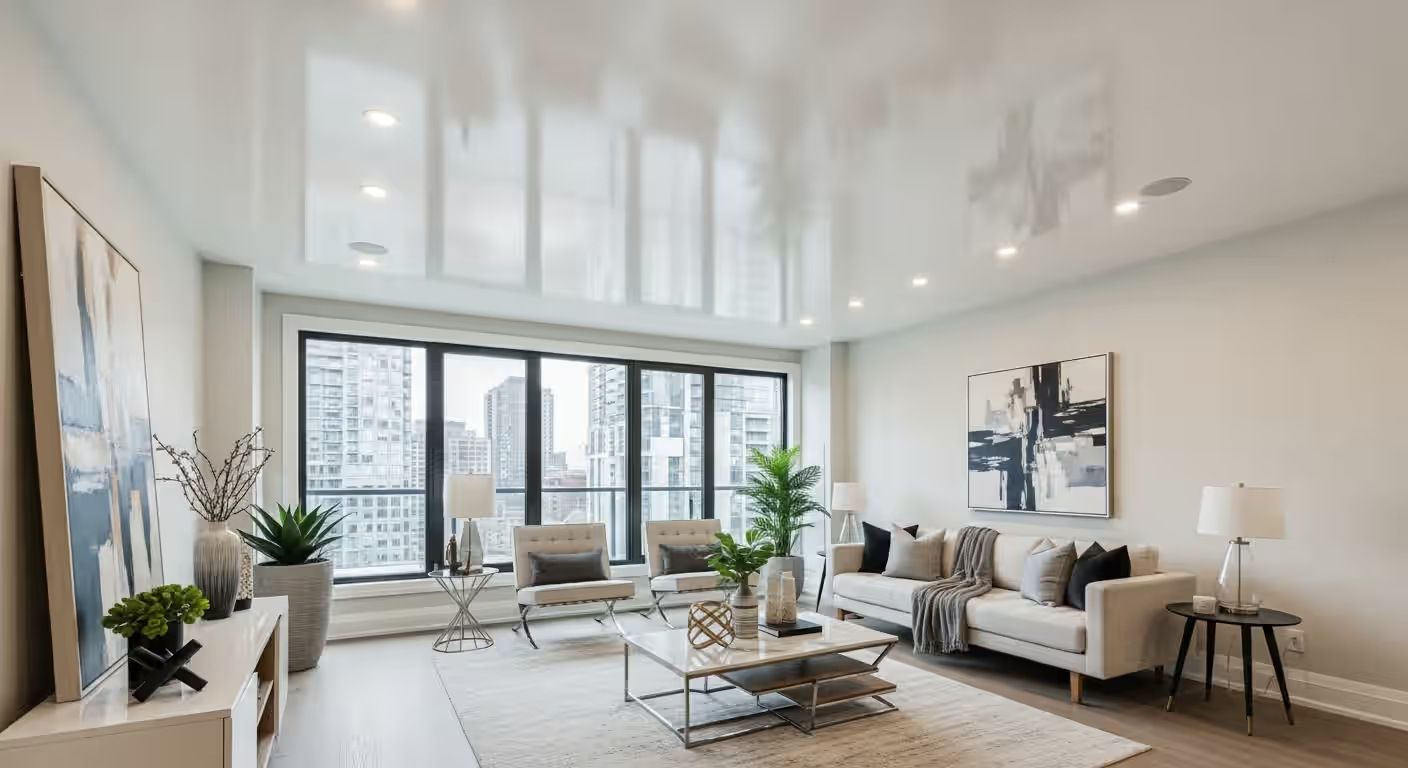
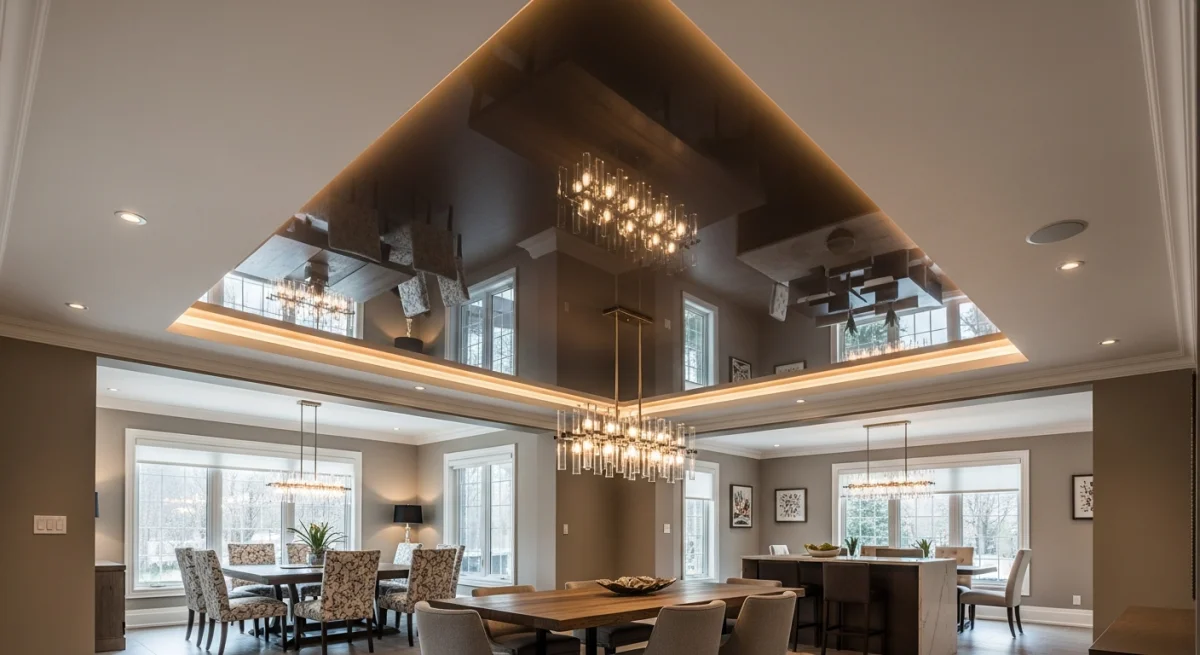
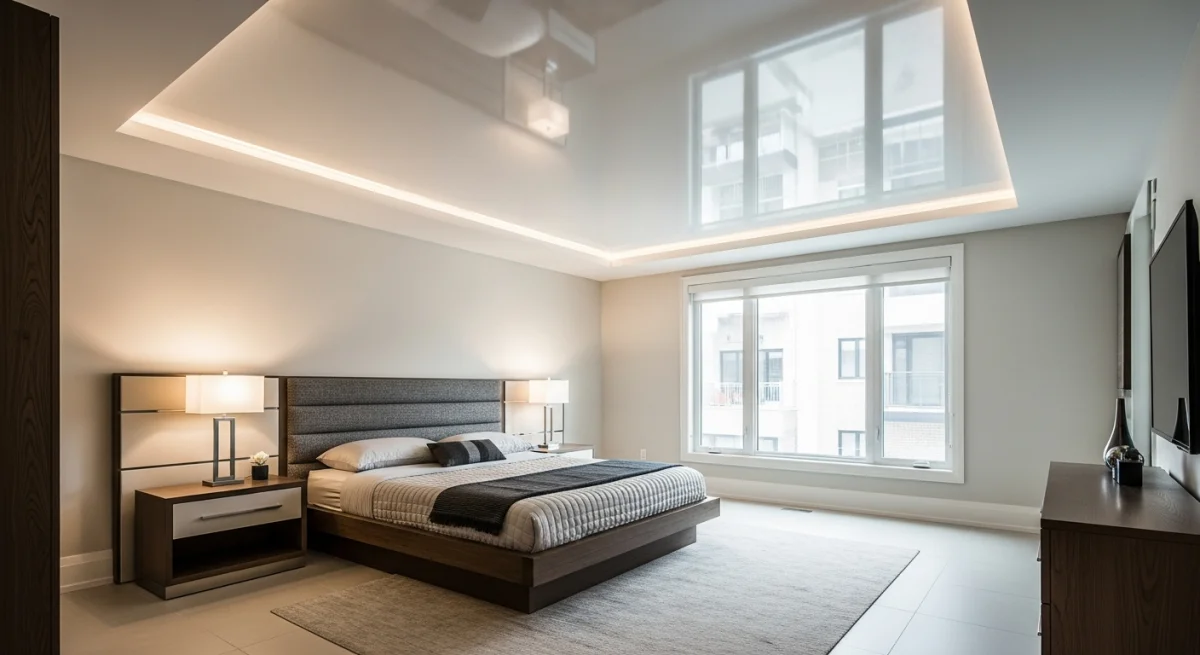
Glossy opaque: reflects light from below. Bright in a well-lit room, dark in a dim room. The ceiling shows reflections of the room contents. Translucent backlit: emits light from above through the membrane. Bright when LED array is on; dark and unremarkable when off. The ceiling shows no reflections (it is not glossy when lit).You can have glossy translucent (rare) - a high-gloss translucent membrane that both reflects and transmits. Premium specialty product. Confusing but striking.
For most residential projects, choose between opaque glossy (mirror reflection effect) and translucent backlit (glowing surface effect). The two effects are different.
How RenoHouse Specifies
Default specifications:
- Bedroom, living room, dining room: opaque glossy or satin (mid-tier MSD Premium).
- Kitchen island accent: translucent backlit with daylight LED.
- Basement false skylight: translucent backlit with daylight LED, custom-cut pocket.
- Master bathroom: opaque glossy.
- Foyer: translucent backlit (premium project) or opaque glossy with cove (mid-tier).
- Restaurant, cafe: translucent backlit for atmosphere; opaque glossy for cleanability.
We bring physical samples of both products during the consultation to view in your actual lighting conditions.
Get a free quote with both translucent and opaque options priced for any Toronto project.FAQ
Can I add backlight to my existing opaque ceiling? Not without replacing the membrane. Translucent and opaque are different products; you cannot retrofit transmission into opaque PVC. Will the LED panels need replacement? Quality LED panels are rated 50,000+ hours. Replacement requires partial detachment of the stretch ceiling for service access - we plan service hatches into the install design. Can a translucent ceiling be glossy? Specialty product available from Barrisol and Clipso. Rare in residential. Does translucent affect water-leak resilience? Yes - translucent PVC has the same impermeable property as opaque PVC. Holds water. The backlit cavity above is a concern (LED panels are not waterproof), so leak response includes drying the LED cavity. Can I have RGB on opaque? Cove RGB LEDs are common on opaque - they wash light onto the ceiling from a profile-mounted strip below. Not the same as backlit RGB through the membrane, but a similar effect at lower cost.Continue Reading