RenoHouse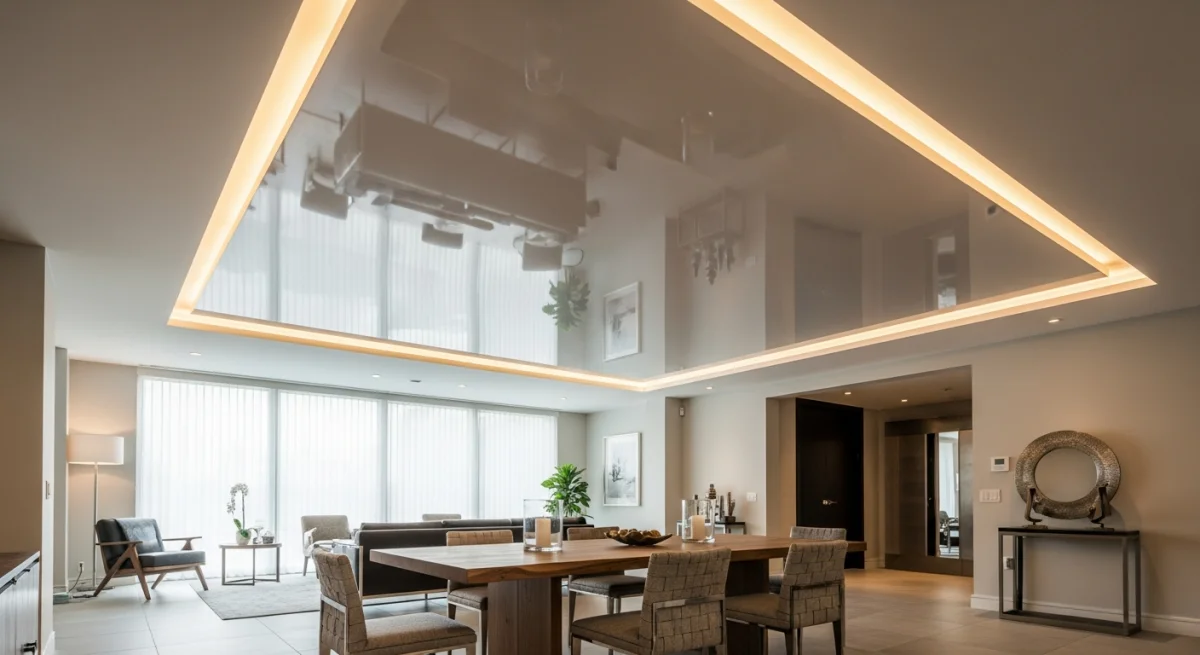

# LED Backlit Stretch Ceiling Toronto 2026: Complete Guide to RGB, Cove & Smart-Home Lighting
Quick answer. Backlit and LED stretch ceilings combine a translucent or standard PVC/fabric membrane with concealed LED strips, panels, or fibre-optic point lighting to create soft glowing surfaces, RGB accent zones, perimeter coves, or "false skylights." In Toronto, expect $18–$30/sqft for a fully backlit translucent ceiling with diffusion panels, $12–$22/sqft for RGB or RGBW strip cove integration around a standard stretch ceiling, and $2,500–$8,000 for smart-home control layered on top depending on whether you choose Lutron Caseta, RA3, Philips Hue or KNX. Low-voltage LED strip work itself does not require an ESA permit — but any 120V tie-in (driver power feeds, wall-box dimmers, switched neutrals) must be done by an ESA-licensed Master Electrician, and that is exactly how RenoHouse coordinates every backlit project.This is the pillar guide for Cluster 3 of our Toronto stretch ceiling series — backlit and LED. If you are still deciding between fundamentals like glossy vs matte film, start with our Toronto stretch ceiling fundamentals pillar. For star-sky fibre-optic ceilings, jump to the star sky pillar. For room-by-room ideas, see the stretch ceiling by room pillar. For pricing, see the stretch ceiling cost pillar. For installation logistics and care, see the installation and care pillar. And for the smart-home backbone the lighting plugs into, see our Toronto smart home installation pillar.
What "Backlit" and "LED Stretch Ceiling" Actually Mean
The terms get used interchangeably in marketing, but they describe four genuinely different systems. Specifying the wrong one is the single most common mistake we see on Toronto projects.
1. Translucent Backlit Membrane (Light-Through Surface)
A light-transmitting PVC film or coated polyester fabric is stretched into the perimeter track. Above the membrane — in the plenum cavity between the new ceiling and the old slab or joists — sits a continuous LED panel array, a grid of LED strips on aluminium channels, or a custom edge-lit light box. Light passes through the film, producing a uniform glow surface that looks like a frosted skylight. Common brands: Barrisol Lumière, Cosmolight, Pongs lite (translucent), Descor Backlit. Light transmission ranges from 50–75% depending on the film. Above the film, installers typically spec 6500K daylight or 4000K neutral LED panels because the human eye perceives the diffused output as warmer than the source — a 4000K source through a translucent film reads as about 3000–3500K in the room.
2. Cove or Perimeter LED (Strip Around the Edge)
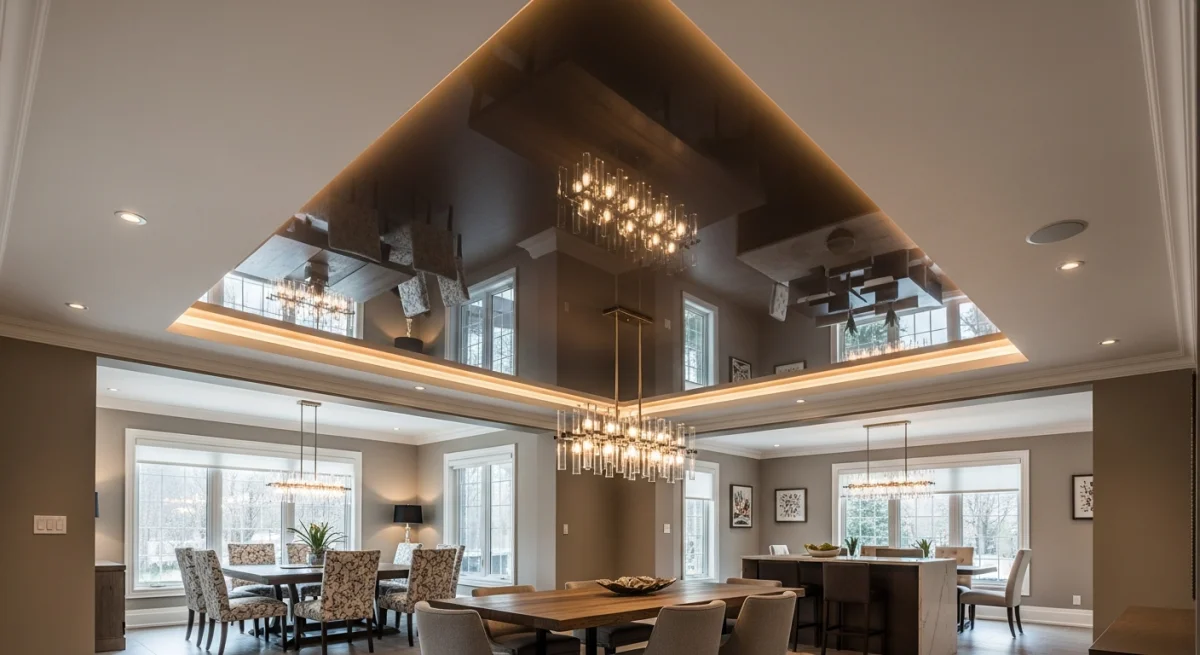
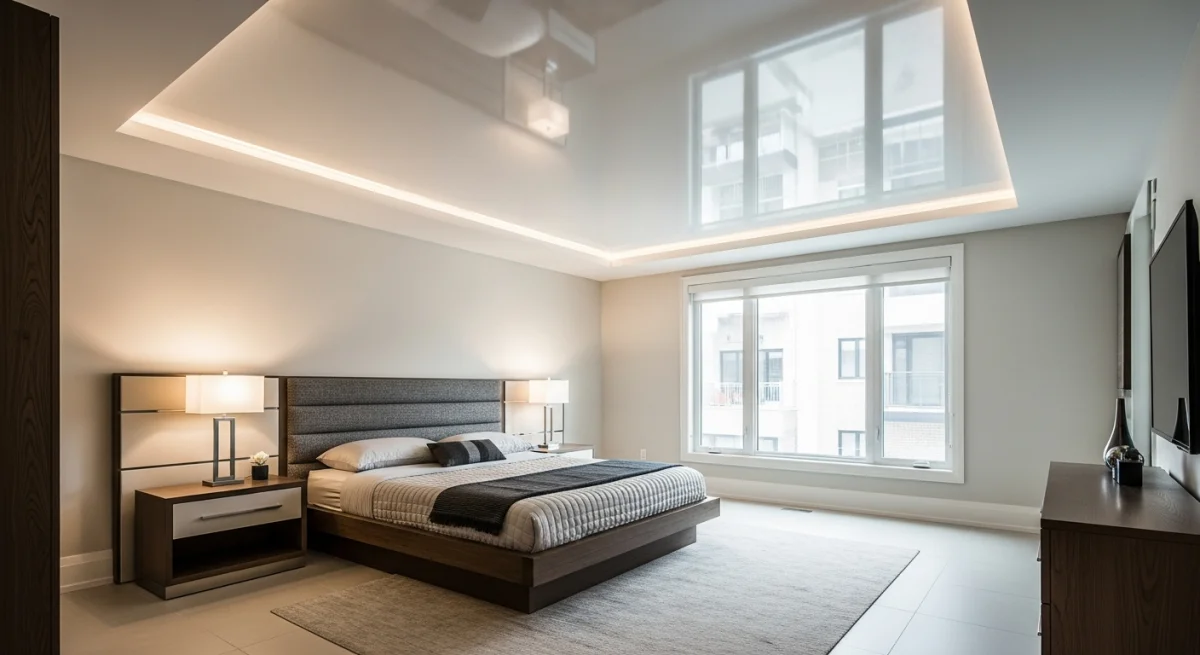
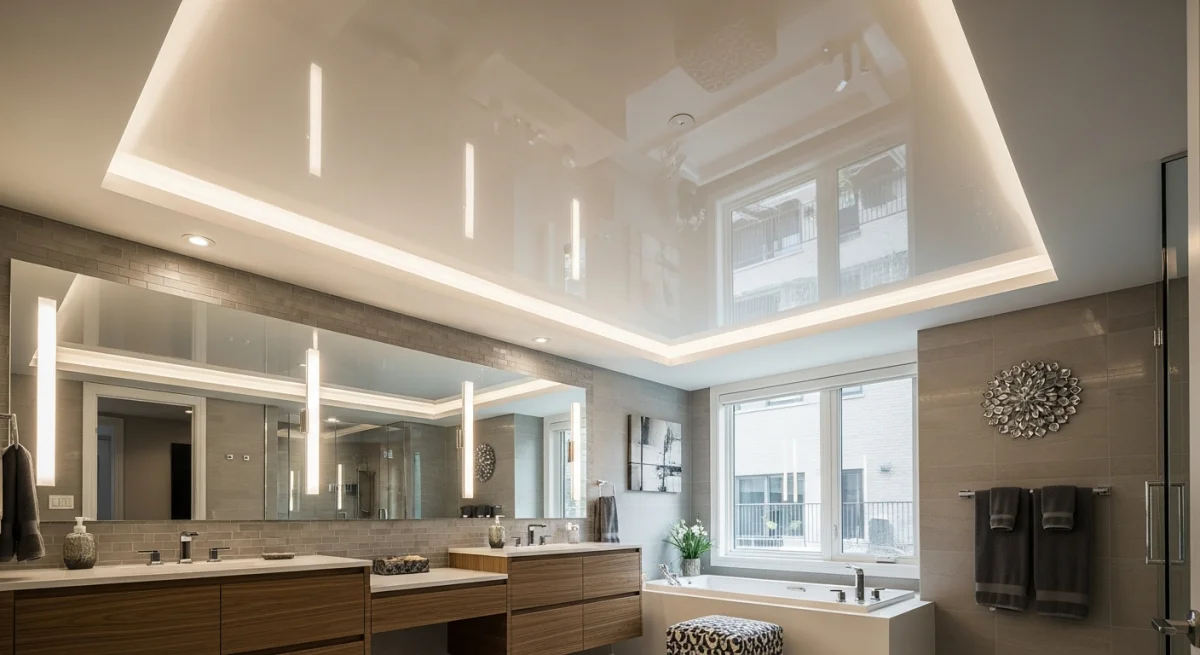
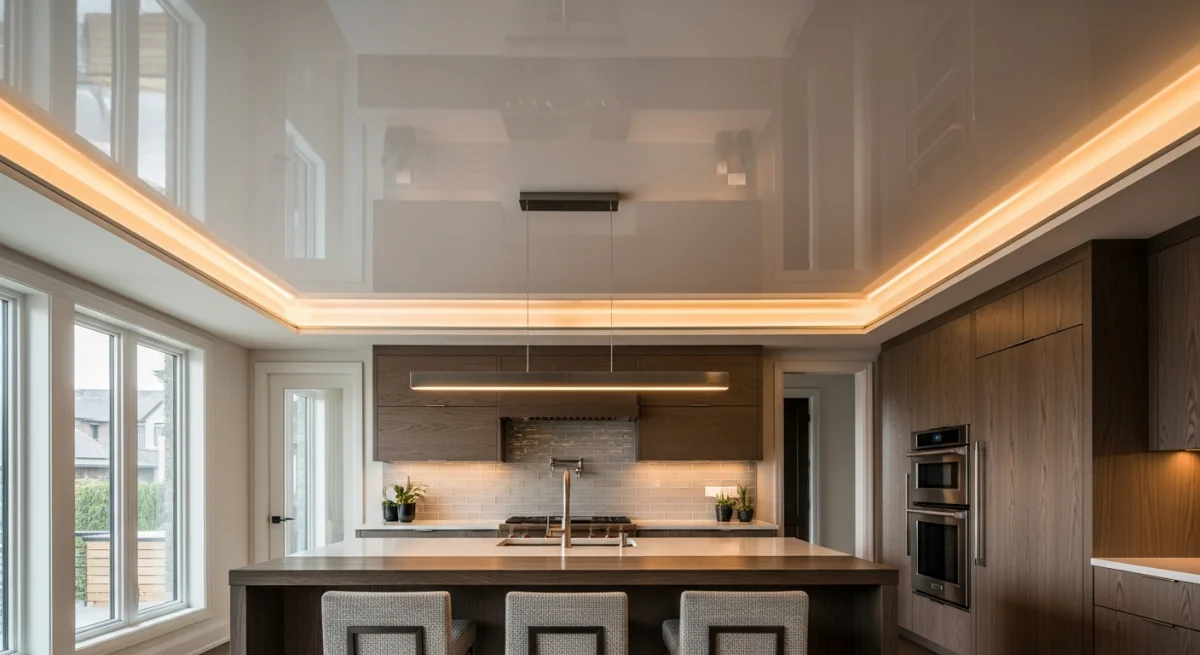
A single-color, tunable-white, RGB, RGBW or RGBWW LED strip is mounted in an aluminium channel concealed behind the perimeter profile of a stretch ceiling. The light washes up the wall or down across the surface depending on profile orientation. This is the most common "LED stretch ceiling" in Toronto — it does not require a translucent film, works with any colour or finish (gloss, satin, matte), and is the lighting upgrade most homeowners actually want.
3. Embedded Spot or Track Lighting
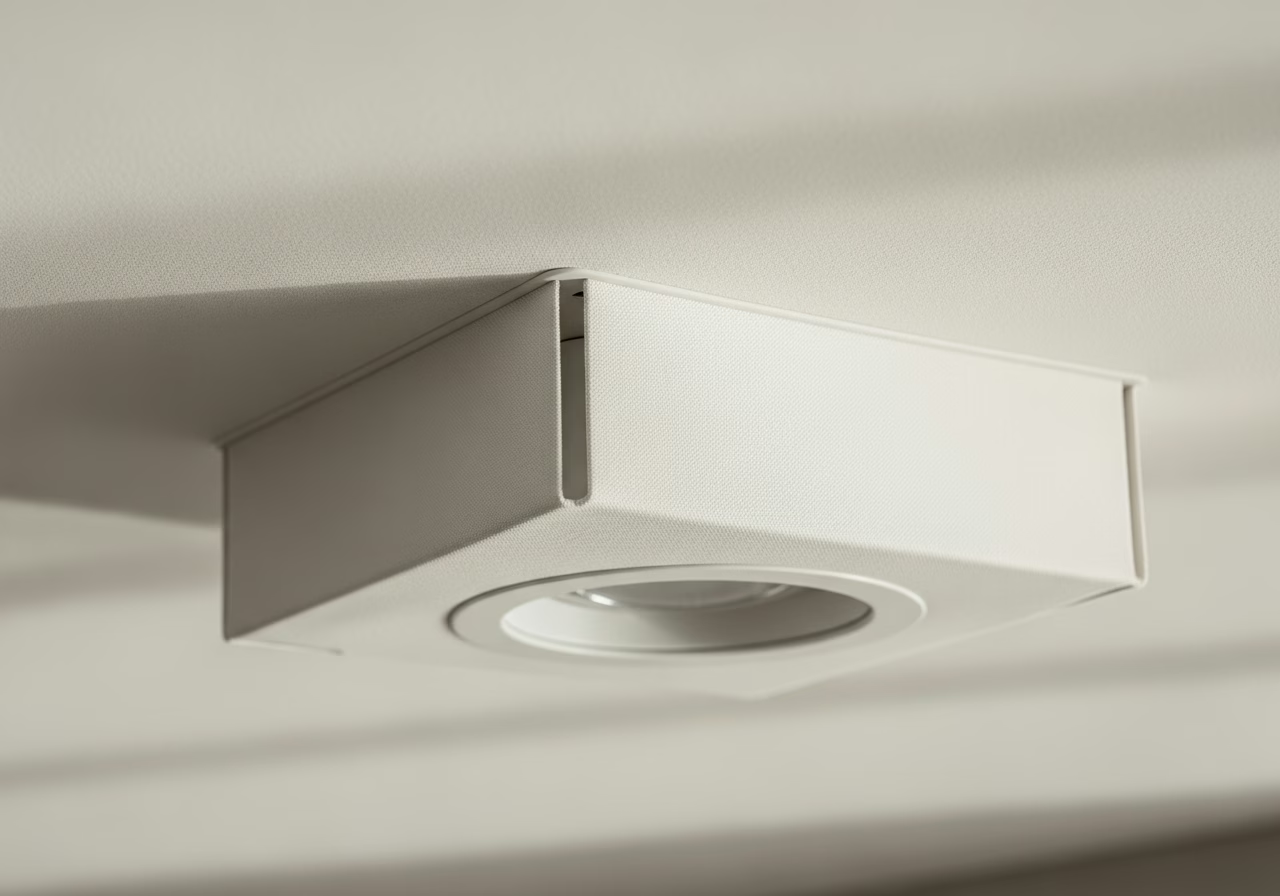
Pot lights, gimbal LEDs, or magnetic track systems pass through the membrane via reinforcement rings. This is conventional ceiling lighting that simply happens to share a stretch ceiling — not really "backlit" at all, though installers sometimes label it that way.
4. Hybrid Star-Sky Plus RGB
Fibre-optic point lighting (handled in detail in our star sky pillar) combined with an RGB perimeter strip. This gives a "galaxy plus aurora" effect that has become signature for Russian-Canadian master bedrooms in Vaughan and Thornhill.
For the rest of this guide we focus on systems 1 and 2 — true backlit translucent and cove/perimeter LED — because that is what "LED backlit stretch ceiling" means to most Toronto homeowners booking quotes in 2026.
Translucent Backlit Stretch Ceiling — How It Works
A backlit ceiling is essentially a giant edge-lit luminaire that happens to be the shape of your room. Done well, it produces hospital-grade uniform lighting with no visible hotspots, no glare, and a colour temperature you can tune to the time of day. Done badly, it looks like a Costco light box bolted to your ceiling.
The Cavity
Above the translucent membrane you need a clean, light-coloured plenum cavity. The minimum recommended depth between the LED source and the film is 150mm (6 inches) — go shallower and you will see hotspots directly under each LED. For premium even-glow installations we spec 250–400mm (10–16 inches) of cavity depth, which is why backlit ceilings drop your finished ceiling height more than a basic stretch ceiling does. In a Toronto condo with an 8'0" slab, that is non-trivial — many Bay/Bloor and CityPlace units end up with 7'4" finished height in the backlit zone, which is still legal under OBC but feels low at the perimeter.
The Light Source
Three patterns dominate:
- LED strip on aluminium channel, 50–100mm spacing — cheapest, highest hotspot risk if cavity is shallow.
- LED panel array (back-mounted edge-lit panels, daisy-chained) — most uniform, mid-priced. Brands like Halco, Pixi, MaxLite work; we usually spec premium panels with a 90+ CRI rating.
- Custom edge-lit light box (acrylic diffuser plus side-mounted LED bars) — premium, used by Barrisol Lumière for high-end retail and luxury residential.
The Diffuser Layer
In premium installations a secondary diffusion layer (a thin opal acrylic sheet, or a second light-frosted film) sits between the LED source and the translucent ceiling. This is what eliminates hotspots when cavity depth is constrained — common in condo retrofits.
The Driver and 120V Feed
This is where ESA matters. The LED strips and panels themselves are 12V or 24V DC and can be installed by anyone competent. The driver (also called LED transformer or power supply) converts 120V to low voltage and must be wired by an ESA-licensed Master Electrician. Drivers are typically located inside the plenum on a dedicated junction box, accessed through a removable maintenance panel cut into the stretch ceiling. RenoHouse coordinates the licensed electrician for the 120V side as a standard part of every backlit project.
Cove and Perimeter LED — The Practical Default
For 80% of Toronto stretch ceiling projects, "LED" means a perimeter cove strip — not a fully backlit ceiling. The economics are dramatically better and the visual effect is what most people actually want.
Profile Choices
Stretch ceiling perimeter profiles come in three flavours that all support LED integration:
- Straight harpoon profile — basic, no light slot.
- L-profile with light slot — accommodates a 10mm aluminium LED channel behind the membrane edge. Light washes the wall.
- KP-profile (combined cove and shadow gap) — premium European profile that creates a clean shadow gap and a wall-wash light effect simultaneously. This is what high-end Vaughan and Thornhill projects spec.
Strip Selection
For a 200 sqft master bedroom with about 18m of perimeter, the strip choice cascades through cost:
Need professional renovation?
Call RenoHouse at 289-212-2345 or get a free estimate today.
Get Free Estimate →- Single-color 2700K or 3000K, 24V, 14W/m, 90+ CRI — $12–18/m strip plus driver, roughly $400–650 in materials, $700–1,100 installed.
- Tunable white 2700–6500K, 24V — about 30% more expensive at material level.
- RGB only — cheap to buy ($8–15/m) but white quality is poor; we rarely spec for residential.
- RGBW or RGBWW — $25–45/m, true colour-mixing plus dedicated white channel. Material cost roughly $700–1,100, installed $1,400–2,200 for 18m.
- Lutron Lumaris RGB+TW (premium spec) — $1,800–3,500 in materials for the same run, plus a Lutron RA3 controller.
We dive deeper into RGB versus RGBW versus RGBWW differences in our dedicated comparison.
Driver Sizing
Total wattage = strip wattage per metre × length × 1.2 safety factor. For a 14W/m strip running 18m, that is 18 × 14 × 1.2 = 302W, so we spec a 350W constant-voltage driver — typically two 175W Mean Well or Magnitude drivers in parallel for redundancy and so that one strip section can be serviced without killing the whole perimeter.
Smart-Home Control — Lutron, Hue, KNX
This is where backlit and cove LED stretch ceilings get genuinely interesting. Once the LED is in the ceiling, you choose the brain.
Lutron Caseta
Caseta is the practical default for Toronto homes. It is wireless RF (Clear Connect), reliable, works with HomeKit, Alexa and Google, and critically supports no-neutral wiring — important in older Toronto homes with two-wire boxes. Caseta dimmers handle 0–10V or ELV (electronic low voltage) drivers depending on which model you choose. For a single perimeter cove circuit you can run a Caseta Pro dimmer for about $250 plus a Smart Bridge Pro for $200. We cover the full integration in our Lutron Caseta stretch ceiling integration guide.
Lutron RA3
RA3 is the premium hard-wired bus system — what high-end Toronto homes spec when they have multiple cove zones, tunable white control, Lumaris RGB+TW, and integration with motorized shades, HVAC, and audio. Budget $5,000–15,000 for the controller, processors, keypads, and programming for a full home. RA3 is the right choice when the stretch ceiling is one of many integrated systems.
Philips Hue
Hue is the homeowner-friendly RGB choice. Hue Lightstrip Plus runs up to 10m per controller, Hue Gradient strips give pixel-mapped colour, and the Hue Bridge ties everything to HomeKit, Alexa, Google, and the Hue app. Best for kids' rooms, master bedroom accent coves, and entertainment zones. Drawbacks: voltage drop on long runs (over 10m needs an extension or signal repeater), and the strips are 12V which limits maximum length. Full guide in our Philips Hue stretch ceiling integration article.
KNX
KNX is the European luxury bus standard — used in Russian-Canadian custom homes in Bridle Path, Forest Hill, and the wealthier pockets of Vaughan. It is a hard-wired protocol that controls lighting, shades, HVAC, and access on a single twisted-pair bus. KNX integrates with stretch ceiling LED via DALI gateways or 0–10V actuators. Budget for KNX is essentially open-ended: a fully KNX-controlled new-build with stretch ceilings runs $40,000–120,000 for the lighting and control layer alone. See our KNX stretch ceiling luxury integration guide for full detail.
Color Temperature — The 2700K vs 3000K vs 5000K Question
Color temperature is measured in Kelvin and is the single biggest determinant of how a backlit ceiling feels. The key Toronto residential numbers:
- 2700K (warm white) — incandescent equivalent. The default for bedrooms, dining, living rooms, hospitality. This is what Russian-Canadian buyers reflexively prefer for master suites because it matches the chandeliers and sconces they already own.
- 3000K (warm-neutral) — slightly cooler. Master bathrooms, kitchens with warm finishes, the universal sweet spot for backlit translucent ceilings because the diffusion warms the perceived temperature.
- 3500K (neutral) — modern kitchens, home offices.
- 4000K (neutral-cool) — contemporary kitchens, garages, basements with daylight emulation, commercial environments.
- 5000K (daylight) — clinical and commercial only. Almost never used in Toronto residential.
- 6500K (cool daylight) — used above translucent backlit films because it perceives as 3000–3500K through the diffusion, and used in commercial backlit panels (think dentist office or hotel lobby).
Full breakdown including how to test the temperature in your room before committing in our color temperature comparison article. For circadian-rhythm tunable systems that shift from cool morning to warm evening automatically, see our tunable white circadian guide.
Costs — What a Toronto Backlit or LED Stretch Ceiling Actually Runs
All-in costs for completed Toronto projects in 2026, vetted-installer pricing including taxes:
| System | $/sqft installed | Typical 200 sqft room | Notes |
|---|---|---|---|
| Standard stretch ceiling, no LED | $6–15 | $1,200–3,000 | Baseline reference |
| Stretch ceiling with single-color cove LED | $12–18 | $2,400–3,600 | Most popular upgrade |
| Stretch ceiling with RGB or RGBW cove | $14–22 | $2,800–4,400 | Includes driver, basic controller |
| Translucent backlit, edge-lit, no smart control | $18–25 | $3,600–5,000 | 4000K or 6500K source |
| Translucent backlit, full panel array, smart control | $22–30 | $4,400–6,000 | Lutron Caseta or Hue integration |
| Hybrid backlit + RGB perimeter | $24–35 | $4,800–7,000 | Two zones, two controllers |
| Backlit with Lutron RA3 or KNX | $30–50+ | $6,000–10,000+ | Custom programming, premium drivers |
ESA Master Electrician for the 120V tie-in is included in those installed prices when you book through RenoHouse. Smart-home programming (Lutron RA3, KNX) is billed separately at $1,500–8,000 depending on scope. Full cost teardown including the 18m strip example in our LED strip stretch ceiling cost guide for Toronto.
Choosing Films and Brands
For translucent backlit installations the film matters enormously — it is the diffusion layer that determines whether your ceiling looks like a luxury skylight or a fluorescent office.
- Barrisol Lumière — the gold standard, French-made, used in Burj Khalifa and Louis Vuitton flagship stores. About 70% light transmission, A+ indoor air quality certification. Specified for premium Toronto residential and commercial. Detailed walkthrough in our Barrisol Lumière translucent guide.
- Cosmolight — Italian, 60–75% transmission, mid-premium pricing. Common Toronto choice when budget excludes Barrisol.
- Pongs lite — German, mid-tier, 55–65% transmission. Heritage brand, dependable.
- Descor Backlit — German, 50–70% transmission, often spec'd for acoustic-plus-backlit hybrid commercial.
- MSD translucent — Chinese, workhorse brand, 50–60% transmission. Used by most Russian-Canadian small installers as the budget translucent option.
For non-translucent stretch ceilings with cove LED you can use any standard PVC or fabric film — the lighting is independent of the membrane.
Dimmers and Controllers
The dimmer is the silent quality determinant of every LED stretch ceiling. Cheap dimmers cause flicker, audible buzz, and shortened LED life. Match the dimmer type to the driver:
- 0–10V dimming — analog, very smooth, requires 0–10V capable driver. Lutron Diva 0–10V or Caseta with 0–10V module.
- PWM dimming — pulse-width modulation, used by most low-voltage LED controllers including Hue and KNX-DALI. Smooth 1–100%.
- Triac / forward-phase — older drivers only. Avoid on residential LED stretch.
- ELV / reverse-phase — works with most modern LED drivers. Lutron Caseta ELV is the workhorse.
We unpack driver-and-dimmer matching in detail in our dimmer and controller selection guide.
Honest Positioning — Who Does the Work
RenoHouse is a vetted installer network, not an in-house install crew. For backlit and LED stretch ceiling projects in the GTA we coordinate two parties:
- 1. A vetted Russian-Canadian stretch ceiling installer who handles the membrane, profile, perimeter LED channel, and any low-voltage strip work. Low-voltage LED strip installation does not require an ESA permit in Ontario.
- 2. An ESA-licensed Master Electrician who handles the 120V tie-in — driver power feeds, wall-box dimmers, switched neutrals, and any new circuit work. This is non-negotiable for code compliance and homeowner insurance.
For smart-home integration (Lutron RA3, KNX, Philips Hue) we coordinate with our preferred Toronto smart-home programmer — see our smart home installation pillar for the broader programme. Every backlit project ships with a documented load schedule, driver placement diagram, ESA permit closeout, and a 10-year RenoHouse-backed installation warranty layered on top of the manufacturer warranty.
Common Toronto Mistakes We See
- Translucent film with under 150mm cavity depth — visible hotspots that no diffuser can fully fix.
- RGB-only strips spec'd for white-light primary use — the white from RGB is not white. Use RGBW or RGBWW.
- No-name drivers — flicker and EMI. Always Mean Well, Magnitude, or Lutron.
- Cove channels installed too tight to the wall — uneven wall wash. Minimum 30mm setback.
- No 120V Master Electrician on the file — fails ESA inspection, voids insurance.
- Hue spec'd for runs over 10m — voltage drop and color shift. Use Lutron RA3 or break into two zones.
- Smart-home programming skipped — homeowner ends up with a $6,000 ceiling and an iPhone-only app. Always programme keypads and physical wall controls.
Frequently Asked Questions
Does a backlit stretch ceiling need an ESA permit?
Low-voltage LED strip work itself does not. The 120V driver feed, dimmer, and any new circuit absolutely do — and must be performed by an ESA-licensed Master Electrician. RenoHouse coordinates the electrician on every backlit project.
How much does a 200 sqft backlit translucent ceiling cost in Toronto?
Roughly $3,600–6,000 installed depending on the diffusion film (MSD versus Barrisol Lumière), cavity depth, LED panel quality, and whether you want smart-home control. Add $1,500–3,000 for Lutron RA3 or KNX programming.
Can I get a backlit ceiling in a Toronto condo with 8' slab height?
Yes, but expect a finished height of about 7'4" in the backlit zone because of the cavity depth required for even diffusion. Many condo owners pair a partial backlit panel (over the kitchen island or master bed) with a standard stretch ceiling elsewhere to preserve room volume.
What colour temperature should I pick?
3000K is the universal sweet spot for backlit translucent. For cove and perimeter LED, 2700K for bedrooms and 3000K for kitchens is the standard. If you want flexibility, spec a tunable white system and let it shift across the day — see our tunable white circadian article.
Can I do this myself?
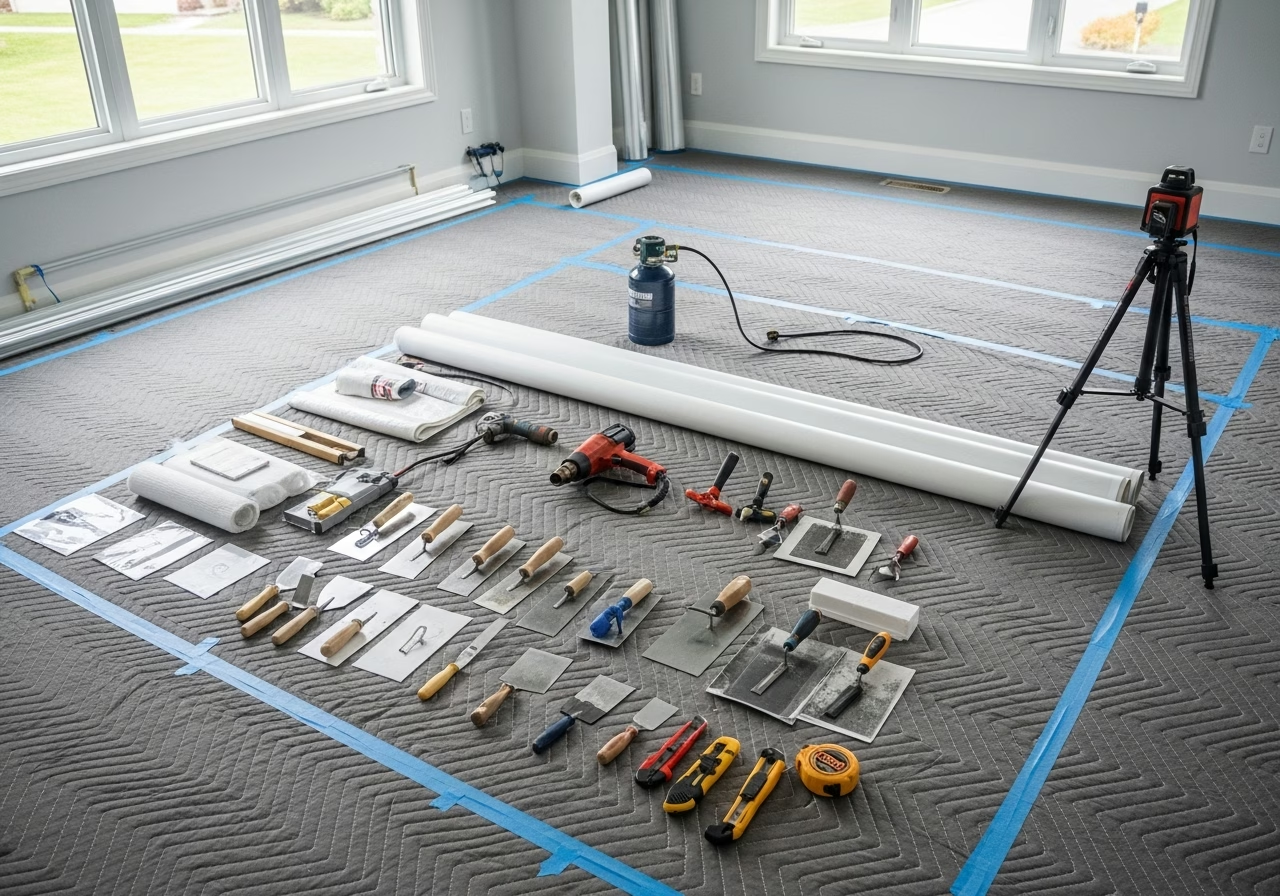
The membrane install requires a gas heat gun and 200+ hours of training — not a DIY job. The LED strip side could theoretically be DIY, but the moment a 120V driver is involved you need an ESA-licensed electrician. We strongly recommend booking the whole package as a coordinated install.
Ready to Plan Your Project?
Booking a backlit or LED stretch ceiling in Toronto starts with a 30-minute measure-and-design visit. We map your room, model the diffusion cavity depth, spec the film and LED system, write the load schedule, and quote a fixed all-in price including ESA Master Electrician and any smart-home integration. Book a backlit stretch ceiling consultation and we will handle the rest.
For the broader stretch ceiling decision tree (matte vs gloss, PVC vs fabric, single vs multi-level) start with our Toronto stretch ceiling complete guide. For the smart-home backbone the lighting plugs into, see our Toronto smart home installation pillar.
Continue Reading
- LED Strip Stretch Ceiling Cost in Toronto: 2026 Pricing Breakdown
- Translucent Backlit Panel Stretch Ceiling: How the Glow Surface Is Built
- Cove Lighting with Stretch Ceiling in Toronto: Profiles, Strips, and the Wall-Wash Effect
Related Services