RenoHouse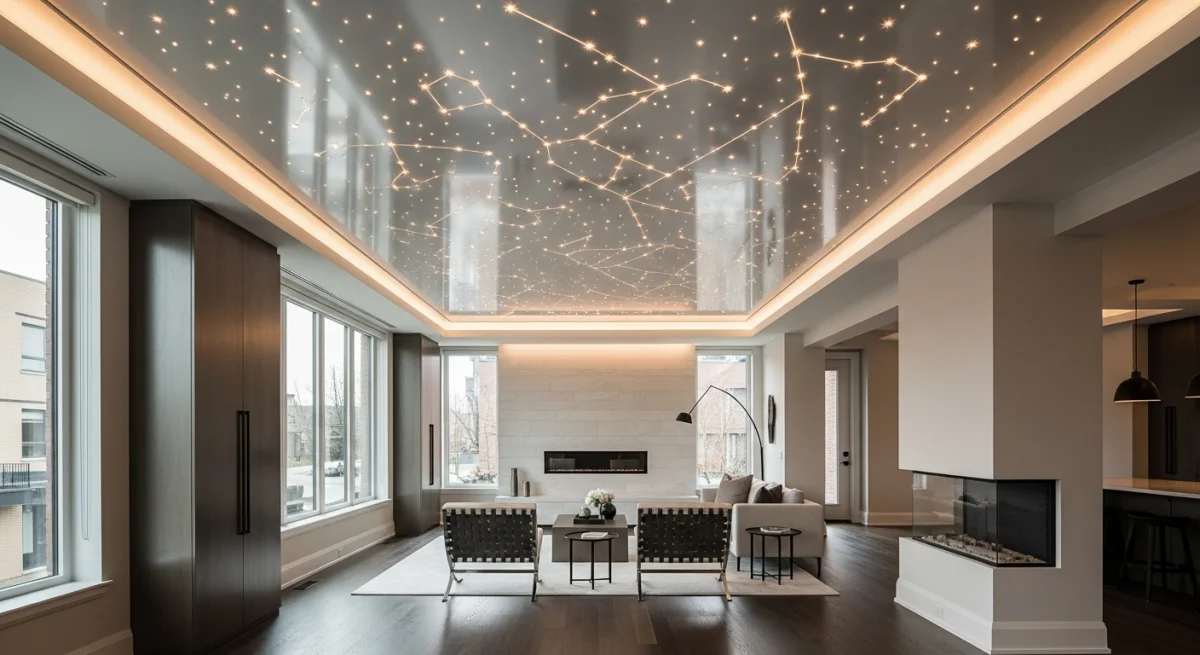

# Constellation Pattern Star Ceiling Design: Personalized Night Skies
A standard star sky ceiling is a randomized starfield. A constellation-pattern ceiling is a star map — actual constellations laid out in real proportional positions, sometimes anchored to a specific date and place (the Toronto night sky on the homeowner's wedding day, for example). The design takes 4–6 weeks longer and adds $400–$1,200 in design fees, but for clients who want the ceiling to be *theirs* in a way no other home has, it is the upgrade that matters most.
This guide covers the design choices, popular constellation patterns, personalized birthday-sky maps, and the technical considerations that distinguish a successful constellation ceiling from one that looks like a failed jigsaw puzzle.
This article is part of our star sky cluster. For the pillar see Star Sky Ceiling Toronto 2026 Complete Guide. For pricing see Star Sky Ceiling Cost in Toronto.
What a Constellation Ceiling Is
A constellation ceiling is a fiber optic star sky where some or all of the stars are placed at *meaningful* positions rather than randomly. Two main approaches:
Pattern-Based
Recognizable constellations placed across the ceiling in their conventional shapes. Big Dipper, Orion, Cassiopeia, Cygnus, Leo, Scorpius, the Pleiades cluster. The proportions are correct but the constellations are placed for compositional balance, not astronomical accuracy.
Date-Anchored Star Map
The actual night sky as it appeared at a specific time and place — the homeowner's wedding date and Toronto coordinates, for example. This requires astronomical data: the precise position of every visible star at that moment, projected onto the ceiling plane. We use specialized software (Stellarium Pro export, then CAD overlay) to generate the drilling map.
Popular Pattern Choices for Toronto Bedrooms
The Big Dipper (Ursa Major)
The most-requested constellation. Easily recognizable, fits well in a 200–280 sqft master bedroom, anchors a randomized starfield with one familiar pattern. Typically rendered with seven 1.5 mm bright fibers (one per star of the dipper), often with Swarovski crystals at each position for daytime visibility.
Orion
The most visually striking constellation for ceiling design. The belt of three stars plus the four corner stars create a strong rectangular composition. Works well in larger rooms (300+ sqft). We often pair Orion with the surrounding *Sword* nebulous region rendered as a slight density gradient.
Cassiopeia
The W-shape sits beautifully across a wider room. Often used as a counterweight to a Big Dipper at the opposite end of the ceiling.
The Pleiades (Seven Sisters)
A tight cluster of 6–7 visible stars. Compact and recognizable. Works as an accent in a smaller room or as one element of a multi-constellation composition.
Zodiac Wheel
A full-ceiling zodiac wheel with all 12 constellations arranged in their celestial positions. Premium installation, typically used in formal dining rooms or dedicated bedrooms. Cost surcharge $600–$1,200 for the design and 4–6 week lead time.
Need professional renovation?
Call RenoHouse at 289-212-2345 or get a free estimate today.
Get Free Estimate →Date-Anchored Star Maps
The bespoke option. Common occasions:
- Wedding date and venue location
- Birthday of a child
- Anniversary
- The night a couple met
- The night a homeowner was born
The design process:
- 1. Client provides date, time (or "around 11 PM" works), and location
- 2. We pull astronomical data from a specialist astronomy software
- 3. We project the visible stars onto the ceiling plane in proportional positions
- 4. We assemble a CAD drilling file with constellation labels for installer reference
- 5. The factory drills the membrane to the exact pattern
- 6. Installation matches the labeled positions
The result is a ceiling that, with the lights on, is decorative; with the lights off and the fiber optic engine running, is the night sky as it appeared at the meaningful moment.
Lead time: 4–6 weeks total. Design fee: $600–$1,200 depending on complexity.
How Constellations Are Rendered on a Stretch Ceiling
A constellation pattern is layered onto a randomized starfield rather than replacing it. The full design typically has:
- 70–80 percent randomized background stars (0.5 mm fibers)
- 15–20 percent medium starfield (0.75 mm fibers)
- 5–10 percent constellation-position stars (1.0 mm and 1.5 mm fibers)
- Optional Swarovski crystal upgrades at constellation primary positions
The background field gives the ceiling depth. The constellation stars are slightly brighter and slightly larger — they read as the recognizable pattern against the surrounding sky.
This mirrors how real constellations work: the bright stars define the pattern; thousands of fainter stars surround them.
Constellation Brightness and Diameter
For the constellation pattern to read clearly, the constellation stars must be visibly brighter than the background field. Recommended diameter mix:
- Background field: 0.5 mm fibers
- Mid-density field: 0.75 mm fibers
- Constellation primary stars: 1.0 mm or 1.5 mm fibers
- Statement constellation anchor stars (one or two per constellation): 1.5 mm fibers + Swarovski crystals
If you make the constellation stars only 0.75 mm and the background 0.5 mm, the contrast is too low — the pattern blends into the background. The constellation reads as "slightly denser cluster" rather than "Big Dipper."
Crystal Anchoring at Constellation Positions
Swarovski crystals at constellation primary positions create daytime visibility of the constellation pattern. With the engine off, the room shows a faint sparkling outline of the constellation — a beautiful daytime decorative element that mirrors the night-time fiber optic version.
Recommended:
- 6 mm or 8 mm Swarovski AB crystals at each constellation primary star
- 4 mm or 5 mm crystals at secondary constellation stars
- No crystals on background field stars
Cost: $40–$120 per constellation depending on size and crystal grade. Full crystal discussion in Swarovski Crystal Star Ceiling: When the Luxury Upgrade Is Worth It.
Common Constellation Design Mistakes
Crowding Too Many Constellations
A 200 sqft master bedroom can comfortably show 1–2 named constellations plus background field. Trying to fit 5 or 6 reduces each to a slightly denser cluster — none of them reads. Restraint is essential.
Placing Constellations Astronomically Wrong
Some clients want a "moon room" with the moon, planets, and constellations all visible. The astronomy enthusiasts in their lives will notice if the moon is in a position incompatible with the constellation arrangement. Use real astronomy software for date-anchored maps; for compositional designs, accept that the design is artistic rather than astronomical and avoid mixing the two.
Over-Sizing Constellations
A Big Dipper that spans 80 percent of the ceiling looks oversized and theatrical. The pattern reads better at 30–40 percent of the ceiling area, with surrounding starfield to anchor it.
Skipping the Background Field
A ceiling with only constellation stars and no background field reads as sparse and artificial. The randomized field is what makes the constellations look like *constellations* rather than *isolated patterns*.
Real Project Examples
Forest Hill Master Bedroom: Wedding Sky Map
- 240 sqft fiber optic ceiling, Cosmolight Galaxy V8
- Date-anchored to client's wedding night, Toronto coordinates, 11 PM
- 1,200 stars total, 7 constellations visible
- 80 Swarovski AB crystals at primary constellation positions
- Total project including custom design: $12,800
Vaughan Kids' Room: Big Dipper + Orion
- 180 sqft fiber optic ceiling, Cosmolight Galaxy V8
- Pattern-based: Big Dipper at one end, Orion at the other
- 800 stars total
- 14 Swarovski crystals at constellation primary positions
- Total project: $7,400
Yorkville Penthouse Dining Room: Zodiac Wheel
- 280 sqft fiber optic ceiling, Universal Fiber Optics XL
- Full zodiac wheel with all 12 constellations in celestial positions
- 2,200 stars total
- 144 Swarovski AB crystals (12 per constellation)
- RGB cycling for theme nights
- Total project: $24,500
How RenoHouse Designs Constellation Ceilings
Our design team uses Stellarium Pro and astronomical projection software to generate accurate star maps. The design process includes:
- Initial consultation to discuss the meaningful date and pattern preferences
- 3D rendering of the proposed ceiling with constellation overlay
- Iterative review and revision (typically 2 rounds)
- CAD drilling file generation
- Factory submission with constellation labels
- Installer briefing with the labeled drawing
Russian-Canadian installer crews experienced with constellation work follow the labeled pattern during fiber threading. RenoHouse layers a 10-year project warranty including pattern accuracy.
To start a constellation ceiling design, visit our Star Sky Ceiling Installation page, read the pillar guide, or compare with the master bedroom design guide.
Continue Reading