RenoHouse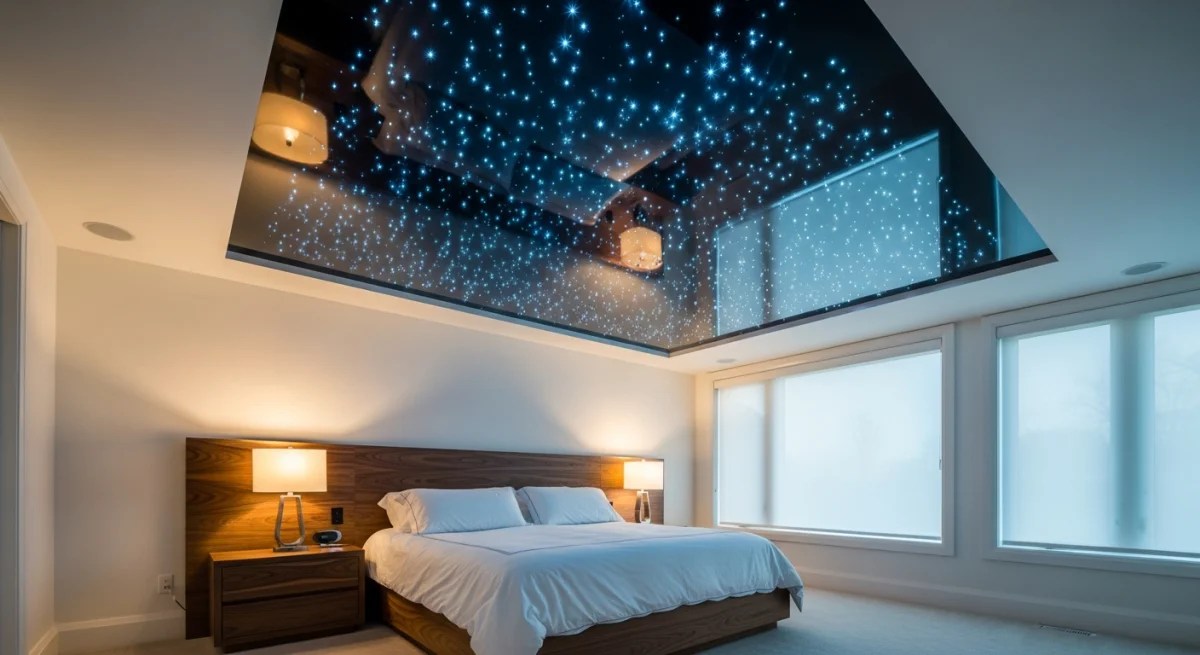

# Star Sky Ceiling for the Toronto Master Bedroom: Design Guide
The master bedroom is where star sky ceilings earn their reputation. Done well, the ceiling becomes the most quietly extraordinary feature in the home — the room where you wake up to a faint pinpoint of light still drifting overhead, where a partner sees Orion when they look up from a pillow at 3 AM, where guests at a dinner party walk through the bedroom suite tour and stop talking mid-sentence.
Done poorly, you get a flat, uniform, slightly disco-feeling array of dots and a homeowner who quietly stops turning the engine on after the first month. The difference is design — star count, density, diameter mix, lighting integration, and a few specific Toronto considerations.
This is a sibling article to our Star Sky Ceiling Toronto 2026 Complete Guide. For the broader bedroom stretch ceiling decision, also see our Master Bedroom Stretch Ceiling Toronto Guide. For full pricing, see Star Sky Ceiling Cost in Toronto.
The Five Decisions That Make or Break a Bedroom Star Ceiling
1. Star Count and Density
A typical Toronto master bedroom is 180–280 sqft. The right density for a bedroom is 60–90 stars per square metre — dense enough to read as a real urban or suburban night sky, sparse enough to avoid a "ceiling light" feeling.
For a 220 sqft (20.4 m²) master bedroom: 1,200–1,800 stars total. We typically recommend 1,400 as the comfortable mid-point.
If your budget pushes you toward fewer stars, we strongly recommend reducing the *area* of starfield rather than the density. A 120 sqft starfield zone over the bed area at 80 stars/m² looks better than a sparse 220 sqft full ceiling at 30 stars/m².
2. Diameter Mix
This is where bedroom ceilings most often go wrong. A uniform array of 0.75 mm fibers reads as a perfect grid of identical dots — your eye flags it as artificial within seconds.
The luxury mix:
- 70 percent 0.5 mm — the background field, faint stars
- 20 percent 0.75 mm — medium stars, the visual rhythm
- 10 percent 1.0 mm and 1.5 mm — the headline stars, where Swarovski crystals go
Mix variation costs about 10–15 percent more for the fiber harness. It is non-negotiable for a bedroom that has to feel real.
3. Membrane Colour
Three options work for bedrooms:
- Matte black PVC — the most realistic, deepest blacks, perfect for dark bedrooms with blackout drapery
- Midnight navy — slightly softer at daytime, hides better when the engine is off, our most-recommended default for Toronto bedrooms with some daylight
- Deep purple-black — rare, but works beautifully in suites with cool-tone interior palettes
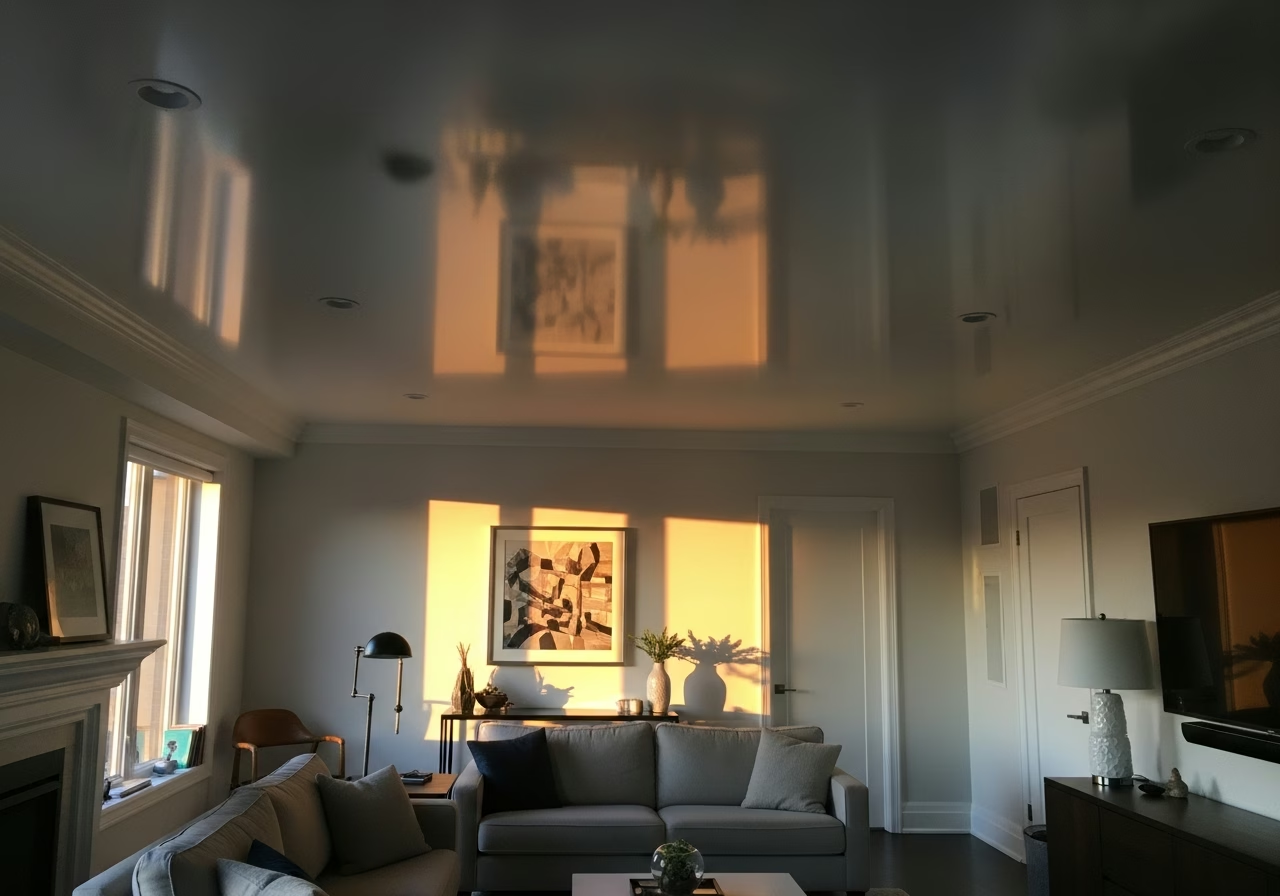
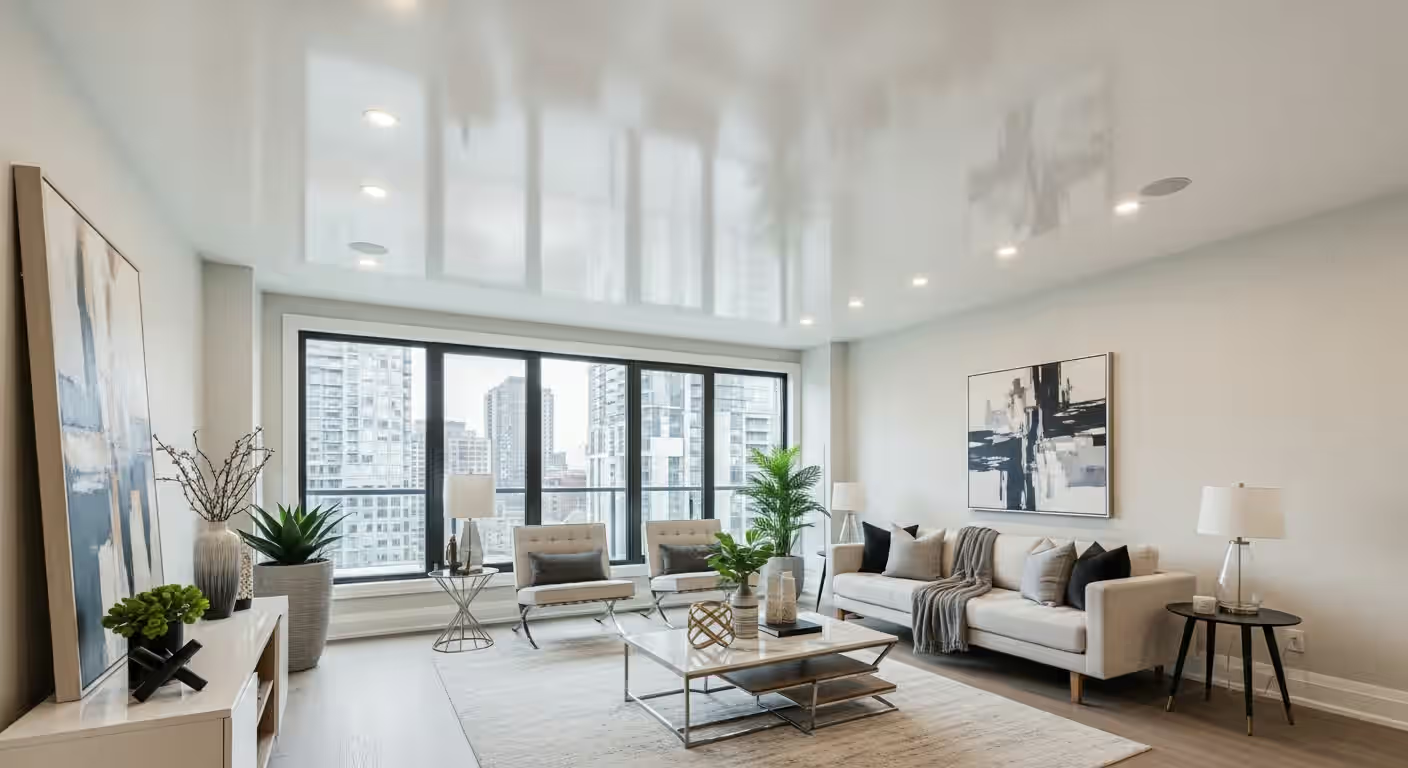
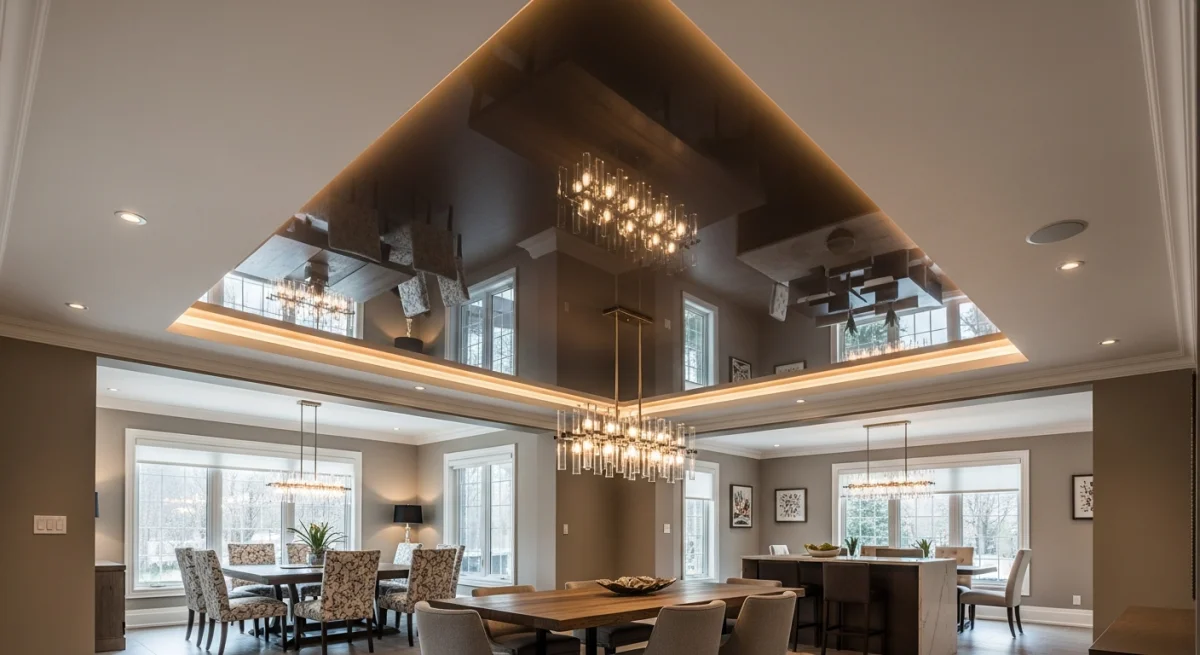
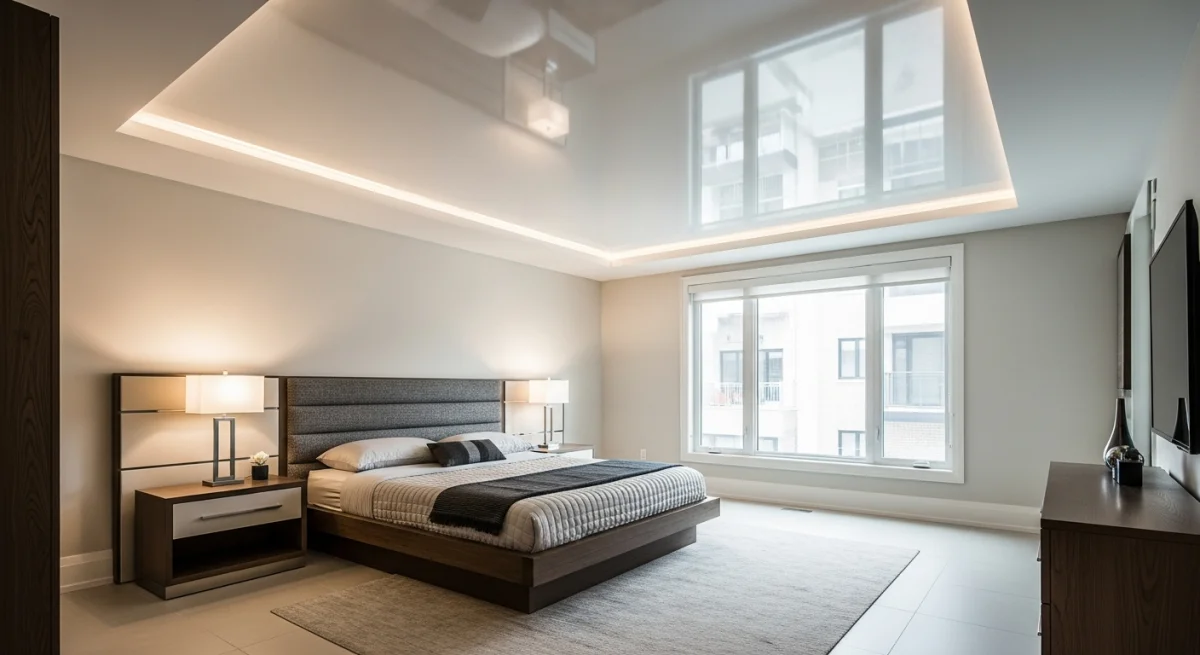
Avoid glossy finishes for bedrooms. Gloss reflects ambient light, drapery, and bedside lamps, which kills the illusion. If a designer is pushing glossy black for a "luxury" feel, push back — gloss black belongs in formal dining rooms, not over your bed.
Need professional renovation?
Call RenoHouse at 289-212-2345 or get a free estimate today.
Get Free Estimate →4. Bed Placement and Star Distribution
The instinct is to centre the densest star concentration over the bed. Resist it.
Real night skies are not centred on the viewer. The most cinematic distribution puts a faint Milky Way *band* running diagonally across the ceiling, with the densest cluster offset toward the foot of the bed or one side wall. From a pillow looking straight up, you see a meaningful gradient rather than a uniform field.
Specific recommendations:
- 5–8 percent denser at the foot of the bed than the head
- A subtle "constellation cluster" at one corner of the room — the eye looks for organization
- One headline star directly above the centre of the king-bed pillow line — this becomes "the personal star" in family conversation
We design star maps in CAD and walk clients through the layout before factory drilling. Lead time for custom maps is 4–6 weeks.
5. Lighting Integration with the Rest of the Bedroom
The star ceiling is one mode. The bedroom has many. Get the integration right:
- Reading lamps: sconce or pendant on dimmable Lutron, 2700K warm. Stars stay on at low level.
- Wall accent: picture lights or art accent on a separate dimmer.
- Closet and bathroom: completely separate circuits — never share with the star engine.
- Smart scenes: *Movie Night* (stars 70 percent, sconces off, blinds closed), *Read* (stars 30 percent, sconces 60 percent), *Sleep* (stars fade over 20 minutes), *Wake* (stars off, daylight scene).
- Wall control: one Lutron keypad with Movie / Read / Sleep / Off engraved. Avoid app-only operation — at 11 PM, no one wants to find their phone.
Toronto-Specific Bedroom Considerations
Daylight from Patio Doors and Large Windows
Many Toronto luxury master bedrooms have wall-to-wall patio doors or oversized windows for skyline views. Daylight ruins the star illusion. The fix is blackout drapery — usually motorized, ideally on the same Lutron scene controller as the star engine.
If you cannot install blackout drapery, accept that the ceiling will mostly be evening and night-time decor. Plan accordingly with Swarovski crystal additions for daytime visual interest.
9 vs 10 Foot Ceilings
Standard 9 ft Toronto master bedroom ceilings work well — the engine plenum sits in the joist bay, you lose 60–80 mm to the stretch frame and fiber routing, and you end up at about 8 ft 6 in finished. Comfortable.
10 ft ceilings (common in Yorkville penthouses and luxury new builds) are the ideal canvas. The depth gives the starfield room to breathe and reduces the *light source proximity* feeling. Headline stars look like real stars rather than embedded ceiling dots.
8 ft ceilings (some older Toronto homes) are usable but tight. The starfield can read as too close. Consider whether the bedroom is a candidate at all.
Vaughan and Forest Hill Tray Ceilings
Tray ceiling configurations — common in Vaughan luxury new builds and Forest Hill renovations — present an opportunity. The tray inset becomes the starfield zone, ringed by indirect cove LED. You get a defined "sky window" rather than a full-ceiling effect, and the tray edge gives the eye a frame to read against.
Pricing for tray-zone star ceilings is typically lower than full-ceiling because the starfield area is smaller, even though density and engine remain the same.
Heritage Properties and Plaster Ceilings
Forest Hill, Rosedale, and Annex heritage properties often have ornate plaster ceilings worth preserving. A stretch star ceiling can be installed as a *removable* layer below the heritage plaster — the harpoon track mounts to a sub-frame, the original ceiling is untouched. Future owners can de-tension the membrane and restore the original ceiling.
We have done this in three Annex master bedrooms. Lead time and cost run about 15 percent above standard installs because of the sub-frame work.
Star Engine and Module Recommendations for Bedrooms
Our default specification for Toronto master bedrooms in the $7,000–$12,000 ceiling budget:
- Engine: Cosmolight Galaxy V8, 5500K cold-white, 50,000-hour LED
- Twinkle module: included, set to 6-second cycle
- Shooting star module: one, set to one streak every 90–120 seconds
- RGB module: optional, most clients prefer pure white
- Smart home: 0–10V dimming to Lutron RA3 keypad
- Crystals: 60–120 Swarovski Aurora Borealis at headline star positions
Engine review in Cosmolight Galaxy V8 Star Ceiling Review.
What It Costs in 2026
A 220 sqft Toronto master bedroom with the spec above lands at $8,500–$12,500 all-in, including HST and our 10-year warranty layer. A budget-driven version with LED matrix in place of fiber optic and no crystals lands at $3,500–$5,500.
Full breakdown in Star Sky Ceiling Cost in Toronto.
How RenoHouse Manages a Master Bedroom Star Sky Project
RenoHouse runs a coordinated installer network — vetted Russian-Canadian fiber optic crews, ESA-licensed electrical partners, and verified Cosmolight, Universal Fiber Optics, and MakeMaster suppliers. We handle:
- In-home design consultation and CAD star map
- 3D rendering of the proposed starfield
- Lutron or Control4 scene programming
- Single-call 10-year warranty on the project layer
- Bilingual project communication
To start a master bedroom design consultation, visit our Star Sky Ceiling Installation page or read the pillar guide.
Continue Reading