RenoHouse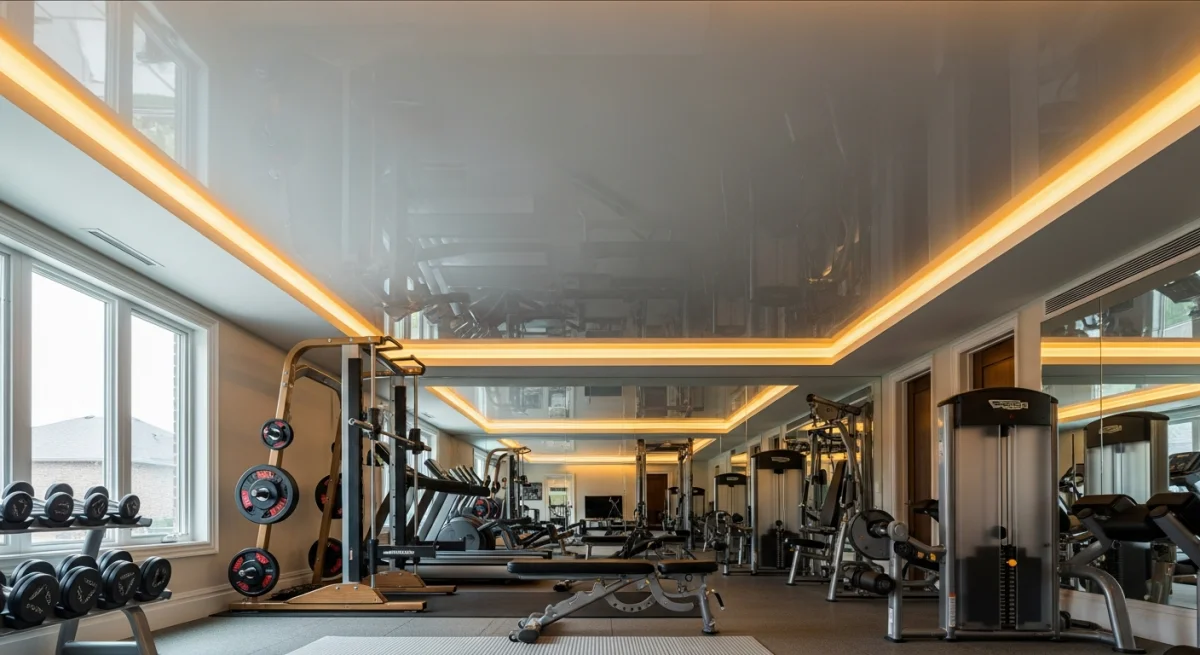

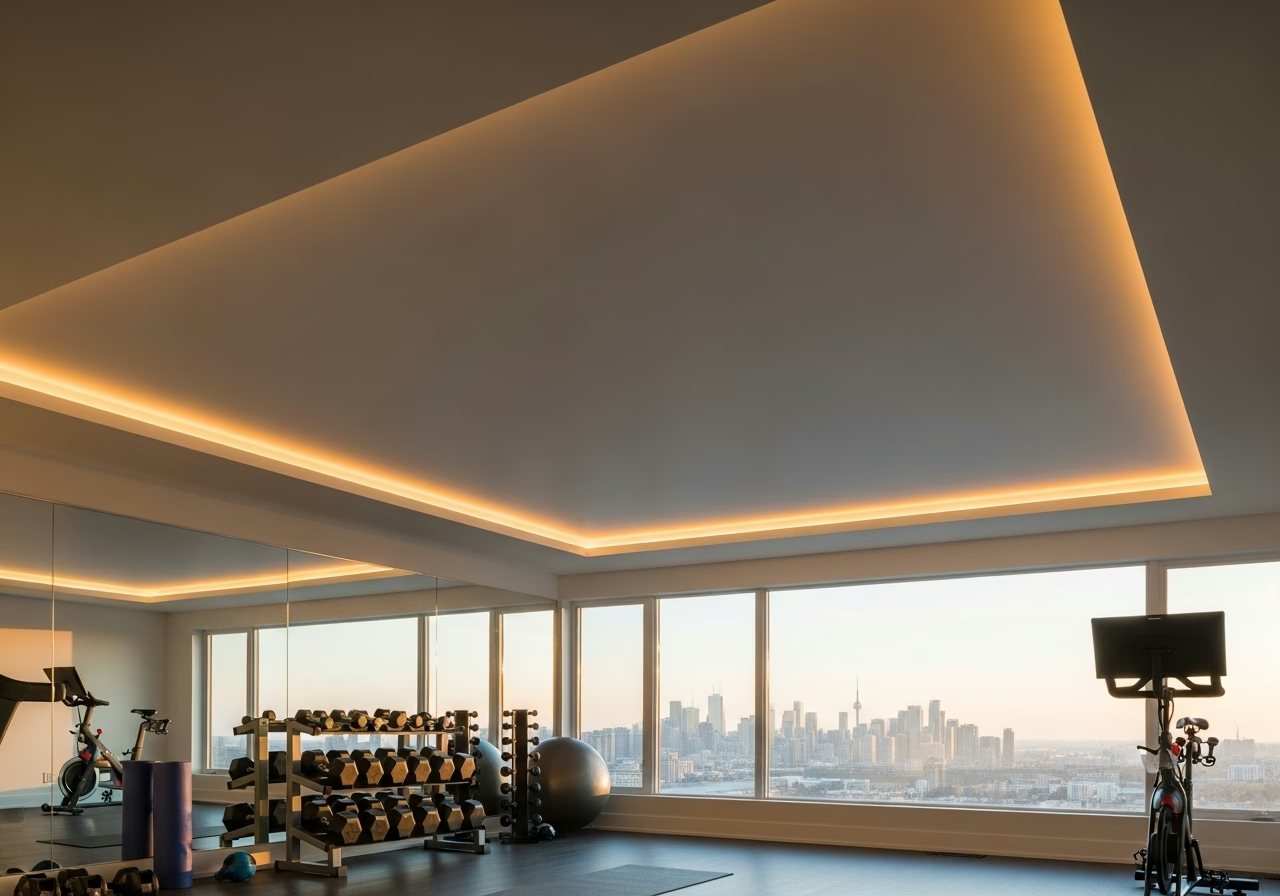
The home gym is a growing residential category for stretch ceilings in Toronto. Post-2020 work-from-home patterns produced a wave of basement and spare-bedroom gym conversions; 2024-2026 has seen these spaces upgraded from utility installs to designed environments. Stretch ceilings in home gyms address two specific problems: glare from overhead lighting during weight training (gloss is wrong), and impact noise transmission to upstairs neighbours or family members (acoustic perforated helps).
This article walks through home gym ceiling design, finish selection, lighting for training, acoustic options, and 2026 Toronto installed pricing.
Why Matte Wins in Gyms
The home gym has unique lighting challenges. During bench press, overhead press, deadlift setup, and most squat variations, the lifter spends significant time staring at or near the ceiling. A glossy ceiling reflects every overhead light fixture as a hot spot directly into the lifter's eyes. This is genuinely uncomfortable during sets and is the primary reason matte wins in gym applications.
Matte PVC reflectance is 5 to 10 percent. Light fixtures bounce diffusely off the ceiling and contribute to even ambient illumination without creating glare hot spots. Specify matte for any home gym ceiling with overhead lighting (which is essentially every home gym).
Satin (15 to 25 percent reflectance) is a borderline alternative for gyms where the lifter rarely looks at the ceiling (cardio-only, group fitness). Glossy is wrong for any gym configuration except possibly mirror-finish wall installations adjacent to the gym (e.g., dance studio mirror walls), and even there fabric or actual mirror is the better choice.
Acoustic Perforated for Impact Noise
Home gyms generate two noise types. Airborne noise (music, video coaching, voice) is the standard acoustic problem. Impact noise (kettlebell drops, deadlift bar contact, jumping rope, plyometric box jumps) is structural \u2014 the impact transmits through the floor, walls, and joists and is heard as bass thuds in adjacent rooms.
Acoustic perforated stretch ceiling (Newmat Acoustic, Clipso Acoustic-810) addresses airborne reflection but does NOT solve impact transmission. For impact reduction, you need floor isolation (rubber lifting platform, Mason-style isolation pads), not ceiling treatment. Acoustic ceiling and impact-isolation flooring are complementary; both contribute to a quieter gym for neighbours and family.
NRC target for home gym: 0.5 to 0.7 with microperforated fabric and 100 mm Rockwool plenum. This is enough to remove flutter echo from voice coaching videos, music, and breathing during cardio. Fabric absorbs better than perforated PVC; specify polyester fabric.
Lighting for Training
Home gym lighting should be:
- High-CRI (90+ CRI minimum). Important for assessing form in mirrors and for accurate skin and clothing color in workout videos.
- 4000 to 5000 K daylight color temperature. Energizing during workouts, alert and clear. Save warm 2700 K for living rooms; gyms benefit from cool light.
- Even ambient distribution. No dark zones, no glare hot spots. Achieved through 8 to 12 pot lights at a consistent grid plus optional indirect cove lighting.
- Dimmable. For varying workout types (intense lifting full-bright, yoga and stretching softer).
- No flicker. Flicker disrupts video recording and can cause headaches during long workouts. Specify high-quality LED drivers.
For a 200 sqft home gym, typical lighting layout is 8 pot lights at 4000 K, 90+ CRI, dimmable, plus an optional perimeter cove LED for indirect uplight on rest days. Cove LED at 4000 K matching the pot lights.
Need professional renovation?
Call RenoHouse at 289-212-2345 or get a free estimate today.
Get Free Estimate →Pot Light Pass-Throughs
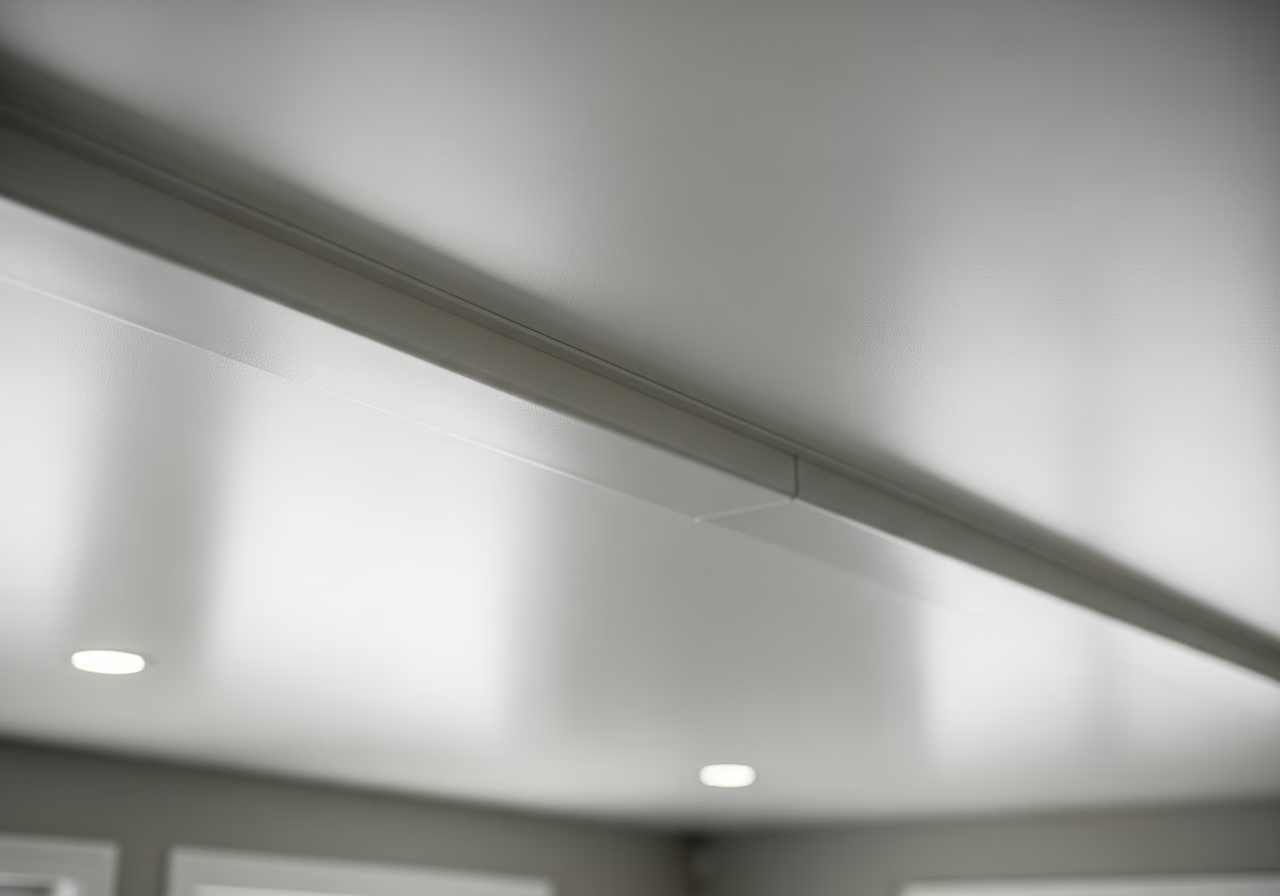
Standard pot light pass-through cost: $40 to $80 each. For a typical home gym with 8 pot lights, that is $320 to $640 in pass-throughs in addition to the per-square-foot ceiling pricing.
Slim LED puck alternatives (Halo HLB Slim, Lithonia Wafer) give a 1-inch profile that mounts directly to the original ceiling, saving 4 to 5 inches of plenum depth. For low-headroom basement gyms, slim pucks are the right choice.
Mirrors and Stretch Ceiling
Most home gyms have wall mirrors. The interaction with the stretch ceiling is benign: matte ceiling reflects faintly in the mirror but does not create the cascading-reflections-of-reflections artifact that glossy ceilings produce in mirror-heavy rooms.
If your gym has a full mirror wall (yoga studio style, 8x8 feet of mirror or more) and you want to avoid any ceiling reflection in the mirror at all, specify the deepest-matte PVC available (some manufacturers offer a "ultra-matte" or "anti-glare" finish that is even less reflective than standard matte).
Pull-Up Bars and Cable Attachments
Ceiling-mounted pull-up bars and cable attachment points need direct mounting to the joists or slab above. The stretch ceiling does NOT support load \u2014 the membrane is decorative. Plan all ceiling-mounted equipment before the stretch ceiling install:
- Pull-up bars: typically mounted to two adjacent joists with lag bolts, $200 to $400 in carpentry to add solid blocking for the bar.
- Cable attachment hooks: mounted to the slab (in concrete-slab basements or condos) or joists. Each hook $100 to $200 for proper structural mount.
- Climbing or hangboard fixtures: require structural assessment and dedicated blocking.
The membrane is then cut around each fixture penetration with a finishing ring. Pass-through cost $80 to $150 per ceiling-mounted gym fixture.
For high-use cable attachments, a steel mounting plate spanning multiple joists (rather than single-joist mount) is recommended to handle dynamic load. We coordinate this with our structural partner.
2026 Installed Pricing
For a typical Toronto home gym stretch ceiling:
- Spare-bedroom gym 100-150 sqft, matte PVC, 6 pot lights: $1,400 to $2,400.
- Basement gym 200-300 sqft, matte PVC, 8 pot lights: $2,400 to $4,200.
- Premium acoustic basement gym 250-350 sqft (Newmat Acoustic + Rockwool): $4,500 to $7,500.
- Multi-level gym with separate cardio and lifting zones 400-600 sqft: $5,500 to $11,000.
- Add ceiling-mounted pull-up bar with structural mount: $400 to $700.
- Add cable attachment hooks (each): $150 to $300.
- Slim LED pucks instead of standard pot lights: $60 to $120 each.
What to Avoid
- Glossy PVC anywhere in a serious lifting gym. Glare during overhead work is genuinely unpleasant.
- Warm 2700 K lighting in a gym used for HIIT or weight training. Wrong color temperature for high-intensity workouts. Use 4000 K or 5000 K.
- Loading the membrane. Do not hang anything from the stretch ceiling itself. All ceiling-mounted gym equipment goes through the membrane to structural mounts above.
- Acoustic perforated as a substitute for floor isolation. Acoustic ceiling reduces airborne sound; impact transmission requires rubber flooring.
- Single-color RGB cove on a fixed program. Use cove for indirect ambient illumination only; do not specify RGB color cycling for active gyms.
Headroom Considerations
Home gym headroom requirements depend on equipment:
- Yoga, Pilates, stretching: 7 feet 6 inches comfortable
- Light dumbbells, kettlebells (under 24 kg): 7 feet comfortable, 6 feet 8 inches workable
- Olympic barbell back squat: 8 feet plus 1 to 2 feet of overhead clearance for setup = 9-10 feet ideal
- Olympic press, snatch, clean & jerk: 10 to 11 feet ideal, 9 feet workable for shorter lifters
- Pull-ups: must clear the bar by at least 12 inches above your hand at full extension
In Toronto basement gyms (typical 6'6" to 7'2" original ceiling), single-level matte stretch ceiling at 5 cm drop is the right call \u2014 every centimetre matters for overhead exercises. Acoustic plenum installs (12 to 18 cm total drop) are too low for serious overhead work in 7-foot basements.
Honest Install Trade-Offs
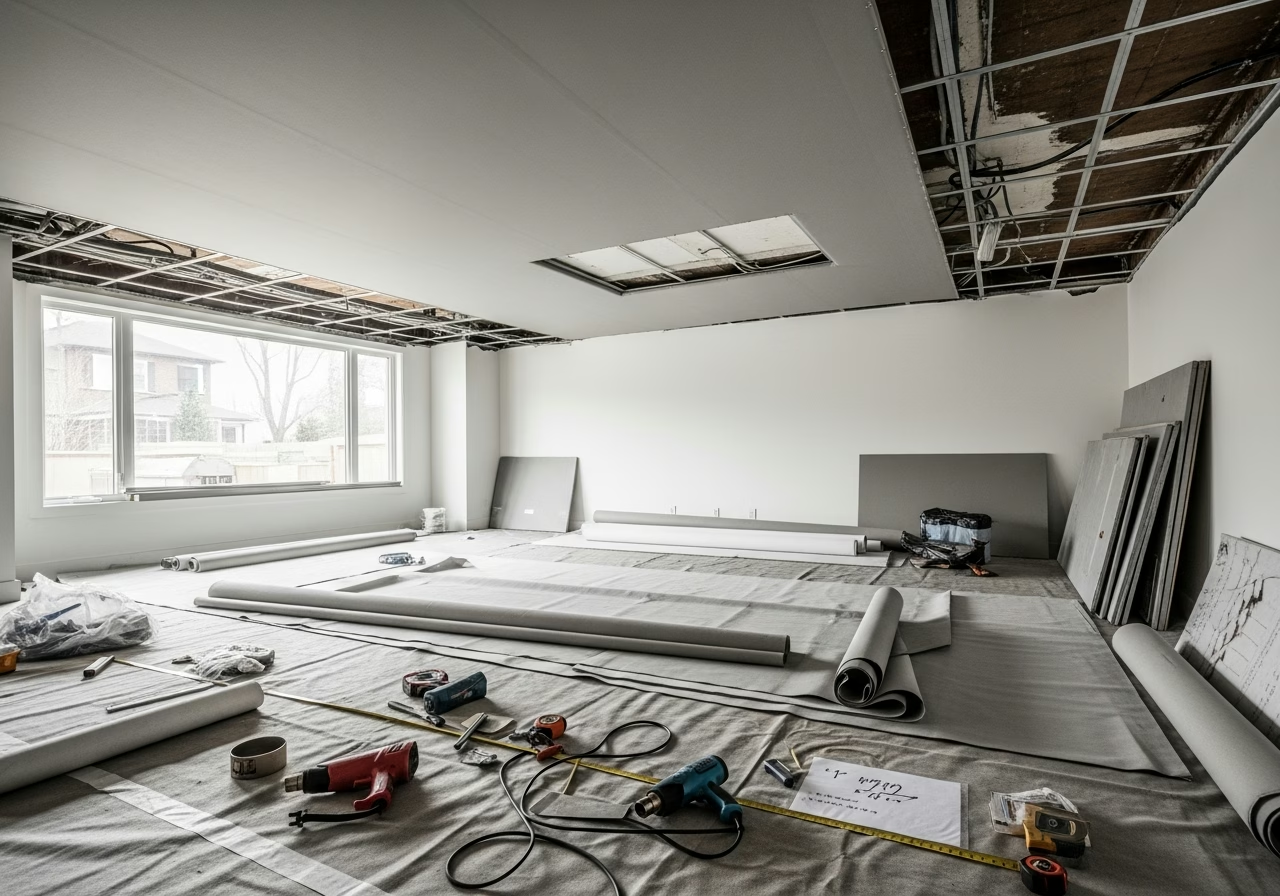
Home gym install is the same heat-stretch process. 2 to 4 hours total for a single-level PVC gym. The room must be empty of equipment during install \u2014 dumbbells, racks, and benches need to be moved out before the heat phase. We provide drop-cloth protection for permanently installed equipment (mirror walls, wall-mounted racks).
For asthma-sensitive lifters, avoid using the gym for 24 hours post-install with windows cracked. Premium A+ certified MSD or Pongs PVC returns to baseline indoor air quality within 24 hours.
Acoustic fabric (cold-stretch) install: 5 to 7 hours for a 250 sqft gym, no heat phase, no off-gassing. Significantly more comfortable for sensitive households.
Related Reading
For the full stretch ceiling room-by-room pillar, see the by-room guide. For basement gym headroom strategy (the most common Toronto home gym location), see the basement stretch ceiling guide. For acoustic specifications shared with home offices, see the home office stretch ceiling guide.
Get a Home Gym Stretch Ceiling Quote
We coordinate vetted installer crews across Toronto, Vaughan, North York, Thornhill, Richmond Hill, Markham, Oakville, and Mississauga. Free in-home measurement including ceiling-mounted equipment structural assessment, acoustic recommendation if applicable, fixed 2026 quote.
Request a home gym stretch ceiling quote.