RenoHouse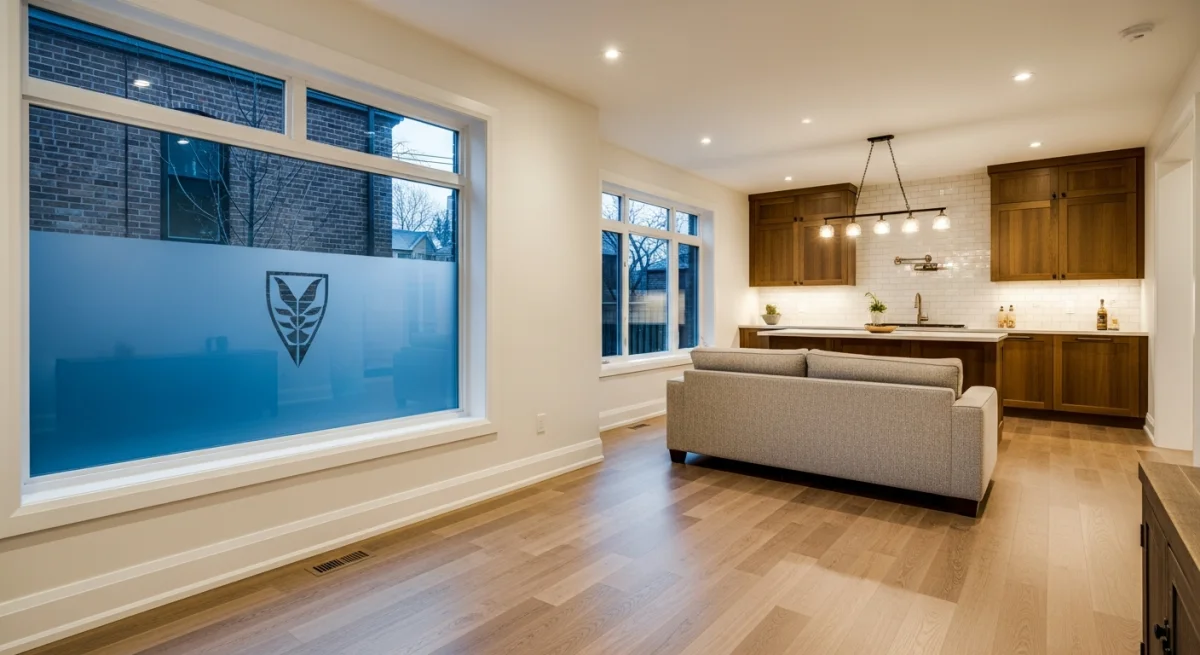

# Mirror Film at Night: The Reverse-Effect Problem Nobody Mentions (Toronto 2026)
Quick answer. A standard one-way mirror window film delivers daytime privacy through a light differential between exterior (bright) and interior (dim). At night with interior lights on, the differential reverses — interior is now 5-50x brighter than the exterior, and the mirror effect operates from the inside. People inside see their own reflection; people outside see in clearly through a slightly tinted window. Most competitor pages and installers gloss over this. We disclose it because customers who get this wrong feel cheated. This post is the honest night-time discussion plus the four practical solutions.This is one of four mirror-film cluster posts cross-linking the existing window-film-security-film sub-service. For the daytime physics start with Mirror Window Film Daytime Privacy Toronto. For broader pillar context see Window Tinting & Solar Film Toronto 2026 Complete Guide.
Why the Effect Reverses at Night
The one-way mirror physics depend on light differential. By day, the exterior is 50-500x brighter than the interior. The film reflects exterior light back; the interior is hidden behind the brighter mirror.
At night with interior lights on, the relationship inverts. A typical Toronto residential interior at evening reaches 200-500 lux (lit room). A nighttime urban exterior is 5-50 lux (streetlight scatter, ambient city light). The interior is now 5-50x brighter than the exterior — a reversed differential of similar magnitude to the daytime effect.
The film does not change. The physics does not change. Only the differential direction reverses. The mirror now masks the dim side (exterior) from the bright side (interior). Interior occupants see their reflection in the window; exterior observers see through into the lit interior.
Need professional home renovation?
Call RenoHouse at 289-212-2345 or get a free estimate today.
Get Free Estimate →The honest comparison: daytime mirror film privacy is essentially perfect on sunny days. Night-time mirror film privacy is essentially zero with interior lights on.
The Four Mitigations
Mitigation 1: Window coverings at night. Curtains, blinds, shades. The film provides daytime privacy; the coverings handle night. This is what most installers honestly recommend. Pros: simple, cheap, effective. Cons: the customer wanted "always on" privacy and now still has to close the blinds.
Real Toronto Scenarios
Liberty Village ground-floor condo. Most occupants are at work 9-6 daytime. Daytime privacy through mirror film is the high-value use. Evenings the occupants close blinds anyway because they prefer the cocoon feeling. Mitigation: simple blinds work. The film delivers daytime privacy; the lifestyle handles night. King West south-east corner unit at the same height as the adjacent tower. Daytime mirror film keeps neighbours from observing through windows during the work-from-home day. Evening the homeowner is generally home with lights on. Mitigation: cellular shades that drop at sunset, or dual-reflective with frosted band for the lower 36 inches that keeps adjacent-tower observers from getting a clean line of sight even when interior is lit. Bluffer's Park lakefront detached. Kitchen and living areas frequently lit at night. The lake-facing exposure means observers from the beach or boats can see in if they are watching at night. Mitigation: motorised shades that close at sunset, or full frost film on the lower window section.Why Some Installers Don't Disclose
The honest answer: customers who hear "this film does not work at night with lights on" often choose ceramic or frosted film instead. Some installers prefer to sell the higher-margin reflective product and let the customer discover the night-time issue post-install.
We do not operate that way. We disclose at quote because:
- 1. Customer satisfaction at year 1 matters more than closing a single sale.
- 2. Returning customers and referrals are worth more than the marginal upsell.
- 3. Long-term reputation in the GTA install market depends on honest disclosure.
If you are getting a quote from another installer, ask them directly: "what does the film look like from outside at night when my lights are on?" The honest answer is "you can see in clearly". If they tell you anything else, walk.
When Mirror Film Still Wins
Three scenarios where the night-time reversal is not a problem:
When Mirror Film Is the Wrong Pick
Three scenarios:
24/7 privacy required. Bathroom, bedroom, ground-floor sightline area where the customer expects always-on privacy. Pick frosted/decorative film instead — the privacy mechanism is opacity, not reflection. Same opacity day and night. Always-lit interior. Open-plan living area lit until late. Mirror film fails the night test. Frosted film, smart glass, or coverings are the answer. Customer cannot accept the night reversal disclosure. Some customers, after hearing the night-time honestly, decide they want a different solution. We respect that and switch to a different product family.Honest Decision Framework
Ask yourself:
- 1. Is the privacy concern primarily daytime (e.g., neighbour watches your window 9-5)? Mirror film works.
- 2. Is the privacy concern primarily night (e.g., you read at night with lights on near a window)? Mirror film fails. Pick frost or coverings.
- 3. Do you close blinds at night anyway? Mirror film works for the day; existing habit handles night.
- 4. Do you need 24/7 always-on privacy regardless of lighting? Pick frost, smart glass, or coverings — not mirror film.
Get an Honest Mirror Film Conversation
Book a free in-home consultation through the window film and security film service page — we walk through your specific privacy use case before quoting. Read sibling posts: Mirror Window Film Daytime Privacy Toronto, Mirror Film vs Frosted vs Blinds Toronto, Mirror Window Film Toronto Condo Ground Floor. For broader pillar context see Window Tinting & Solar Film Toronto 2026 Complete Guide and Window Film Installation Toronto 2026 Complete Guide.
Continue Reading