RenoHouse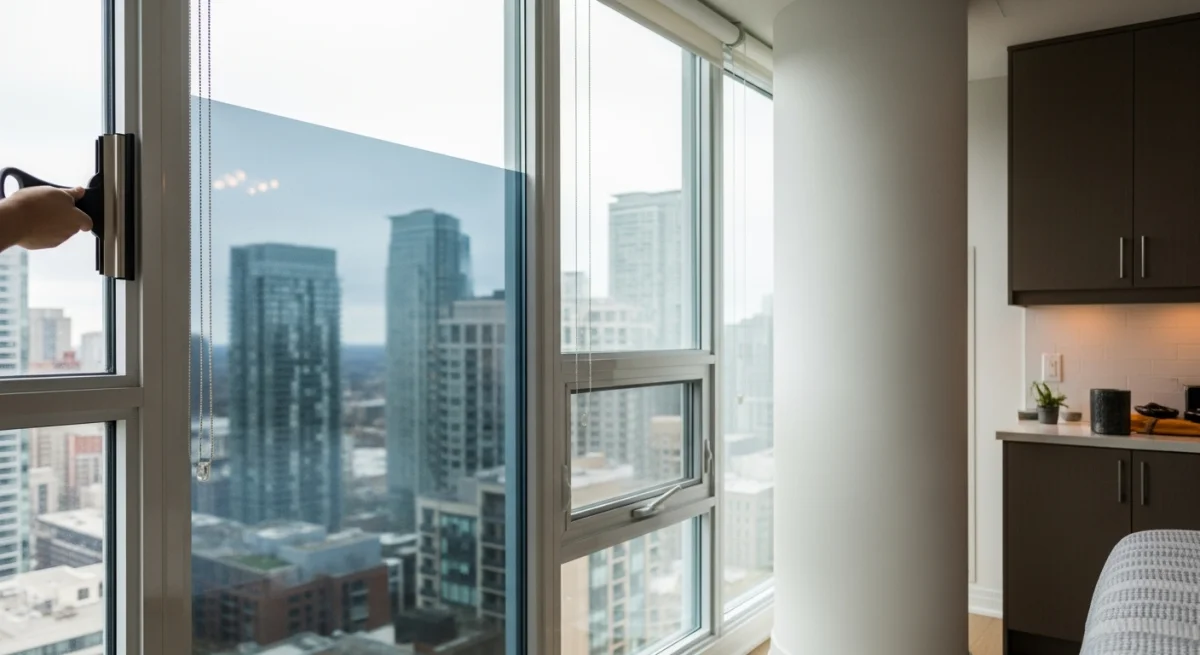

# Window Tinting & Solar Film Toronto 2026: The Complete Pillar Guide
Quick answer. A south- or west-facing Toronto condo or detached home with summer heat overrun, glare, or UV-fade problems usually has three options: live with it, replace the windows ($1,200-$2,500 per opening, HRS rebate eligible), or install solar window film ($10-$25/sqft installed, no rebate but 5-10x cheaper than replacement). Modern ceramic films reject 50-62% of total solar energy (TSER) and 95-98% of infrared heat with no metallic look and no signal interference. Premium nano-ceramic and multilayer optical films (3M Prestige, 3M Crystalline) push optical clarity to the point that the room does not look filmed at all. The two questions that determine whether film is a fit for your specific glass: (1) will it crack the IGU or void the seal warranty, and (2) will the condo board approve. This guide answers both, plus everything else.Why the IGU Thermal-Stress Question Comes First
Before pricing, brand, or VLT — the first technical question on every solar film job is whether the proposed film is compatible with the specific glass. Solar film absorbs additional infrared energy at the centre of the pane while frame-shaded edges stay cool. The differential creates tensile stress at the glass edges. Past a critical threshold (around 40 degrees Celsius edge-to-centre delta on annealed glass) the pane cracks — typically a horizontal or vertical line propagating from the edge inward. This is called thermal-stress fracture, and it is the number one risk window film introduces to your glass.
Glass tolerance hierarchy. Tempered glass tolerates almost any film. Heat-strengthened glass is high tolerance. Annealed (float) glass — the standard for most residential side-window glazing in IGUs — is moderate tolerance and is where most thermal-stress problems happen. Laminated glass with a PVB interlayer is low tolerance because the interlayer holds heat. Wired glass is very low tolerance and almost no film is appropriate. IGU-specific risks. Most Toronto residential glass since 1990 is double-pane IGU with sealed argon-filled spaces and low-E coating on one or two surfaces. Three additional risks beyond simple thermal stress: heat retention in the air gap accelerating seal failure (which voids the IGU manufacturer warranty under Pella, Andersen, and several Canadian window manufacturers' terms); low-E coating interaction (some films interact poorly with sputtered soft-coat low-E); and triple-pane glass (more common in 2018-plus OBC-compliant new builds) being even more thermally stressed by film. The professional protocol. Every quote we issue starts with a documented glass survey: glass type from the tempered stamp or IGU spacer bar, glass thickness, tint, IGU age, low-E surface, frame material, and exposure intensity. We cross-reference the proposed film against the manufacturer compatibility chart from 3M, Llumar, Madico, or SolarGard. If the chart returns OK we proceed. If marginal we propose a different film series. If not recommended we refuse the install or warn you in writing that the manufacturer warranty does not apply. Read the deep-dive at Will Window Film Crack My Condo Windows Toronto.Five Performance Numbers That Matter
Every quality window film publishes five numbers. Memorise these and you can read any spec sheet.
For the full framework see TSER VLT SHGC Window Film Explained.
Ceramic vs Dyed vs Metallized vs Nano-Ceramic
Dyed films are PET with absorbing dyes. Cheapest, fade purple in 3-7 years, modest heat rejection (TSER 25-35%). Skip for residential. Metallized (sputtered) films deposit thin metal on PET (aluminum, titanium, chromium, silver, gold). Reflects IR effectively and creates the mirror look. Drawback: blocks RF signals — cellular, WiFi 5 GHz, GPS, garage-door remotes. Fine for detached garages, problematic for condos. Ceramic films use non-metal nano-ceramic particles. Excellent IR rejection (88-95%) with no metal and no signal interference. Neutral tint, high clarity. Industry default since 2018. Examples: 3M Ceramic, Llumar Vista Ceramic, Madico Optitune, SolarGard Sentinel Ceramic. Nano-ceramic / multilayer optical is the highest-performance class. 3M Prestige uses 200+ multilayer optical layers; 3M Crystalline pushes even higher. TSER 55-62%, IR rejection 95-98%, virtually optical clarity. Dual-reflective is engineered with high-reflectivity outer layer and low-reflectivity inner layer. Daytime mirror outside, low interior glare from inside. Examples: 3M Night Vision, Llumar Dual Reflective, SolarGard TrueVue.The full comparison: Ceramic vs Dyed vs Metallized Window Film Toronto.
Need professional home renovation?
Call RenoHouse at 289-212-2345 or get a free estimate today.
Get Free Estimate →Brand Deep-Dive: 3M, Llumar, Madico, SolarGard, Hanita
3M Prestige Series is the residential flagship across most premium Toronto installs. PR 70 has VLT 68% and TSER ~50%; PR 60 has VLT 61% and TSER ~53%; PR 50 has VLT 50% and TSER ~56%; PR 40 has VLT 39% and TSER ~59%. All variants reject 99.9% UV and ~97% IR. Construction: 200+ multilayer optical film layers, non-metal, no signal interference. Lifetime residential warranty when registered through 3M Authorized Dealer. Toronto installed price: $15-$22/sqft. 3M Crystalline is the very high-end clarity option (Crystalline 70 / 50 / 40). Originally an automotive flagship, residential-spec available. Even higher IR rejection (98%), highest optical clarity. Toronto installed price: $18-$25/sqft. 3M Night Vision (NV) Series is dual-reflective metallic-coated. NV 15 has VLT 18% and TSER ~70%; NV 25 has VLT 25% and TSER ~64%; NV 35 has VLT 35% and TSER ~58%. Mid-tier residential pricing, $11-16/sqft. Metallized — signal interference applies. Llumar Vista Spectrally Selective (VS Series). VS 70, VS 60, VS 38. Comparable TSER to Prestige. 15-year residential warranty through Llumar SelectPro dealer. $14-$20/sqft. Madico Optitune Ceramic. OT 65, OT 50, OT 35. Strong adhesive technology, Madico Premier Installer warranty. $10-$16/sqft. SolarGard Sentinel Ceramic and TrueVue Dual Reflective. Strong commercial spec, TrueVue is residential-tuned dual-reflective. $11-$15/sqft typical. Hanita SolarZone (Avery Dennison subsidiary). Bronze-tone reflective and ceramic options, niche but well-regarded for warmer aesthetic. $10-$14/sqft.The full comparison: 3M Prestige vs Llumar Vista vs Madico Optitune.
Toronto Condo Solar Film: South/West Exposure Reality
Downtown Toronto condo glass — particularly in towers built 2005-2020 — was specified for visible-light delivery, not heat performance. South-facing and west-facing units in Liberty Village, CityPlace, King West, the Distillery, and Yorkville regularly hit interior surface temperatures of 38-48 degrees C in summer afternoon sun, with room air temperatures spiking 4-8 degrees C above the rest of the unit. The HVAC overruns, comfort imbalance kicks in, hardwood-floor fade accelerates, and electrical bills spike during the May-September cooling season.
A typical 700 sqft south/west Liberty Village condo (~120 sqft of window glass) on Toronto Hydro ULO runs ~600 kWh of summer cooling pre-film at $60-$80/month. Post-film with ceramic at 55% TSER drops to ~430 kWh at $40-$55/month. Seasonal savings May-September: $100-$150. On a $1,400-$2,200 mid-tier ceramic install the simple energy payback is 9-20 years. The case is fundamentally about comfort, glare, and UV-fade prevention — cooling savings are a tailwind. See the full ROI math at Condo South-West Window Tint Toronto ROI.
Pricing — 2026 GTA Installed
Real installed pricing in Toronto/GTA for 2026:
- Metallized solar (signal interference): $7-$10/sqft
- Ceramic mid-tier (Llumar Air Blue, Madico Sunscape): $10-$14/sqft
- Ceramic premium (3M Ceramic, Llumar Vista Ceramic): $10-$18/sqft
- Dual-reflective (3M Night Vision, Llumar DR): $11-$16/sqft
- Nano-ceramic flagship (3M Prestige): $15-$22/sqft
- Multilayer optical premium (3M Crystalline): $18-$25/sqft
Full pricing matrix: Solar Window Tint Cost Toronto Comparison.
Honest Scope: Warranty, Condo Board, HRS
Warranty validity requires manufacturer-Authorized Dealer. A non-certified installer cannot register the warranty and the manufacturer will not honour claims. We coordinate 3M Authorized Dealer or Llumar SelectPro for premium product so the warranty actually attaches. See Window Film Warranty 3M Authorized Dealer Toronto.
Mirror and Reflective Film — A Different Sub-Service
If your primary concern is daytime privacy from a sidewalk, neighbour, or adjacent tower (not solar heat or break-in resistance) the right product family is reflective or dual-reflective mirror film. The night-time reversal physics matter and are honestly disclosed. See the four mirror posts under our window-film-security-film sub-service: Mirror Window Film Daytime Privacy Toronto, Mirror Film Night-Time Reverse Effect Explained, Mirror Film vs Frosted vs Blinds Toronto, Mirror Window Film Toronto Condo Ground Floor.
Cluster Posts in This Guide
This pillar links to all 13 cluster posts in the solar + mirror cluster:
- Will Window Film Crack My Condo Windows Toronto
- Solar Window Tint Cost Toronto Comparison
- Ceramic vs Dyed vs Metallized Window Film Toronto
- 3M Prestige vs Llumar Vista vs Madico Optitune
- Condo South-West Window Tint Toronto ROI
- TSER VLT SHGC Window Film Explained
- Window Film Warranty 3M Authorized Dealer Toronto
- Tinted Window vs Window Replacement Cost Toronto
- Window Tint Condo Board Approval Toronto
- Mirror Window Film Daytime Privacy Toronto
- Mirror Film Night-Time Reverse Effect Explained
- Mirror Film vs Frosted vs Blinds Toronto
- Mirror Window Film Toronto Condo Ground Floor
Cross-References
For the broader window film context (security, decorative, UV-only) see the existing pillar Window Film Installation Toronto 2026 Complete Guide.
Get a Solar Film Quote
For Toronto solar window film projects, RenoHouse coordinates manufacturer-Authorized Dealer installs for premium product (3M Prestige, 3M Crystalline, Llumar Vista) so your warranty registers correctly. We perform the IGU thermal-stress survey, prepare condo board submissions, and handle install end-to-end. Book a consultation through the window tinting and solar film service page or call 289-212-2345.
Continue Reading