RenoHouse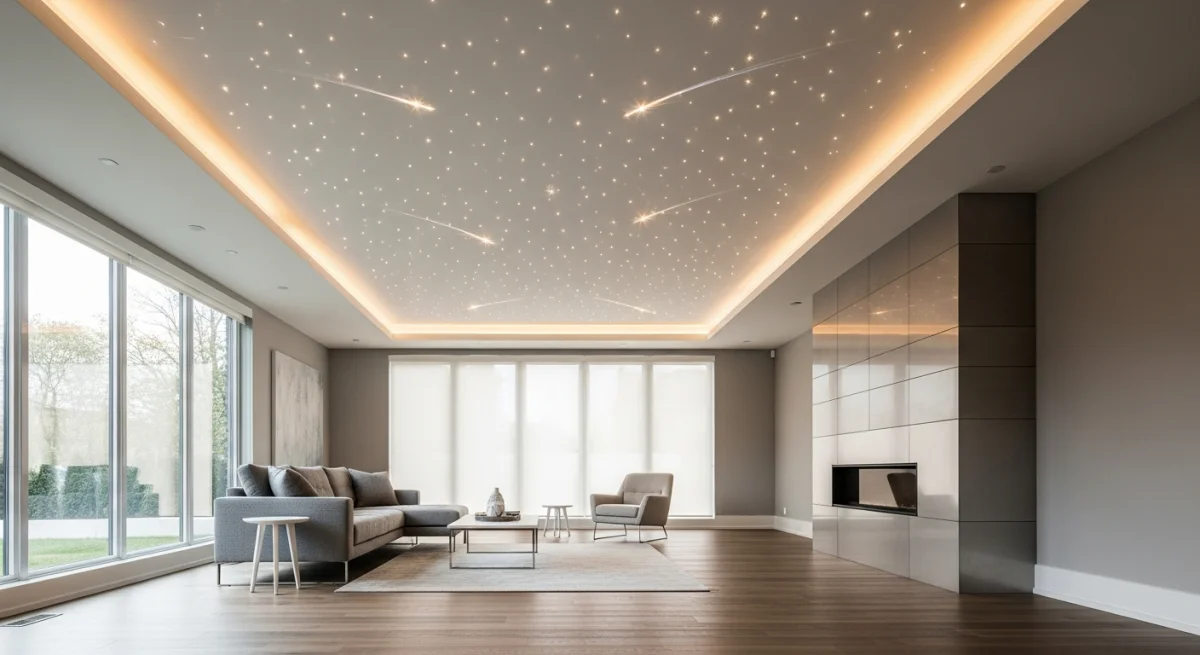

# Shooting Star Effect on a Fiber Optic Ceiling: Programming and Design
Of every upgrade available on a fiber optic star ceiling, the shooting star module is the one that consistently produces the most genuine reactions. Twinkle is subtle and easy to miss. RGB cycling is decorative but expected. Crystals are static. The shooting star is the moment — once every minute or two, a streak of light traces an arc across the ceiling, and even people who installed the ceiling and have lived with it for two years still look up and pause when one fires. This guide explains how shooting star modules work, how to program them, and how to integrate them into bedrooms, theatres, and restaurants.
This article is part of our star sky cluster. For the broader pillar see Star Sky Ceiling Toronto 2026 Complete Guide. For pricing context see Star Sky Ceiling Cost in Toronto.
How a Shooting Star Module Works
A shooting star module is an add-on to a fiber optic light engine. Mechanically, it consists of:
- A dedicated higher-output LED light source
- A motorized track or rotating optical assembly
- One or more dedicated fiber strands routed across a programmed path on the ceiling
- A controller that triggers the module at programmed intervals
When the module fires:
- 1. The dedicated LED illuminates briefly
- 2. The motorized assembly moves the lit point along the fiber path
- 3. From below, the viewer sees a streak of light traveling across the ceiling — typically 12–20 inches of apparent travel
- 4. The streak fades in and out at the start and end for a natural meteor look
The fiber path is set at install time. The streak length and direction are physical, not programmable. You choose where the shooting stars travel before the membrane is drilled.
Single vs Dual Shooting Star Modules
Single Module
Recommended for master bedrooms, kids' rooms, and small accent installs. One streak across the ceiling at programmable intervals (typically 60–180 seconds for bedrooms, 120–300 seconds for kids' rooms).
The streak path runs in one direction only. We typically angle it diagonally across the room so it covers the visual field of someone in bed looking up.
Cost added: $400–$700 module + installation.
Dual Module
Recommended for home theatres, restaurants, and large rooms above 350 sqft. Two streaks across different ceiling zones, typically:
- Module 1: upper third of ceiling, one direction
- Module 2: lower third of ceiling, opposite direction
The dual setup provides 1.5–2x the apparent firing frequency without making any single area feel busy. Critical for theatre experiences where dramatic pacing matters.
Cost added: $750–$1,400 for both modules + installation.
Triple or Quad Modules
Used in large commercial spaces (800+ sqft restaurants, ballrooms, hospitality lobbies). Each module covers a designated zone, all coordinated through DMX. Programming becomes significantly more complex.
Programming Intervals
The interval between firings is the most important programming decision. Common settings:
Need professional renovation?
Call RenoHouse at 289-212-2345 or get a free estimate today.
Get Free Estimate →| Application | Interval Range | Recommended Default |
|---|---|---|
| Master bedroom | 60–180 seconds | 90 seconds |
| Kids' room | 120–300 seconds | 180 seconds |
| Home theatre, ambient | 60–120 seconds | 75 seconds |
| Home theatre, scene-triggered | DMX cue only | varies |
| Restaurant private dining | 90–180 seconds | 120 seconds |
| Restaurant cocktail lounge | 45–90 seconds | 60 seconds |
Why these ranges:
- Faster than 45 seconds: the streaks become predictable and lose their *moment* quality. Diners notice the pattern.
- Slower than 300 seconds: the streaks are so rare that the homeowner forgets the module exists. The wow moment never comes.
- 60–180 seconds: the sweet spot. Long enough to feel like a real event, short enough to feel attainable.
Most engines support randomization within an interval band — for example, "fire between 60 and 120 seconds, randomized." We always enable randomization. Fixed-interval shooting stars feel mechanical.
DMX Triggering for Theatres
The advanced shooting star programming uses DMX cues rather than time-based intervals. The theatre processor (Trinnov, Marantz, JBL Synthesis) sends a DMX command to fire a shooting star at specific moments in scene programming.
Use cases:
- Pre-show ambient mode: time-based, every 90 seconds
- Trailer transition cue: shooting star fires at first frame
- Feature start: dual shooting stars fire as house lights drop
- Dramatic scene moments: pre-programmed cues fire on calibrated music beats
- Credits rolling: return to time-based mode
Theatre integrators charge $800–$1,800 to program a serious cue list. Worth it for dedicated theatre rooms; overkill for media rooms.
We discuss broader theatre integration in Star Sky Ceiling for the Home Theatre.
Streak Path Design
The path the shooting star travels is a design decision made before factory drilling.
Diagonal Across the Bedroom (Default for Master Bedrooms)
Streak runs diagonally from one corner of the room to the opposite corner area, covering the visual field of someone in bed. Most popular path. Easy to install.
Window-to-Wall (Romantic Configuration)
Streak runs from the window-side corner toward the bed wall, suggesting a meteor falling toward the viewer. Slightly more dramatic, slightly harder to install (requires the fiber path through joists).
Zone-Specific (Theatres)
In theatres, the upper-third streak typically runs left-to-right above the screen, while the lower-third streak runs right-to-left over the seating area. The opposing directions create visual rhythm.
Constellation-Anchored (Specialty)
For constellation-mapped ceilings, the streak path runs *between* identified constellations — for example, from the Big Dipper toward Orion. This requires custom design coordination at the factory drilling stage. Lead time adds 2–3 weeks.
Brightness and Streak Length
The shooting star LED is brighter than ambient star fibers — typically 3–5x the output of a 1.5 mm headline star. This is intentional. The shooting star should *clearly* be brighter than the rest of the field.
Streak length is fixed by the mechanical track:
- Standard module: 14–18 inches apparent travel
- Extended module: 22–28 inches apparent travel (premium)
- Dual-track module: two parallel 14-inch streaks (specialty, theatres only)
The standard 14–18 inch streak reads as authentic at typical viewing distances. The extended streak is dramatic but starts to feel theatrical in a residential bedroom.
Photographing the Shooting Star
Phone cameras (iPhone 15+, Pixel 8+) capture the shooting star in 1-second night-mode exposures. The streak appears as a clean light trail in the photograph. This is a substantial part of the appeal for homeowners who share design moments with friends and family.
Pro photography of the shooting star uses a 4–8 second exposure on a tripod, capturing multiple firings in a single frame. The result is the classic "meteor shower" look you see in real night-sky photography.
Common Shooting Star Mistakes
Aiming the Streak at the Bed
Resist the instinct to make the streak point directly at the pillow. From a pillow looking up, a streak that starts above your head and ends at your feet feels too literal — like a missile coming at you. Diagonal across the room reads as natural sky.
Over-Triggering
A shooting star every 20 seconds is a lighting effect, not a sky. Stick to the recommended intervals. The rarity is the point.
Pairing Twinkle Speed with Streak Frequency
If twinkle is set to fast (every 2 seconds) and shooting stars fire every 60 seconds, the ceiling feels chaotic. Slower twinkle (6–8 seconds) plus mid-frequency streaks (90 seconds) feels balanced.
Skipping the Module to Save Money
The shooting star is the single highest-impact upgrade per dollar on a fiber optic ceiling. Skipping it to save $500 produces a noticeably less impressive ceiling. We never recommend skipping it on premium master bedrooms or theatres.
Real Project Examples
Vaughan Master Bedroom
- 220 sqft fiber optic ceiling, Cosmolight Galaxy V8
- Single shooting star module, diagonal path
- Interval: 75–120 seconds, randomized
- Total project including module: $9,300
Forest Hill Home Theatre
- 380 sqft fiber optic theatre ceiling, Universal Fiber Optics XL
- Dual shooting star modules, opposing zones
- Time-based mode + DMX cue list integration with Trinnov
- Total project including dual modules and DMX programming: $19,400
Yorkville Restaurant Private Dining
- 350 sqft fiber optic ceiling, Universal Fiber Optics XL
- Dual shooting star modules, conservative intervals
- Branded scene programming for events
- Total project including dual modules: $32,800
How RenoHouse Sources and Programs Shooting Star Modules
Cosmolight, Universal Fiber Optics, and MakeMaster all ship shooting star add-on modules through verified Canadian distributors. Our installer network includes technicians experienced with module installation, path planning, and DMX integration. RenoHouse layers a 10-year project warranty including module replacement during the warranty period.
For a design consultation, visit our Star Sky Ceiling Installation page, or read the pillar guide.
Continue Reading