RenoHouse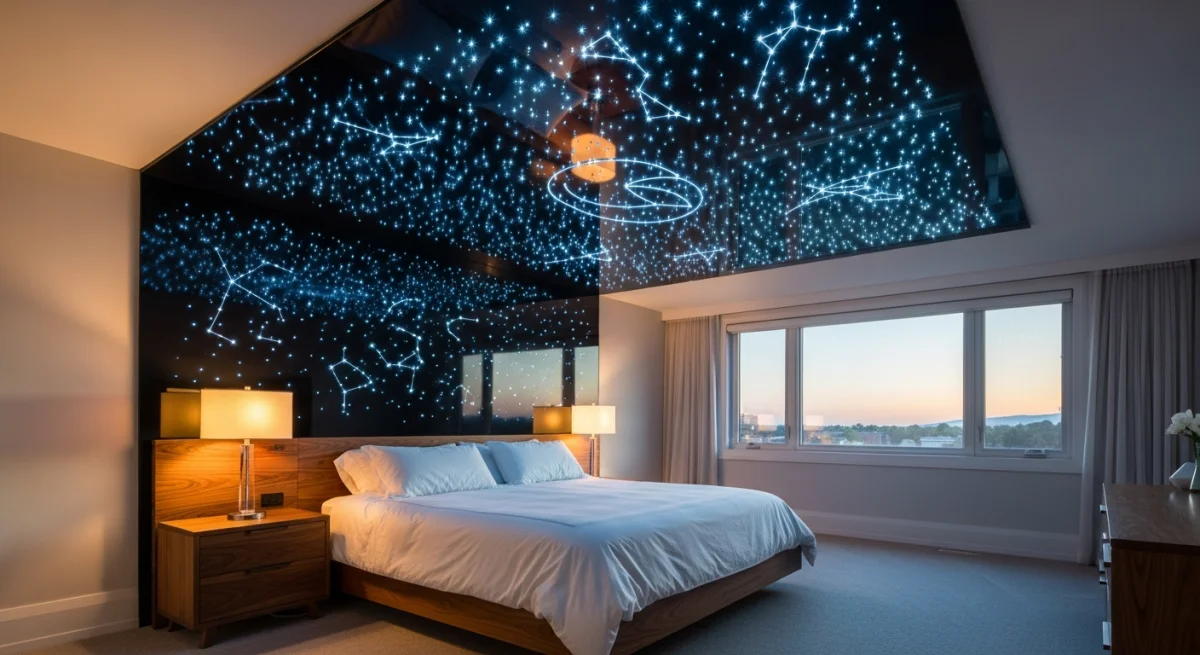

# Star Sky Ceiling for the Toronto Home Theatre: Acoustic and Visual Combo
The home theatre is the room where star sky ceilings perform their best technical work. The space is intentionally dark, the audience is seated and looking up, the design is already cinematic, and the absence of competing daylight means even subtle starfield effects read clearly. A 1,500-star fiber optic ceiling above a Toronto basement theatre is genuinely indistinguishable from a real night sky, and the moment the lights go down before a movie is one of the most quietly impressive home moments in the city.
This guide covers the design choices specific to home theatres — density, acoustic integration, blackout coordination, dual shooting star programming, and integration with theatre processors. It assumes you have read our Star Sky Ceiling Toronto 2026 Complete Guide. For pricing, see Star Sky Ceiling Cost in Toronto.
Why Home Theatres Are the Ideal Canvas
Three properties of theatre rooms align perfectly with star sky ceiling technology:
1. Intentional darkness. Theatres are designed for blackout. Daylight ruins star ceilings; theatres have no daylight to begin with. The starfield reads at full effect from minute one. 2. Audience orientation. Reclining theatre seats put the viewer's head at a 30–40 degree angle, with the ceiling in their primary upper field of view. In a master bedroom, the ceiling is mostly visible from a pillow. In a theatre, it is visible from every seat. 3. Suspension of disbelief is already happening. A theatre is a room designed to convince you that you are inside a story. A star ceiling reinforces that. The audience accepts the night sky as part of the room narrative.Density: Theatres Want Full Milky Way
Bedrooms work well at 60–90 stars per square metre. Theatres want 100–150 stars per square metre — full Milky Way density. The room is darker, the viewing distance is longer (typically 3–5 metres to the ceiling), and the dramatic effect benefits from the sense of an *overwhelming* starfield rather than a *suggestive* one.
For a 350 sqft (32.5 m²) theatre at 130 stars/m²: about 4,200 stars. For a 250 sqft theatre at 110 stars/m²: about 2,500 stars.
These numbers exceed the capacity of a single Cosmolight Galaxy V8 (800 stars). For most theatres we use the Universal Fiber Optics XL engine (up to 2,500 stars from one engine), or two coordinated engines for very large rooms. See Cosmolight Galaxy V8 Star Ceiling Review for the engine comparison.
Diameter Mix for Theatres
Theatres benefit from a more aggressive headline-star fraction than bedrooms:
- 65 percent 0.5 mm — background field
- 20 percent 0.75 mm — medium stars
- 10 percent 1.0 mm — bright stars
- 5 percent 1.5 mm — *very* bright stars, the visual anchors
The brighter mix reads better at 4–5 metre viewing distance. A pure 0.5 mm field, fine in a bedroom at 2 metres, looks dim and underwhelming at theatre distance.
Milky Way Band Design
The signature theatre starfield is the Milky Way band — a denser concentration of stars running diagonally across the ceiling, with sparser fields on either side. This mimics the actual band of the Milky Way visible from a dark Toronto rural location.
Design conventions:
- The band runs diagonally, not parallel to the screen wall
- Density inside the band is 1.5x to 2x the surrounding field
- The band has soft edges, not a defined boundary
- Headline stars cluster slightly more inside the band
For an authentic look, we often anchor the band to a real constellation — Cygnus, Cassiopeia, or Sagittarius depending on the homeowner's preference. The custom star map adds 4–6 weeks lead time and $400–$1,200 design surcharge. Full constellation guidance in Constellation Pattern Star Ceiling Design.
Dual Shooting Star Programming
Theatres are the one application where we install two shooting star modules rather than one. The reason is dramatic pacing: a single shooting star every 90 seconds reads as decorative; two streaks at randomized 60–180 second intervals reads as authentic.
Need professional renovation?
Call RenoHouse at 289-212-2345 or get a free estimate today.
Get Free Estimate →Recommended programming:
- Module 1: streaks across the upper third of the ceiling, typical 60–120 second interval
- Module 2: streaks across the lower third, typical 90–180 second interval, often coordinated with screen content via DMX trigger
The DMX trigger option is the *wow* feature — a dedicated cue in the theatre processor fires a shooting star at programmed scene moments (a Star Wars hyperspace transition, an emotional moment in a romance, the climax of a fireworks scene). Done sparingly, it is unforgettable.
Full shooting star design discussion in Shooting Star Effect Fiber Optic Ceiling.
Acoustic Considerations
Stretch ceilings have a complicated relationship with acoustics. Standard PVC membrane is acoustically reflective — it bounces high-frequency sound back into the room, sometimes creating slap echo or comb filtering. In a theatre tuned for surround sound, this matters.
Two approaches we use:
1. Acoustically transparent fabric membrane. Clipso AC and Barrisol Acoustic systems use perforated fabric that lets sound pass through. Place absorbing material in the plenum behind the membrane and you get effective ceiling absorption. The starfield works because fiber optic terminations are pinpoint and do not block sound transmission. Cost: $35–$55 per sqft for the membrane alone, before fiber optic. 2. Standard PVC with strategic absorber zones. Place professional acoustic absorbers in the rear third of the ceiling (above the seating row) and PVC stretch in the front two-thirds (above the audience-facing zone). The starfield runs across the PVC area. Slightly less effective acoustically but cheaper.For a serious theatre tuned by a professional calibrator, option 1 (acoustic fabric) is correct. For a casual media room, option 2 (PVC with strategic absorbers) is fine.
Blackout Integration
Toronto basement theatres are usually already dark, but coordination still matters:
- All ambient light sources on the same scene controller as the star engine
- Door light leak addressed with sweeps and gaskets
- Stair light from the upper floor isolated with door closure
- Equipment rack LEDs disabled or hidden behind a closed cabinet
- Seating cup-holder LEDs on dimmed amber, fade-down with the lights
The brighter the room, the less the star ceiling reads. A 100 lumen door leak from a hallway will compete with a 1,500-star fiber optic ceiling and visibly reduce the apparent star contrast.
Theatre Processor Integration
Star sky engines integrate with theatre processors three ways:
1. DMX-512 cues. Universal Fiber Optics XL engines accept DMX directly. Your theatre processor (Trinnov, Marantz, JBL Synthesis) sends cues for *Pre-Show*, *Trailers*, *Feature*, *Credits*, *House Lights*. Each cue has its own star scene. 2. Lutron RA3 with theatre integration. The Lutron processor talks to both the theatre processor and the star engine. Scenes flow through Lutron rather than direct DMX. Slightly less precise but easier to integrate with non-star room lighting. 3. Control4 or Savant. Whole-home controllers with theatre modules. Best when the theatre is part of a larger smart home install.For a dedicated theatre, DMX direct is the cleanest path. For a media room that is part of a larger smart home, Control4 or Savant.
Plenum and Membrane Depth
Theatres tend to have lower finished ceilings than master bedrooms — a typical Toronto basement theatre is 7'6" to 8'4" finished. Star sky systems lose 60–80 mm to the engine plenum and fiber harness routing. Plan accordingly:
- Pre-install ceiling height: 8'0"
- After star sky stretch ceiling: 7'7" to 7'9"
If you are below 7'8" pre-install, consider whether a star ceiling is the right call. Acoustic absorber panels above the membrane add another 30–50 mm of plenum requirement.
Sample Theatre Project
A 380 sqft Forest Hill basement theatre we installed in early 2026:
- Acoustically transparent Clipso membrane, midnight navy
- 1,800 fiber optic stars, 65/20/10/5 diameter mix
- Universal Fiber Optics XL engine
- Dual shooting star modules with DMX trigger from theatre processor
- Milky Way band running diagonal anchored to Cygnus
- DMX integration with Trinnov processor
- 9-zone Lutron RA3 lighting integration
- 10-year RenoHouse project warranty
Total project: $18,500 including HST. Theatre processor integration was an additional $2,200 in calibrator fees, paid to the audio integrator separately.
How RenoHouse Manages Theatre Star Ceiling Projects
Theatre projects require coordination across multiple trades — fiber optic installer, ESA-licensed electrician, audio integrator, drywall and trim, and sometimes the theatre furniture vendor. RenoHouse acts as the project coordinator, holding the schedule and the responsibility.
Our installer network includes Russian-Canadian crews experienced with Universal Fiber Optics XL and DMX integration, ESA-licensed theatre electricians, and verified suppliers. We layer a 10-year project warranty on top of manufacturer terms.
To plan a theatre install, visit our Star Sky Ceiling Installation page, read the pillar guide, or compare with a master bedroom design.
Continue Reading
- Shooting Star Effect on a Fiber Optic Ceiling: Programming and Design
- Star Sky Stretch Ceiling Toronto: The Complete 2026 Installation Guide
- Star Sky Ceiling for the Toronto Master Bedroom: Design Guide
Frequently Asked Questions
How much does a fiber optic star ceiling cost?
Fiber optic star ceilings in Toronto home theatres range from $8,000 to $25,000, depending on fiber count (1,000–3,000 strands), control system complexity, and acoustic panel integration. A standard 1,500-fibre installation costs around $12,000–$18,000 before labour. Premium installations with dual shooting-star programming and motorized brightness dimming add $3,000–$5,000. Request itemized quotes that separate hardware, installation labour, blackout framing, and acoustic integration to compare accurately.
How many fiber optics do I need for my home theater?
A 1,500-fibre installation is the standard sweet spot for a Toronto basement home theatre, creating a realistic starfield over a 12'×14' ceiling. Higher density (2,000–3,000 fibres) adds immersion but risks oversaturation and optical waste. Lower counts (under 1,000) feel sparse. Consultant analysis of your ceiling area, viewing distance, and ambient light control determines the optimal density for your specific room.
Will a star ceiling affect my home theater acoustics?
Star ceilings and acoustic panels work together. The fiber optic core sits within the acoustic membrane without compromising sound absorption. Acoustic-backed star ceilings maintain NRC ratings between 0.6–0.8. If you're upgrading a Toronto theatre space, specify 'theatre-grade acoustic membrane with fiber optic pre-drill' to your installer to avoid acoustic degradation. Acoustic damage happens only with poor installation planning.
How long does star ceiling installation take?
Fiber optic star ceiling installation takes three to five days, including blackout integration and acoustic setup. Electrical work depends on your control hub location; most Toronto installers route 240V or 120V within wall cavities. The projector head (light source) requires dedicated circuit capacity. Consult your electrician during planning—ESA certification isn't required for low-voltage fibre runs, but service panel upgrades cost $500–$1,200.