RenoHouse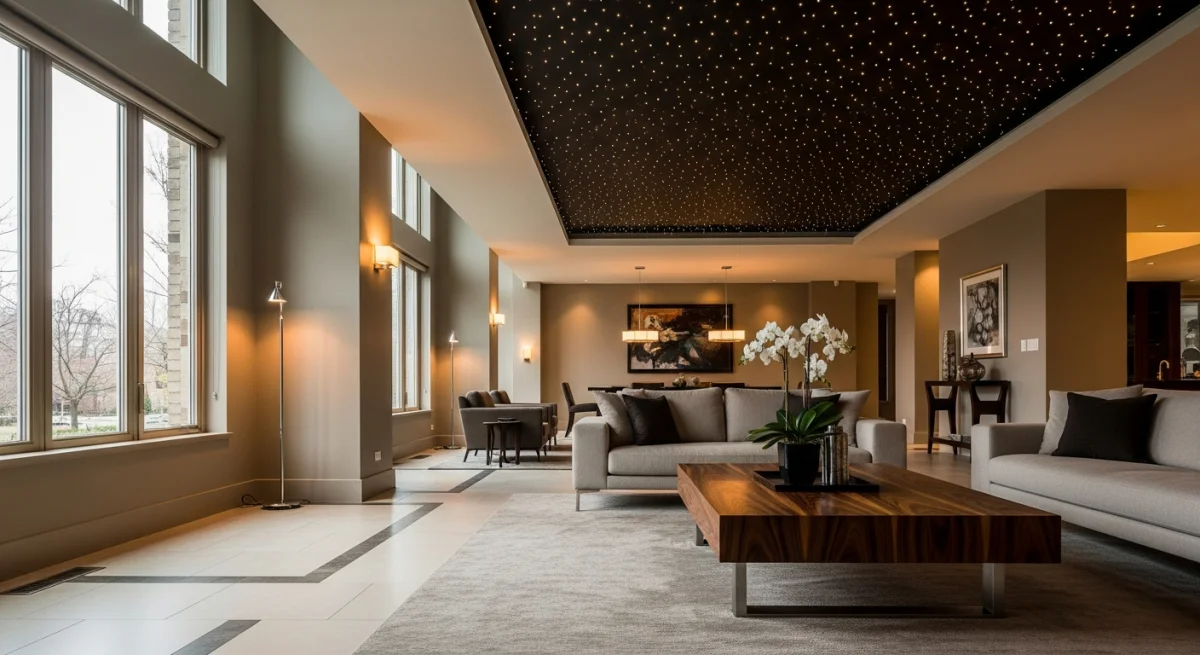

# Cosmolight Galaxy V8 Star Ceiling Review: Real-World Toronto Performance
After installing the Cosmolight Galaxy V8 engine in 60+ Toronto homes since it shipped in late 2024, our installer network has a clear sense of where it wins, where it has weak points, and which clients should choose it over the Universal Fiber Optics XL or a MakeMaster engine. This is the engine review most consultations skip over — and the one that determines whether your $9,000 ceiling looks transcendent or merely fine.
This review is part of our star sky cluster. For the broader system comparison see Fiber Optic vs LED Matrix Star Ceiling, and for full installation pricing see Star Sky Ceiling Cost in Toronto.
What the Galaxy V8 Is
The Cosmolight Galaxy V8 is an LED-based fiber optic light engine — the central source that feeds 200 to 800 individual PMMA fibers terminating as star points in a stretch ceiling membrane. It replaced the older halogen-engine generation that dominated the GTA market through 2022.
Key specifications:
- LED light source, 50,000+ hour rated life
- 200–800 fiber capacity from a single engine
- Built-in mechanical twinkle wheel with adjustable speed
- Optional RGB colour cycling module
- Optional shooting star add-on module
- 0–10V dimming input plus DMX-512 input
- Wi-Fi remote app for iOS and Android
- Compact form factor — 220 mm × 180 mm × 90 mm
- 100–240V universal supply, 24V output to fiber harness
- IP20 rating (indoor only)
Build Quality
After three years of GTA installations, our service callbacks on Galaxy V8 engines run under 4 percent — almost all related to the optional RGB module rather than the core engine. The chassis is aluminum, the internal LED is a proprietary Cosmolight COB module, and the fiber harness mounts via a precision-machined puck that holds 800 fiber tails without crosstalk or back-reflection.
The mechanical twinkle wheel — the part most prone to wear — uses a brushless motor with sealed bearings. We have not seen one fail in service yet.
Light Output and Realism
This is where the Galaxy V8 separates itself. The COB LED is colour-calibrated to 5500K with a CRI above 90, which renders a *cold-white star* that looks correct against a dark navy or matte black PVC membrane. Older halogen engines produced an orange-white that always looked slightly artificial.
When paired with a 70/20/10 fiber diameter mix (0.5 mm / 0.75 mm / 1.0 mm), the resulting starfield reads as a genuine night sky from a typical bedroom viewing distance of 2–3 metres.
Need professional renovation?
Call RenoHouse at 289-212-2345 or get a free estimate today.
Get Free Estimate →The twinkle wheel produces a natural shimmer rather than the synchronized flashing some LED matrix systems exhibit. Speed is adjustable from one twinkle every 12 seconds (very subtle) to one every 2 seconds (active). We default to 6-second cycles for bedrooms.
Shooting Star Module Performance
The optional shooting star add-on is, in our opinion, the single most important upgrade. It dedicates one larger-diameter fiber on a moving track that streaks across the ceiling at programmable intervals — typically one every 60 to 180 seconds for bedrooms.
The streak length is fixed by the track geometry — about 18 inches of apparent travel, which photographs beautifully and reads as a real meteor from below. Multiple modules can be installed; for theatres we typically run two. Full design discussion in Shooting Star Effect Fiber Optic Ceiling.
Smart Home Integration
The Galaxy V8 ships with three integration paths:
1. Cosmolight Wi-Fi App. Adequate for a single ceiling, basic dimming, twinkle speed, colour cycling. Not great for whole-home scenes. 2. 0–10V Dimming. Works with Lutron Caseta dimmers, RA3, and most smart dimming platforms. We use this most often for master bedroom installs paired with Lutron — the homeowner's existing wall keypad just works. 3. DMX-512. The professional path. DMX gives you per-channel control of dim level, twinkle speed, RGB if equipped, and shooting star triggers. Required for theatre integration. We pair it with Control4, Savant, or Home Assistant DMX bridges.The Wi-Fi app, while functional, has a clunky interface and we usually recommend disabling it after commissioning in favour of 0–10V or DMX. Cosmolight has not significantly improved the app since 2024.
Where the Galaxy V8 Wins
- Master bedrooms. The 5500K cold-white LED is exactly right. The 800-fiber capacity covers any realistic bedroom star count. Twinkle is natural. Smart home integration is mature.
- Restaurant private dining and lounges. Photographs well, twinkle reads on phone video, RGB module enables theme-night colour scenes.
- Mid-size home theatres. Up to 800 stars in a single 250 sqft theatre, with shooting star and DMX integration.
Where the Galaxy V8 Falls Short
- Large home theatres above 350 sqft. 800 stars is not enough density. We use Universal Fiber Optics XL for full Milky Way bands.
- Commercial spaces above 500 sqft. Same density limitation. Multiple Galaxy V8 engines work but introduce twinkle synchronization issues unless DMX-coordinated.
- Budget-driven kids' rooms. Overkill. A MakeMaster engine at half the price serves a kids' room well.
- Outdoor or covered patio applications. IP20 rating means indoor-only. Use a different system for outdoor canopies.
Comparison: Galaxy V8 vs Universal Fiber Optics XL vs MakeMaster
| Factor | Galaxy V8 | UFO XL | MakeMaster |
|---|---|---|---|
| Star capacity | up to 800 | up to 2,500 | up to 300 |
| LED colour temp | 5500K | adjustable 4500–6500K | 5000K fixed |
| CRI | 90+ | 95+ | 80+ |
| Twinkle quality | excellent | excellent | good |
| Shooting star | modular | modular, multiple per engine | basic |
| Smart home | 0–10V, DMX, Wi-Fi | DMX, BACnet, Wi-Fi | Wi-Fi only |
| Wholesale price | $1,200–$1,800 | $2,200–$3,500 | $400–$600 |
| Best for | master bedrooms, mid theatres | large theatres, commercial | kids' rooms, accents |
Maintenance and Service
The wear part is the LED COB module. After 50,000 hours of use — which at 4 hours per night is over 34 years — output drops to 70 percent. In practice, no Toronto homeowner will run the engine to end-of-life. The COB module is field-replaceable in 25 minutes by a trained technician.
The twinkle motor is sealed and rated for 100,000 hours. The fiber harness, once installed, is essentially maintenance-free. We have never replaced one for failure — only when a homeowner expanded their star count during a renovation.
For full care guidance see Star Sky Ceiling Maintenance and Care.
Pricing in Toronto in 2026
Galaxy V8 installed pricing through our installer network:
- Engine alone, no upgrades: $1,650–$2,200
- Engine plus twinkle (always recommended): $1,850–$2,500
- Engine plus twinkle plus single shooting star: $2,400–$3,200
- Engine plus twinkle plus dual shooting star plus RGB: $3,200–$4,400
These are engine-only line items. Fiber harness, membrane, electrical, and labour are separate. See Star Sky Ceiling Cost in Toronto for whole-project pricing.
Our Verdict
For Toronto master bedrooms in the $7,000 to $12,000 ceiling budget, the Cosmolight Galaxy V8 with twinkle and one shooting star module is our default specification. It outperforms older halogen engines in every measurable way, integrates cleanly with Lutron and Control4, and the build quality has held up across three years of GTA service.
If your project is a large home theatre, restaurant, or commercial space above 500 sqft, step up to the Universal Fiber Optics XL. If your project is a kids' room or accent ceiling under 80 sqft, save money with a MakeMaster engine. For everything in between, the Galaxy V8 is the right call.
How RenoHouse Sources and Warranties the Galaxy V8
Cosmolight ships through verified Canadian distributors with full warranty backing. RenoHouse layers a 10-year project warranty on top of Cosmolight's 5-year engine warranty, covering installation labour, fiber harness integrity, and engine swap labour for the full project lifetime.
Our installer network includes Russian-Canadian crews who trained on the Galaxy V8 platform from its launch — meaning your engine is commissioned by people who know it deeply, not contractors learning on your project.
To plan a Galaxy V8 install for your space, visit our Star Sky Ceiling Installation page, or read the pillar guide.
Continue Reading