RenoHouse

# Fiber Optic vs LED Matrix Star Ceiling: Which Looks More Real?
Every star sky ceiling consultation we run in Toronto eventually arrives at the same question. The homeowner has done their research, found two quotes — one twice the price of the other — and wants to know whether the cheaper system is genuinely close enough to justify the savings, or whether they will regret it the first time guests look up.
The short answer: for a master bedroom, a high-end home theatre, or anything you want to *feel like a real sky*, fiber optic wins decisively. For kids' rooms, accent ceilings, and budget-driven projects where programmable patterns matter more than realism, LED matrix is genuinely good in 2026.
This is a sibling article to our Star Sky Ceiling Toronto 2026 Complete Guide. If pricing is your main question, jump to Star Sky Ceiling Cost in Toronto.
How the Two Systems Actually Work
Fiber Optic with a Central LED Engine
One LED light engine — typically a Cosmolight Galaxy V8, a Universal Fiber Optics illuminator, or a MakeMaster engine — feeds 200 to 2,000 individual PMMA optical fibers. Each fiber is a hair-thin strand of polished plastic that pipes a tiny dot of light from the engine to the membrane surface. The star you see is the polished tip of that fiber, exiting through a pinhole drilled in the PVC membrane.
The light source is hidden. The membrane has no electronics in it. The "stars" are passive optical terminations.
LED Matrix Behind a Translucent Membrane
A grid of surface-mount LEDs (typically 5050 or 3528 SMD) is mounted to a backing board behind a translucent stretch membrane. Each LED is its own light source. A controller drives the matrix — random twinkle, constellation patterns, colour washes, synchronized scenes.
The light source is the membrane. The membrane is essentially a giant low-resolution screen.
Need professional renovation?
Call RenoHouse at 289-212-2345 or get a free estimate today.
Get Free Estimate →Realism: The Big Reason People Choose Fiber Optic
A real star is a point. From four metres away, the human eye reads anything wider than about 0.6 mm as a *dot* rather than a *point*, and your visual system flags non-points as artificial.
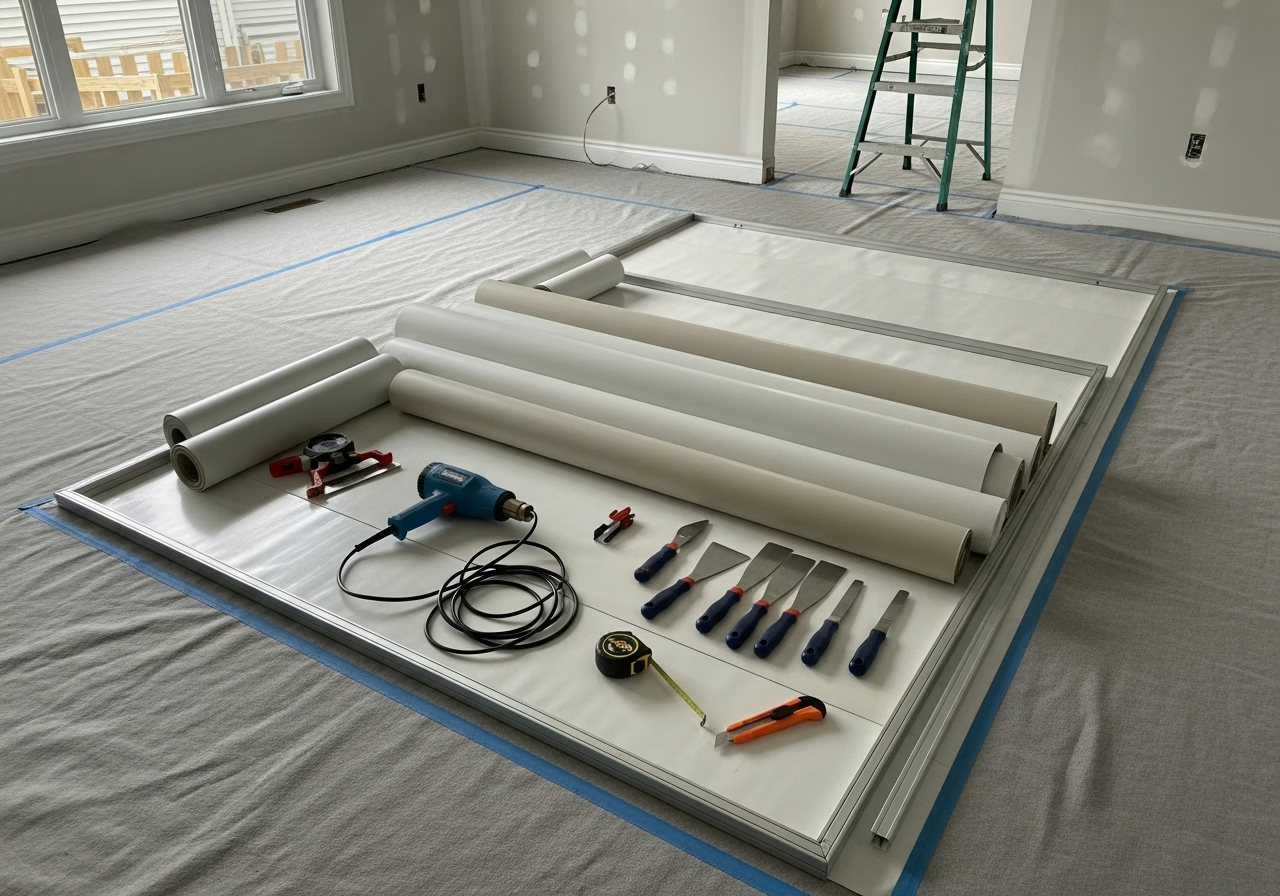
Fiber optic tips at 0.5 mm, 0.75 mm, and 1 mm read as crisp points. The brightness varies because you can mix fiber diameters across the harness — exactly the way real stars vary in apparent magnitude.
LED matrix pixels are physically larger (typically 2.5–5 mm SMD packages), and the diffusion through the membrane spreads each one into a soft halo of 8–15 mm. From across a master bedroom, you read soft glowing dots rather than pinpoint stars.
In a kids' room three feet below the ceiling? Either looks magical. In a Bridle Path master suite with the homeowner staring up from a king bed two metres away? The LED matrix gives itself away.
Side by Side: Fiber Optic vs LED Matrix
| Factor | Fiber Optic | LED Matrix |
|---|---|---|
| Realism (point sources) | Excellent | Fair to good |
| Star count flexibility | 200–2,500 from one engine | Limited by panel size |
| Variable brightness | Native (mix fiber diameters) | Programmable per pixel |
| Twinkle quality | Mechanical or LED, very natural | Programmable, sometimes too uniform |
| Shooting star effect | Dedicated module, single point streak | Animated across pixels, less crisp |
| Colour cycling | RGB engine, all stars cycle together | Per-pixel RGB possible |
| Constellation accuracy | Custom drilled membrane, exact | Programmable but limited resolution |
| Membrane lifespan | 15–20 years (PVC) | 15–20 years (PVC) |
| Light source lifespan | 50,000+ hour LED engine | 30,000–50,000 hour LEDs |
| Service / repair | Replace engine, fibers stay | Replace LED panel, often re-pull membrane |
| Installed cost (Toronto 2026) | $20–$45 per sqft | $12–$25 per sqft |
When LED Matrix Genuinely Makes Sense
We do not push every client toward fiber optic. The cases where we recommend LED matrix:
- Kids' rooms. Programmable patterns, planet animations, bedtime sleep modes, and colour scenes are more engaging for a four-year-old than authentic star realism. See Star Sky Ceiling for Kids' Rooms.
- Accent ceilings under 60 sqft. A small powder room or hallway accent does not justify a $1,500 fiber engine.
- Renters or short-term residences. Lower investment, easier to leave behind.
- Budget-driven primary bedrooms. A 200 sqft master at $14/sqft is $2,800 — half the cost of fiber optic. Still beautiful, just less authentic up close.
When Fiber Optic Is the Only Right Answer
- Master bedrooms in luxury homes. Bridle Path, Forest Hill, Yorkville penthouses, Vaughan estate builds. Clients spending $4M–$15M on a home will notice an LED grid.
- Home theatres. The dark room reveals every diffusion artifact. See Star Sky Ceiling for the Home Theatre.
- Restaurants and hospitality. Photography quality matters for social media reach. Fiber optic photographs beautifully on phone cameras; LED matrix sometimes shows moiré patterns on video.
- Anywhere you want Swarovski crystal upgrades. Crystals only work with fiber optic — they sit beside the fiber tips.
Maintenance and Service Differences
Fiber optic ceilings are remarkably low-maintenance. The fibers themselves do not degrade in normal indoor conditions. The wear part is the LED engine — typically 50,000 hours of useful life, then a 30-minute swap. The membrane does not have to come down.
LED matrix systems put the wear parts behind the membrane. If a section of LEDs fails after 10 years, the membrane usually has to be at least partially de-tensioned to access the panel. Repair is more invasive.
For full care guidance see Star Sky Ceiling Maintenance and Care.
Smart Home Integration
Both systems integrate with modern smart homes. Fiber optic engines from Cosmolight and Universal Fiber Optics ship with 0–10V dimming, DMX, and Wi-Fi options that talk to Lutron, Control4, Savant, and Home Assistant. LED matrix controllers offer per-pixel control through proprietary apps and DMX bridges.
The richer per-pixel addressability of LED matrix is genuinely useful in a kids' room (planet shows, sleep fade, colour-by-mood). For an adult master bedroom, the simpler fiber optic engine — one dimmer, one twinkle speed, one shooting star button — is usually the better experience.
What We Recommend in 2026
After 200+ Toronto installations across both systems:
- Master bedroom in a luxury home: fiber optic, 500–800 stars, Cosmolight Galaxy V8 or equivalent
- Home theatre: fiber optic, 1,200–2,000 stars, Universal Fiber Optics engine
- Kids' room or nursery: LED matrix with programmable patterns
- Restaurant private dining: fiber optic, 800–1,200 stars, custom constellation map
- Hallway or powder room accent under 50 sqft: LED matrix for cost, fiber for premium homes
How RenoHouse Sources Both Systems
We work as a coordinated network of Russian-Canadian installer partners with verified suppliers for both technologies. Cosmolight, Universal Fiber Optics, and MakeMaster for fiber optic. Multiple GTA-stocked LED matrix suppliers for budget builds. RenoHouse handles project management, single-source warranty (10 years on the project layer, manufacturer terms on the engines themselves), and bilingual coordination.
Ready to compare for your space? Book a consultation through our Star Sky Ceiling Installation page, or read the pillar guide and cost breakdown first.
Continue Reading