RenoHouse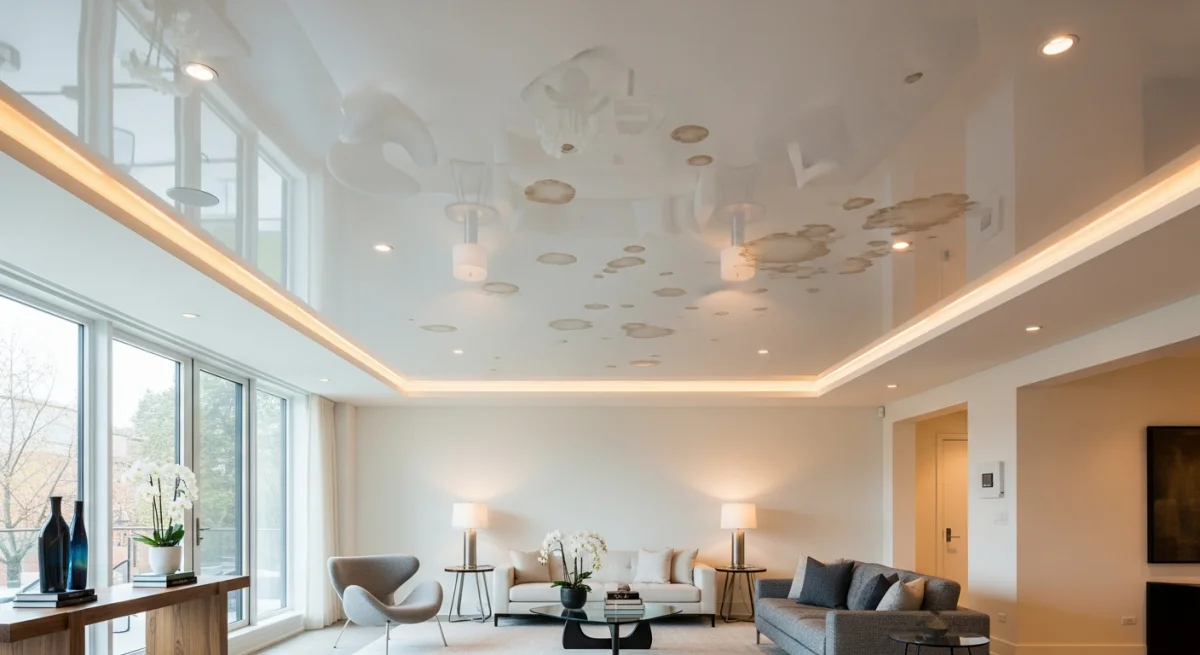

# Stretch Ceiling Troubleshooting: Bubbles, Stains, Sag and Other Problems
Quick answer. Most stretch ceiling issues have inexpensive fixes. New-install bubbles self-resolve in 24–48 hours. A popped corner re-seats in 5 minutes under warranty. Yellow stains in kitchens are surface grease and clean with diluted Dawn. Real sagging on long walls usually traces to under-anchored profile and is fixed for $200–$300. Punctures over 5 mm typically mean membrane replacement at $300–$600 per room. Here's the diagnostic guide.A well-installed stretch ceiling rarely has problems. When something does come up, almost all of it falls into one of nine recognizable patterns. Here's how to identify what you're seeing and what the realistic fix is.
For broader install and care context, see our installation & care pillar. For routine cleaning protocols, see cleaning & care. For full removal-and-replacement scenarios, see removal & replacement.
Issue 1: Small Bubbles or Wave Marks (First 24–48 Hours)
Symptom. New install. You walk into the room the next morning and there's a slight bubble or wave in the membrane that wasn't there at walkthrough. Cause. Temperature and humidity equilibration. The PVC was hooked at 60–70 °C and is still finding its final tension as the room temperature stabilizes. Minor variations in factory cut tolerance and harpoon-edge tension show up briefly. Fix. Wait 48 hours. 95% of new-install bubbles self-resolve as the membrane reaches full thermal equilibrium. Check again on day 3. If it persists past 72 hours. A harpoon edge has slipped at one corner or a section, or the factory cut had a slight error. Five-minute warranty visit — installer re-warms the affected section and re-seats the harpoon. No charge under standard 10-year warranty.Issue 2: Persistent Bubble (Months Later)
- A small leak from above that has accumulated water (see water damage recovery — sometimes a slow drip is the cause).
- A pest issue in the plenum (rare, but a mouse on top of the membrane creates a localized bulge).
- Insulation that has shifted in the plenum and is pressing down.
- A failed drywall fastener above that has dropped and is touching the membrane.
Issue 3: Popped Corner / Loose Section
Symptom. A corner of the membrane has pulled out of the harpoon track, or a 30-cm section along one wall has come unhooked. Visible drooping. Cause. Usually:- The harpoon weld has fatigued at that corner (most common at year 7–10 of original install).
- The track was under-anchored at that section and has flexed enough to release the harpoon.
- An impact event — someone bumped the ceiling with a long object.
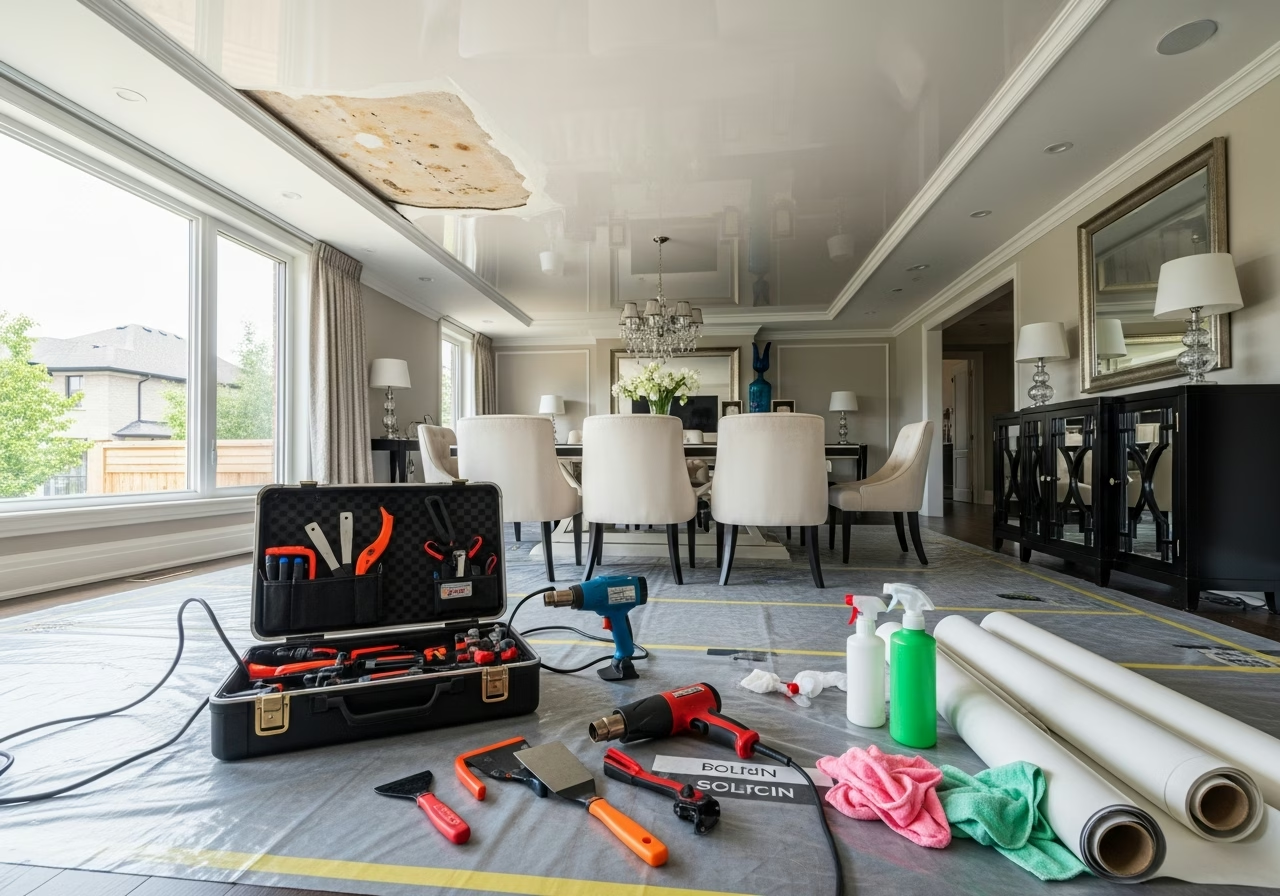
If the harpoon weld is genuinely failed (the harpoon has separated from the membrane edge), partial-section repair isn't possible — the membrane needs replacement.
Need professional renovation?
Call RenoHouse at 289-212-2345 or get a free estimate today.
Get Free Estimate →Issue 4: Genuine Sagging on Long Walls
- PVC profile track on a long wall — see aluminum vs PVC profile for why this happens.
- Aluminum track but anchor spacing too wide (>200 mm).
- Anchors into drywall paper without stud or anchor support.
If the track itself has deformed (PVC profile that's bowed past its elastic limit), track replacement is needed — typically $300–$600 plus partial membrane reinstallation.
Issue 5: Yellow or Grey Stains
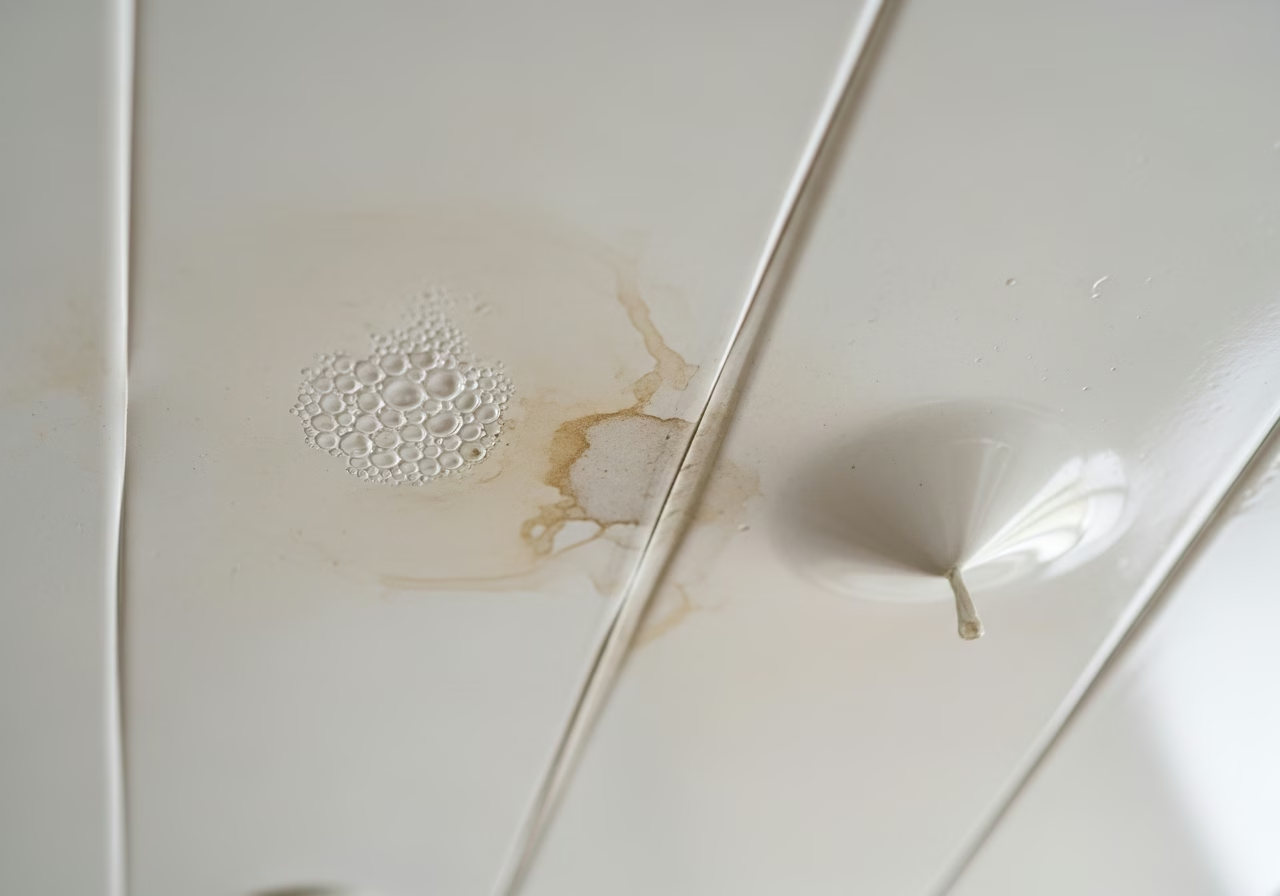
Symptom. A yellow or grey discoloration patch, usually in or near a kitchen, sometimes near a smoking-related space (rare in modern non-smoking buildings). Cause. 90% of cases:- Cooking grease aerosolized over months/years and accumulated on the membrane surface.
- Above kitchens with wok or stir-fry cooking, this can develop in 1–2 years.
10% of cases:
- Nicotine residue (smoking inside).
- Mineral deposits from steam (long-term humid bathroom).
- Migration through perforation (a small puncture allowing water/grease to wick into the membrane interior).
- For surface-only grease that won't budge: a stronger degreaser (Krud Kutter Original, dilute) tested in a corner first.
- For migrated stains (the mark is *inside* the membrane, not on the surface): replacement is the answer. Surface chemistry can't reach migrated stains without damaging the membrane. Single-room replacement: $300–$600 (track reused).
Issue 6: Punctures and Tears
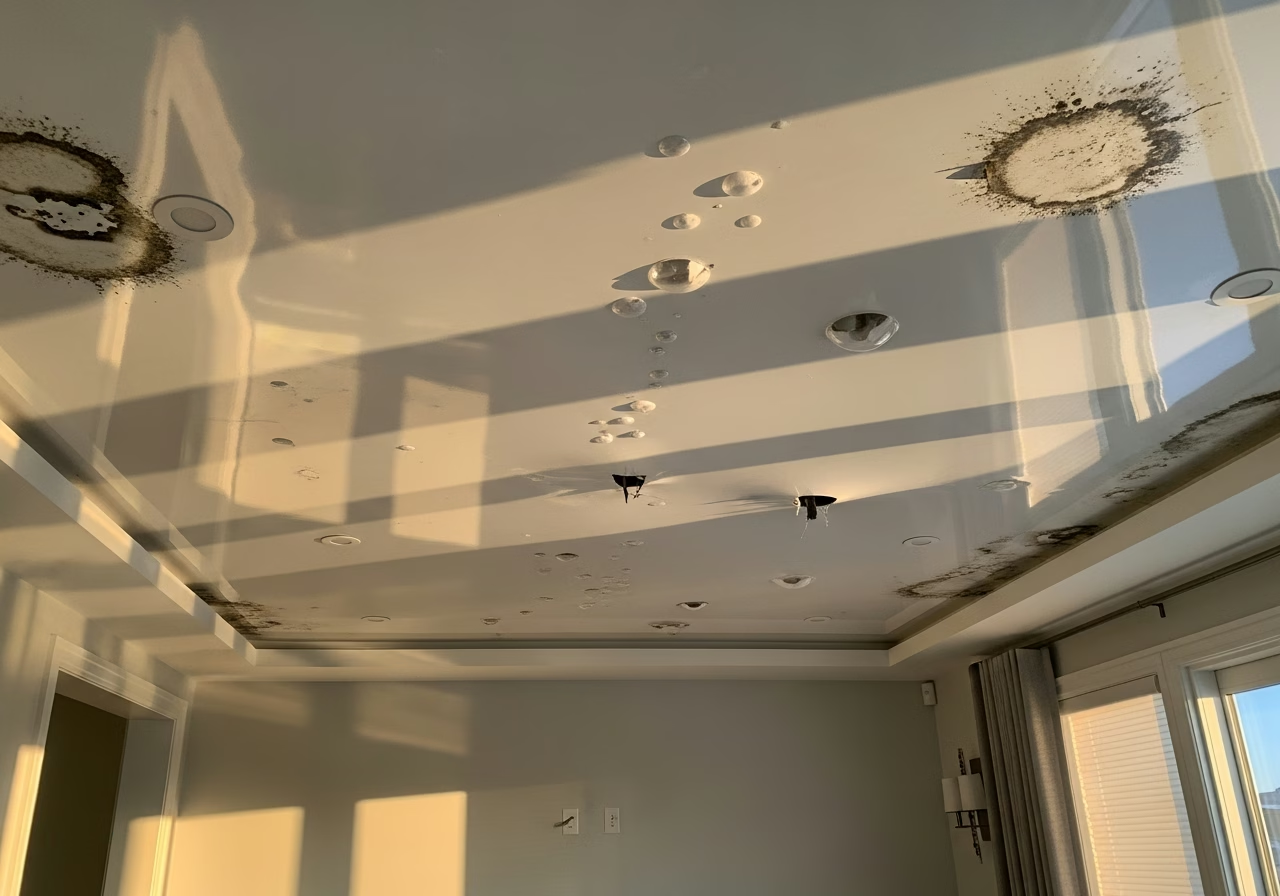
- Champagne cork (yes, regularly).
- Kid throwing a hard toy.
- Curtain rod swung the wrong way during install of new window treatments.
- Tall furniture being moved (chair-back, lamp).
- Cat with very long claws (rare but happens in low-ceiling rooms).
- Pinhole (under 2 mm): patch kit available — small adhesive patch from the factory in matching colour. Cost: $30–$50 if you have a kit; $80–$120 service call if not. Visible only at oblique angle on glossy films.
- Small puncture (2–5 mm): patch is visible on glossy. On matte/satin, often acceptable. On glossy, replacement is the honest recommendation.
- Tear (over 5 mm) or slit: cannot be patched durably. Membrane replacement at $300–$600 single room.
The pragmatic answer for most kitchen and bedroom punctures is replacement — the visible patch on a glossy ceiling is more annoying than a fresh ceiling.
Issue 7: Condensation Droplets (Bathrooms)
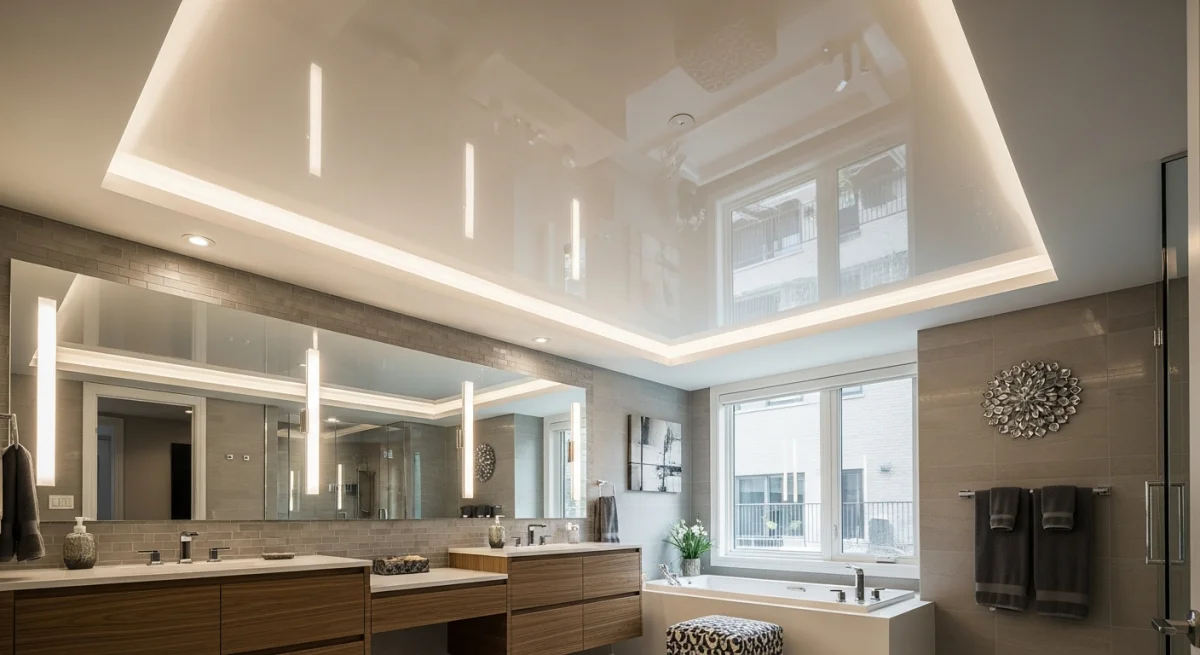
Symptom. Visible water droplets forming on the bottom of a glossy bathroom ceiling during or after showers. Cause. Not a defect. The same physics as a cold mirror or window in a hot shower — the ceiling membrane is at room ambient temperature (cooler than the shower steam) and water condenses on it. Fix. Not a fix per se — improvement of bathroom ventilation:- Run the bath fan during the shower and for 15 minutes after.
- Verify the bath fan is rated for the room size (50 CFM minimum for a typical 5×8 ft bathroom; 80–110 CFM for larger).
- Verify the bath fan actually vents to outside (some Toronto townhomes have fans that vent into the attic — not code-compliant).
Glossy films are slightly more prone to visible droplets than matte. Some homeowners prefer matte in bathrooms for this reason. Both finishes are equally waterproof; the difference is purely aesthetic.
Issue 8: Membrane Has "Yellowed" Overall (Not a Localized Stain)
Symptom. The whole ceiling looks slightly yellower than when it was installed. Most noticeable next to white walls or new white paint. Cause. Plasticizer migration in PVC films. Premium A+/M1-certified films (Pongs Decoflair, MSD Premium A+, Clipso PVC) are colour-stable for 15+ years. Budget Halead economy films and some grey-market Bauf imports yellow noticeably in 7–10 years, especially in kitchens and bathrooms where heat accelerates the process. Fix. No reversal. Plasticizer migration is one-way. Replacement is the answer. This is why we always recommend specifying A+/M1 certification at original purchase — the cost premium is small and the longevity difference is significant.Issue 9: "It Looks Different from When It Was Installed"
Symptom. Vague — homeowner reports the ceiling doesn't look as good as it did, but can't point to a specific defect. Cause. Often dust accumulation (matte and glossy both collect dust over 12+ months). Sometimes lighting changes (a new lamp or window treatment changes how the ceiling reflects). Fix. Routine cleaning per cleaning & care. Spot-clean any visible marks. Often 90% of "looks different" complaints resolve with a 15-minute proper cleaning.When to Call vs DIY
DIY-fixable:- Routine cleaning.
- Spot-clean a fingerprint or a single mark.
- Push a slightly-loose trim bead back into place.
- Wait 48 hours on a new-install bubble.
- Anything involving the harpoon coming out of the track.
- Any visible water bulge.
- Any persistent bubble older than 72 hours.
- Any stain that doesn't lift with one cleaning attempt.
- Any puncture, tear, or hole.
- Any visible sag or wave.
- Smell of something off (rare; usually only with cheap films).
The default rule: if you're tempted to use a knife, hot air, or a chemical solvent on a stretch ceiling, stop. Call instead.
Cost Summary for Common Fixes
| Issue | Fix | Cost in 2026 Toronto |
|---|---|---|
| Bubble or wave at 48–72 hours | Re-seat harpoon | $0 (warranty) or $100–$150 |
| Popped corner | Re-seat with spatula | $0 (warranty) or $100–$150 |
| Loose trim bead | Push back in | $0 (DIY) |
| Surface grease stain | Clean with degreaser | $0 (DIY) or $80–$150 |
| Migrated stain | Membrane replacement | $300–$600 |
| Sag from track deflection | Re-anchor track | $200–$500 |
| Pinhole puncture | Patch kit | $30–$120 |
| Tear over 5 mm | Membrane replacement | $300–$600 |
| Overall yellowing (old budget film) | Membrane replacement + upgrade | $1,400–$2,000 |
| Water bulge from upstairs leak | Drainage + re-tension | $250–$400 (see water damage recovery) |
What's Always Free Under Warranty
RenoHouse's installer-network 10-year warranty covers, at no charge:
- Harpoon re-seating in years 1–10.
- Trim bead replacement in years 1–5.
- New-install bubble correction (any time in year 1).
- Track re-anchoring if installer error caused the deflection.
- Emergency drainage in years 1–2 within GTA.
It does not cover:
- Impact damage (puncture, tear) — homeowner insurance.
- Stain or yellow caused by environmental factors (cooking, smoking).
- Damage from DIY repair attempts.
Get a Diagnostic Visit
Request a stretch ceiling service visit — site assessment, diagnosis, and quote in writing before any work proceeds. Most issues are smaller than they look. For broader install context see our installation & care pillar.FAQ
Will the warranty cover a fix if my original installer is no longer in business? RenoHouse's layered 10-year warranty covers RenoHouse-coordinated installs regardless of which partner installer originally did the work. For ceilings installed by other companies, we still service but it's at standard service rates. Can I patch a small hole with tape? No. Tape adhesive damages PVC over months and the patch is visible. Use a factory matching adhesive disc or replace. My ceiling makes a faint clicking sound when the heat comes on. Is that normal? Yes — thermal expansion of the membrane and track. Common in winter when furnace cycles change room temp by 3–4 °C. Not a defect. Should I worry about a fly or moth trapped behind the translucent membrane? Annoying, but the fix is to detach a corner, evict the visitor, and re-tension. Service call $100–$150. More common with backlit ceilings where insects are attracted to the LED glow. What if I notice a problem the day of install? Tell the installer before sign-off. Walkthrough is the moment to catch anything; don't sign off if something looks wrong.Continue Reading
- How to Clean and Maintain a Stretch Ceiling (Glossy, Matte, Fabric)
- Stretch Ceiling Installation & Care in Toronto: The Complete 2026 Owner
- Stretch Ceiling Water Damage Recovery in Toronto: The 100-Litre Rescue