RenoHouse

# Philips Hue Stretch Ceiling RGB in Toronto: Lightstrip Plus and Gradient for Cove and Accent
Quick answer. Philips Hue is the most homeowner-friendly RGBW option for stretch ceiling cove and accent lighting in Toronto. Hue Lightstrip Plus runs up to 10m per controller, Hue Gradient strips give pixel-mapped colour, the Hue Bridge ties everything to HomeKit, Alexa, Google, and the Hue app, and the whole experience feels like a consumer product rather than a controls system. Budget $250–$650 for a Hue strip plus controller for a single-zone cove, or $1,500–$3,000 for a multi-zone whole-home Hue setup. Limitations: voltage drop on runs over 10m (need extension or break into zones), 12V strip means more conductor mass, and integration depth is shallower than Lutron RA3 for advanced scenes. ESA Master Electrician handles the 120V tie-in.This article is part of our LED backlit stretch ceiling pillar. For Lutron Caseta comparison see our Caseta integration guide. For broader smart-home context see our Toronto smart home installation pillar.
Why Hue Works for Stretch Ceiling
Hue's strengths:
- App-first experience — homeowners (especially those without a controls integrator) find the Hue app intuitive.
- Native HomeKit, Alexa, Google, SmartThings integration via Hue Bridge.
- Wide product family — Lightstrip Plus, Gradient, Bloom accent lights, Iris, recessed downlights — all Zigbee-compatible.
- Reliable Zigbee mesh — Hue runs its own Zigbee 3.0 mesh, separate from Wi-Fi.
- Scene support — preset colour and brightness combinations triggered from app, voice, or motion.
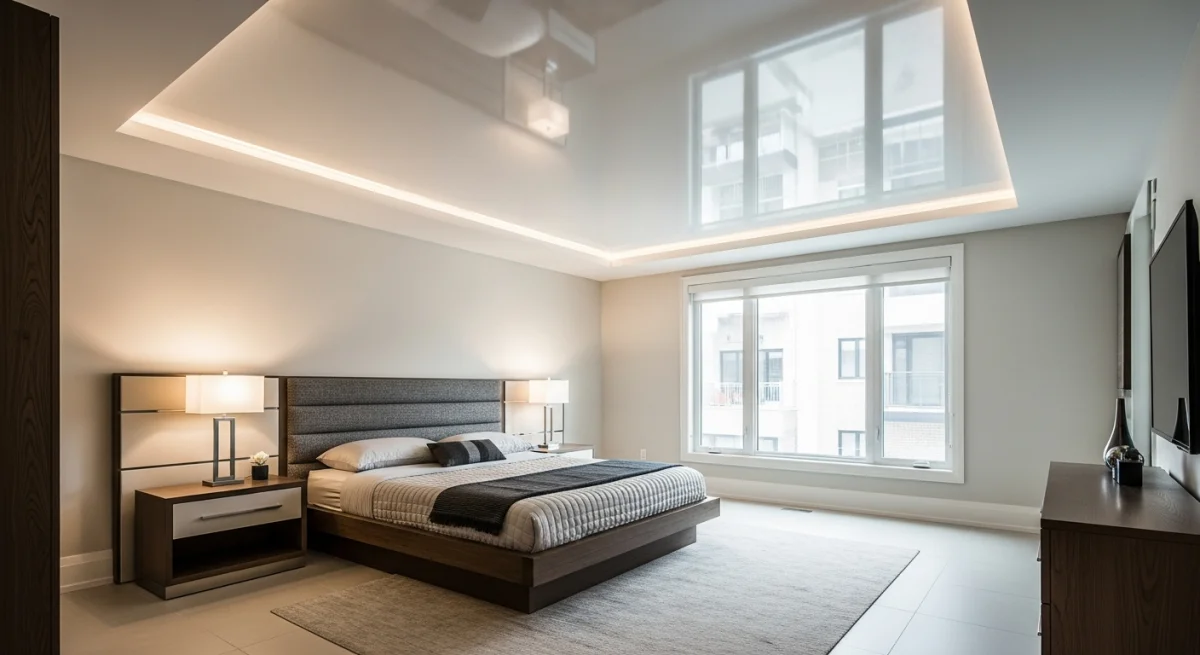
For a master bedroom cove, a kids' room ceiling, or a living room accent zone, Hue is often the right answer.
Hue Product Family for Stretch Ceiling
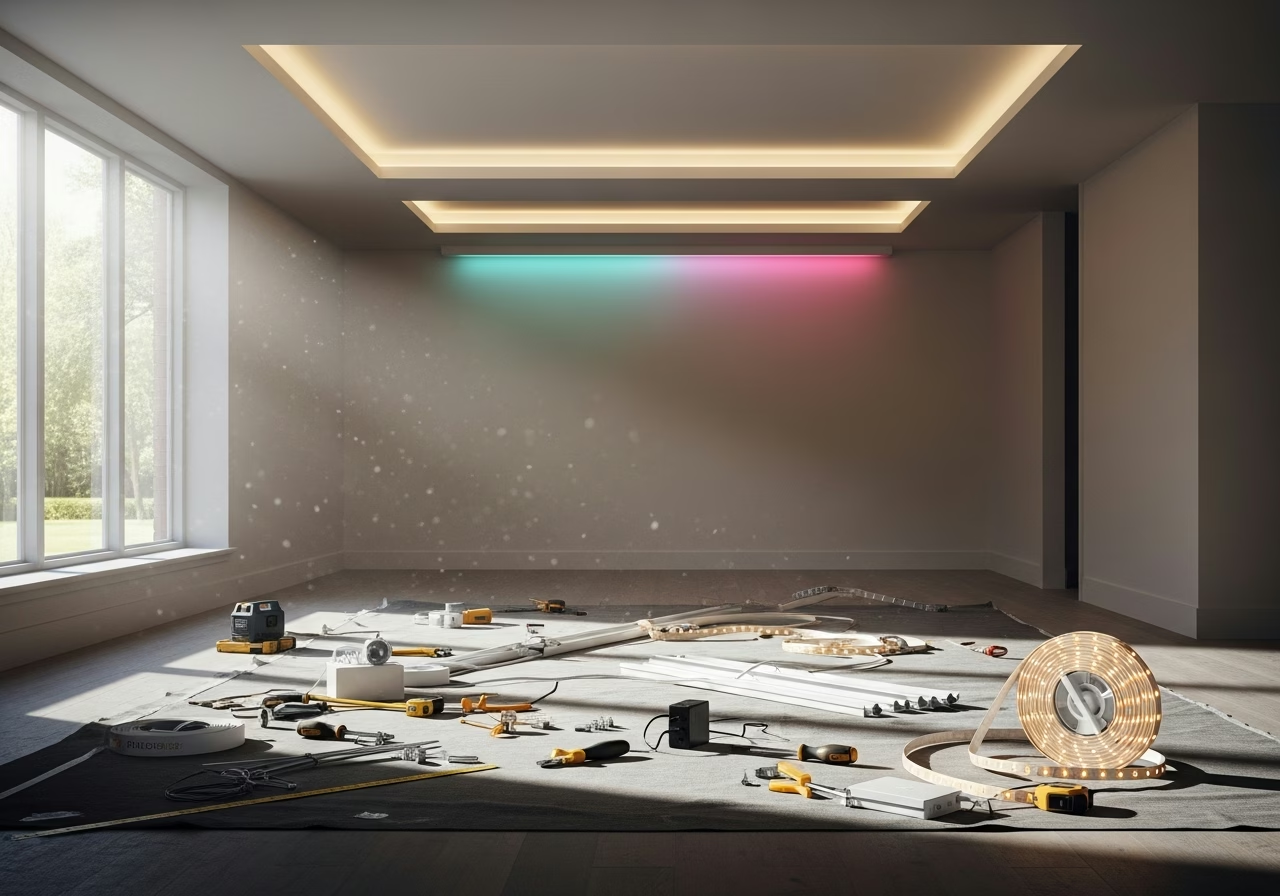
Hue White Ambiance Lightstrip
Tunable white only (no colour). 2200K–6500K range. Up to 10m per controller. The right pick for cove projects where colour is unnecessary — bedrooms, dining rooms, hallways with circadian shifts.
Hue Lightstrip Plus
The flagship RGBW strip. 1600 lumens, 16M+ colours, 2000K–6500K white range. 2m starter kit plus 1m extensions, max 10m per controller. The default Hue choice for residential cove with occasional colour use.
Hue Gradient Lightstrip
Pixel-mapped multi-colour strip — different segments display different colours simultaneously, for sunset effects, sync-with-TV scenes, or party modes. 2m, 3m, and 5m versions. Used in entertainment zones and feature ceilings.
Hue Bloom and Iris
Accent uplights placed in the plenum cavity — adds colour wash to a translucent backlit ceiling without strip wiring. Less common, useful for retrofits.
Need professional renovation?
Call RenoHouse at 289-212-2345 or get a free estimate today.
Get Free Estimate →Voltage Drop and Length Limits
Hue Lightstrip Plus is 12V. At 10m maximum length, voltage drop is already noticeable — colours shift slightly toward red at the far end because blue and green LEDs draw more current and dim faster.
For longer perimeters in Toronto stretch ceilings:
- Up to 10m — single Hue strip, single controller.
- 10–20m — two Hue strips, two controllers, two scenes. Programmed identically but two separate Bridges entries.
- 20m+ — Hue is no longer the right answer. Step up to Lutron RA3 + Lumaris (24V, longer runs).
For a typical 18m master bedroom perimeter, two 9m Hue Lightstrip Plus runs split at the head of the bed is the cleanest install.
Wiring and Driver Considerations
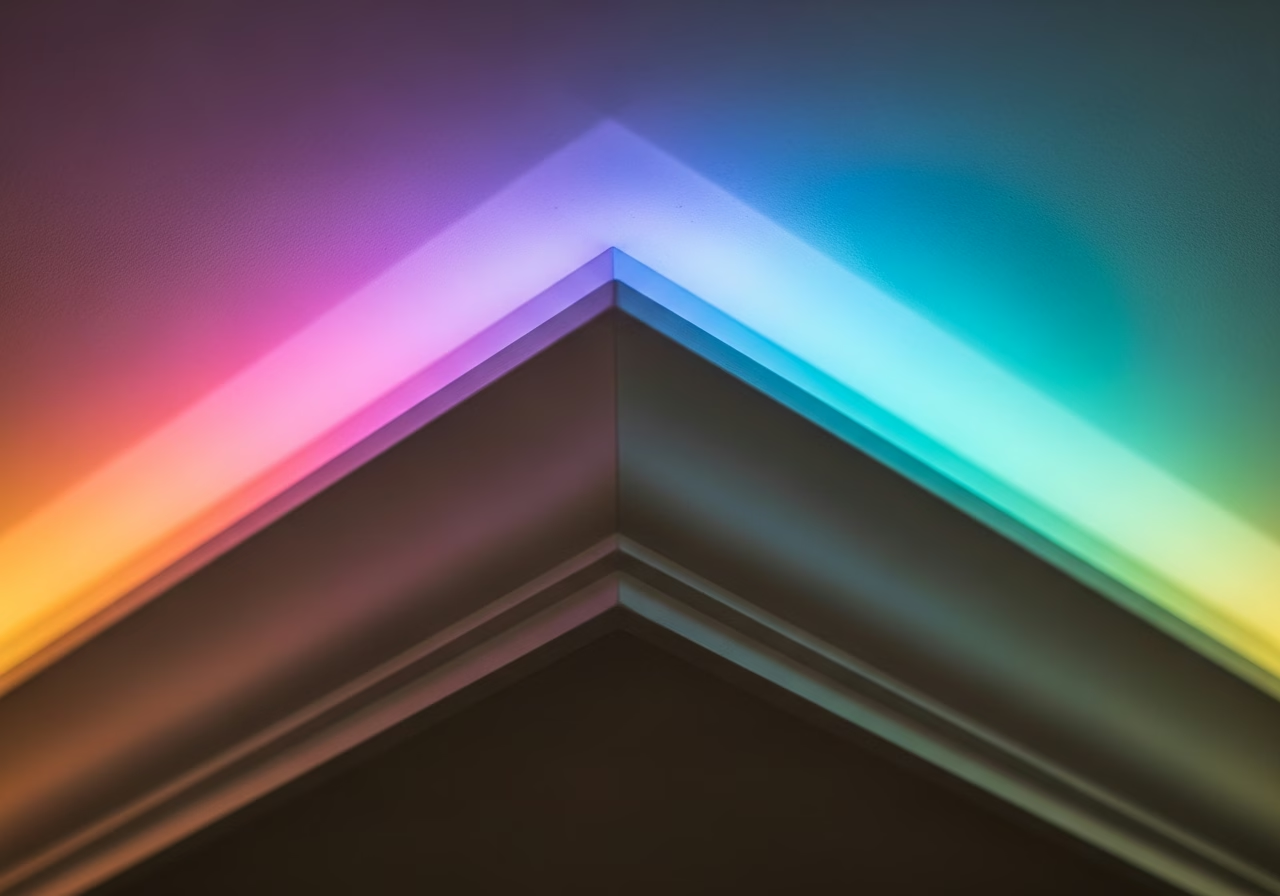
Hue strips have their own controller built in — they are not driven by an ELV or 0–10V dimmer. The Hue controller plugs into a standard 120V outlet in the plenum cavity. This means:
- No external dimmer required. Hue dims natively via the Bridge.
- 120V outlet in plenum — RenoHouse coordinates the ESA-licensed Master Electrician to install the outlet during stretch ceiling install.
- No driver matching headache — Hue does its own DC conversion.
Tradeoff: Hue strips are 12V, so for the same 14W/m brightness they pull more current (1.17A/m vs 0.58A/m for 24V). This means thicker conductor or more frequent power injection on long runs.
Hue Bridge Setup
The Hue Bridge is the brains. Connect:
- Bridge to home Wi-Fi router via Ethernet (gigabit, no Wi-Fi config needed).
- Hue strips automatically pair to Bridge during initial setup.
- HomeKit pairing via Hue app or Apple Home app.
- Alexa or Google pairing via skill or app.
The Bridge supports up to 50 lights per network. For a multi-zone whole-home Hue install, plan around the 50-light cap (or run two Bridges).
Programmed Scenes for Stretch Ceiling Cove
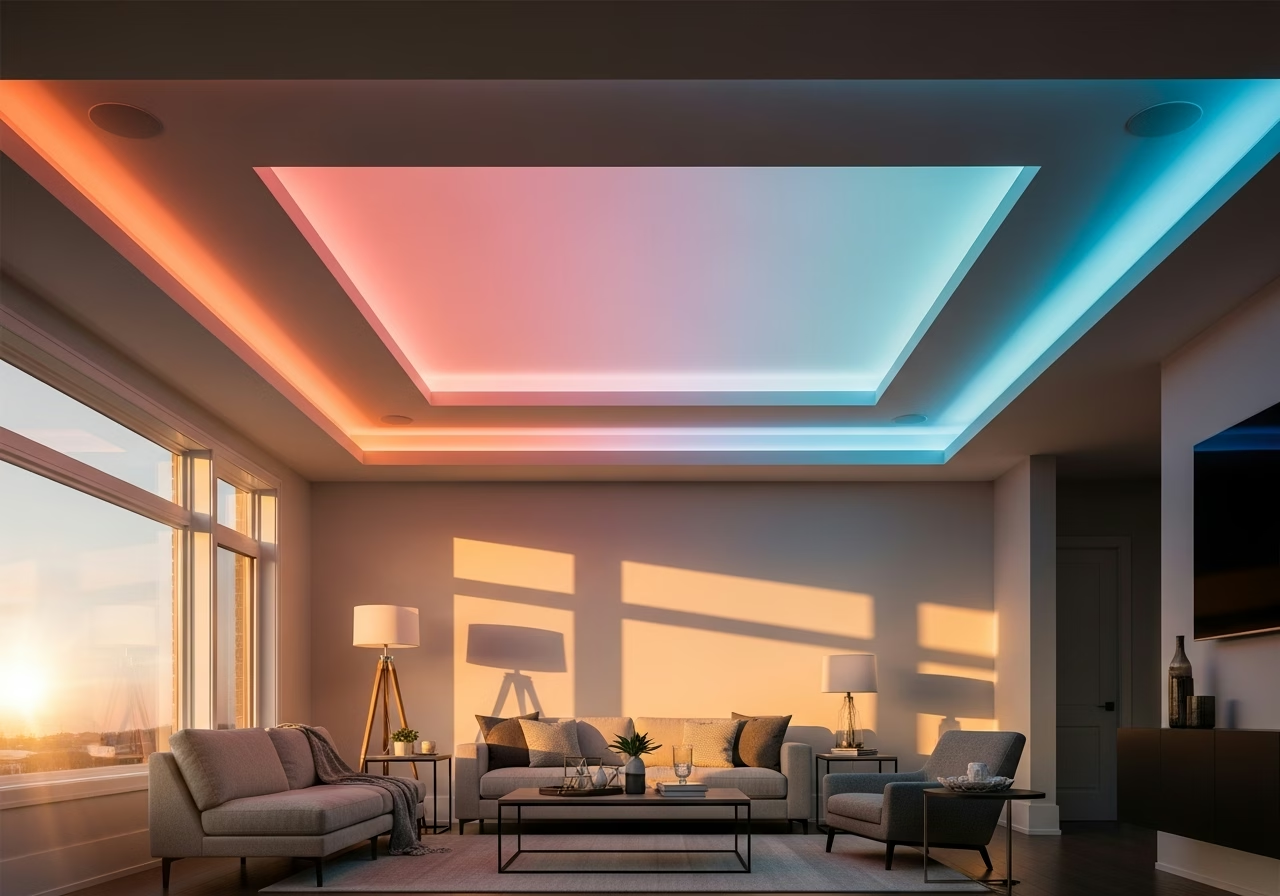
Common scene programming we set up for Toronto homeowners:
- Wake — gradual ramp from 2200K dim to 4000K bright over 30 min.
- Day — 4000K, 80% brightness.
- Evening — 2700K, 60% brightness.
- Movie — 2200K, 15% brightness, slight RGB warm wash.
- Party — slow RGB cycle, 80% brightness.
- Sleep — gradual dim from 2700K 30% to off over 15 min.
Scenes are triggered from voice, app, motion sensor, or wall remote. We typically install a Hue Tap or Hue Dimmer Switch at the room entrance for physical scene control — homeowners do not want to open an app every time they enter a room.
Hue + Stretch Ceiling Worked Pricing — 200 sqft Master Bedroom
| Line Item | Cost |
|---|---|
| 2 × Hue Lightstrip Plus 5m starter | $360 |
| 4 × Hue Lightstrip Plus 1m extension | $120 |
| Hue Bridge | $80 |
| Hue Dimmer Switch | $35 |
| Aluminium LED channel with frosted lens, 18m | $180 |
| Installer labour for cove integration | $700 |
| ESA Master Electrician (outlet install) | $300 |
| All-in cove subtotal | $1,775 |
This is on top of the base stretch ceiling install. Hue prices fluctuate; the 2026 numbers above assume regular retail.
Where Hue Falls Short
- Multi-zone scale — beyond 4–6 zones, Hue Bridge management becomes fragmented. Step up to RA3 or KNX.
- Long perimeters — 10m strip limit forces zone splits.
- Driver matching depth — no native 0–10V or ELV control; Hue is its own ecosystem.
- Wall control aesthetics — Hue Dimmer Switches are plastic battery-powered and look consumer-grade. RA3 keypads are aluminium and engraved.
- Reliability under heavy load — Hue Bridge has a per-second command rate limit; busy automations can backlog.
For luxury Toronto homes, Lutron RA3 is a better fit. For everyday residential with one or two cove zones, Hue is faster and cheaper.
Mistakes We Fix on Hue Stretch Ceiling Projects
- Single 10m Hue Lightstrip on a 14m perimeter — voltage drop, dim end. Split into two 7m zones.
- No 120V outlet in plenum, controller hidden in wall — fails inspection. Add proper outlet.
- Bridge on 2.4GHz Wi-Fi (it is wired, but its app is on Wi-Fi) — 5GHz iPhone cannot find Bridge. Use mDNS-friendly router setup.
- Mixing Hue with non-Hue Zigbee strips on the same Bridge — works, but causes mesh stability issues. Keep Hue Bridge for Hue products only.
- No physical wall switch — homeowner forced to open app. Add Hue Dimmer Switch or Tap.
Verdict
Philips Hue is the right RGBW choice for residential Toronto stretch ceiling projects with cove or accent lighting when:
- The perimeter is under 20m.
- The household is HomeKit, Alexa, or Google-first.
- The homeowner wants a consumer-friendly app experience.
- Total project budget is $1,500–$5,000 for the smart layer.
For larger homes, more zones, or premium control aesthetics, step up to Lutron RA3 or KNX.
Book a backlit stretch ceiling consultation and we will spec the right system. For the full project guide see our LED backlit stretch ceiling pillar, and for broader smart-home context see our Toronto smart home installation pillar.