 RenoHouse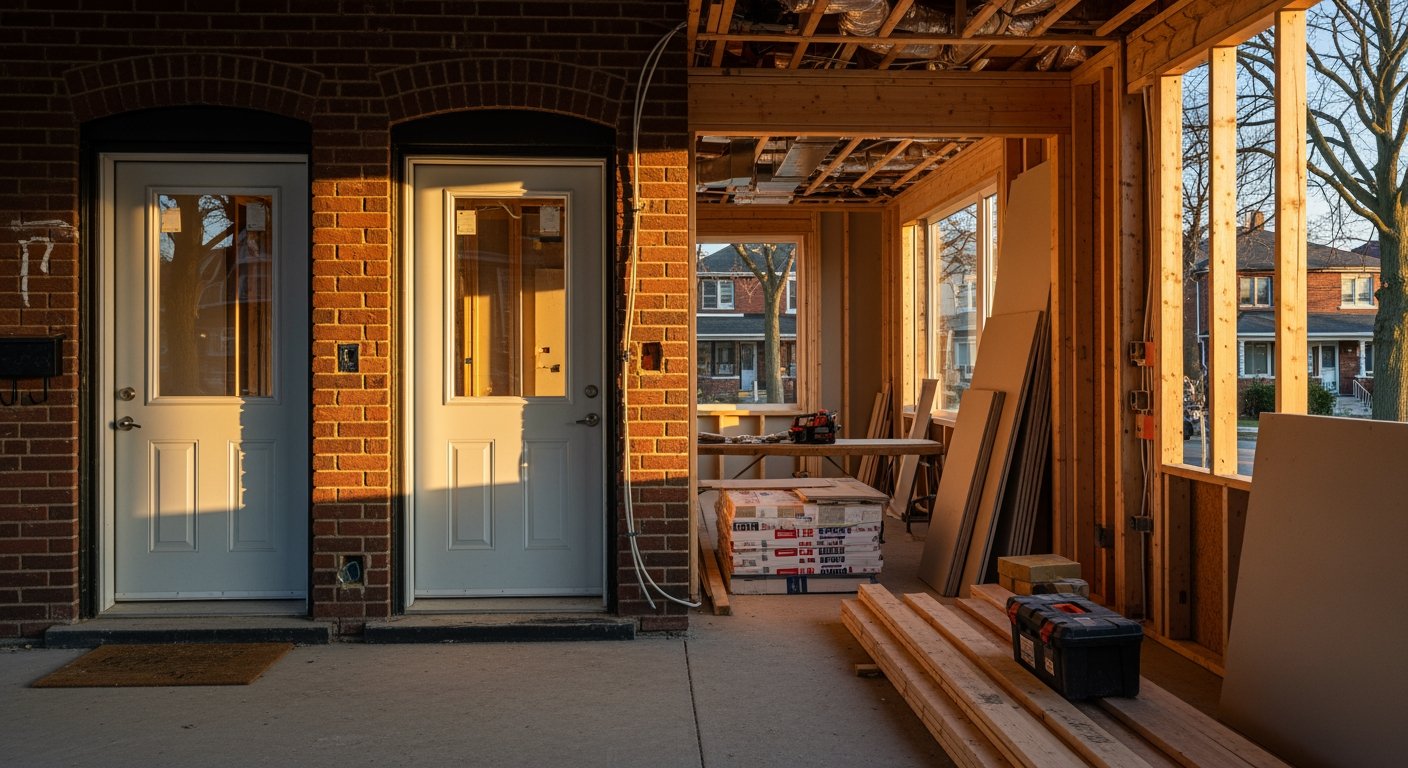
Convert Your Toronto Home Into A 3 or 4-Unit Multiplex
Professional multiplex conversion toronto services in Toronto and the Greater Toronto Area. Licensed, insured, and trusted by homeowners across the GTA.
Projects Completed
Years Experience
Client Satisfaction
Google Rating
How It Works
A simple, stress-free process from start to finish.
Send Your Request
Call or WhatsApp us 24/7. Send photos, video, comments about what needs to be done, and your location.
Remote Estimate
We review everything, discuss details, and provide a clear estimate — often within hours, no visit needed.
Repair Process
Our licensed team arrives on the agreed date and completes your multiplex conversion toronto to the highest standards.
Handover & Warranty
Final walkthrough with you, full cleanup, and warranty documentation provided.
Send Your Request
Call or WhatsApp us 24/7. Send photos, video, and a description of the work + your location.
Remote Estimate
We review everything, clarify details, and give you a price — often within hours.
Repair Process
Licensed team arrives on schedule and completes your multiplex conversion toronto professionally.
Handover & Warranty
Final walkthrough, full cleanup, and warranty documentation.
Multiplex Conversion Toronto in Toronto GTA
Multiplex conversion turns a single-family detached, semi-detached, or row house into a legal duplex, triplex, or fourplex. Following Toronto City Council's May 2023 Multiplex Study decision (By-law 287-2023 and follow-on amendments through 2024-2025), and the provincial mandate of Bill 23 (More Homes Built Faster Act), up to four dwelling units per lot are now permitted as-of-right across all residential R-zones in the City of Toronto. The conversion involves coordinated structural, mechanical, electrical, and life-safety work: dividing the building into legal demising assemblies with OBC 9.10.4 fire separations, ensuring each unit has compliant means of egress per OBC 9.9, upgrading the electrical service (typically 200A to 400A), separating or sub-metering utilities, adding mechanical ventilation per OBC 9.32, and meeting OBC 9.36 envelope performance. RenoHouse delivers multiplex conversions end-to-end across Toronto, North York, Scarborough, Etobicoke, and the 905, from feasibility through Committee of Adjustment representation, full Building Permit, construction, and final occupancy. 2026 GTA project budgets run $285,000 to $675,000 with 10 to 18 month timelines. CMHC MLI Select financing for four-unit conversions delivers 50-year amortization at near-prime rates — the most powerful financing tool available to small-scale Toronto investors.
# Multiplex Conversion in Toronto: The 2026 Definitive Guide
A multiplex conversion takes an existing single-family home and reorganizes it into two, three, or four legally separate dwelling units, each with its own kitchen, bathroom, primary sleeping area, and code-compliant means of egress. Since City Council's May 2023 adoption of the Multiplex Zoning By-law (By-law 287-2023) and the subsequent 2024-2025 amendments harmonizing with Ontario Regulation 462/24 under Bill 23, the More Homes Built Faster Act, up to four units per lot are permitted as-of-right in every R-zone in the City of Toronto. The same as-of-right four-unit rule has been adopted by Mississauga, Brampton, Vaughan, Markham, and most of the 905 in response to Bill 23 provincial obligations.
Multiplex conversion is the highest-leverage residential renovation play in the GTA in 2026. The combination of (1) as-of-right four-unit zoning, (2) CMHC MLI Select financing for four-plus-unit properties, and (3) GTA rental demand currently absorbing every legal unit within weeks of completion creates ROI profiles that single-family renovations cannot match. RenoHouse runs end-to-end multiplex projects from feasibility through final occupancy.
What a Multiplex Is — and the Toronto Definitions
Under By-law 569-2013 as amended by By-law 287-2023, a multiplex is a residential building containing 2, 3, or 4 dwelling units within a single primary structure. Specifically:
- Duplex: 2 dwelling units, typically stacked (one per floor).
- Triplex: 3 dwelling units.
- Fourplex: 4 dwelling units.
- Additional ARUs: A multiplex up to fourplex can be paired with a garden suite or laneway suite for a total of 5 units on a single lot. CMHC MLI Select financing requires 5+ units in some product variants — this is the canonical "4-plex plus garden suite" stack play.
A multiplex is distinct from a rooming house (sleeping units sharing kitchen/bathroom), which is separately governed and requires Municipal Licensing under Chapter 285-2022. RenoHouse does not deliver rooming-house conversions.
The 2026 Toronto Regulatory Landscape
Bill 23 and the Multiplex Bylaw
Bill 23 mandated minimum three-unit as-of-right zoning across Ontario starting in 2024. Toronto went further with By-law 287-2023 (adopted May 11, 2023, effective for permits filed thereafter), permitting up to four units as-of-right citywide. The follow-on 2024-2025 amendments removed angular plane restrictions and increased height allowances in line with O.Reg 462/24.
Performance Standards Under By-law 569-2013
Key rules for a multiplex conversion that stays within the existing building envelope (no rear or roof addition):
- Up to 4 units permitted as-of-right on any lot in R, RD, RS, RT, or RM zones.
- No minimum unit size dictated by zoning (but OBC 9.5 dictates minimum room sizes — bedroom 7 m², living room 13 m²).
- Parking: zero required for multiplex units (Toronto removed parking minimums 2022).
- Refuse storage: 1 organic bin + 1 recycling bin + 1 garbage bin per dwelling unit, screened and located in accordance with Toronto Solid Waste Management Services placement rules.
- Bicycle parking: 1 long-term bicycle space per dwelling unit beyond the first, located indoors or in a secured outdoor enclosure.
- Soft-landscaping: 50% of front yard, 75% of rear yard if no garden suite.
Building Code Compliance — Critical for Multiplex
Multiplex conversions trigger more OBC compliance items than any other ARU scope:
- OBC Part 9 applies (residential, 3 storeys or less, 600 m² or less). Beyond this scale, OBC Part 3 applies and the project effectively becomes a small apartment building (significantly more complex and expensive).
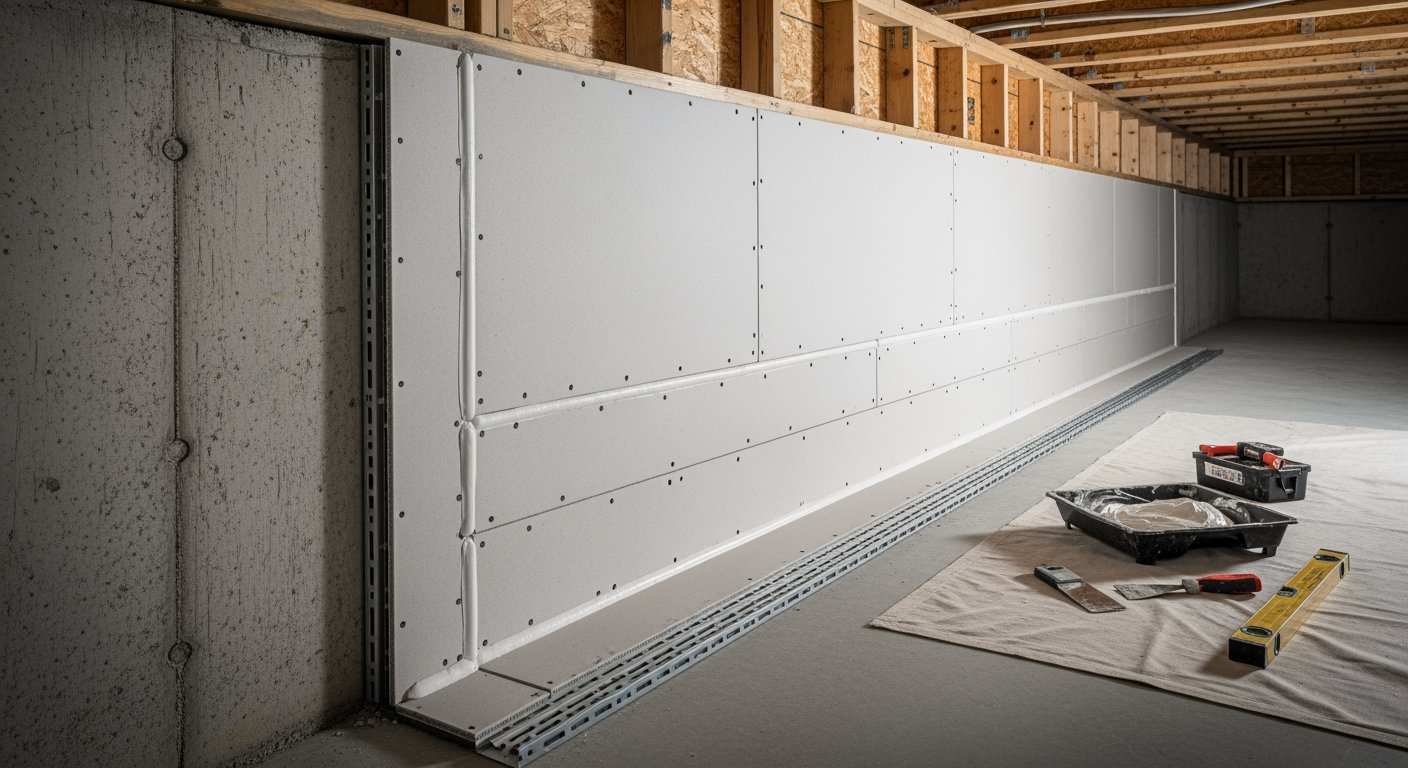
- OBC 9.10.4 fire separation between every dwelling unit: minimum 45-minute fire-resistance rating (typically ULC W301 5/8" Type X drywall both sides on resilient channel), or 1-hour rating where required by configuration. Floor-ceiling assemblies between stacked units need 45-minute rating with STC 50 acoustic performance per OBC 9.11.
- OBC 9.10.4.1 demising walls extend continuously from concrete slab to underside of roof deck — no breaks at attic level.
- OBC 9.9 means of egress for each unit: every unit needs a primary egress (door to exterior or to fire-rated public corridor) and every bedroom needs an egress window or door per 9.9.10 (0.35 m² openable, 380 mm clear opening minimum dimension).
- OBC 9.9.5 public corridors connecting more than one unit need 1-hour fire-rated walls and self-closing 20-minute doors.
- OBC 9.32 mechanical ventilation: continuous principal exhaust (HRV or equivalent) sized per dwelling unit at 14 to 22 L/s minimum.
- OBC 9.36 energy: prescriptive R-value or performance-path compliance for new exterior assemblies and any walls modified by the conversion.
When Committee of Adjustment Is Required
A multiplex conversion that adds no GFA and stays within the existing building envelope is as-of-right and requires no COA. Common COA triggers:
- Rear or third-storey addition exceeding zone height (typically 10.0 m max in RD, 11.5 m in RM).
- Bay-window or porch addition encroaching beyond setback by more than 0.6 m.
- Lot coverage exceeding zone maximum after addition.
- Garden-suite-plus-fourplex stack play exceeding combined ancillary GFA.
COA hearings add 12 to 16 weeks. RenoHouse handles the application end-to-end.
Site Plan Control
Multiplex projects under 600 m² total GFA are exempt from Site Plan Control. Larger projects (typically a fourplex with rear and third-storey additions on a wide lot) trigger Site Plan, adding 10 to 14 weeks and dedicated landscape, lighting, and waste drawings.
2026 GTA Pricing Tiers
Multiplex pricing scales with (a) number of units, (b) extent of structural alteration, and (c) finish quality. RenoHouse uses three tiers.
Floor Tier — $285,000 to $385,000 (duplex or simple triplex within existing envelope)
- Existing house is structurally sound, no addition.
- Divide into 2 or 3 units with new demising walls and floor-ceiling separations.
- Upgrade electrical to 200A or 400A with 3 sub-panels.
- Plumbing stack additions (1 new wet wall per upper unit).
- 1 bathroom + 1 kitchen per unit, mid-range finishes.
- HRV ventilation per OBC 9.32, sub-metered hydro.
- 1,400 to 1,900 sq ft total habitable area.
Standard Tier — $385,000 to $525,000 (triplex or simple fourplex with modest addition)
- Triplex or fourplex configuration, typically requires modest rear addition or basement underpinning.
- 200A or 400A service, separate sub-panels.
- 1 bathroom + 1 kitchen per unit, mid- to upper-mid finishes.
- HRV per unit, sub-metered hydro and gas.
- Acoustic engineering on stacked floor-ceiling assemblies (STC 55 target, not just 50).
- 2,100 to 2,800 sq ft total habitable area.
Premium Tier — $525,000 to $675,000 (fourplex with full third-storey addition or garden suite stack)
- Fourplex with rear and/or third-storey addition; or fourplex plus garden suite for 5-unit CMHC MLI Select play.
- 400A electrical service, full sub-metering of hydro, gas, water.
- 1 bathroom + 1 ensuite + 1 kitchen per unit, upper-mid to premium finishes.
- HRV per unit, in-suite ducted heat pumps.
- Acoustic engineering, architect-led design.
- COA hearing, Site Plan Control management included.
- 3,400 to 4,200 sq ft total habitable area.
Realistic Project Timeline
| Phase | Duration | Notes |
|---|---|---|
| Feasibility, zoning review, financing pre-qual | 4 to 6 weeks | Confirms as-of-right vs COA path |
| Schematic design + acoustic + structural consult | 6 to 8 weeks | Owner sign-off |
| Construction drawings + OBC matrices | 6 to 10 weeks | Full Part 9 package |
| Committee of Adjustment (if needed) | 12 to 16 weeks | Skip if as-of-right |
| Toronto Building Permit review | 8 to 14 weeks | Multiplex draws closer scrutiny than single-unit ARU |
| Site Plan Control (if triggered) | 10 to 14 weeks | Concurrent with permit possible |
| Construction | 24 to 40 weeks | Strip-out, structural, MEP, drywall, finishes |
| Inspections + occupancy | 3 to 5 weeks | ESA, plumbing, building, fire, occupancy |
| Total | 10 to 18 months | 18+ months for full COA + Site Plan + addition |
Common Permit-Rejection Gotchas (Multiplex Specific)
- Demising wall does not extend to underside of roof deck per OBC 9.10.4.1. Builders often stop the demising wall at the attic floor, breaking the fire separation. Solution: continuous assembly drawing showing roof-deck termination.
- Floor-ceiling assembly STC below 50. OBC 9.11 sets STC 50 minimum between dwelling units. Existing dimensional-lumber floors typically test at STC 35 to 40 without remediation. Solution: resilient channel + Type X drywall + acoustic batt + resilient underlay (typically QuietWalk or Maxxon). Premium tier targets STC 55.
- Public corridor finishes flame-spread over 150 per OBC 9.10.17. Solution: ULC S102-rated wallcovering specs.
- Refuse storage location does not meet Toronto Solid Waste placement. Multiplex needs designated screened bin storage, accessible to collection. Solution: designated bin enclosure in site plan.
- Sub-panel breaker count inadequate for the unit count. ESA Section 8 review will catch this. Solution: oversized service (400A) and proper main switchboard design.
- Bedroom egress window non-compliant per OBC 9.9.10. Existing windows in older homes almost universally fail. Solution: new egress windows specified per unit.
- Sanitary stack undersized for 4 units. Old 3" cast-iron stacks may need to be upsized to 4". Solution: plumber sizing report at design phase.
- Boulevard parking elimination — Toronto eliminated parking minimums but the City may still require curb-cut elimination if existing driveway is being removed. Solution: ROW permit and proper curb-cut restoration.
Ontario Fire Code, ULC Ratings, and Insurance
Multiplex projects are a step above single-ARU complexity:
- OBC 9.10.4 governs fire separations between dwelling units; cross-referenced by Ontario Fire Code (O.Reg 213/07) for ongoing compliance.
- ULC W301, W302, W305 are common assembly references for 45-minute and 1-hour walls/floors.
- ULC S101 governs the fire-resistance test method; ULC S102 governs surface flame-spread; ULC S115 governs through-penetration firestop systems (critical at MEP penetrations through demising walls).
- Self-closing 20-minute doors at every unit entry into the common corridor per OBC 9.9.5.
- Interconnected smoke alarms within each unit and in common corridors per Ontario Fire Code Part 9.
- CO alarm outside each sleeping area in units with fuel-burning appliances or attached garages.
- Fire-extinguisher required in common corridor per Ontario Fire Code.
Insurance for a fourplex moves from residential to small-multi-unit commercial residential, with premiums typically $2,800 to $4,800/year depending on construction class and replacement value. Failure to disclose multiplex conversion voids coverage during a claim. Most owners refinance into a CMHC-insured commercial mortgage at occupancy and the lender mandates proper insurance as a condition.
Five-Submarket Considerations
Toronto Old City
The sweet spot for multiplex. Lot widths 18 to 30 ft, building footprints 1,100 to 1,600 sq ft, basement underpinning + third-storey addition combinations producing 4 to 5 unit stacks. Rent comps in Leslieville, Riverdale, Roncesvalles, Junction, Bloor West, the Annex, and the Danforth support $2,200 to $3,000/month per 1BR unit and $2,800 to $3,600/month per 2BR.
North York / Scarborough / Etobicoke
Wider lots (40 to 60 ft) with larger building footprints make for easier triplex and fourplex layouts without addition. Premium tier less common; Standard tier dominates. Rents $1,800 to $2,400/month per 1BR.
Inner Suburbs (East York, York)
1940s-50s housing stock with shallow basements; multiplex play frequently includes underpinning. Leaside heritage designation complicates exterior modifications.
905 (Mississauga, Brampton, Vaughan, Markham, Oakville)
Mississauga By-law 0270-2024 explicitly permits up to four units per lot. Construction costs run 10 to 15% below Toronto Old City. Rent comparables are 15 to 25% lower, but lot sizes are larger and the math still works for triplex and fourplex conversions.
Heritage Districts
Multiplex permitted but exterior changes need Heritage Permit. Heritage Preservation Services scrutinizes any third-storey addition or rear addition visible from the street. Add 12 to 16 weeks and $25,000 to $65,000 to budget for heritage-compliant materials and additional drawings.
ROI Math for the Owner
Using Standard Tier 3-unit triplex at $445,000 all-in (plus initial purchase):
| Submarket | Unit mix | Total monthly rent | Net annual | Years to payback (construction only) |
|---|---|---|---|---|
| Leslieville / Riverdale | 1BR + 2BR + 2BR | $8,300 | $77,500 | 5.7 |
| Junction / Roncesvalles | 1BR + 2BR + 2BR | $7,800 | $72,800 | 6.1 |
| North York / Scarborough | 1BR + 2BR + 2BR | $6,400 | $59,500 | 7.5 |
| Mississauga / Brampton | 1BR + 2BR + 2BR | $5,900 | $54,900 | 8.1 |
| Vaughan / Markham | 1BR + 2BR + 2BR | $6,200 | $57,700 | 7.7 |
With CMHC MLI Select on a 4-unit conversion (50-year amortization, near-prime rate, 95% LTV), levered IRR routinely exceeds 18%. Property value uplift on a legal fourplex in inner-city Toronto runs $550,000 to $850,000 versus the same lot single-family.
Compliance Checklist — Fully Legal Toronto Fourplex
- Building Permit issued with final occupancy for each unit.
- P.Eng-stamped structural drawings (any addition or load redistribution).
- ESA electrical inspection certificate for upgraded service.
- Plumbing rough-in and final inspection (306A plumber) for each unit.
- OBC 9.10.4 fire separation walls extending to roof deck.
- OBC 9.11 acoustic STC 50+ between stacked units.
- OBC 9.9 egress for each unit and each bedroom.
- OBC 9.32 HRV ventilation per unit.
- OBC 9.36 energy compliance.
- ULC S115 firestopping at MEP penetrations.
- Self-closing 20-min doors at unit entries.
- Interconnected smoke alarms, CO alarms, fire extinguisher.
- Refuse storage enclosure compliant with Toronto SWM placement.
- Sub-metered or split-billed utilities, insurance re-rated.
- Each unit registered with Municipal Licensing & Standards with unique civic address.
Ready to evaluate your property for a multiplex play? Send us your survey, a recent valuation, and current floor plans. We'll return a written feasibility note within 7 business days showing the most efficient unit-count configuration, the appropriate tier, COA/Site Plan exposure, and projected rent and IRR.
Why Trust RenoHouse
On-Time Completion
We respect deadlines for multiplex conversion toronto projects. 95% of jobs finish on or ahead of schedule.
Certified & Insured
Proper licensing, full insurance coverage, and WSIB protection. Your property and our team are completely protected.
Satisfaction Guarantee
We're not done until you're 100% happy with your multiplex conversion toronto. That's our promise.
Sound Familiar?
These are the most common problems our clients face.
Need professional help with this?
Not sure where to start?
Want quality results the first time?
Tired of putting it off?
Looking for a reliable contractor?
Want a free, no-obligation estimate?
Ready to get started?
Free estimate, no obligation. We respond within 1 hour.
What Our Clients Say
“RenoHouse replaced all our windows in just two days. The new windows are beautiful, energy-efficient, and the team left everything spotless. Highly recommend!”

Michael R.
Oakville
“New windows transformed our home. Quieter, warmer, and our energy bill dropped noticeably. Excellent installation crew.”

David K.
Vaughan
“Professional from start to finish. They replaced 8 windows in one day and cleaned up perfectly. Highly recommend RenoHouse!”

Sandra W.
Burlington
Our Multiplex Conversion Toronto Work
Professional multiplex conversion toronto results from RenoHouse projects across the Toronto GTA.
Multiplex Conversion Toronto
Toronto GTA
Quality Workmanship
Licensed & Insured
Like what you see? Let's talk about your project.
🧮 Multiplex Conversion Toronto Services — Cost Estimator
GTA / Ontario — 2026 market pricing
📊 Where the cost goes (typical breakdown)
📋 What affects your price:
💡 Estimates use 2026 GTA/Ontario market data. Actual cost depends on site conditions, material selections, and project scope. Book a free in-home quote for a precise number.
Frequently Asked Questions About Multiplex Conversion Toronto
Up to 4 dwelling units within a single primary building (the multiplex) plus optionally 1 additional garden suite or laneway suite for a total of 5 units. This was unlocked by Toronto City Council in May 2023 (By-law 287-2023) following the provincial Bill 23 mandate. The 5-unit stack play is the canonical setup for CMHC MLI Select financing.
Multiplex up to 4 units is as-of-right across all Toronto R-zones — no rezoning, no Committee of Adjustment required if the work stays within the existing building envelope. COA is only triggered by additions exceeding zone height/setback or by a 5+ unit project.
CMHC MLI Select is a federal mortgage insurance program for rental properties with 5+ units (in some product variants, 4+). It enables 50-year amortization, 95% loan-to-value, and near-prime interest rates in exchange for affordability, energy-efficiency, or accessibility commitments. For a Toronto fourplex-plus-garden-suite, MLI Select typically saves $1,800 to $3,500/month in debt service compared to a conventional mortgage.
Plan for 12 to 18 months from first call to last tenant move-in. Design and permit phase is 5 to 7 months (longer if COA or Site Plan triggered). Construction is 6 to 10 months. Inspections and occupancy add 3 to 5 weeks. Projects without addition (existing envelope only) compress to 10 to 12 months.
Acoustic non-compliance is the most common late-stage cost shock. Existing dimensional-lumber floors test at STC 35 to 40; OBC 9.11 mandates STC 50 between dwellings. Properly retrofitting an existing floor-ceiling assembly (resilient channel + Type X + acoustic batt + underlay) can cost $18 to $35 per sq ft. Designing this in from day one is much cheaper than fixing it after drywall.
Not legally required, but strongly recommended. Toronto Hydro will install separate meters for $1,800 to $4,200 per additional service at conversion time; doing this later requires service interruption and re-permitting. Tenant-billed hydro reduces landlord operating cost variance and is a near-universal expectation in 2026 leases.
Yes, but the property must be rewritten as small-multi-unit commercial residential. Standard home insurers (TD, Allstate, Belair) typically transfer the policy to their commercial subsidiaries. Premium runs $2,800 to $4,800/year for a fourplex versus $1,400 to $2,200 for the prior single-family. Disclose at occupancy — failure to disclose voids coverage.
No. A multiplex up to 4 units remains in the residential R-zone under By-law 569-2013. Property tax classification stays residential for properties under 7 units. The multiplex is a residential use of land, distinct from apartment buildings (Part 3 OBC, commercial property tax).


You Might Also Need
Customers who looked at multiplex conversion toronto also asked us about these complementary services.


We Serve All GTA
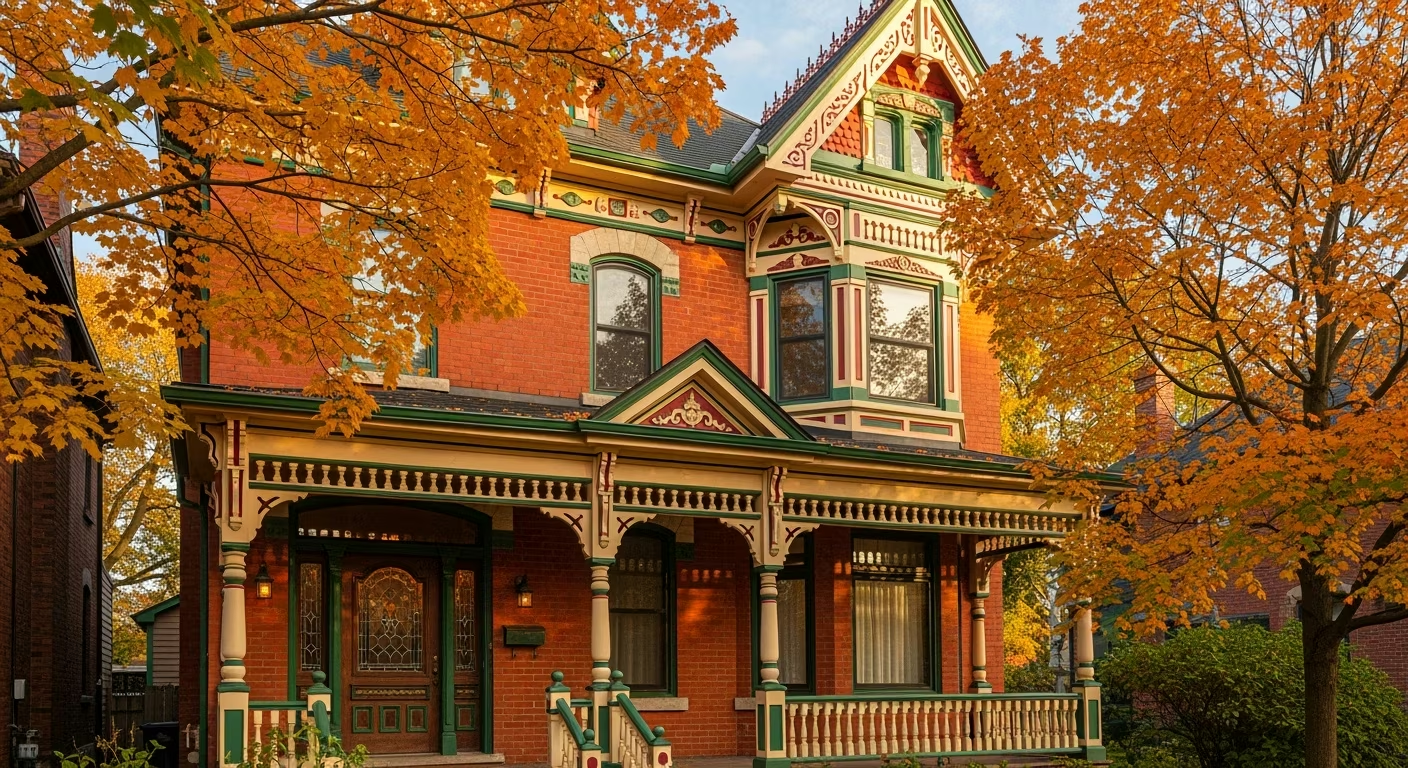
Professional multiplex conversion toronto services available across the Greater Toronto Area.
“RenoHouse delivered our 2-bedroom garden suite on a tight Roncesvalles lot in 11 months from contract to occupancy. Final cost within 4% of quote — rare in this market.”
— Daniel & Priya R., Roncesvalles, Toronto
Get a Free Multiplex Conversion Toronto Estimate
Contact us today for a free, no-obligation quote for your multiplex conversion toronto project in Toronto GTA. We'll get back to you within 1 hour.