 RenoHouse
Radon Mitigation & Testing — Toronto GTA Health Canada Compliant
Professional radon mitigation & testing services in Toronto and the Greater Toronto Area. Licensed, insured, and trusted by homeowners across the GTA.
Projects Completed
Years Experience
Client Satisfaction
Google Rating
How It Works
A simple, stress-free process from start to finish.
Send Your Request
Call or WhatsApp us 24/7. Send photos, video, comments about what needs to be done, and your location.
Remote Estimate
We review everything, discuss details, and provide a clear estimate — often within hours, no visit needed.
Repair Process
Our licensed team arrives on the agreed date and completes your radon mitigation & testing to the highest standards.
Handover & Warranty
Final walkthrough with you, full cleanup, and warranty documentation provided.
Send Your Request
Call or WhatsApp us 24/7. Send photos, video, and a description of the work + your location.
Remote Estimate
We review everything, clarify details, and give you a price — often within hours.
Repair Process
Licensed team arrives on schedule and completes your radon mitigation & testing professionally.
Handover & Warranty
Final walkthrough, full cleanup, and warranty documentation.
Radon Mitigation & Testing in Toronto GTA
RenoHouse coordinates radon testing and sub-slab depressurization mitigation systems for Toronto and GTA homeowners. Radon is a Class 1 carcinogen — Health Canada's residential guideline is 200 Bq/m³ and 19% of GTA homes test above that threshold per the Health Canada cross-Canada radon survey. Our scope is project management: certified C-NRPP (Canadian National Radon Proficiency Program) professional partners design and commission the mitigation system, RenoHouse self-performs the construction wrap (slab coring, drywall around the riser, paint, hardwood refinish around equipment) and handles the long-term performance verification.
Why Toronto homes have radon
Radon-222 is a naturally occurring radioactive gas produced by uranium decay in the soil and bedrock under your home. The Greater Toronto Area sits on shale and limestone with measurable uranium content; basement slabs without proper sub-slab vapour barriers and with cracks at cold joints, plumbing penetrations, and sump pits act as radon entry pathways. Cold-weather stack effect (warm air rising in winter) pulls soil gas into the basement at higher rates November through March — which is why Health Canada recommends long-term tests of 91+ days, ideally over the heating season.
Health Canada 200 Bq/m³ guideline
Health Canada recommends mitigation when the long-term average residential radon concentration exceeds 200 Bq/m³ (becquerels per cubic metre). The World Health Organization sets a tighter recommendation at 100 Bq/m³. Health Canada's Cross-Canada Survey of Radon Concentrations in Homes (2009–2013, updated 2024) found 7% of Canadian homes above 200 Bq/m³; in the GTA the figure is approximately 19% — much higher than national average due to soil composition. Lung cancer is the established health risk; Health Canada attributes 16% of all lung cancer deaths in Canada to residential radon exposure. After smoking, radon is the second leading cause of lung cancer.
Testing — long-term vs short-term
Long-term alpha-track test (91+ days, ideally 12 months): $50–$150 DIY kit (Take Action on Radon, AccuStar, Radalink) or $200–$400 with C-NRPP-certified professional placement and laboratory analysis. This is the Health Canada-recommended test. Short-term test (2–7 days): not Health Canada-approved for decision-making; useful only for real-estate transaction screening or post-mitigation verification. Continuous radon monitor (consumer grade Airthings Wave Plus or Corentium): $250–$400 — useful for ongoing monitoring after mitigation. Professional pre-purchase short-term test (real estate transactions): $300–$600 by a C-NRPP-certified measurement professional. RenoHouse coordinates testing with C-NRPP partners (SafeAir Environmental, Radon Environmental Management, Take Action on Radon).
Mitigation — sub-slab depressurization
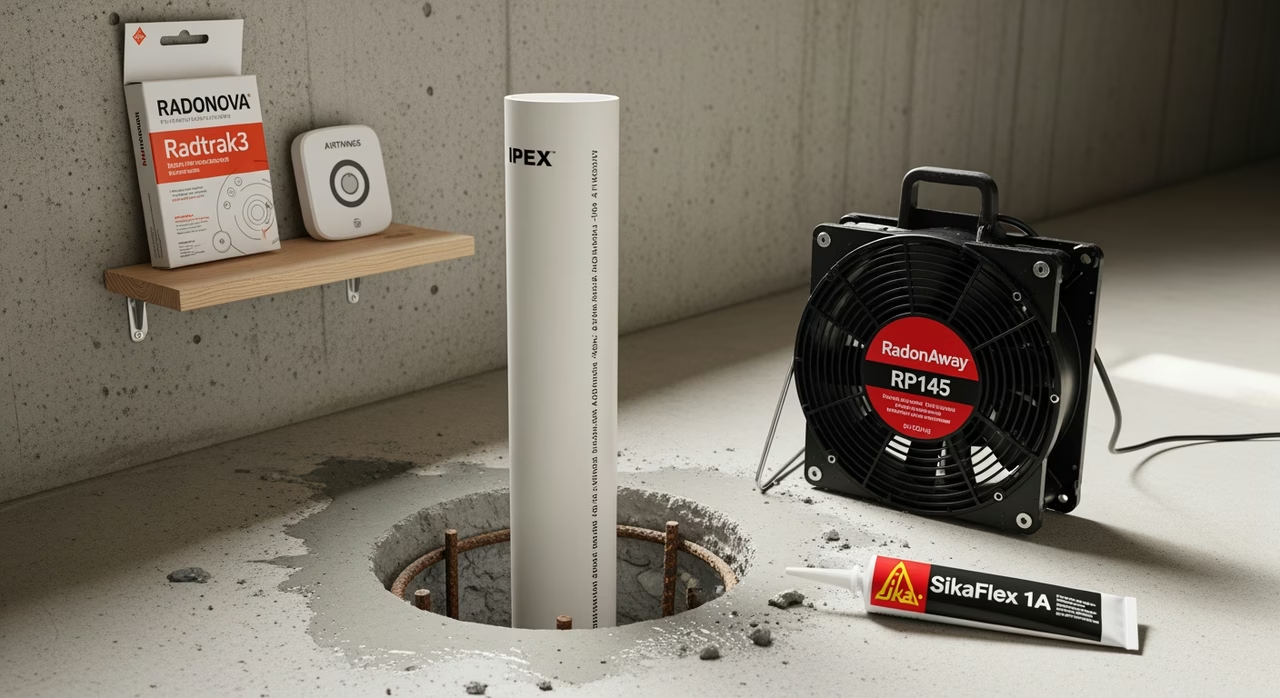
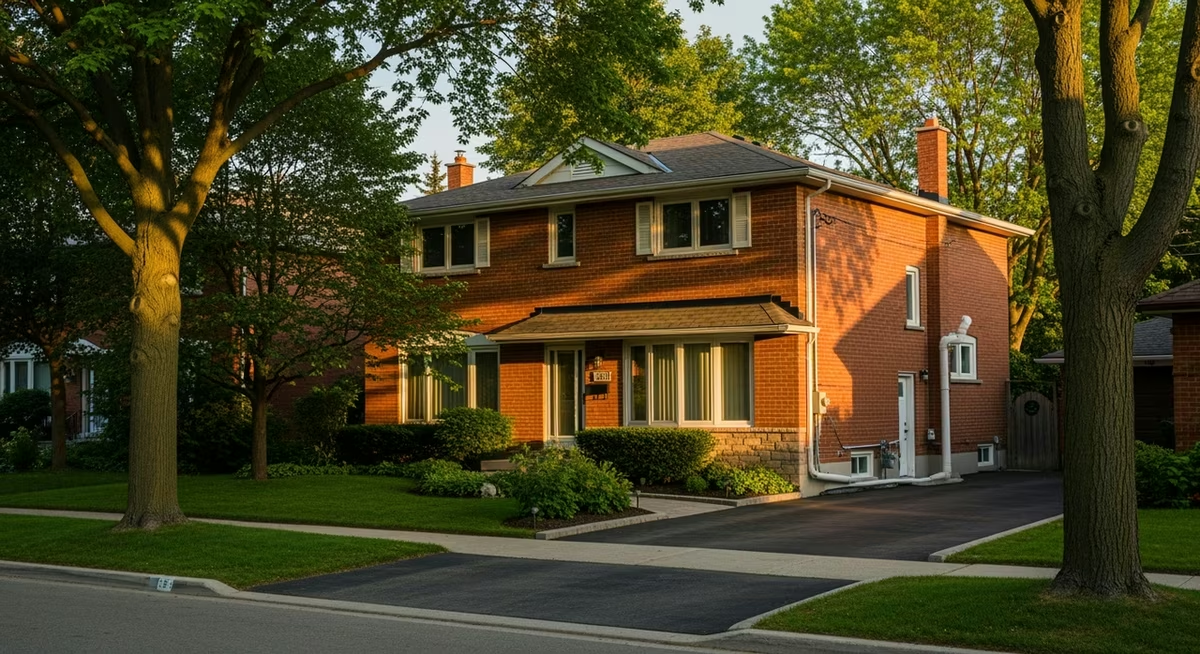
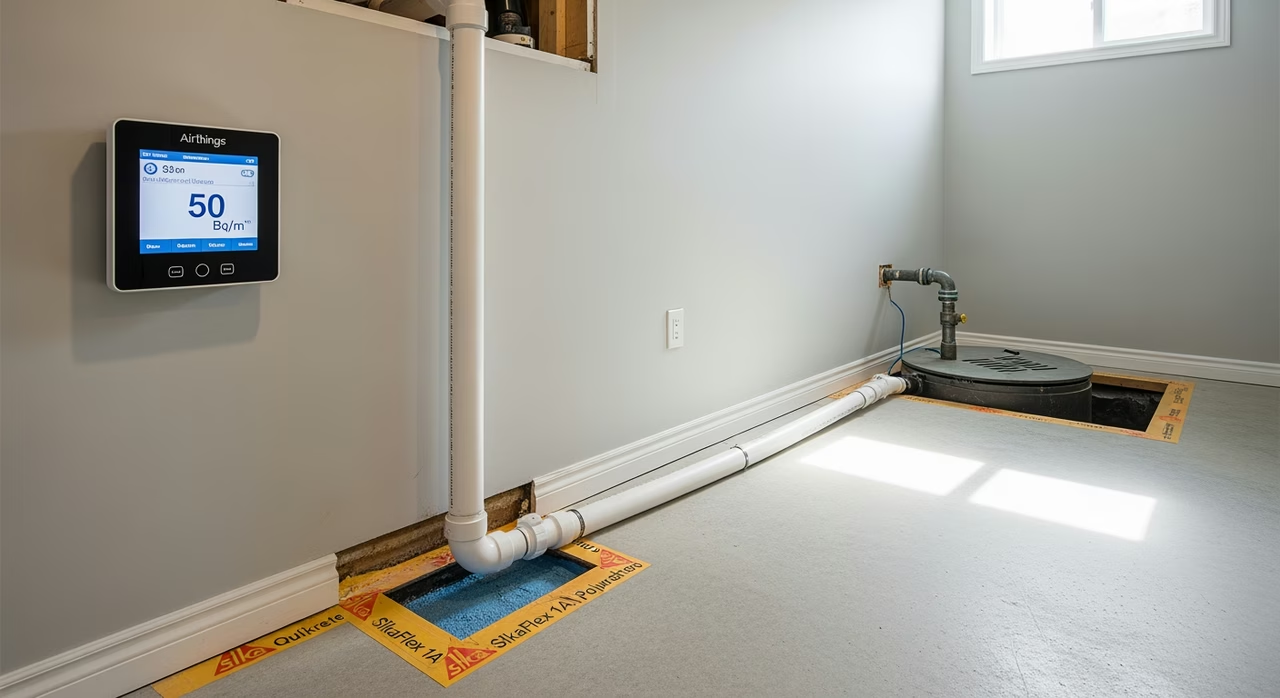
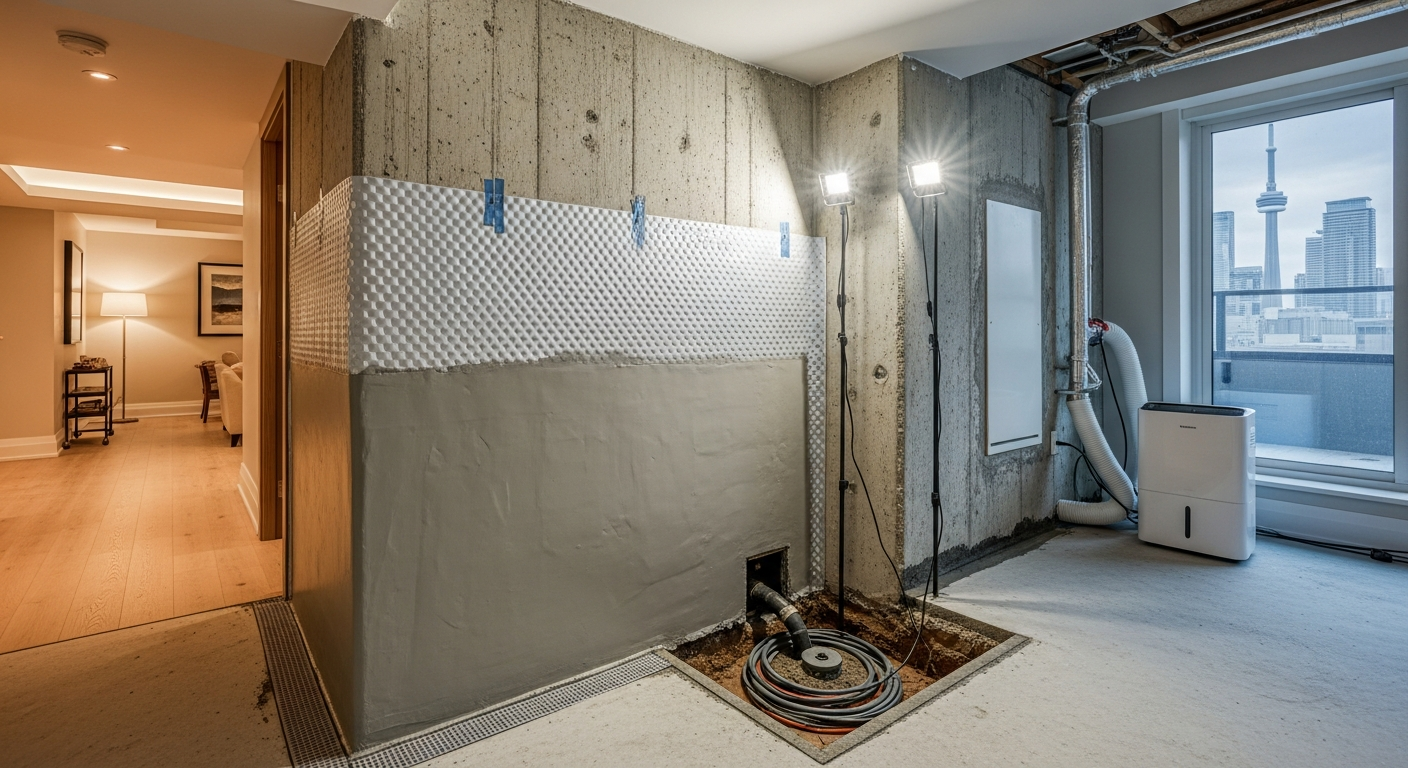
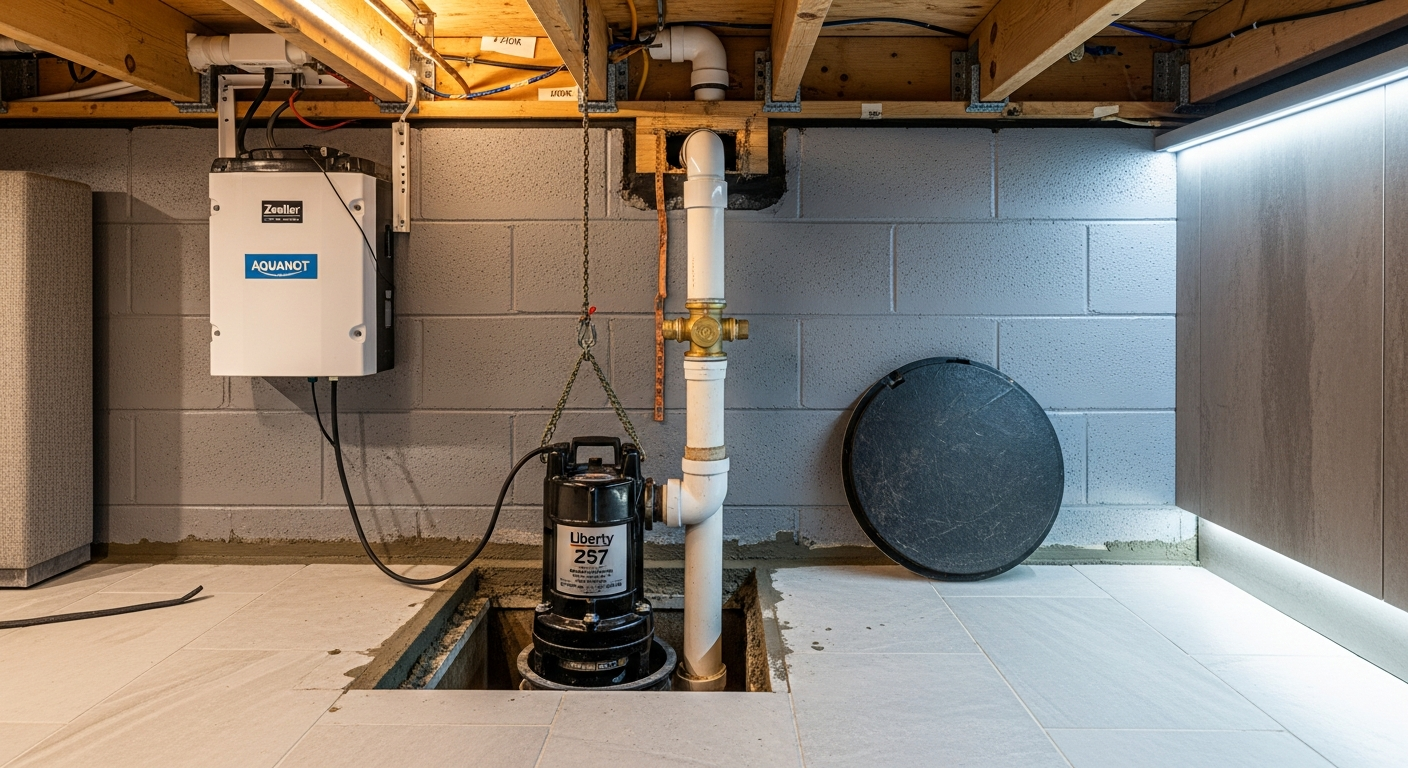
When a long-term test result exceeds 200 Bq/m³, the standard mitigation technique is active sub-slab depressurization (SSD). A 100mm (4-inch) suction pit is cored through the basement slab into the gravel layer beneath; a sealed PVC riser routes from the pit through the basement to a continuous-duty radon-rated fan (RadonAway RP145, Festa Fan-Tech RN1, or similar) mounted in the attic or on the exterior wall above grade; the fan creates negative pressure under the slab, drawing radon-laden soil gas up and out the discharge stack above the roofline. All slab cracks, cold joints, plumbing penetrations, and the sump pit are sealed with polyurethane radon-rated sealant. Post-mitigation verification test confirms the system is working — target is below 100 Bq/m³ post-mitigation.
Project value
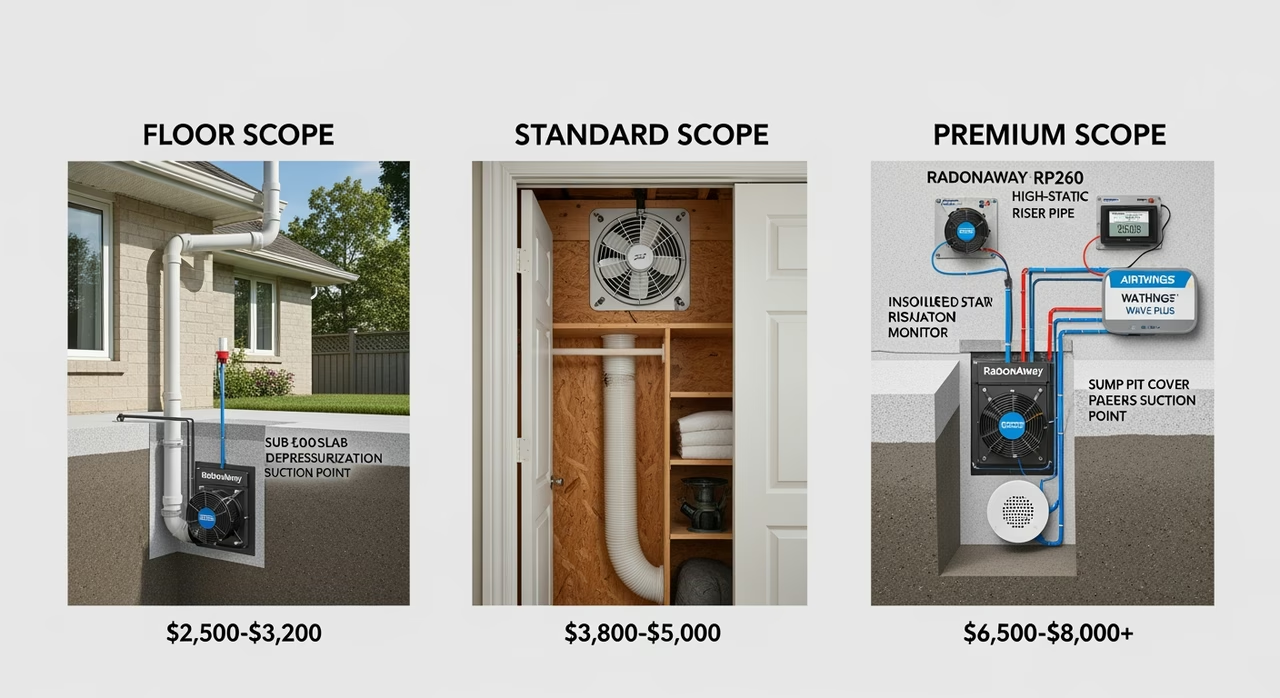
Long-term test only: $50–$200 DIY, $250–$500 professional. Sub-slab depressurization mitigation system: $2,000–$4,500 typical residential. Includes slab coring, riser routing, fan installation, exterior or attic discharge, slab sealing, sump cover (if applicable), construction wrap (drywall, paint), and post-mitigation verification test. Complex installations (finished basement requiring riser concealment, multiple suction points for large slabs >150 m², older homes with stone foundations needing special detailing) run $4,500–$7,500. New-construction passive rough-in (OBC 2024 requirement effective January 2025 for new homes): $400–$800 incremental during framing. Subsequent activation if post-occupancy test exceeds 200 Bq/m³: $800–$1,500.
Honest scope and certification
Mitigation system design and commissioning must be performed by a C-NRPP-certified radon mitigation professional — this certification is required by Health Canada and by most major Canadian insurers post-claim. RenoHouse does NOT hold C-NRPP certification in-house; we coordinate certified subcontractor partners for system design, installation of the fan and riser, and post-mitigation verification testing. RenoHouse self-performs the slab coring (we own coring equipment), the construction wrap (drywall, paint, hardwood refinish around the riser), and homeowner communication. The C-NRPP partner signs off on system commissioning and provides the post-mitigation verification report. This honest scope split protects you (certified mitigation professional accountable for the active system) and us (we don't represent capability we don't have).
OBC 2024 new-construction rough-ins
Effective January 1, 2025, the Ontario Building Code requires radon-resistant rough-ins for new residential construction: a continuous sub-slab gas-permeable layer (typically 4 inches of clean stone), a sealed sub-slab vapour barrier (10-mil reinforced poly), and a capped 100mm vertical riser pipe routed from below the slab to above the roofline ready for fan activation if post-occupancy testing exceeds 200 Bq/m³. RenoHouse performs OBC 2024 radon rough-ins as part of new-build and major renovation scopes; activation (fan + verification test) is performed by C-NRPP partner if post-occupancy test triggers.
Pairing with basement renovation
Radon mitigation is most cost-effective when paired with basement finishing or basement waterproofing — slab work is already in scope, suction pit coring overlaps with sump pit work, and riser routing can be concealed inside finished walls. Combined basement-finish + radon mitigation projects save 25–40% compared to retrofitting radon mitigation into a finished basement. We strongly recommend testing BEFORE basement finishing to determine whether mitigation is needed.
Serving Toronto, Mississauga, Brampton, Vaughan, Markham, Richmond Hill, Oakville, Burlington, Etobicoke, Scarborough, North York, and all GTA communities. Call 289-212-2345 for a free radon-mitigation consultation.

Service detail and neighbourhood context for Toronto and the GTA.
Toronto/GTA neighborhood considerations
- Forest Hill / Rosedale / Lawrence Park (heritage 1920s+): Heritage rubble-foundation basement — high radon-ingress risk (cracked slab + uncapped sump-pit + open soil-floor crawlspace). 90-day Alpha-track or Radtrak2 test $48-$80 detector. Typical Toronto basement reading 150-280 Bq/m3 (Health Canada action level 200 Bq/m3).
- North York / Scarborough / Etobicoke (post-war 1950s-70s): Post-war poured-concrete basement — moderate radon risk (slab-crack + sump-pit penetration). Active sub-slab depressurization (ASD) mitigation $1,800-$3,400 with RadonAway RP145 fan + 4" PVC vent through soffit.
- Mississauga / Brampton / Vaughan (1990s+ subdivisions): 1990s+ poured-concrete + sealed-slab — low baseline. Reading typically <100 Bq/m3. Mitigation rarely needed.
- Caledon / King City / Aurora (rural / well water / large lot): Rural with crawlspace or slab-on-grade — variable. Granite-bedrock proximity (Caledon, King) elevated radon risk. Full test $80-$140; ASD mitigation $2,200-$4,200.
- Downtown condos (King West / Liberty Village / Yorkville): Condo above ground-floor — radon-risk negligible. Ground-floor unit + basement parking shared-air — test $48-$80.
Health Canada Radon Action Level 200 Bq/m3 (long-term average). C-NRPP (Canadian National Radon Proficiency Program) certified measurement + mitigation. Take Action on Radon program (govt + Lung Cancer Canada).
The RenoHouse Difference
11+ Years Experience
Over a decade of expertise in radon mitigation & testing. We've seen it all and know how to handle any challenge.
Warranty Protected
All work comes with comprehensive warranty coverage. We stand behind our craftsmanship and use quality materials that last.
Competitive Rates
Fair pricing on radon mitigation & testing without compromising quality. We match or beat competitor quotes.
Sound Familiar?
These are the most common problems our clients face.
Health Canada says 19% of GTA homes test above 200 Bq/m³ — worried about your basement?
Long-term winter radon test came back over the Health Canada guideline?
Confused about DIY alpha-track kits vs professional C-NRPP testing for a real-estate transaction?
OBC 2024 radon rough-in for a new build — need to activate the system after a high test?
Finishing a basement bedroom and want to mitigate before drywall goes up?
Lung-cancer risk concerns from radon — need a certified mitigation system that actually works?
Ready to get started?
Free estimate, no obligation. We respond within 1 hour.
What Our Clients Say
“RenoHouse replaced all our windows in just two days. The new windows are beautiful, energy-efficient, and the team left everything spotless. Highly recommend!”

Michael R.
Oakville
“New windows transformed our home. Quieter, warmer, and our energy bill dropped noticeably. Excellent installation crew.”

David K.
Vaughan
“Professional from start to finish. They replaced 8 windows in one day and cleaned up perfectly. Highly recommend RenoHouse!”

Sandra W.
Burlington
Our Radon Mitigation & Testing Work
Professional radon mitigation & testing results from RenoHouse projects across the Toronto GTA.
Radon Mitigation & Testing
Toronto GTA
Quality Workmanship
Licensed & Insured
Like what you see? Let's talk about your project.
🧮 Radon Mitigation & Testing — Cost Estimator
GTA / Ontario — 2026 market pricing
⚙️ Add-ons & Options
📊 Where the cost goes (typical breakdown)
📋 What affects your price:
💡 Estimates use 2026 GTA/Ontario market data. Actual cost depends on site conditions, material selections, and project scope. Book a free in-home quote for a precise number.
Frequently Asked Questions About Radon Mitigation & Testing
Health Canada recommends mitigation when the long-term average residential radon concentration exceeds 200 Bq/m³ (becquerels per cubic metre). The World Health Organization sets a tighter recommendation at 100 Bq/m³. Health Canada attributes 16% of all lung cancer deaths in Canada to residential radon — second only to smoking. Long-term testing of 91+ days, ideally over the heating season, is required for an accurate average.
Approximately 19% of GTA homes test above the Health Canada 200 Bq/m³ guideline per the Health Canada Cross-Canada Survey of Radon Concentrations in Homes — substantially higher than the 7% national average due to local shale and limestone bedrock. Cold-weather stack effect during Toronto's heating season concentrates radon entry through slab cracks, cold joints, plumbing penetrations, and uncovered sump pits.
Long-term alpha-track test 91+ days (Health Canada-recommended): $50–$150 DIY kit, $200–$400 with C-NRPP-certified professional placement and lab analysis. Continuous radon monitor (Airthings Wave Plus / Corentium): $250–$400. Professional pre-purchase short-term test (real-estate transactions): $300–$600. We recommend the 91+ day long-term test for any decision-making — short-term tests have too much variability.
Sub-slab depressurization mitigation system: $2,000–$4,500 typical residential. Includes slab coring, riser routing, fan installation (RadonAway RP145 or similar), exterior or attic discharge above roofline, slab sealing with radon-rated polyurethane sealant, sump cover, construction wrap, and post-mitigation verification test. Complex installations (finished basement riser concealment, multiple suction points, stone foundations): $4,500–$7,500. Pairing with basement finishing saves 25–40%.
Yes — for the mitigation system design and commissioning. Health Canada and most major Canadian insurers require C-NRPP (Canadian National Radon Proficiency Program) certification for the mitigation professional who designs the system and performs post-mitigation verification testing. RenoHouse does NOT hold C-NRPP certification in-house; we coordinate certified subcontractor partners (SafeAir Environmental, Radon Environmental Management, Take Action on Radon) for system design and verification. RenoHouse self-performs slab coring, construction wrap, and homeowner communication.
A 4-inch suction pit is cored through the basement slab into the gravel layer beneath. A sealed PVC riser pipe routes from the pit, through the basement, to a continuous-duty radon-rated fan (RadonAway RP145, Festa Fan-Tech) mounted in the attic or on the exterior wall above grade. The fan creates slight negative pressure under the slab, drawing radon-laden soil gas up and out the discharge stack above the roofline. All slab cracks, cold joints, plumbing penetrations, and the sump pit are sealed. Post-mitigation verification target: below 100 Bq/m³.
Effective January 1, 2025, the Ontario Building Code requires radon-resistant rough-ins for new residential construction: a continuous sub-slab gas-permeable layer (4 inches of clean stone), a sealed sub-slab vapour barrier (10-mil reinforced poly), and a capped 100mm vertical riser pipe from below the slab to above the roofline — ready for fan activation if post-occupancy testing exceeds 200 Bq/m³. Rough-in cost: $400–$800 incremental during framing. Activation if needed (fan + verification test): $800–$1,500.
Health Canada recommends every Canadian home test for radon at least once. Best time to start a long-term 91-day test: November through March, during the heating season when stack effect maximizes radon entry. Re-test after any major basement renovation, slab work, foundation repair, or HVAC change. Re-test 12–24 months after mitigation system commissioning to verify continued performance. We recommend testing BEFORE finishing a basement — retrofitting mitigation into a finished basement costs 1.5–2x more.
DIY long-term alpha-track test kits (Take Action on Radon, AccuStar, Radalink) are Health Canada-approved and produce reliable results when placed correctly: lowest occupied level of the home, minimum 50cm from exterior walls and floor, minimum 90cm above the floor, away from windows / vents / heat sources, in a normally occupied area for 91+ days. Mail to certified lab for analysis. For pre-purchase real estate transactions, a C-NRPP-certified measurement professional is typically required by lenders or buyers; we coordinate that referral.
Health Canada says mitigation is recommended above 200 Bq/m³ but acknowledges health benefits at lower thresholds. WHO recommends action above 100 Bq/m³. Between 100–200 Bq/m³ is a personal risk-tolerance decision: many homeowners mitigate at this level, especially for finished basements where children play, home offices, or rental units. Mitigation is the same cost ($2,000–$4,500) regardless of starting concentration — and post-mitigation results typically come in below 50 Bq/m³ regardless of pre-mitigation level.
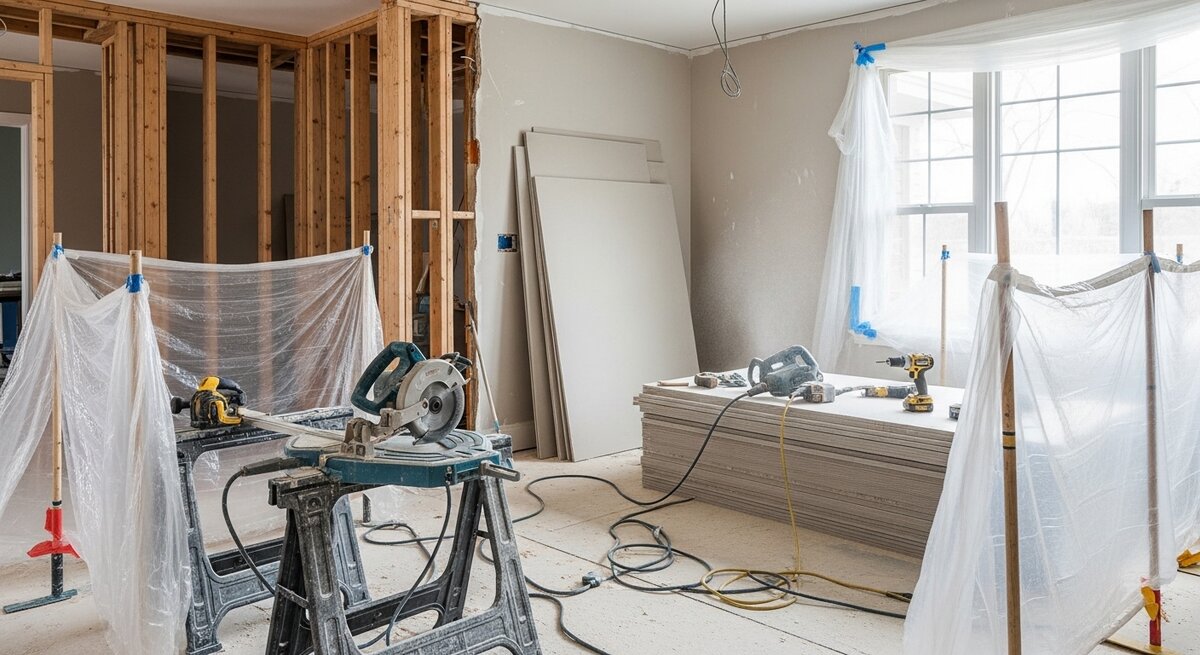
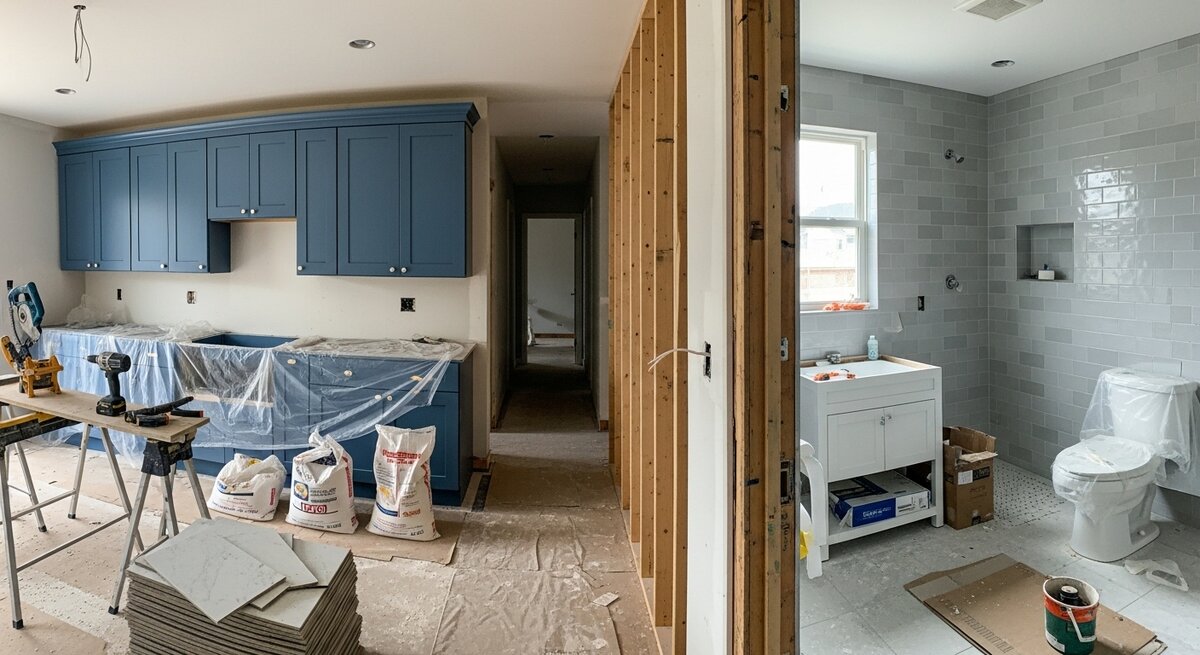


You Might Also Need
Customers who looked at radon mitigation & testing also asked us about these complementary services.


We Serve All GTA
Professional radon mitigation & testing services available across the Greater Toronto Area.
“Renovated our entire main floor — kitchen, living room, flooring, paint, lighting. They coordinated everything perfectly. One contractor for the whole project.”
— Anthony G., North York
Get a Free Radon Mitigation & Testing Estimate
Contact us today for a free, no-obligation quote for your radon mitigation & testing project in Toronto GTA. We'll get back to you within 1 hour.