RenoHouse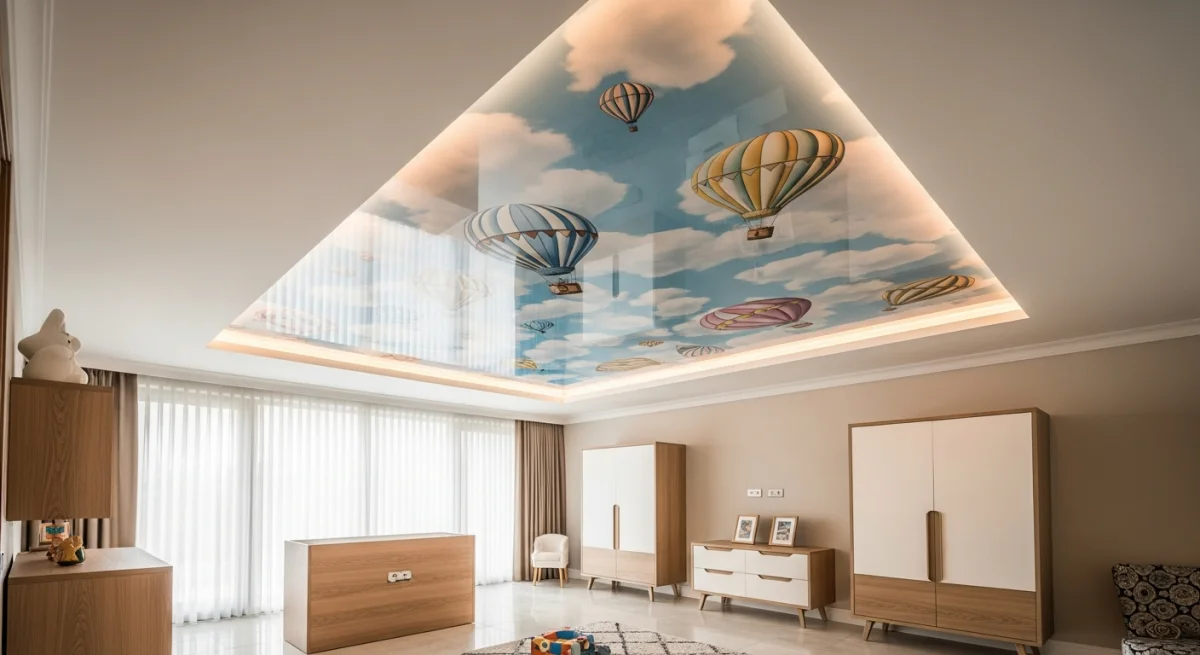

Kids' rooms are the most-photographed stretch ceiling category in our Toronto portfolio. Printed PVC ceilings featuring galaxies, daytime cloud skies, hot air balloons, dinosaurs, jungle scenes, and underwater themes dominate the cluster. Russian-Canadian families across Thornhill, Vaughan, and North York lean particularly heavily into printed kids' ceilings \u2014 it is one of the highest-conversion categories for our installer network.
This article walks through which print themes work, ink and material safety, fiber-optic star sky considerations for kids, sleep-training trade-offs, and 2026 Toronto installed pricing.
Print Theme Categories
The five print categories that dominate kids' room installs across the GTA:
Daytime cloud sky. Soft blue gradient with scattered cumulus clouds. Universally appealing, gender-neutral, ages from infant through teen. The most-installed kids' theme; about 35 percent of our printed kids' ceiling jobs. Pairs with any furniture style. Galaxy / starfield (printed, not fiber-optic). Deep navy or black background with printed stars, nebulae, planets. Visually striking but less convertible to other room uses if you outgrow it. Best for ages 4 through teen. Cartoon and theme. Dinosaurs, unicorns, jungle, underwater, space rockets, Disney-licensed (licensing required and adds cost). Highest emotional impact at install but shortest aesthetic lifespan \u2014 a 5-year-old's dinosaur ceiling is embarrassing to a 12-year-old. Plan for replacement at age transitions. Hot air balloons / soft pastel. A subset of the cloud sky category with stylized whimsical imagery. Works well in nurseries and ages 2 through 8. Custom family imagery. Family photo printed at full resolution, often a beloved vacation panorama or a parent-painted artwork scaled up. Print resolution matters \u2014 720 dpi minimum at full size, ideally 1200 dpi or higher.Print Resolution and Material
The print is applied via wide-format UV-cured solvent or eco-solvent printer directly onto the PVC membrane (or polyester fabric). Resolution typically 720 to 1440 dpi. For a 200 square foot room, the print file should be at least 4000 by 5000 pixels at delivery resolution.
For Toronto installs we specify eco-solvent or latex inks (HP Latex, Mimaki LUS), not regular solvent inks. Eco-solvent and latex are tested for low-VOC indoor use and are preferred for any kids' room. Regular solvent inks have stronger off-gassing during the first 30 to 60 days post-print and we do not specify them for children's rooms.
The membrane itself: A+ certified PVC (MSD or Pongs) for printed ceilings. Avoid budget films from grey-market suppliers because the plasticizer load is higher and harder to verify.
Fiber-Optic Star Sky for Kids' Rooms
Fiber-optic star sky in a kids' room is a premium upgrade that comes with parental judgment. The technology itself is safe: PMMA fiber strands sealed inside the membrane, fed by a central LED projector that lives in the plenum or an adjacent closet. There is no exposed electricity in the room and no heat at the membrane surface.
Star density for kids' rooms: 35 to 60 stars per square metre is the right range. More than 100 stars per square metre starts to look overwhelming and disrupts sleep. The projector should support a programmable timer (Galaxy V8 has this built in; Cosmolight requires a Lutron Caseta or similar to add timer control).
Need professional renovation?
Call RenoHouse at 289-212-2345 or get a free estimate today.
Get Free Estimate →Sleep-training implications. A constantly twinkling ceiling with active shooting stars is genuinely beautiful but it is a stimulant for kids who are still developing sleep habits. Most pediatricians we have spoken to recommend the projector be on a timer that fades to off 20 to 30 minutes after bedtime. We program this default into every kids' room install and provide instructions for parents to extend or shorten the on-time as the child grows.
Cost: a 200 square foot kids' room with full-area fiber-optic star sky runs $5,500 to $9,500 in 2026. Partial-area (only above the bed) drops to $3,500 to $6,000.
Combination: Printed + Fiber-Optic Star

A premium pattern: printed daytime cloud sky during the day (with the projector off), transforming into a starfield at night when the projector activates. This requires a translucent or partially translucent printed membrane and careful design \u2014 the printed clouds should not block the star pinpoints. We support this pattern but specify it carefully; about 10 percent of our kids' room printed installs include the dual-mode upgrade.
Cost premium: $2,000 to $4,500 over a printed-only ceiling.
Acoustic Considerations
Kids' rooms generate noise. Toy clatter, music, video calls, occasional tantrums. A microperforated acoustic stretch ceiling (Newmat Acoustic, Clipso Acoustic-810) backed by 100 mm Rockwool reduces airborne noise transmission to adjacent rooms by 5 to 10 dBA \u2014 enough to noticeably reduce the toddler's voice carrying through the upstairs hallway.
Acoustic upgrade premium: $5 to $10 per square foot. We recommend it specifically for shared-wall kids' rooms (where the kid's room shares a wall with a parent's bedroom) and for large open-plan family homes where sound carries.
Headroom and Pot Light Considerations
Kids' rooms generally have 8 to 9 foot ceilings in Toronto homes. Single-level PVC stretch ceiling drops 25 to 40 mm; not a concern. Pot light pass-throughs at $40 to $80 each. Most kids' rooms use 4 to 6 pot lights plus a central ceiling fan or pendant.
Ceiling fan installation through stretch ceiling: the fan is mounted to the original ceiling above using a standard fan-rated ceiling box, then the membrane is cut around the fan downrod with a sealed plastic ring. Pass-through cost: $80 to $150 for the fan-specific ring (slightly larger than a pot light ring).
2026 Installed Pricing
For a typical Toronto kids' room stretch ceiling install:
- Standard kids' room 100-150 sqft, plain matte or satin PVC, 4 pot lights: $1,400 to $2,400.
- Printed PVC (cloud sky, galaxy, theme): $2,800 to $4,800. Print adds $13 to $22 per square foot over plain PVC.
- Custom family imagery print: $3,200 to $5,500 depending on artwork prep complexity.
- Fiber-optic star sky full-area: $5,500 to $9,500.
- Fiber-optic star sky partial-area (over bed only): $3,500 to $6,000.
- Combination printed + fiber-optic: $7,500 to $13,000.
- Acoustic perforated upgrade: add $5 to $10 per square foot.
What to Avoid
- Heavy character licensing. Disney, Marvel, Pixar licensed prints require the licensee certification, which adds $400 to $1,500 per design and limits reprint flexibility. Stick with generic theme imagery (generic dinosaurs, generic galaxies) or use original artwork.
- Bright RGB color cycling all night. A perimeter LED that cycles colors all night will disrupt sleep. Specify a programmable Lutron or Hue setup with an automatic shutoff at bedtime.
- High-gloss printed PVC in kids' rooms. Glossy reflects the printed image's own pixels back at angles, and the print can read as "shiny and cheap." Specify matte or satin.
- Dense 150-stars-per-square-metre fiber-optic in toddler rooms. Too stimulating. Stay at 35 to 60 stars per square metre and use the timer.
- Solvent ink prints in nurseries. Use eco-solvent or latex only.
Russian-Canadian Aesthetic Note
Russian-Canadian families lean toward printed clouds, galaxies with dense stars, and fairy-tale themes (e.g., "Snow Queen" inspired snowflake patterns). Multi-level designs combining a printed center panel with a glossy white border are a common upgrade. Fiber-optic star skies in kids' rooms are 4 to 5 times more common in Russian-Canadian than Anglo-Canadian households across our installer data.
Honest Install Trade-Offs
PVC printed kids' room install: 2.5 to 3.5 hours, room temperature 50 to 70 degrees Celsius during the heat phase, mandatory ventilation. The print itself is fully cured before delivery; off-gassing is from the membrane, not the ink. Premium A+ certified MSD or Pongs film with eco-solvent print returns to baseline indoor air quality within 24 hours of install with windows cracked.
We strongly recommend the install happen at least 7 days before a child returns to occupy the room, and ideally 14 to 30 days for nurseries. This gives the membrane time to fully equilibrate and removes any residual heat-phase off-gassing concerns. For asthma-sensitive or allergy-sensitive children, we recommend 30 days minimum with active ventilation.
Related Reading
For the broader stretch ceiling room map, see the by-room pillar. For nursery-specific safety detail (newborn through age 2), see the nursery stretch ceiling guide. For master bedroom installs that often pair with kids' room installs in family renovations, see the master bedroom stretch ceiling guide.
Get a Kids' Room Stretch Ceiling Quote
We coordinate vetted installer crews including bilingual Russian-English teams across the GTA. Free in-home measurement, design consultation including print theme selection from our portfolio of 200+ pre-designed kids' patterns, A+ certified PVC, eco-solvent or latex ink only.
Request a kids' room stretch ceiling quote.