RenoHouse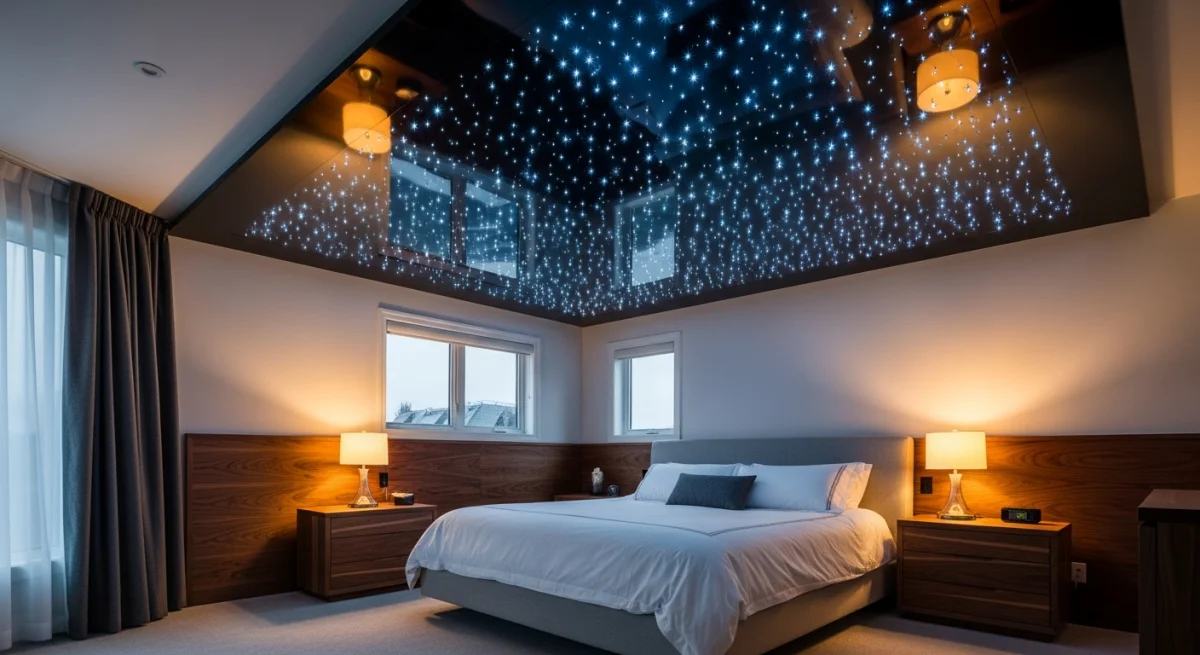

# Star Sky Ceiling for Kids' Rooms: Magical Designs That Help Sleep
A star sky ceiling in a kids' room is one of the few luxury upgrades that pays back daily. Bedtime resistance drops. Night terrors fade. The kid who used to scream at lights-out is asking to go to bed early to "watch the stars." Parents we have installed for routinely message us months later to say the ceiling is the best thing they ever bought for their child.
The design priorities for a kids' room are different from an adult master bedroom. Realism matters less. Programmability, sleep-supporting fade modes, durability, and safety matter more. This guide walks through the choices that make a kids' room star ceiling a long-term win rather than a six-month novelty.
This article is a sibling to our Star Sky Ceiling Toronto 2026 Complete Guide. For pricing, see Star Sky Ceiling Cost in Toronto.
Fiber Optic vs LED Matrix for Kids' Rooms
This is the one cluster post where we routinely recommend LED matrix over fiber optic. The reasons:
- Programmability beats realism. A four-year-old does not care whether the stars look like real points of light. They care that they can ask Alexa to "turn on the planets" and watch a Saturn animation drift across the ceiling.
- Cost. LED matrix at $12–$25 per sqft is half the cost of fiber optic. The savings can fund a second feature (motorized bed canopy, climbing wall, reading nook).
- Per-pixel control. LED matrix can do constellation animations, planet shows, colour scenes, and sleep-fade modes that fiber optic cannot match.
- Durability tradeoff is acceptable. LED matrix has shorter expected service life than fiber optic, but a 10–15 year service window is fine for a kids' room — by then the kid has outgrown the ceiling.
Full system comparison in Fiber Optic vs LED Matrix Star Ceiling.
If the kids' room is in a long-term forever home and the parents want a ceiling that survives multiple kids, fiber optic with a Cosmolight Galaxy V8 still makes sense. The decision usually turns on budget and how soon the parents expect to renovate.
Age-Appropriate Design Considerations
Infants (0–18 months)
The ceiling is for the parents during night feeds, not the baby. Priorities:
- Very low maximum brightness — soft enough to feed at 3 AM without waking the baby fully
- 2700K warm white only — cool 5500K star colour is too alerting for infants
- No motion or twinkle — infants are easily over-stimulated
- Voice control essential — hands free during feeds
A simple LED matrix with one warm-white scene, hand-tuned to about 8 percent brightness, integrated with Alexa, runs about $2,800 installed for a typical 130 sqft nursery.
Toddlers (18 months – 4 years)
The ceiling becomes part of the bedtime routine. Priorities:
- Bedtime fade — stars dim from 60 percent to 8 percent over 20–30 minutes, reinforcing sleep cues
- Soft colour scenes — gentle blue, lavender, dawn pink
- Simple wall control — one button at parent height, simple "stars on" voice command
- No flashing or strobe modes — many toddlers find them frightening
LED matrix systems with sleep-fade programming work beautifully here. We typically program 2–3 scenes: *Bedtime* (slow fade), *Storytime* (constellation drift), *Off*.
Need professional renovation?
Call RenoHouse at 289-212-2345 or get a free estimate today.
Get Free Estimate →Kids (4–10 years)
The ceiling becomes a personality feature. Priorities:
- Planet shows, constellation animations, "shooting star wishes" mode
- Friend-impressing demo button
- Themed scenes — Star Wars, Frozen, dinosaur sky (creative interpretation)
- Educational potential — actual constellation patterns, parent narration mode
This is the age where LED matrix earns its keep. Programmable per-pixel control gives you Saturn, the Big Dipper, a full lunar cycle, or whatever the kid is currently obsessed with.
Tweens and Teens (10+ years)
The ceiling shifts back toward "real" star sky. By age 11 or 12, kids start to find planet animations cheesy and prefer authentic-looking starfields. If the original install was LED matrix, this is when families sometimes upgrade to fiber optic. If the original was fiber optic, the ceiling matures with the kid.
For tweens and teens, treat the ceiling more like a small adult bedroom — the master bedroom design guide applies with minor adjustments.
Sleep Science: How a Star Ceiling Supports Bedtime
The bedtime fade is the most clinically meaningful feature. Pediatric sleep research consistently shows that gradual light reduction over 15–30 minutes supports melatonin production and sleep onset more effectively than abrupt darkness.
A well-programmed kids' room star ceiling:
- 1. Starts at 50–60 percent brightness during pre-sleep routine (book, song)
- 2. Drops to 25 percent during quiet time
- 3. Fades to 8–10 percent over the next 15 minutes
- 4. Continues to a sustained 3–5 percent overnight glow — bright enough for parents to navigate the room, dim enough not to disrupt sleep
- 5. Fades to off by 11 PM (or whatever overnight cutoff the parents choose)
- 6. Returns to gentle dawn-pink wake-up scene at the morning hour
This entire sequence runs as a programmed scene from a Lutron keypad, an Alexa routine, or a Home Assistant automation.
Safety Considerations Parents Often Miss
Membrane Off-Gassing
PVC stretch membranes off-gas during the first 48–72 hours after heat installation. The smell is noticeable. We recommend installing a kids' room ceiling at least 5 days before the kid sleeps in the room, with windows open and fresh-air ventilation running. After 5 days, off-gassing is essentially complete and the membrane is inert.
This is a *don't install at 8 PM the night before* point — sometimes installer crews push schedule, and parents do not realize the off-gassing window matters.
Electrical Safety
ESA-licensed electrical hookup is mandatory in Toronto. Make sure the installer subcontracts to a licensed electrician. The LED engine must be on a dedicated circuit with appropriate fuse protection, and any wall control wiring must be code-compliant. Insurance does not cover unlicensed electrical work in a kids' room.
Engine Heat
LED engines run cool — typically 30–35 °C surface temperature in operation, well below any safety threshold. But the engine should not be in the kid's reach. Mount it in the closet, a service hatch, or above the door header — never over the play area at low level.
Crash and Impact
Kids' rooms get balls thrown, pillows whacked, and the occasional climbing experiment. PVC membranes are surprisingly resilient — most light impacts bounce off without damage. Sharp corners (toy edges, climbing handholds) can puncture. If a tear occurs, repair is usually a full membrane replacement of the affected zone, not a patch. Plan on replacing once during the kid's tenure if the room is high-energy.
Smart Home Integration for Kids' Rooms
Three integration paths we use:
What It Costs
Typical 2026 Toronto kids' room star sky ceiling pricing:
- 130 sqft nursery, LED matrix, basic scenes: $2,800–$4,200
- 150 sqft toddler room, LED matrix with planet shows and sleep fade: $3,800–$5,500
- 180 sqft kids' room, fiber optic Galaxy V8 with shooting star: $6,800–$9,800
- 200 sqft teen room, fiber optic with crystals and full smart integration: $8,500–$12,500
Detailed pricing breakdown in Star Sky Ceiling Cost in Toronto.
How RenoHouse Manages Kids' Room Star Ceiling Projects
We coordinate installer crews who have done dozens of kids' rooms across the GTA, ESA-licensed electrical partners, and LED matrix or Cosmolight fiber optic suppliers. Our project management handles design consultation, off-gassing-aware scheduling, smart home programming, and a 10-year warranty layer.
Most kids' room installs run 1–2 days on site. Custom star map kids' rooms with personalized constellation patterns (the kid's birthday night sky over Toronto, for example) take 4–6 weeks lead time.
To start a kids' room design, visit our Star Sky Ceiling Installation page or read the pillar guide.
Continue Reading