RenoHouse

Toronto's restaurant and commercial fitout market has shifted toward acoustic stretch ceilings as the default treatment for hard-surface dining rooms. Restaurants on King West, Yonge & Eglinton, Ossington, College, Queen West, and the Distillery District routinely retrofit their dining rooms with microperforated acoustic stretch ceilings to hit the 70 dBA target diners actually want. Adjacent commercial categories \u2014 dental and medical offices, salons, retail boutiques, fitness studios \u2014 use stretch ceilings for the combination of acoustic performance, easy cleanability, and design flexibility.
This article walks through commercial stretch ceiling specifications, Ontario fire code compliance, restaurant-specific acoustic targets, lighting integration, and 2026 commercial pricing for Toronto and the GTA.
The Restaurant Acoustic Problem
A Toronto restaurant with hardwood floors, exposed brick walls, glass front, and a 30-seat dining room typically measures 78 to 85 dBA at peak service. Diners cannot hear their table conversation; staff has to lean in to take orders. The acoustic problem is the single largest negative review category in Toronto restaurant journalism (after slow service).
Microperforated acoustic stretch ceiling (Newmat Acoustic, Clipso Acoustic-810, Descor Acoustic) backed by 100 mm Rockwool plenum insulation reduces dining room dBA by 4 to 7 \u2014 enough to drop a 78 dBA room to a comfortable 71 to 74 dBA. Combined with acoustic wall panels (one or two walls behind banquettes) and area rugs, the dining room can hit the 65 to 70 dBA sweet spot.
NRC targets for commercial:
- Casual cafe / fast-casual: NRC 0.4 to 0.6 acceptable
- Mid-tier full-service restaurant: NRC 0.6 to 0.7 ideal
- Fine dining / quiet ambience: NRC 0.7 to 0.85 required
- Dental and medical office: NRC 0.6 to 0.7 (patient privacy)
- Salon / spa: NRC 0.5 to 0.7 (relaxation)
- Retail boutique: NRC 0.3 to 0.5 (less critical)
- Fitness studio: NRC 0.5 to 0.7 (impact noise reduction)
Ontario Fire Code: Class A Requirement
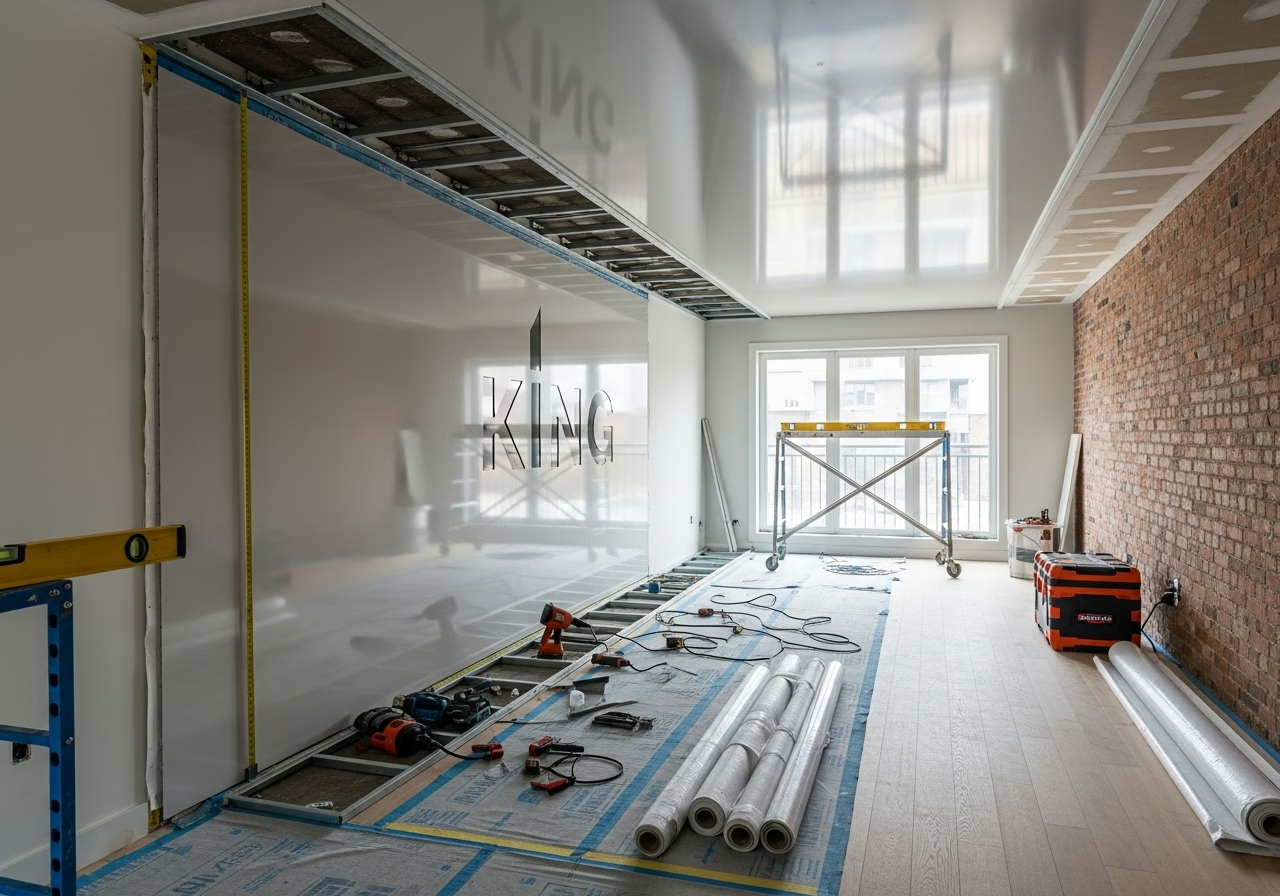
Ontario Building Code 9.10 requires Flame Spread Index (FSI) of 150 or lower for general residential and commercial ceiling areas. For exit corridors, lobby areas, and shared common-area ceilings, Class A rating is required \u2014 FSI of 25 or lower, Smoke Developed Index of 50 or lower (ASTM E84 / CAN/ULC-S102 testing standard).
Premium PVC stretch ceiling films meet Class A: MSD 5-meter Class A, Pongs Decoflair Class A, Clipso Class A fabric. Budget films may meet only the 150-FSI general standard, which is fine for residential dining rooms but not for commercial corridors or restaurants over a certain capacity.
For Toronto commercial installs we always specify Class A films and provide the test certificate (ASTM E84 report) to the building inspector and fire department on request. Restaurant landlords increasingly require this documentation as part of tenant fitout approval.
Decorative + Functional Combination
Commercial clients often want both acoustic performance and visual drama. The combinations we install regularly:
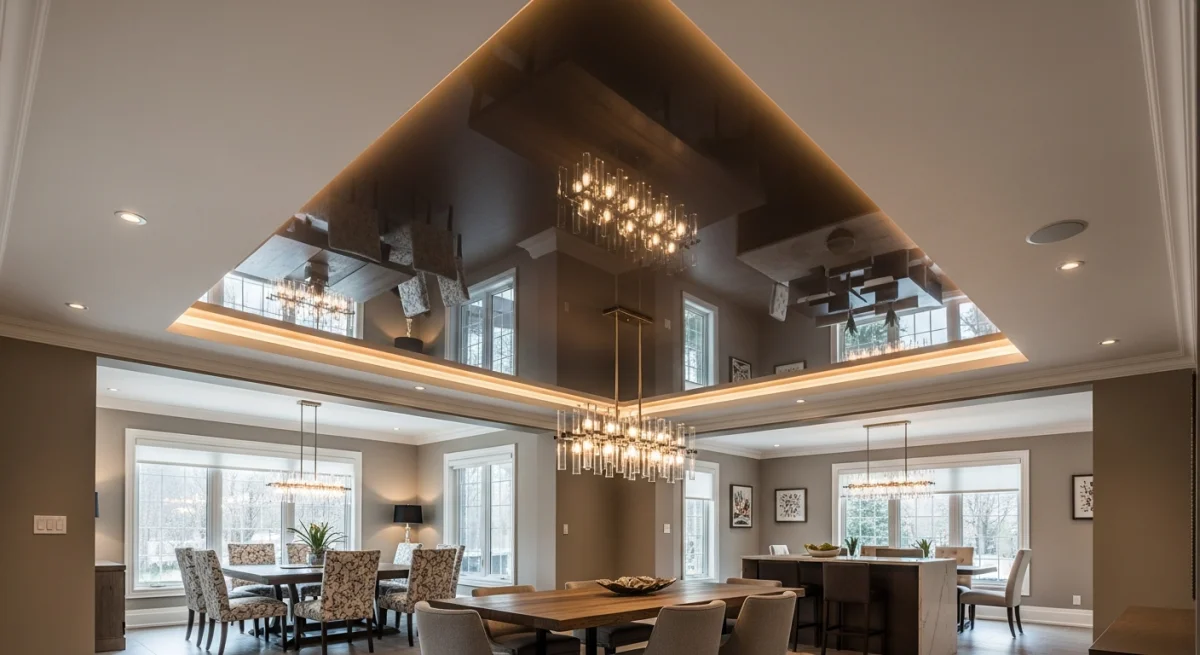
Backlit translucent + acoustic perforated. A center-of-room backlit panel using translucent acoustic membrane (yes, this exists \u2014 Newmat makes it specifically for this combination). The backlit area glows while still absorbing sound. Premium specification, $35 to $55 per square foot. Printed acoustic. A printed image (restaurant brand artwork, abstract pattern, food photography) on microperforated polyester. Print quality is reduced compared to PVC (perforations slightly disrupt the image at close range) but at typical dining room ceiling viewing distance the print reads cleanly. $25 to $40 per square foot. Multi-level with cove RGB. Stepped ceiling with hidden RGB LED cove for ambience changes throughout service (warm 2700 K for dinner, cool blue for late-night cocktail mode, accent colors for branded events). Common in cocktail bars and fine dining. $40 to $70 per linear foot of cove plus base ceiling pricing.Restaurant Kitchen and Bar Considerations
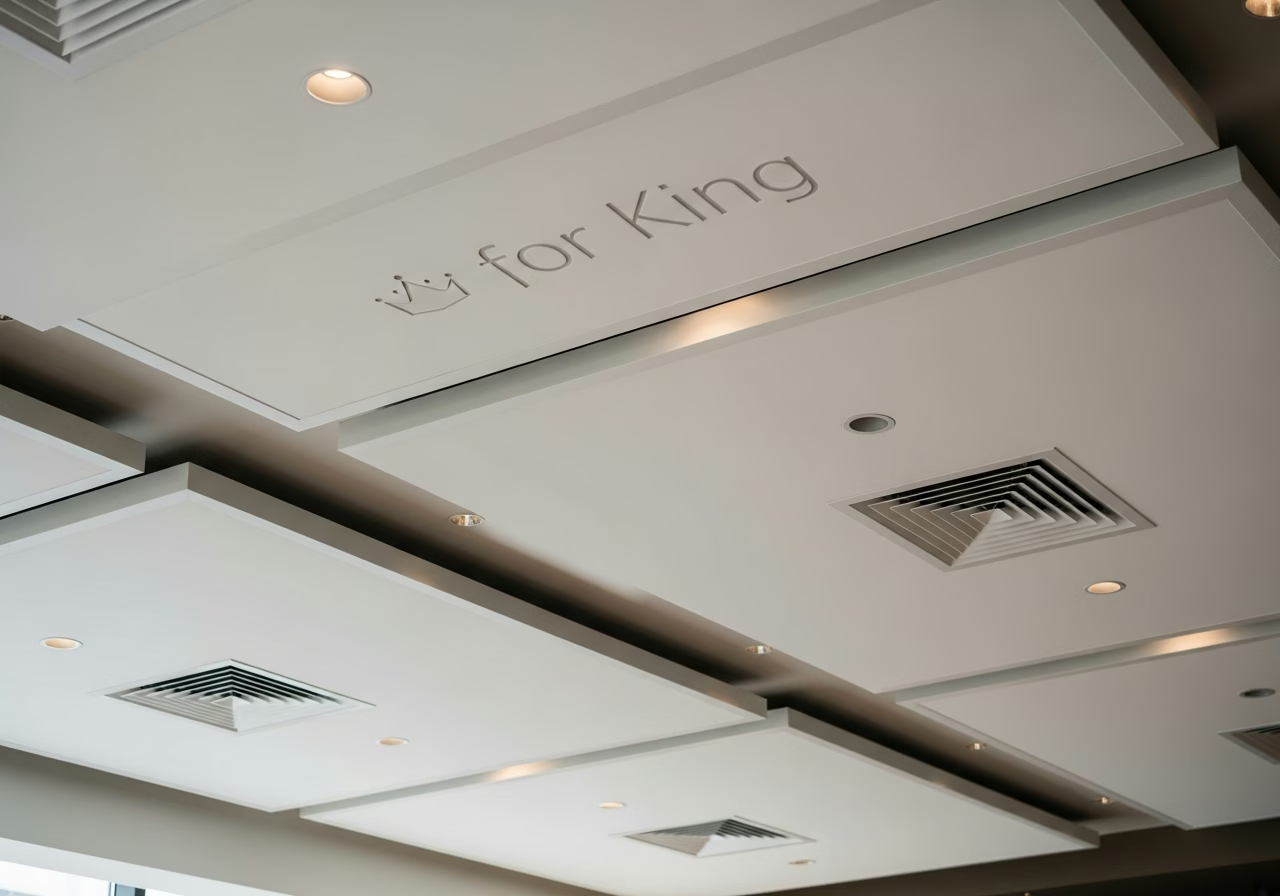
Restaurant front-of-house dining rooms are well-suited to stretch ceiling. Restaurant kitchens are NOT \u2014 commercial cooking grease loads, high heat, and constant cleaning chemical exposure exceed PVC's working envelope. Specify proper kitchen ceiling materials (washable Type X drywall, FRP panels, or stainless steel) for the kitchen itself.
Need professional renovation?
Call RenoHouse at 289-212-2345 or get a free estimate today.
Get Free Estimate →Bar areas are intermediate. Light cooking (no fryers, no high-heat ranges) is fine; serious bar food prep with deep fryers is not. Specify acoustic stretch ceiling for the bar zone only if the kitchen is well-isolated and bar-side cooking is light.
Dental and Medical Office Specifications
Dental and medical offices have specific requirements:
- Easy clean / wipe-down for infection control. PVC stretch ceiling exceeds standard drywall by a wide margin \u2014 it is non-porous and survives bleach-based cleaning.
- Patient privacy NRC 0.6 to 0.7. Microperforated fabric with plenum insulation.
- High-output medical pot lights pass-through. IP44 or higher minimum for procedure rooms.
- No off-gassing during operating hours. Specify A+ certified Clipso fabric (cold-stretch, no heat install) for occupied office installs; or schedule PVC heat install for nights/weekends with 48-hour ventilation buffer.
- Compliance documentation. Many Toronto dental and medical offices require MSDS sheets, fire test certificates, and infection-control compatible material attestations as part of tenant improvement permits.
We have completed dental office stretch ceiling installs across Yonge, Bayview, North York, and Vaughan. Cost ranges $4,500 to $14,000 per office depending on size.
Salon, Spa, and Retail
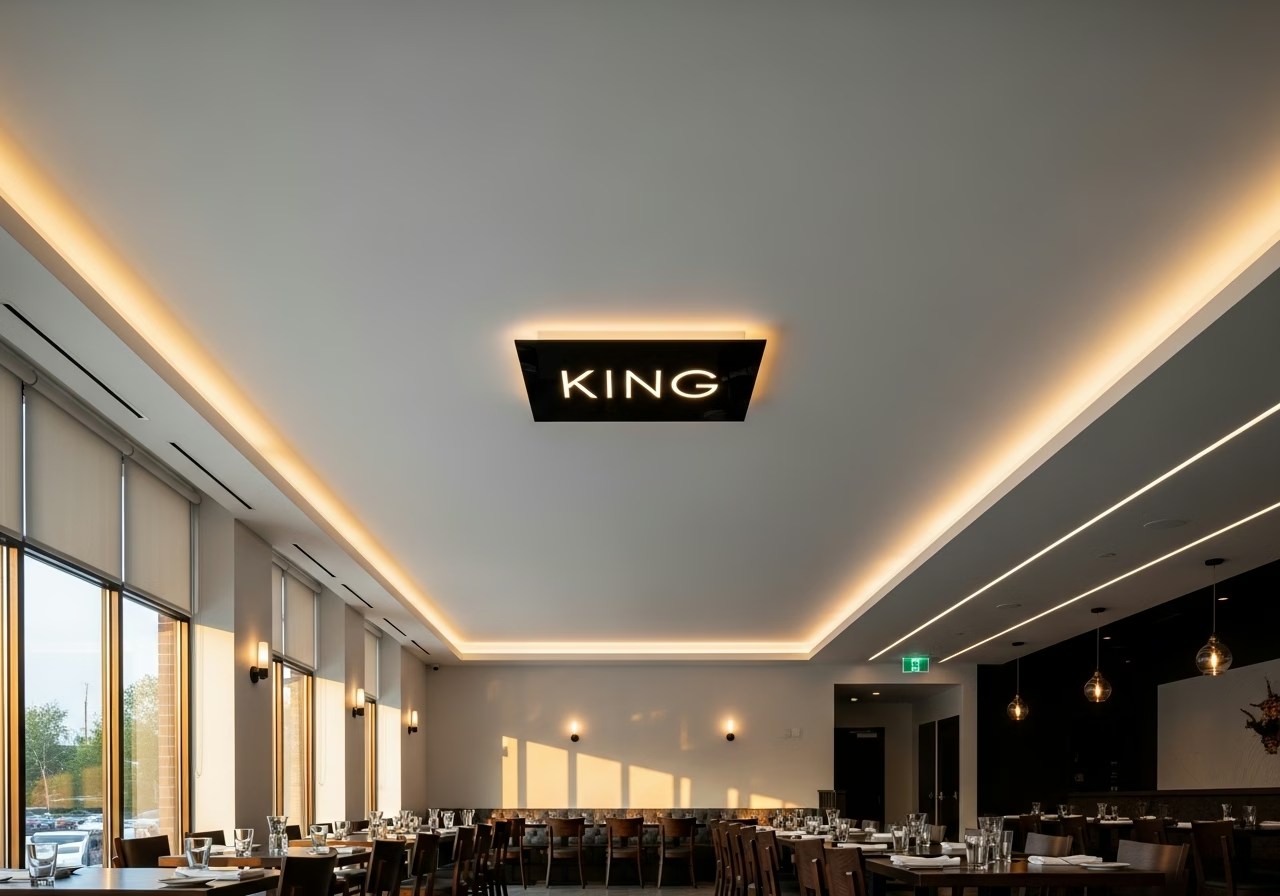
Salon and spa interiors are dominated by PVC stretch ceiling because of the combination of waterproof (hair washing, color treatment), easy clean (chemical exposure), and design flexibility (printed brand imagery, glossy reflectance, RGB cove for ambience). Retail boutiques use stretch ceiling for visual drama \u2014 backlit ceiling above checkout counters, glossy reflective ceilings doubling apparent shop volume.
Pricing: typical Toronto salon (800 to 1,200 sqft) $5,500 to $14,000; spa with multiple rooms $8,000 to $24,000; boutique retail $3,500 to $9,500.
Fitness Studio
A growing commercial category. Yoga studios use plain matte PVC for clean appearance and easy maintenance. Spin and HIIT studios use acoustic perforated for impact noise reduction (jumping and dropping weights generates significant airborne reflection). Combat sports studios (boxing, MMA) sometimes specify high-NRC perforated fabric for serious sound containment.
For a 1,500 sqft yoga studio: $4,500 to $8,500. For an acoustic-treated 1,500 sqft HIIT studio: $7,500 to $14,000.
2026 Commercial Pricing Summary
| Use case | Sq ft typical | 2026 installed |
|---|---|---|
| Cafe/fast casual | 1,000-1,500 | $5,500-$11,000 |
| Mid-tier restaurant | 1,500-2,500 | $9,500-$22,000 |
| Fine dining (acoustic premium) | 2,000-3,000 | $18,000-$38,000 |
| Dental office | 800-1,200 | $4,500-$14,000 |
| Salon | 800-1,200 | $5,500-$14,000 |
| Spa multi-room | 1,500-2,500 | $8,000-$24,000 |
| Retail boutique | 600-1,200 | $3,500-$9,500 |
| Yoga studio | 1,000-1,500 | $4,500-$8,500 |
| HIIT/spin (acoustic) | 1,500-2,500 | $7,500-$14,000 |
These are turnkey installed pricing including A+ certified Class A films, acoustic Rockwool plenum where applicable, all pass-throughs (sprinklers, smoke detectors, HVAC, lighting), and post-install fire/acoustic certificates.
Working with Tenant Improvement Permits
Toronto commercial fitouts typically require Tenant Improvement (TI) permits from the city. Stretch ceiling installation is part of the broader interior finish scope and is usually grouped with the rest of the fitout permit. We provide:
- Material specification sheets (fire rating, acoustic NRC, ingredient declarations)
- Installation scope and timeline for the general contractor's project schedule
- WSIB clearance and $2M general liability proof for the building landlord
- Post-install certification that fire-system and code-required ceiling fixtures (sprinklers, alarms, exit signage) remain functional
We are familiar with the Toronto BIRT permit workflow and can submit specifications and documentation directly to the project's permit expediter.
Honest Install Trade-Offs
Commercial PVC install: 1 to 3 days for a typical 1,500 to 2,500 sqft restaurant. Heat-stretch process generates 50 to 70 degree ambient temperature; restaurant must be closed during install (or zone-isolated for partial installs). Mandatory ventilation; we work with the HVAC system and exterior vents.
For occupied commercial spaces (dental offices, salons that cannot fully close), we recommend cold-stretch fabric (Clipso, Newmat) or scheduled overnight/weekend PVC installs with 24 to 48 hour ventilation buffer before reopening.
Class A films return to baseline indoor air quality within 24 hours. We provide post-install air quality testing on commercial requests where occupant sensitivity is a concern.
Related Reading
For the full stretch ceiling room-by-room pillar, see the by-room guide. For acoustic specifications similar to home offices, see the home office stretch ceiling guide. For kitchen-specific install considerations (residential, but principles apply), see the kitchen stretch ceiling guide.
Get a Commercial Stretch Ceiling Quote
We coordinate vetted commercial installer crews experienced in Toronto restaurant, dental, medical, salon, spa, and retail fitouts across the GTA. $2M general liability minimum, WSIB clearance, Class A certified films and fabrics, full TI permit documentation support.
Request a commercial stretch ceiling quote.