RenoHouse

# Basement Underpinning Cost Toronto: 2026 Comparison
Quick answer. Basement underpinning is one of the most variable-cost renovations in Toronto. Two homes on the same street can quote within $25,000 of each other for the structural underpin alone — driven by soil, wall condition, mechanical complexity, and the depth required to hit Ontario Building Code minimum ceiling height.Basement underpinning is one of the most variable-cost renovations in Toronto. Two homes on the same street can quote within $25,000 of each other for the structural underpin alone — driven by soil, wall condition, mechanical complexity, and the depth required to hit Ontario Building Code minimum ceiling height. This article gives realistic 2026 CAD numbers tier by tier, line item by line item, and explains the factors that move costs up and down.
For the full structural and process context, see our Basement Underpinning Toronto: Complete 2026 Guide. For method comparison, see Underpinning vs Bench Footing Toronto. For specific use cases that drive the depth requirement, see Basement Lowering Toronto Ceiling Height.
The Three Cost Layers
Every Toronto basement-lowering project has three distinct cost layers that homeowners often confuse:
- 1. Structural layer — engineering, demo, excavation, underpinning or bench, new slab, waterproofing. This is the core cost discussed in this article.
- 2. Rough-in layer — plumbing, electrical, HVAC relocations and additions for the planned use case.
- 3. Finishing layer — drywall, insulation, flooring, kitchen, bathroom, trim, paint.
The structural layer typically runs $30,000 to $150,000. The rough-in layer adds $10,000 to $30,000 depending on complexity. The finishing layer can match or exceed the structural cost — a finished basement apartment with kitchen and bathroom commonly runs $80,000 to $140,000 in finished scope alone.
This article focuses on the structural and rough-in layers. Finished basement scope is covered separately in our renovation pricing guides.
Tier 1 — Bench Footing Only: $30,000 to $60,000
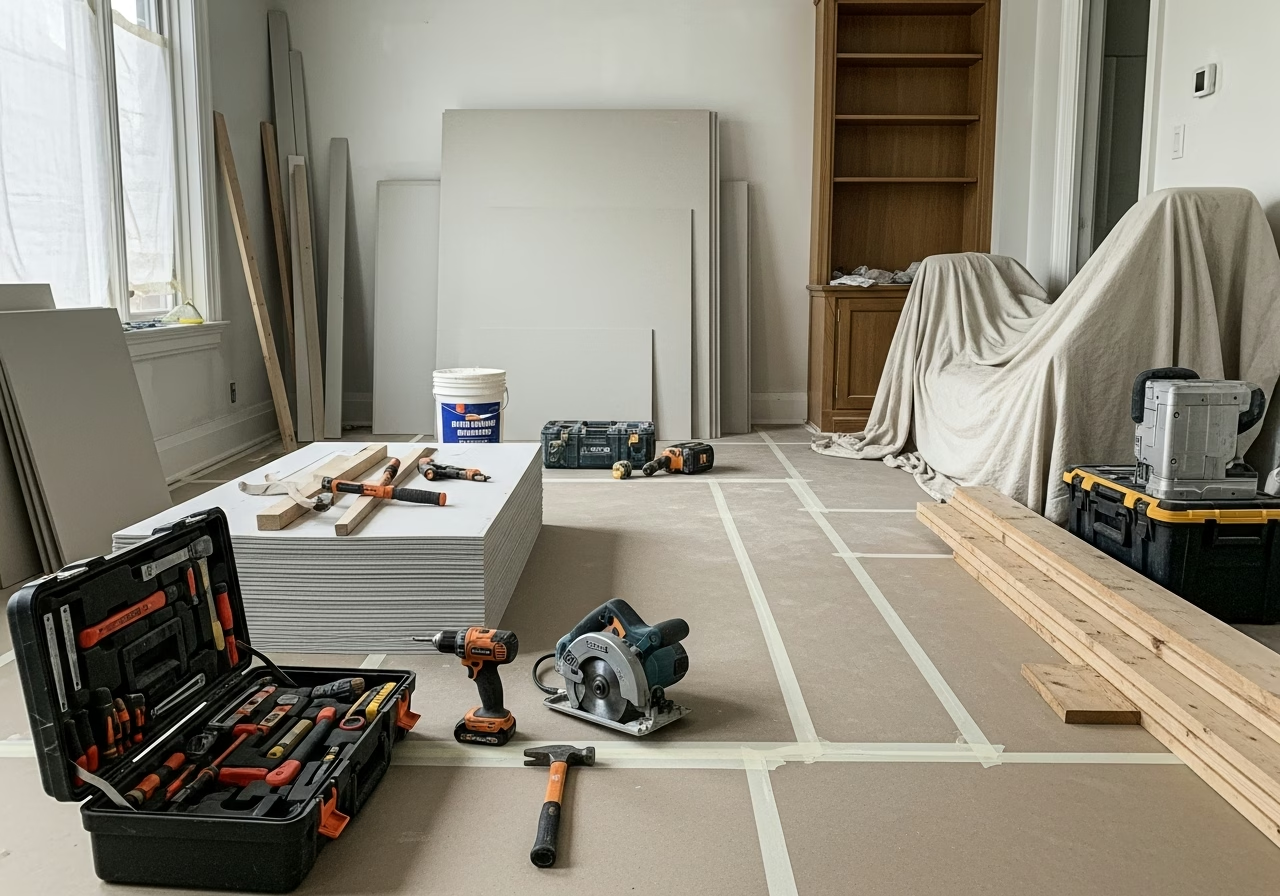
The lowest-cost path to additional headroom in a Toronto basement. Bench footing leaves the existing perimeter footing in place and lowers only the centre of the slab.
| Line Item | Range |
|---|---|
| Engineer design and stamped drawings | $2,000 to $3,500 |
| Building Permit fees | $1,800 to $3,000 |
| Demo of existing slab | $3,500 to $5,500 |
| Excavation and disposal (centre only) | $6,500 to $11,000 |
| Bench formwork and concrete | $7,500 to $13,000 |
| New weeping tile and drainage stone | $3,500 to $5,500 |
| New slab pour | $5,500 to $9,000 |
| Plumbing rough-in (basic) | $2,500 to $5,000 |
| Electrical rough-in (basic) | $1,500 to $3,000 |
| Project management | $4,000 to $8,000 |
| Subtotal structural plus basic rough-in | $38,300 to $66,500 |
For more on bench footing costs across detached and semi-detached homes, see Bench Footing Cost Toronto Detached Semi.
Tier 2 — Partial Underpin Plus Bench: $70,000 to $120,000
The hybrid that gives full headroom on one or two sides where it matters (typically front of house for a legal apartment kitchen and living room) and bench footing on the rest.
Typical scope:| Line Item | Range |
|---|---|
| Engineer design and stamped drawings | $4,000 to $6,500 |
| Building Permit fees | $2,500 to $4,500 |
| Demo of existing slab | $4,000 to $6,500 |
| Excavation and disposal | $10,000 to $17,000 |
| Underpinning concrete (1 to 2 sides) | $18,000 to $30,000 |
| Bench formwork and concrete (remaining sides) | $5,500 to $9,500 |
| Weeping tile and drainage stone | $4,000 to $6,500 |
| Exterior dampproofing on new wall sections | $1,800 to $3,500 |
| New slab pour | $6,000 to $10,000 |
| Plumbing rough-in (apartment scope) | $4,500 to $8,500 |
| Electrical rough-in (apartment scope) | $3,500 to $6,500 |
| HVAC rerouting | $2,500 to $5,000 |
| Project management | $6,500 to $11,000 |
| Subtotal structural plus apartment rough-in | $72,800 to $124,500 |
Tier 3 — Full Perimeter Underpin: $80,000 to $150,000
Complete perimeter foundation extension. The standard for legal basement apartments where bench geometry is unacceptable, full multiplex conversions, and premium wellness or wine cellar installations.
Typical scope:| Line Item | Range |
|---|---|
| Engineer design and stamped drawings | $5,500 to $8,500 |
| Soil report (often required) | $1,800 to $3,500 |
| Building Permit fees | $2,800 to $5,500 |
| Demo of existing slab | $4,000 to $6,500 |
| Excavation and disposal (full perimeter) | $14,000 to $24,000 |
| Underpinning concrete (full perimeter pin work) | $35,000 to $58,000 |
| Weeping tile and drainage stone | $4,500 to $7,500 |
| Exterior dampproofing or membrane | $3,500 to $6,500 |
| Interior dimple membrane (where specified) | $2,500 to $4,500 |
| New slab pour with vapour barrier and mesh | $6,500 to $11,000 |
| Plumbing rough-in (full apartment or multi-feature) | $5,500 to $10,500 |
| Electrical rough-in | $3,500 to $7,000 |
| HVAC rerouting and new supply | $3,500 to $7,000 |
| Project management | $8,500 to $14,000 |
| Subtotal structural plus full rough-in | $101,100 to $173,500 |
The lower end of the $80,000 to $150,000 Tier 3 range applies when soil is favourable, no soil report is required, and rough-in scope is modest. The upper end applies when conditions push every line item.
Tier 4 — Full Multiplex Underpin Scope: $150,000 to $240,000+
Full perimeter underpin combined with structural alterations to support multiplex conversion: separate exterior basement entrance with retaining walls, multiple egress windows, full multi-unit mechanical scope, fire separation rough-in, and structural openings or beams in the floor system above for unit separation.
This tier overlaps with the multiplex project budget overall. See our Multiplex Conversion Toronto: 2026 Complete Guide and Underpinning During Multiplex Conversion Toronto for the integrated cost picture.
Cost Drivers — What Moves the Number Up or Down
Depth of Underpin
The single largest cost variable. Each additional foot of depth adds approximately 18 to 25 percent to the underpinning concrete line item because excavation, shoring, and concrete volume all increase. A 36-inch underpin is typically 50 to 70 percent more expensive than a 24-inch underpin on the same house.
Linear Feet of Foundation
A 25-foot-wide row house has roughly 110 linear feet of perimeter foundation. A 30-foot-wide detached has 140 to 160 linear feet. A 40-foot-wide custom detached can have 180 linear feet or more. Underpinning concrete is priced per linear foot of perimeter — typically $80 to $150 per linear foot of pin for the structural concrete work itself in 2026 GTA pricing. Wider houses cost more proportionally.
Soil Type
Heavy clay (east Toronto): predictable, slower excavation, baseline pricing.
Sand and silt (west Toronto): more shoring, narrower pins, 15 to 25 percent premium on underpinning concrete.
Need professional home renovation?
Call RenoHouse at 289-212-2345 or get a free estimate today.
Get Free Estimate →Bedrock (Forest Hill, parts of Lawrence Park): rock breaking can add $8,000 to $25,000 depending on how much rock is encountered.
High water table (waterfront, low-lying areas): de-watering during excavation can add $3,500 to $12,000.
See Underpinning Soil Types Toronto Clay Sand for the full geology picture.
Site Access
A house with rear lane access and a wide driveway allows efficient soil disposal — typically 40 to 80 tandem-truck loads removed by direct truck access. Cost-favourable.
A house with only front-yard access through a tight Toronto front entrance requires conveyor systems or wheelbarrow runs to a curbside skip. Slower, more labour, adds $4,000 to $10,000.
A house with shared rear lane and neighbour fence issues can be the worst case — soil out through the front, equipment and concrete in through the front, adds $6,000 to $15,000.
Wall Condition
A foundation in good condition (sound rubble masonry, sound concrete block, sound poured concrete) underpins straightforwardly. A foundation in poor condition (eroded mortar, cracked block, bowed walls) requires repair or stabilization before underpinning, adding $5,000 to $20,000 to the project.
We commonly assess wall condition during the initial site review and flag this as a separate budget item.
Mechanical Complexity
A basement with the soil stack along one wall, the boiler in a back corner, and minimal cross-routing of services is straightforward. A basement with a soil stack in the centre, the boiler in the middle of the floor, ductwork running across the ceiling at multiple drops, and an old buried oil tank in the floor adds $8,000 to $25,000 in mechanical relocation and abatement.
Asbestos and Vermiculite
Toronto homes pre-1986 are subject to Ontario Regulation 278/05 — a Designated Substance Survey is required before demolition. If asbestos pipe wrap, vermiculite insulation, or asbestos-containing floor tile is identified, abatement adds $1,500 to $15,000 depending on extent.
We coordinate licensed abatement firms (AMC Environmental, Canada Restoration Services, CPR24) when DSS results require it. RenoHouse does not perform abatement directly.
Engineering Firm Choice
Engineering fees vary across the Toronto firms we coordinate with:
- BGE Engineering: $4,500 to $7,500 typical residential underpin design.
- Glogowski Architectural: $5,500 to $9,500 when bundled with architectural scope.
- Cunningham Engineering: $5,000 to $8,500, premium for heritage masonry experience.
- Verner Polak Engineering: $6,000 to $10,000 for multiplex-scope projects.
See Underpinning Structural Engineer Toronto PEng.
Permit Office Workload
City of Toronto Building Permit timelines for structural permits in 2026 run 6 to 12 weeks. Some district offices (Toronto and East York, North York) have heavier workloads than others (Etobicoke York, Scarborough). Permit timing does not change cost directly but does change project carrying cost — financing, lost rent, project management overhead — by $2,000 to $8,000 if the permit takes 12 weeks instead of 6.
See Underpinning Permit Process Toronto Timeline.
Neighbourhood Cost Factors
Forest Hill, Lawrence Park, Rosedale, Hoggs Hollow: premium pricing zones. Engineers and contractors expect higher fees and more attention to finish detail. Add 10 to 18 percent to the structural cost versus baseline.
Cost Compared to Alternatives
Above-grade addition: $300 to $500 per square foot in 2026 Toronto. A 400-square-foot rear addition is $120,000 to $200,000 before any kitchen or bathroom scope. Garden suite: $400,000 to $650,000 for a 600 to 800 square foot detached unit. Highest cost per square foot of any residential addition in 2026 Toronto. Basement underpinning: $80,000 to $150,000 plus finishing, total $160,000 to $290,000 for a fully finished legal basement apartment (700 to 1000 square feet typically).The math is clear when you compare per-square-foot delivered: underpinning is the lowest-cost path to legal living square footage for most Toronto homeowners, especially when combined with rental income from a legal secondary suite.
Financing Considerations
Toronto homeowners commonly finance underpinning through:
- HELOC (home equity line of credit): prime plus 0.5 to 1.5 percent, flexible draws as work progresses. Most common in 2026.
- Refinance: locks in fixed rate, larger lump sum, typically used when underpinning is part of a larger renovation budget.
- Construction draw mortgage: newer build territory, less common for retrofit underpinning.
- Toronto HELP loan (Home Energy Loan Program): up to $125,000 at low interest, but the project must include energy retrofit components.
The structural underpin itself does not qualify for HELP. Adding insulation upgrades, heat pump conversion, or window replacement to the basement scope can pull the project into HELP eligibility for a portion of the budget.
What to Ask in a Quote Comparison
When comparing two underpinning quotes, the questions that surface real differences:
- 1. Is the engineer fee included or extra? Which firm?
- 2. Is the soil report included? Required or optional?
- 3. Is the asbestos DSS included? What if abatement is required?
- 4. Is exterior dampproofing or full waterproofing membrane specified?
- 5. Is the new slab plain or fibre-reinforced or wire-mesh?
- 6. What is the contingency allowance for unexpected wall condition?
- 7. What is the schedule and what are the cure-time gaps between pin sequences?
- 8. What insurance is in place — general liability and excess?
- 9. Are inspections coordinated by the contractor or the homeowner?
- 10. What is the payment schedule and what are the milestone hold-backs?
A $25,000 cost difference between two quotes often resolves to differences in answers 1 through 10, not in core construction cost.
Next Steps
For a written budget specific to your home, the path is:
- 1. Site visit and as-built measurement.
- 2. Initial soil discussion based on neighbourhood and wall condition.
- 3. Engineer engagement for design pricing.
- 4. Asbestos DSS scheduling if home is pre-1986.
- 5. Detailed line-item budget delivered with the engineer's method recommendation.
Sources & References
Authoritative sources cited in this guide:
- Ontario Building Code — OBC official text
- Toronto Building Permits — City permit portal
- Tarion New Home Warranty — Ontario new-build warranty regulator
- HCRA — Home Construction Regulatory Authority — Ontario builder/vendor licensing
Continue Reading
- Basement Underpinning Toronto: Complete 2026 Guide
- Underpinning vs Bench Footing Toronto: Method Comparison 2026
- Bench Footing Cost Toronto: Detached vs Semi-Detached 2026
Related Reading
- Basement Underpinning Toronto: Complete 2026 Guide
- Underpinning vs Bench Footing Toronto: Method Comparison 2026
- Bench Footing Cost Toronto: Detached vs Semi-Detached 2026
Frequently Asked Questions
How much does basement underpinning cost in Toronto?
Basement underpinning costs $40,000 to $120,000 for a single span (one wall section) in Toronto. Mid-range projects land around $60,000–$90,000 including structural design, bench footing, mechanical relocation, and permits. Deeper foundations, complex soil, or older homes push toward the higher end. Costs exclude finishes like drywall or electrical upgrades.
Do I need a permit for basement underpinning?
Yes. Basement underpinning requires a Toronto building permit and structural engineer's stamp. You'll also need ESA certification if you relocate electrical panels and a geotechnical report for deeper cuts. Permits cost $300–$800 and processing takes 2–4 weeks. Unpermitted work creates liability and resale problems.
What factors drive up basement underpinning cost?
Soil type is primary—clay and silt demand more bracing; sand and gravel are faster and cheaper. Foundation age and damage increase cost if walls need extra support. GTA homes built before 1980 often have outdated wall construction requiring reinforcement. Existing utilities (pipes, HVAC, electrical) near the zone add relocation expense. Depth to meet Ontario Building Code ceiling minimums also scales cost.
Does basement underpinning add resale value?
Yes, but indirectly. Underpinning itself doesn't command a premium; the finished livable space it enables does. A fully developed basement adds 10–20% to home value. However, resale buyers in Toronto want proof: permits, ESA sign-offs, engineering reports. Without documentation, the investment carries risk. Expect ROI if you create a legal rental suite or primary living space, not just extra height.