RenoHouse

# Stretch Ceiling Installation & Care in Toronto: The Complete 2026 Owner's Manual
Quick answer. A typical PVC stretch ceiling in a Toronto bedroom or living room is installed in 2 to 3 hours per 200 sqft room, on top of the existing drywall, by a two-person crew using a propane heater that warms the room to 60–70 °C so the film stretches into a perimeter aluminum or PVC track. Fabric (cold-stretch) ceilings take 4 to 5 hours but skip the heat. Once installed, day-to-day care is almost nothing — a damp microfiber every six to twelve months — and a properly installed PVC ceiling will hold a 100-litre upstairs leak long enough to save your floors.This is the pillar guide for everything that happens after you choose colour and finish: how the install actually works, what tools belong in the truck, how the room is prepped, what cleaning is safe, what to do when something goes wrong, and the realistic timeline for a Toronto condo or detached home.
Honest positioning up front. RenoHouse is not the certified installer holding the heat gun. The hot-stretch install requires a licensed propane heater, 200+ hours of training, factory-cut films, and Yashar/Dilov harpoon spatulas — it is not a DIY job and we don't pretend otherwise. What RenoHouse does is coordinate a vetted installer network across Toronto, Vaughan, Thornhill, North York, Richmond Hill, and Markham, plus project management, condo-board paperwork, and a layered warranty sitting on top of the installer's own.For broader cost and product context, see our stretch ceiling cost guide, the room-by-room guide, the star sky pillar, the backlit / LED pillar, and the fundamentals pillar.
What Actually Happens on Install Day
A standard install is broken into ten steps. Total on-site time for one 200 sqft room with a PVC film: 2.5 to 3.5 hours. Furniture stays in the room (pushed to the centre, covered). No drywall dust, no demolition.
| Step | Time | What's happening |
|---|---|---|
| 1 | (separate visit, 30 min) | Laser measurement, diagonal squareness check, fixture count |
| 2 | (factory, 24–72 hr) | Film cut and harpoon edge HF-welded around the perimeter |
| 3 | 15 min | Floor protection, furniture push-back, wall masking |
| 4 | 45 min | Aluminum or PVC profile mounted around the room with anchors every 150–200 mm |
| 5 | 30 min | Existing fixtures dropped, wires sleeved, mounting platforms set |
| 6 | 30–45 min | Propane heater raises room to 60 °C; film unfolded and corner-clipped |
| 7 | 45–60 min | Stretch and hook sequence — corners first, then sides progressively |
| 8 | 20–40 min | Fixture pass-throughs cut with heat-melted rings |
| 9 | 20 min | Flexible plastic trim bead inserted into the profile gap |
| 10 | 15 min | Heater out, vent, walkthrough with homeowner |
If the room is over 5 m on one side and you've chosen MSD or a similarly wide film, no seam is needed. If you've chosen fabric (Clipso, Newmat), the heat steps disappear and steps 6–9 take longer because the fabric is trimmed flush by hand.
For step-by-step photos and a deeper walkthrough, see How a Stretch Ceiling Is Installed: Step-by-Step.
Hot Stretch (PVC) vs Cold Stretch (Fabric)
These are two genuinely different installation systems, not just two finishes.
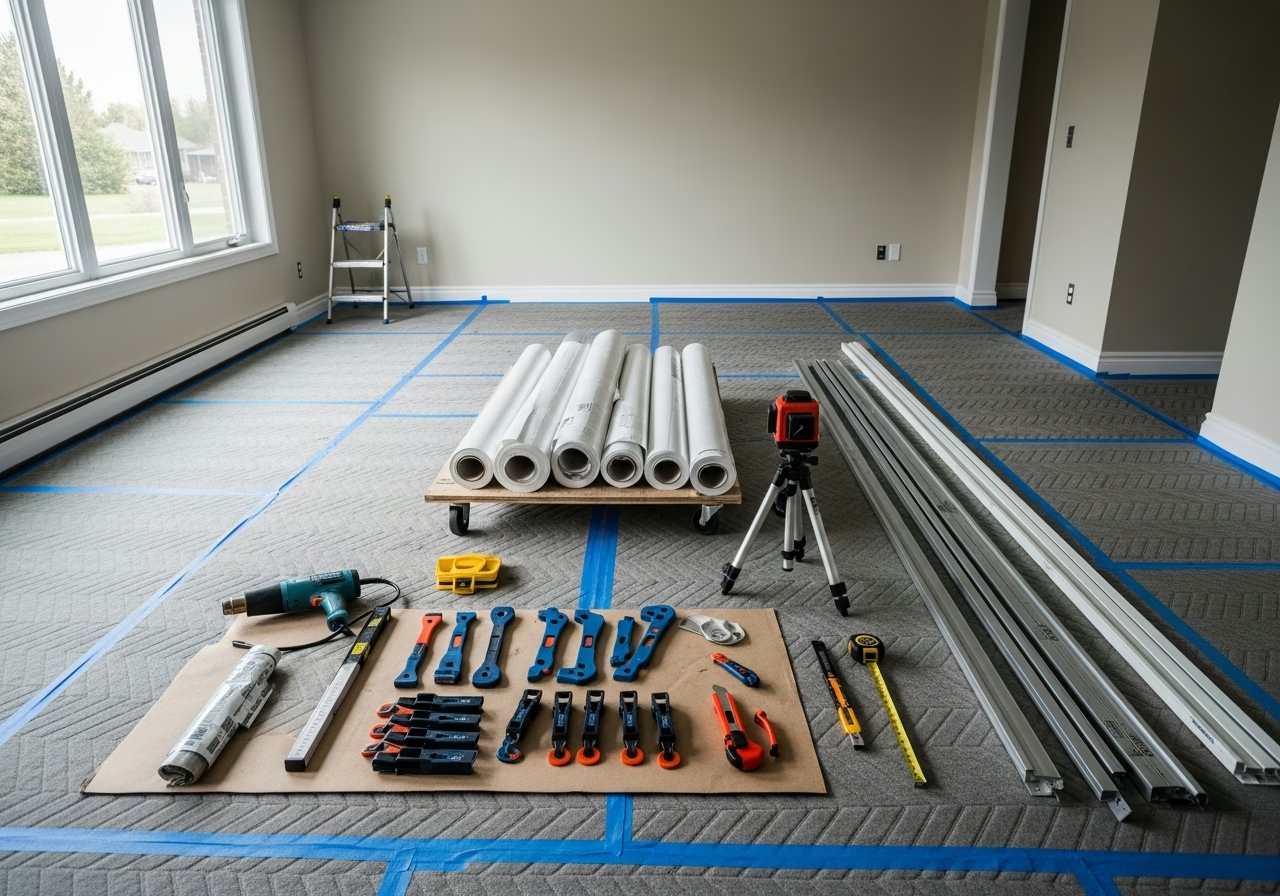
A side-by-side comparison with the trade-offs spelled out: Heat-Gun vs Cold Install for Stretch Ceilings.
The Track System: Aluminum vs PVC Profile
The track (also called the *baguette*, profile, or perimeter rail) is what holds the membrane. It's the unsung hero — a bad track means a saggy ceiling in three years.
Aluminum harpoon track ($4–$7 per linear foot). Premium choice, used by Yashar, Dilov, ProFix, and Eurokraj-grade systems. Rigid, precise, holds tension indefinitely, and supports re-installation if the membrane is ever drained or replaced. This is what every premium installer uses. RenoHouse's vetted partners default to aluminum on every project regardless of film tier. PVC profile track ($2–$3 per linear foot). Economy option. Flexible, easier to bend around curved walls, and cheaper. Acceptable for short spans and budget jobs, but on long walls (>4 m) PVC profile can deflect under tension over years and the ceiling can develop a slight wave. Some Russian-community cash-job installers default to PVC profile to keep the bid low. RenoHouse declines those jobs unless the homeowner explicitly understands the trade-off.A full breakdown of when each is appropriate: Harpoon Track Systems: Aluminum vs PVC Profile.
Need professional renovation?
Call RenoHouse at 289-212-2345 or get a free estimate today.
Get Free Estimate →Why It's a 2–3 Hour Job (And When It Isn't)
The "your bedroom done in an afternoon" promise is genuine for a standard 200 sqft single-level PVC ceiling with one or two fixture cut-outs. The reasons: factory pre-cutting eliminates on-site fabrication, the harpoon system is essentially a snap-fit, and PVC's thermal stretch is fast.
It takes longer when:
- Multi-level (two-tier coffered design): add 4–8 hours for sub-frame drywall framing.
- Star sky with fiber optics: add 6–12 hours for fiber routing through the plenum and projector tuning.
- Backlit translucent: add 3–6 hours for LED panel installation and uniformity testing.
- More than 6 fixture pass-throughs: each takes 8–15 minutes to cut and ring.
- Curved / dome shapes: add 8–16 hours.
- Rooms over 30 m² that need a seam-welded membrane: factory lead time goes from 48 hours to 5–7 days.
For a typical Toronto two-bedroom condo (living room + 2 bedrooms = 3 ceilings), expect a single full day with a two-person crew, plus a half-day return for any backlit zones.
A full timeline breakdown including same-day scheduling: The 2–3 Hour Stretch Ceiling Install in Toronto.
Day-to-Day Care: Almost Nothing
PVC stretch ceilings collect almost no dust because the surface is non-porous and slightly anti-static. Fabric ceilings collect a little more (the texture catches airborne particles) but still less than drywall.
Realistic cleaning schedule:- Glossy PVC — once every 6 months, damp microfiber cloth, mild dish soap solution.
- Matte / satin PVC — once every 12 months, same routine.
- Fabric (Clipso, Newmat) — once every 12–24 months, dry vacuum with brush attachment; spot-clean stains with Clipso's recommended cleaner.
- Abrasive sponges, scrub brushes, or magic-eraser melamine pads — they scratch glossy films.
- Solvents (acetone, mineral spirits, paint thinner).
- Steam cleaners (heat distorts the membrane).
- Anything pointed (broom handles, swiffers with hard ends, raised arms with rings on).
The full care manual with finish-specific protocols: How to Clean and Maintain a Stretch Ceiling.
Removing or Replacing a Stretch Ceiling
Stretch ceilings are reversible — this is one of the biggest under-stated advantages over drywall. A trained installer can drain the ceiling and pull the membrane out of the harpoon track in 30 to 60 minutes for a single-room ceiling. The track stays. The membrane comes out either intact (if you're keeping it for re-installation after a renovation behind the ceiling) or gets replaced with a new one.
Common removal scenarios:- Drywall repair above the ceiling (an upstairs leak fixed at the source).
- Recessed-light retrofit that requires plenum access.
- HVAC work, electrical re-wiring, sprinkler retrofit.
- Selling the home and the buyer doesn't want it (rare in Russian-community resale; very common in Anglo-buyer transactions in Old Toronto).
- Damage replacement after a major leak or impact puncture.
A walkthrough of the process: Stretch Ceiling Removal & Replacement in Toronto.
When the Upstairs Floods: The Toronto Condo Selling Point
This is the one feature drywall genuinely cannot match. A welded-edge PVC stretch ceiling will hold approximately 100 litres per square metre of leaked water, ballooning down toward the floor like a giant water balloon — and stay sealed long enough for a professional to drain it.
The drill:- 1. Don't panic. The membrane is doing its job. Don't poke it.
- 2. Place buckets and towels under the bulge (in case of overflow at the perimeter).
- 3. Call your installer or RenoHouse's emergency line. This is not a 2 a.m. self-service problem — improperly draining a hot-stretched ceiling will tear the harpoon weld.
- 4. The installer arrives with a pump or large bucket, partially detaches one corner, drains the water through a small slit at the lowest point, and re-tensions the membrane after it dries.
The full emergency response playbook: Stretch Ceiling Water Damage Recovery in Toronto. Also see the broader Water Damage Emergency 24-Hour Response guide for what your insurance adjuster will want documented.
Common Problems & How They're Fixed
A well-installed stretch ceiling rarely has issues, but here's the small list of things that can come up.
The full troubleshooting matrix: Stretch Ceiling Troubleshooting: Bubbles, Stains & Sag.
Toronto Condo Boards: The Approval Reality
Most Toronto condo boards do not require approval for a stretch ceiling install — it's interior, non-structural, and reversible — but most boards still require notice and contractor insurance documentation before any work involving a heater, drilling, or moving equipment up an elevator.
What boards typically ask for:- Two weeks' written notice to property management.
- Contractor's CAD $2M general liability certificate.
- WSIB clearance for all on-site workers.
- Elevator booking (some buildings limit move-in/move-out style bookings to weekdays 9–4).
- Statutory holiday and weekend work restrictions (most older buildings ban Sunday work; 9 a.m. earliest weekday start).
- Heritage-designated buildings on Bay, King, Front, Bloor.
- Co-op buildings (rare in Toronto but exist in Forest Hill, Don Mills).
- Buildings under 5 years old where the developer warranty is still active and changes can void it.
The full condo approval playbook including sample notice letters: Stretch Ceiling Condo Board Approval in Toronto. For broader condo-renovation rules, see our Condo Renovation Toronto Cost Guide.
How RenoHouse's Coordinated Service Works
We are honest about what we do. RenoHouse is not the certified installer. The propane-heated, harpoon-tracked, factory-welded install is performed by one of our 3 vetted Russian-Canadian installer partners who carry $2M general liability, WSIB clearance, and 8–15 years of GTA install experience. We've watched them work, vetted their warranty payouts, and audited their MSD/Halead/Pongs film sourcing.
What you get from RenoHouse on top of the install:- A single point of contact for the project (not five WhatsApp threads with subcontractors).
- Condo paperwork done for you — board notice, insurance certificates, elevator booking.
- Bilingual EN/RU service if you prefer Russian on the call.
- A layered 10-year warranty that sits on top of the installer's warranty — so if the small installer disappears in year 6 (which happens), RenoHouse covers the call-back.
- Project management for combined renovations — if the stretch ceiling is part of a larger condo or basement reno, we sequence trades correctly (electrical roughing → primer paint → stretch ceiling → flooring → finish paint).
- Free emergency leak-drainage in years 1–2 within the GTA service area.
When to Get a Quote
If you're more than 2 weeks out from install (most condo projects are), get a measurement quote now — site measurement is free and locks in 2026 pricing against any mid-year vendor adjustments.
Request a free stretch ceiling installation quote — site measurement, condo paperwork support, and our installer-network coordination, all in one call.FAQ
Is a stretch ceiling install messy? No. There's no drywall dust. Furniture is pushed to the centre and covered. The propane heater is vented; you smell warm air for an hour and then nothing. Can I stay home during install? Yes, but you'll want to leave the room being worked on. The heat (60–70 °C) is uncomfortable for the 30–45 minutes the heater runs. Do I need to remove furniture? No. Push to the centre and cover. Wall art comes off the affected walls only. How soon can I use the room? Immediately after walkthrough. The ceiling is at full tension within 30–60 minutes of the heater shutting off. No off-gassing if you're using a premium A+/M1-certified film (which RenoHouse specifies on every project). Will the install void my building's drywall warranty? No — drywall is undisturbed; track anchors go through the drywall into the joists or concrete slab. If you're in a 2-year-old building with active developer warranty, we'll document the install for your records. Can the same crew handle a star sky or backlit upgrade? Yes — the same vetted installers handle star sky and backlit work, just with longer lead times for fiber optics or LED panels. Will the ceiling smell after install? A premium A+ film has near-zero VOC and you won't smell it. A grey-market budget film (Halead economy, some Bauf imports) can smell faintly of new-PVC for 3–5 days. Specify A+ certification when getting quotes.Continue Reading
- The 2–3 Hour Stretch Ceiling Install in Toronto: What
- Stretch Ceilings Toronto: The Complete 2026 Homeowner
- How a Stretch Ceiling Is Installed: Step-by-Step (Toronto, 2026)
Related Services